
Diora Acoustics Chors 5 vs Triangle Borea BR09
The Diora Acoustics Chors 5 scores 0.5 higher; the Triangle Borea BR09 costs $1,400 less. The reviews favour the Chors 5 on treble and placement, and the Borea BR09 on mids and amplifier needs.
By Jakub Charkiewicz, updated .
Our pick Diora Acoustics Chors 5 The Chors 5 is 0.5 ahead on score: five steps, more than the $1,400 the Borea BR09 saves can buy back under the rule. The reviews favour the Borea BR09 over the Chors 5 on mids and amplifier needs, which is its case.
When to choose the Borea BR09 over the Chors 5The short version
The Diora Acoustics Chors 5 scores 8.5/10 (Highly Recommended) and the Triangle Borea BR09 8.0/10 (Recommended). At $2,499/pair against $1,099/pair, the Borea BR09 saves you $1,400 over the Chors 5. On treble, the Chors 5's review lists "Smooth, ceramic-influenced treble" where the Borea BR09's lists "Treble is spicier on-axis than off-axis". On mids the Borea BR09 has the edge over the Chors 5: "Cellulose midrange driver - natural vocals/instruments" against "Midrange slightly scooped - vocals step back". The published pick rule chooses the Chors 5 over the Borea BR09.
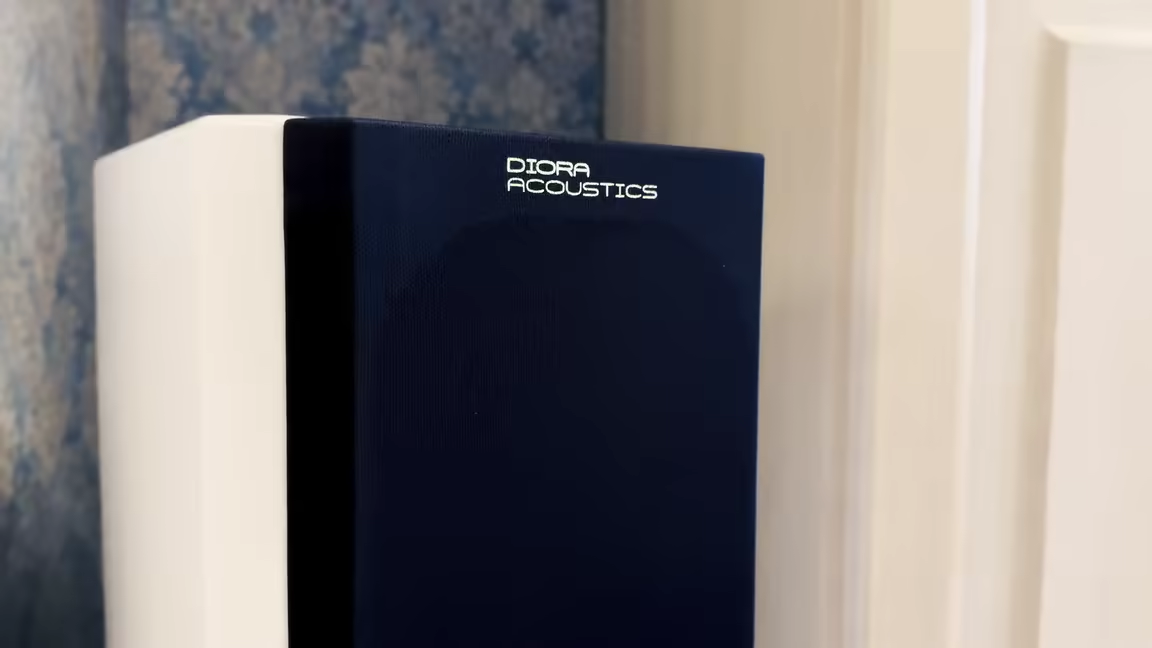
Higher score
Diora Acoustics Chors 5
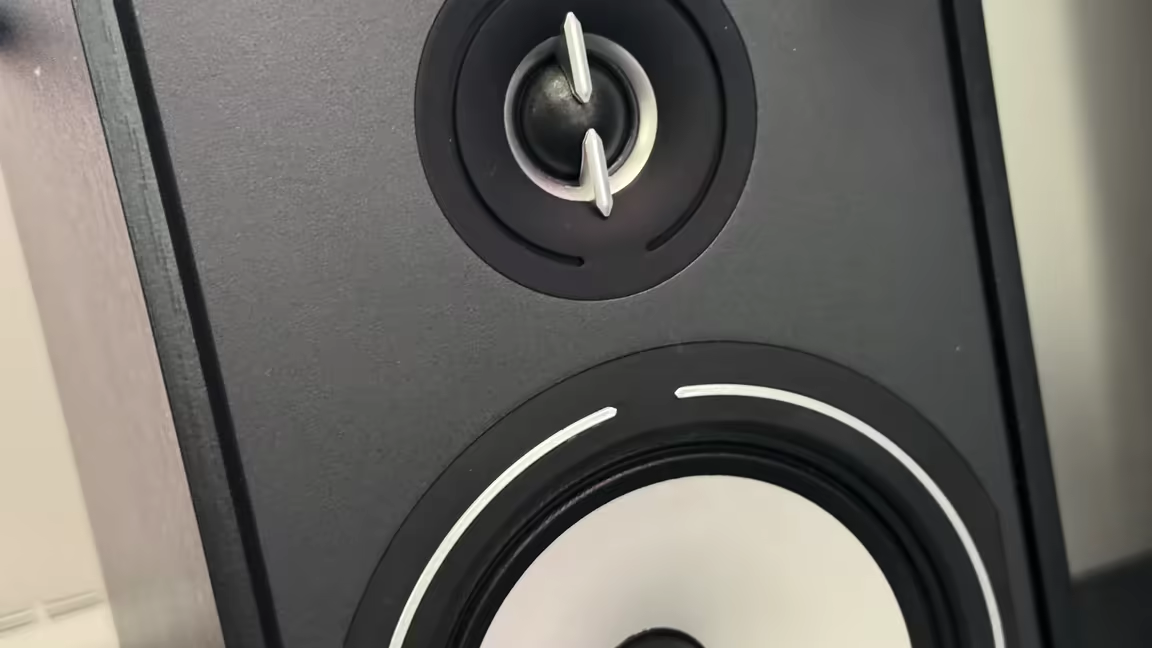
Triangle Borea BR09
Which one to buy
Our pick is the Chors 5, unless its mids or amplifier needs would be a dealbreaker; then the Borea BR09.
Diora Acoustics Chors 5
Our pick. Choose it if:
- The Chors 5's treble and placement matter more to you than the Borea BR09's mids and amplifier needs.
- You would pay $1,400 over the Borea BR09 for the Chors 5's 8.5 against 8.0 on the rubric.
- You want the Chors 5's brighter sound, where the Borea BR09 runs warmer.
Triangle Borea BR09
Choose it instead if:
- The Borea BR09's mids and amplifier needs matter more to you than the Chors 5's treble and placement.
- Keeping $1,400 matters more to you than the Chors 5's five-step lead over the Borea BR09, 8.5 against 8.0.
- You want the Borea BR09's warmer sound, where the Chors 5 runs brighter.
What matters most to you?
| What matters | Diora Acoustics Chors 5 | Triangle Borea BR09 |
|---|---|---|
| Sound | 8.4 | 8.1 |
| Technical performance | 8.4 | 7.9 |
| Build & comfort | 9.0 | 7.8 |
| System fit | 8.7 | 8.3 |
| Value | 8.1 | 7.8 |
The widest gap is build & comfort: 9.0 for the Chors 5 against 7.8 for the Borea BR09. Each column comes from its own review's pros and cons, 14 for the Chors 5 and 14 for the Borea BR09, and recombines to its headline score, 8.5 and 8.0. How a score is built
Where they differ
Six topics the Chors 5 and Borea BR09 reviews both discuss, the most decisive first.
Only the Chors 5
Only the Borea BR09
Treble
The Chors 5 review lists one strength here, the Borea BR09 review one flaw.
- Chors 5, strength: "Smooth, ceramic-influenced treble"
- Borea BR09, flaw: "Treble is spicier on-axis than off-axis"
Mids and vocals
The Borea BR09 review lists one strength here, the Chors 5 review one flaw.
- Borea BR09, strength: "Cellulose midrange driver - natural vocals/instruments"
- Chors 5, flaw: "Midrange slightly scooped - vocals step back"
Amplifier needs
The Borea BR09 review lists one strength here, the Chors 5 review one flaw.
- Borea BR09, strength: "92dB sensitivity - easy to drive"
- Chors 5, flaw: "Best at slightly elevated volumes"
Soundstage and imaging
The Borea BR09 review lists one strength and one flaw here, the Chors 5 review one flaw.
- Borea BR09, strength: "Surprisingly large soundstage for a budget speaker"
- Chors 5, flaw: "Soundstage isn't pinpoint sharp"
Placement and room
The Chors 5 review lists one strength here, the Borea BR09 review one strength and one flaw.
- Chors 5, strength: "Wall-tolerant due to no port"
- Borea BR09, flaw: "Bass needs careful placement away from walls"
Cabinet and finish
The Chors 5 review lists two strengths here, the Borea BR09 review two strengths and one flaw.
- Chors 5, strength: "Beautiful gloss white finish with multiple options"
- Borea BR09, flaw: "Light cabinet (23kg) - some resonances vs heavy speakers"
Only the Chors 5 review discusses bass (one strength, one flaw) and detail (one flaw); only the Borea BR09 review discusses tonal balance (one flaw).
What they have in common
The Chors 5 and the Borea BR09 are both floor-standing speakers, and both have a decoupling pedestal base and floor spikes in the box. Neither the Chors 5 nor the Borea BR09 has bi-wire terminals. The Chors 5 and Borea BR09 reviews both praise driver design, and both fault connections.
Sound signature, overlaid
On tonal balance the Chors 5 sounds bright where the Borea BR09 sounds warm, on presentation the Chors 5 sounds analytical where the Borea BR09 sits near neutral, on energy the Chors 5 sounds energetic where the Borea BR09 sits near neutral, and on stage size the Chors 5 sits near neutral where the Borea BR09 sounds wide-staged. Neither the Chors 5 nor the Borea BR09 leans either way on bass weight.
On paper
The Chors 5 ranks #1 and the Borea BR09 #4 of the 6 speakers reviewed here; on value the Chors 5 rates Steep and the Borea BR09 Fair.
The Chors 5 and Borea BR09 figures come from Diora Acoustics's official site and Triangle's official site.
| Spec | Diora Acoustics Chors 5 | Triangle Borea BR09 |
|---|---|---|
| Type | 2-way closed-box floor-stander | 3-way floor-stander |
| Sensitivity | 90 dB SPL | 92 dB SPL |
| Impedance | 4 Ω | 8 Ω |
| Frequency response | 44 Hz - 22 kHz (−3 dB) | 35 Hz - 22 kHz |
| Drivers | 25.5 mm ceramic dome tweeter + 2× 170 mm ceramic woofers | 3× 165 mm bass + cellulose midrange |
| Power handling | 120 W | 170 W |
| Minimum impedance | 3.7 Ω | 3.3 Ω |
Only the Borea BR09 review records weight and recommended amplifier, not the Chors 5 review.
How these verdicts were reached
The Borea BR09 was reviewed in September 2024 and the Chors 5 in October 2024, on one reference chain and rubric. The Chors 5 review never mentions the Borea BR09, nor the Borea BR09 review the Chors 5: two separate sessions. The Chors 5 and Borea BR09 reviews were both re-checked in September 2026.
Questions about the Chors 5 and Borea BR09
What is the difference between the Diora Acoustics Chors 5 and the Triangle Borea BR09?
The Diora Acoustics Chors 5 edges the Borea BR09 where it is measured, 8.5 to 8.0. In the reviews' own lines, treble and placement go to the Chors 5 and mids and amplifier needs to the Borea BR09. Where they really split is voicing: the Chors 5 runs clearly brighter, the Borea BR09 warmer.
Which should you buy, the Diora Acoustics Chors 5 or the Triangle Borea BR09?
The Chors 5: its 8.5 against the Borea BR09's 8.0 is five steps, a lead the published pick rule keeps even at $1,400 more.
Which has the better-behaved treble, the Chors 5 or the Borea BR09?
The Chors 5: its review lists one strength on treble, the Borea BR09 review one flaw.
Which is better for vocals, the Chors 5 or the Borea BR09?
The Borea BR09: its review lists one strength on mids, the Chors 5 review one flaw.
Is the Chors 5 worth $1,400 more than the Borea BR09?
On the pick rule, yes: the Chors 5's 0.5 lead over the Borea BR09 is five steps, more than the rule trades for $1,400. In the reviews' own lines, it buys the Chors 5's treble and placement over the Borea BR09.
Why is the Chors 5 rated higher than the Borea BR09?
The Chors 5 scores 8.5 and carries the Highly Recommended verdict; the Borea BR09 scores 8.0 and is rated Recommended. On the published scale Highly Recommended covers 8.2 - 9.4 and Recommended 7.0 - 8.4, so the 0.5 points between the Chors 5 and the Borea BR09 cross a tier line. In the reviews' own lines, the Chors 5's lead over the Borea BR09 comes from treble and placement.
Where they rank
In Best Speakers the Chors 5 ranks #1 and the Borea BR09 #4.
Chors 5 #1 - Best Overall Borea BR09 #4 6 picks