Headphones · Side-by-side
Flare Audio E-PROTOTYPE vs Kiwi Ears Belle, Cadenza II, Orchestra II
Dead heat on score. The Kiwi Ears Belle, Cadenza II, Orchestra II costs $119 less, so it's the default.
See which one to buy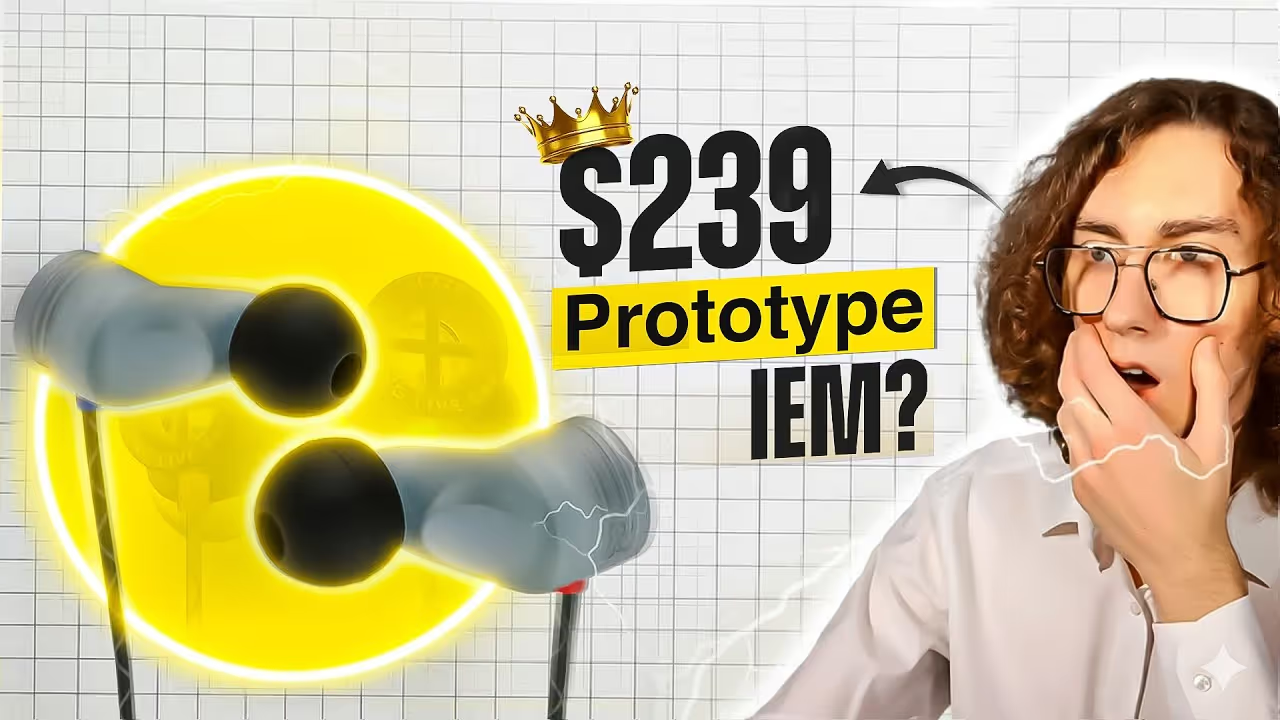
Too close to call
Flare Audio
E-PROTOTYPE
Unlike anything you've heard or seen. The E-PROTOTYPE goes to extremes - both positive and negative - using proprietary technologies you won't find anywhere else.
Too close to call
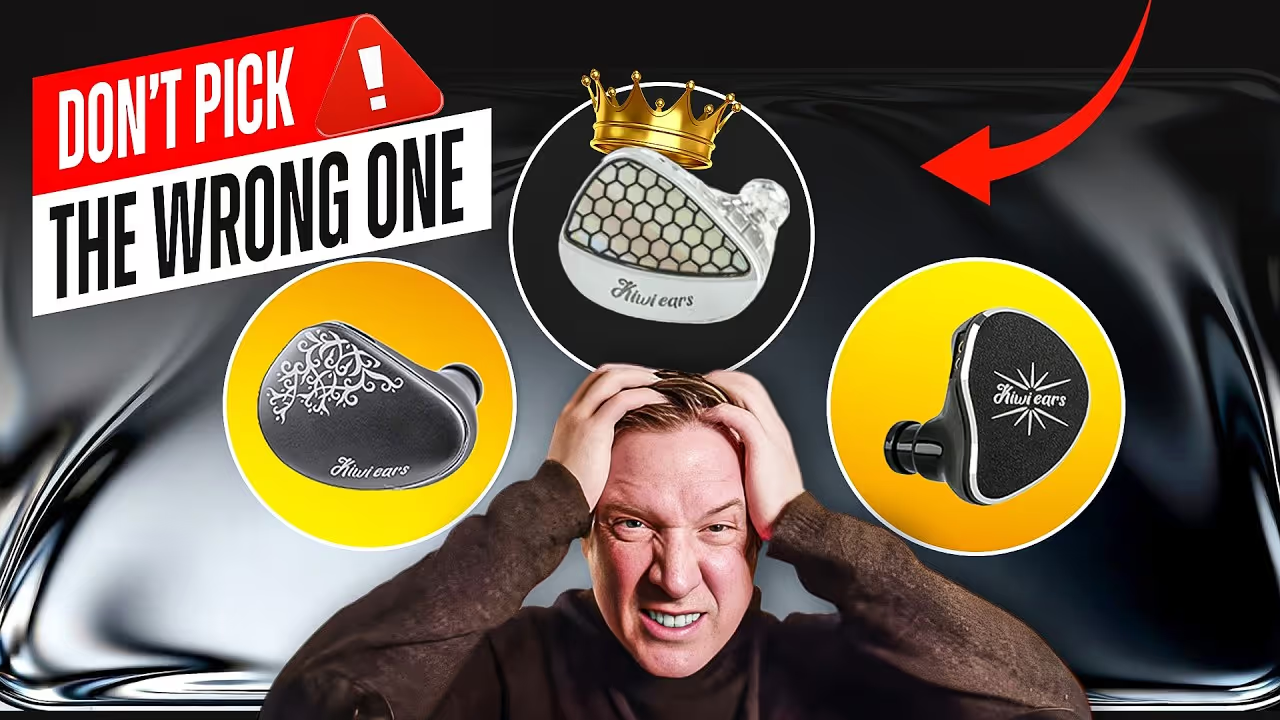
Kiwi Ears
Belle, Cadenza II, Orchestra II
Three Kiwi Ears IEMs head-to-head - the $30 Belle with a mic, the $50 Cadenza II with KARS 2.0, and the 10-BA $350 Orchestra II flagship. Which is the value pick?
Sound signature, overlaid
Each axis is positioned from the review body itself. The same word-frequency model anchors every review on the catalogue.
| Axis | Flare Audio E-PROTOTYPE | Kiwi Ears Belle, Cadenza II, Orchestra II |
|---|---|---|
| Warm to Bright | sits near neutral | sits near neutral |
| Relaxed to Analytical | leans analytical | leans analytical |
| Polite to Aggressive | leans aggressive | leans aggressive |
| Lean to Bass-heavy | no clear signal in the review | sits near neutral |
| Intimate to Wide stage | leans wide stage | sits near neutral |
Specs, side by side
Manufacturer figures unless a measured value is noted; N/A means we haven't recorded that spec yet.
| Spec | Flare Audio E-PROTOTYPE | Kiwi Ears Belle, Cadenza II, Orchestra II |
|---|---|---|
| Driver | Dynamic | Balanced armature |
| Connector | 3.5 mm single-ended (non-detachable) | N/A |
| Belle impedance | N/A | 32 Ω |
| Belle sensitivity | N/A | 103 dB |
| Belle driver | N/A | 10 mm DLC dynamic |
| Belle frequency response | N/A | 20 Hz – 20 kHz |
| Belle weight | N/A | 3.5 g per side |
Pros & cons, side by side
E-PROTOTYPE
Pros
- Possibly the best low-end of any IEM I've heard
- Bass is extremely well layered, resolving, and punchy
- Ideal sound separation - nothing blends, no matter how busy
- Astonishing detail retrieval without getting sharp
- Impeccable dynamic range with long, satisfying decay
- 3D-printed in the UK with professional-grade equipment
- 100-day return window - real confidence from the brand
- Lightweight despite the unusual shape
Cons
- Tonality is a love-or-hate situation - not for everyone
- Recessed yet peaky and unnatural mids
- Timbre is a real weakness - things sound slightly plasticky
- Soundstage is intimate, not wide
- Cable is non-detachable
- Single-ended only - no balanced option
- Fit takes work - left earpiece needs precise positioning
- Definitely not a one-and-only IEM
Belle, Cadenza II, Orchestra II
Pros
- Covers three budgets - $30 Belle, $50 Cadenza II, $350 Orchestra II
- Belle is a tremendous-value V-shape with a built-in microphone
- Cadenza II betters the Belle in every sonic way and stays light
- Orchestra II's 10 balanced armatures stay coherent and linear
- Cadenza II's KARS 2.0 labyrinth tube tightens the low end
- Orchestra II ships with 3.5mm + 4.4mm balanced cables and a case
- Multiple ear-tip densities (Belle and Orchestra II) tune the sound
- All three scale up impressively with a decent dongle
Cons
- Belle's ear tips are a real fight to fit and swap
- Low bass and high treble roll off straight from a phone
- All three really want a ~$79 dongle to open up
- No microphone on the Cadenza II or Orchestra II
- Orchestra II is heavy at 7g per side - not for jogging
- Cadenza II includes only a single set of ear tips
- Orchestra II's price jump is only justified with a balanced dongle
Which one to buy
Short version: the rubric calls this one too close to split - but what's upstream, what you listen for, and what your budget allows can each flip it. Here's the case for each.
The case for the E-PROTOTYPE
Flare Audio E-PROTOTYPE
- Possibly the best low-end of any IEM I've heard
- Bass is extremely well layered, resolving, and punchy
- That $119 premium buys character and build, not a higher score
- The Kiwi Ears Belle, Cadenza II, Orchestra II's main trade-off is one you'd rather not live with: Belle's ear tips are a real fight to fit and swap
The case for the Belle, Cadenza II, Orchestra II
Kiwi Ears Belle, Cadenza II, Orchestra II
- Covers three budgets - $30 Belle, $50 Cadenza II, $350 Orchestra II
- Belle is a tremendous-value V-shape with a built-in microphone
- Cheaper by $119, and it gives up nothing on the score
- The Flare Audio E-PROTOTYPE's main trade-off is one you'd rather not live with: Tonality is a love-or-hate situation - not for everyone
How they were tested head-to-head
Same chain for both - the Flare Audio E-PROTOTYPE and the Kiwi Ears Belle, Cadenza II, Orchestra II, driven from the same HIFIMAN Serenade amp/DAC (Himalaya Pro R2R), fed bit-perfect from the Hermes 12th digital transport over USB. The two were volume-matched at the output and swapped across the same set of reference recordings - acoustic, vocal-led, dense modern, and large-scale orchestral - so every session compared like for like. No demo-room verdicts, no half-remembered impressions from an earlier listen: this is a direct head-to-head, scored against the published headphones reference list at the matching price tier.
What the 0.1-point score gap actually means
The score gap between the Flare Audio E-PROTOTYPE and the Kiwi Ears Belle, Cadenza II, Orchestra II is within rounding distance of zero. Same rubric, same reference list, same ears - so when the numbers land this close, the differences are signature, not skill. Read the pros and cons side by side: wherever one piece's strength is the other's compromise is exactly where you'll hear it in real listening.
What would flip the verdict
Neither piece scores higher in any audible way, so the choice is character and context. Take the Flare Audio E-PROTOTYPE if its pros sound like the system you're building; take the Kiwi Ears Belle, Cadenza II, Orchestra II if its first paragraph reads more like the music you actually play. System pairing - amp synergy for headphones and DACs, room behaviour for speakers, software stability for sources - is where these two diverge in practice. Read both reviews end to end: the pros and cons summarise, but the prose tells you which one belongs in your chain.
Common questions about this comparison
What's the real-world difference between the Flare Audio E-PROTOTYPE and the Kiwi Ears Belle, Cadenza II, Orchestra II?
On paper it's a tie - 8.0 and 8.1, inside rounding distance. Where they really split is voicing: the Belle, Cadenza II, Orchestra II runs a touch more energetic, the E-PROTOTYPE more polite. Each review flags something different - the E-PROTOTYPE's "Lightweight despite the unusual shape" against the Belle, Cadenza II, Orchestra II's "All three scale up impressively with a decent dongle". Choose on that, not the score column.
Which should you buy, the Flare Audio E-PROTOTYPE or the Kiwi Ears Belle, Cadenza II, Orchestra II?
On the rubric it's a coin-flip (8.0 and 8.1), so price and fit break the tie. The Kiwi Ears Belle, Cadenza II, Orchestra II is $119 cheaper for the same measured performance - make it the default, and pay up for the Flare Audio E-PROTOTYPE only if its standout, "Ideal sound separation - nothing blends, no matter how busy", is something your setup actually needs.
Is the E-PROTOTYPE's $119 premium worth it?
Not on the numbers - $119 more for no rubric advantage. You're paying for what's specific to the Flare Audio E-PROTOTYPE - "Astonishing detail retrieval without getting sharp" - not for measured performance, so it's worth it only if that solves a problem the Kiwi Ears Belle, Cadenza II, Orchestra II leaves open.
Where they rank
This page is the head-to-head - the buying guides put both of these up against the whole field.