
HIFIMAN Ananda Nano vs HIFIMAN Sundara
The HIFIMAN Sundara scores 0.4 higher and costs $200 less than the HIFIMAN Ananda Nano. The reviews favour the Ananda Nano over the Sundara on driver technology, while only the Sundara's review singles out its tonal balance.
By Jakub Charkiewicz, updated .
Our pick HIFIMAN Sundara The Sundara is 0.4 ahead on score and costs $200 less than the Ananda Nano: nothing to trade. The reviews favour the Ananda Nano over the Sundara on driver technology, which is its case.
When to choose the Ananda Nano over the SundaraThe short version
The HIFIMAN Ananda Nano scores 8.6/10 (Highly Recommended) and the HIFIMAN Sundara 9.0/10 (Highly Recommended). At $499 against $299, the Sundara saves you $200 over the Ananda Nano. On driver technology, the Ananda Nano's review lists "Nanometer-thickness diaphragm at $500 - previously Susvara-only tech" where the Sundara's lists "Does not include Stealth Magnets". The published pick rule chooses the Sundara over the Ananda Nano.
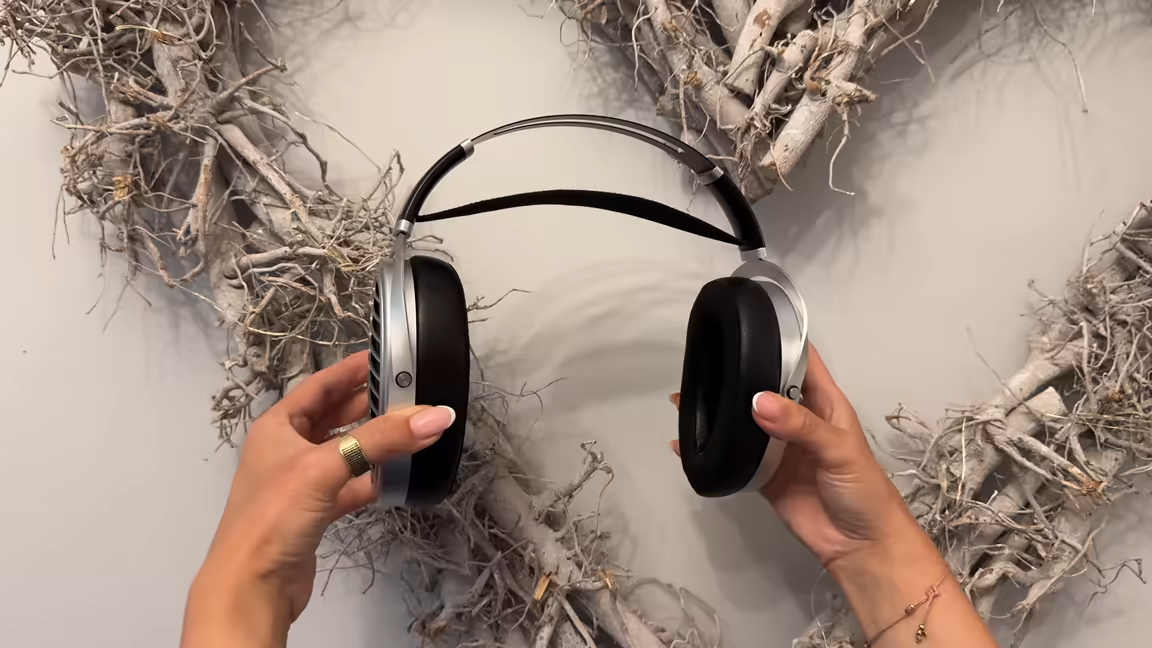
HIFIMAN Ananda Nano
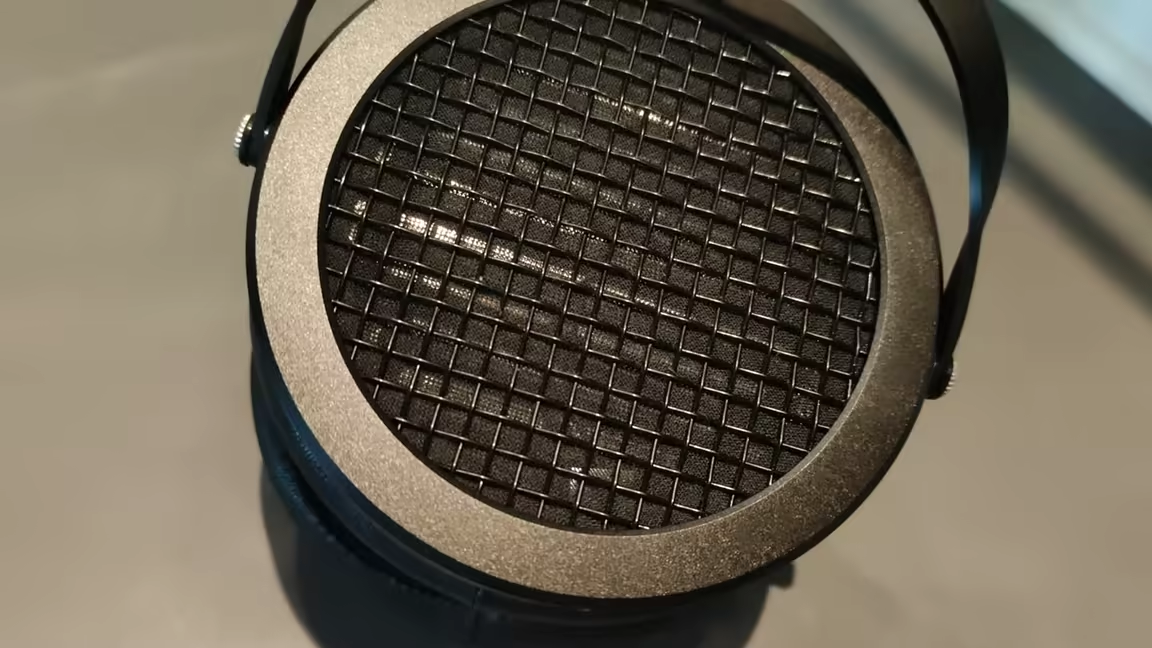
Higher score
HIFIMAN Sundara
In the reviewer's words
The Ananda Nano review mentions the Sundara in passing, verbatim below.
The headband looks the same as on the Sundara, Ananda Stealth, or the HE6se - it's also a hybrid with a suspension strap, cup tilt, and size adjustment, but no swivel.
Which one to buy
Our pick is the Sundara, unless its driver technology would be a dealbreaker; then the Ananda Nano.
HIFIMAN Ananda Nano
Choose it instead if:
- Driver technology matters most to you, and that is where the reviews favour the Ananda Nano over the Sundara.
HIFIMAN Sundara
Our pick. Choose it if:
- The Sundara's tonal balance appeals to you: only the Sundara review singles it out, where the Ananda Nano review is silent.
- You want the Sundara's higher score (9.0 against 8.6) and $200 back against the Ananda Nano.
- You want the Sundara's more energetic sound; the Ananda Nano sits closer to neutral there.
What matters most to you?
| What matters | HIFIMAN Ananda Nano | HIFIMAN Sundara |
|---|---|---|
| Sound | 8.8 | 9.0 |
| Technical performance | 9.0 | 9.3 |
| Build & comfort | 8.0 | 8.6 |
| System fit | 8.5 | 8.7 |
| Value | 8.4 | 9.2 |
The widest gap is value: 8.4 for the Ananda Nano against 9.2 for the Sundara. Each column comes from its own review's pros and cons, 14 for the Ananda Nano and 12 for the Sundara, and recombines to its headline score, 8.6 and 9.0. How a score is built
Where they differ
The Ananda Nano has Stealth Magnets and the Sundara does not.
Only the Sundara
Driver technology
The Ananda Nano review lists three strengths here, the Sundara review one flaw.
- Ananda Nano, strength: "Nanometer-thickness diaphragm at $500"
- Sundara, flaw: "Does not include Stealth Magnets"
Build and design
The Ananda Nano review lists one flaw here and the Sundara review one strength; the Ananda Nano review weighs the two on this directly, quoted above.
- Ananda Nano, flaw: "Hard plastic earcup material - not real black"
- Sundara, strength: "Excellent build - metal parts, suspension strap, dual 3.5mm"
Comfort and fit
The Ananda Nano review lists two flaws here and the Sundara review one strength and four flaws; the Ananda Nano review weighs the two on this directly, quoted above.
- Ananda Nano, flaw: "Significantly more clamp force than the Stealth"
- Sundara, flaw: "Inner pad diameter likely too small for many ears"
Only the Ananda Nano review discusses treble (two flaws) and amp matching (one strength, one flaw); only the Sundara review discusses tonal balance (one strength).
What they have in common
The Ananda Nano and the Sundara are both open-back planar magnetic headphones from HIFIMAN, and both have dual 3.5mm cable sockets. Neither the Ananda Nano nor the Sundara has cups that swivel. The Ananda Nano and Sundara reviews both praise detail, soundstage, and bass.
Sound signature, overlaid
On tonal balance the Ananda Nano sits near neutral where the Sundara sounds warm and on energy the Ananda Nano sits near neutral where the Sundara sounds energetic. The Ananda Nano and the Sundara both sound analytical and wide-staged. The Sundara review reads bass weight and the Ananda Nano review does not, so the two go uncompared there.
On paper
The Ananda Nano ranks #11 and the Sundara #4 of the 30 headphones reviewed here; on value the Ananda Nano rates Fair and the Sundara Excellent. The Ananda Nano and the Sundara both take Dual 3.5 mm cables, so one upgrade cable fits either. The Ananda Nano and Sundara spec sheets match on driver (Planar magnetic) and connector (Dual 3.5 mm).
The Ananda Nano and Sundara figures come from HIFIMAN's official site.
| Spec | HIFIMAN Ananda Nano | HIFIMAN Sundara |
|---|---|---|
| Sensitivity | 94 dB | 94 dB/mW |
Only the Ananda Nano review records frequency response; only the Sundara review records impedance and weight.
How these verdicts were reached
The Sundara was reviewed in July 2023 and the Ananda Nano in June 2024, 11 months later, on one reference chain and rubric. The Ananda Nano review mentions the Sundara in passing, quoted above. The Ananda Nano and Sundara reviews were both re-checked in September 2026.
Questions about the Ananda Nano and Sundara
What is the difference between the HIFIMAN Ananda Nano and the HIFIMAN Sundara?
Scores first: the HIFIMAN Sundara takes it from the Ananda Nano, 9.0 to 8.6. The reviews favour the Ananda Nano over the Sundara on driver technology, while only the Sundara's review singles out its tonal balance. On voicing the Sundara is the more energetic of the two; the Ananda Nano does not lean far on that axis.
Which should you buy, the HIFIMAN Ananda Nano or the HIFIMAN Sundara?
The Sundara: it leads the Ananda Nano on both counts, 9.0 against 8.6 and $200 less.
How does the engineering differ between the Ananda Nano and the Sundara?
The Ananda Nano: its review lists three strengths on driver technology, the Sundara review one flaw.
Is the Ananda Nano worth $200 more than the Sundara?
Not on score: the Ananda Nano costs $200 more than the Sundara for 0.4 less on the rubric. In the reviews' own lines, it buys the Ananda Nano's driver technology over the Sundara.
Where they rank
In Best Headphones Under $500 the Sundara ranks #1 and the Ananda Nano #5; in Best Open-Back Headphones the Sundara ranks #4 and the Ananda Nano #10; in Best Planar Magnetic Headphones the Sundara ranks #4 and the Ananda Nano #8; only the Sundara makes Best Reference-Grade Audio Gear (#10).
Sundara #1 - Best Overall Ananda Nano #5 12 picks
Sundara #4 - Best Value Ananda Nano #10 14 picks
Best Planar Magnetic Headphones
Sundara #4 - Best Value Ananda Nano #8 11 picks
Best Reference-Grade Audio Gear
Sundara #10 - Best Value Ananda Nano not listed 10 picks