
Tonewinner AD-1PA+ vs Tonewinner AD-2PRO+
The Tonewinner AD-1PA+ scores 0.2 higher; the Tonewinner AD-2PRO+ costs $476 less. The reviews favour the AD-1PA+ on build, and the AD-2PRO+ on features.
By Jakub Charkiewicz, updated .
Our pick Tonewinner AD-1PA+ The AD-1PA+ is 0.2 ahead on score: two steps, more than the $476 the AD-2PRO+ saves can buy back under the rule. The reviews favour the AD-2PRO+ over the AD-1PA+ on features, which is its case.
When to choose the AD-2PRO+ over the AD-1PA+The short version
The Tonewinner AD-1PA+ scores 9.0/10 (Highly Recommended) and the Tonewinner AD-2PRO+ 8.8/10 (Highly Recommended). At $3,175 against $2,699, the AD-2PRO+ saves you $476 over the AD-1PA+. On features, the AD-2PRO+'s review lists "Switchable Class A and Class A/B operation" where the AD-1PA+'s lists "Class AB sounds drier and more clinical vs Class A". On build the AD-1PA+ has the edge over the AD-2PRO+: "Massive 43kg overbuilt chassis with side heatsinks" against "Generates a lot of heat over time". The published pick rule chooses the AD-1PA+ over the AD-2PRO+.
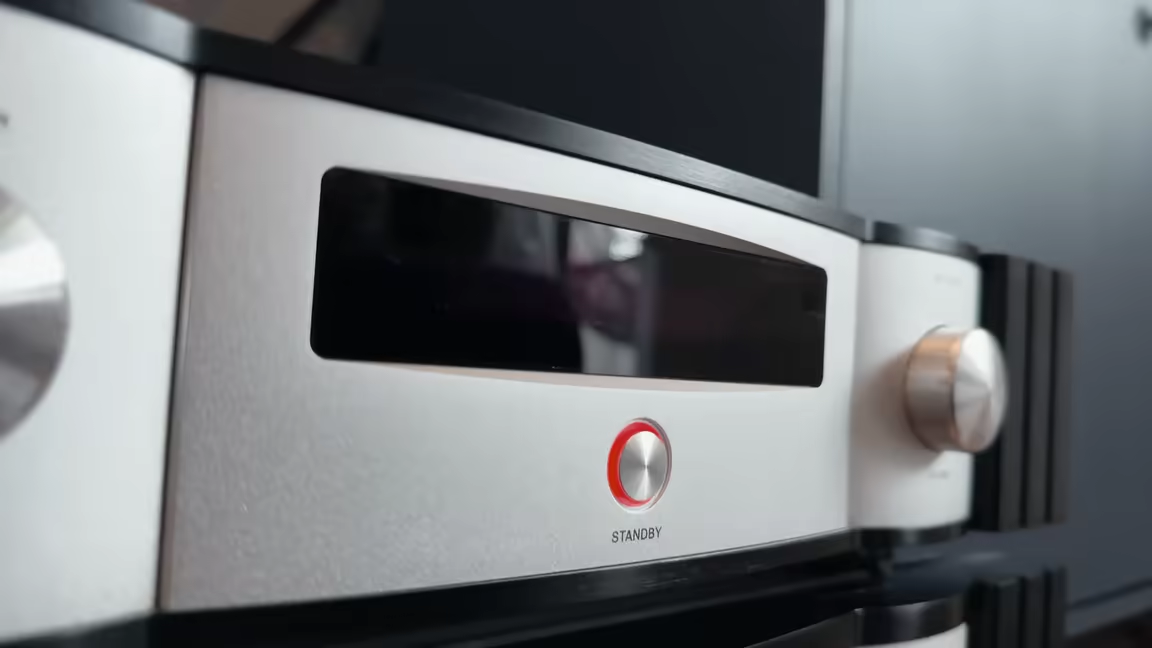
Higher score
Tonewinner AD-1PA+
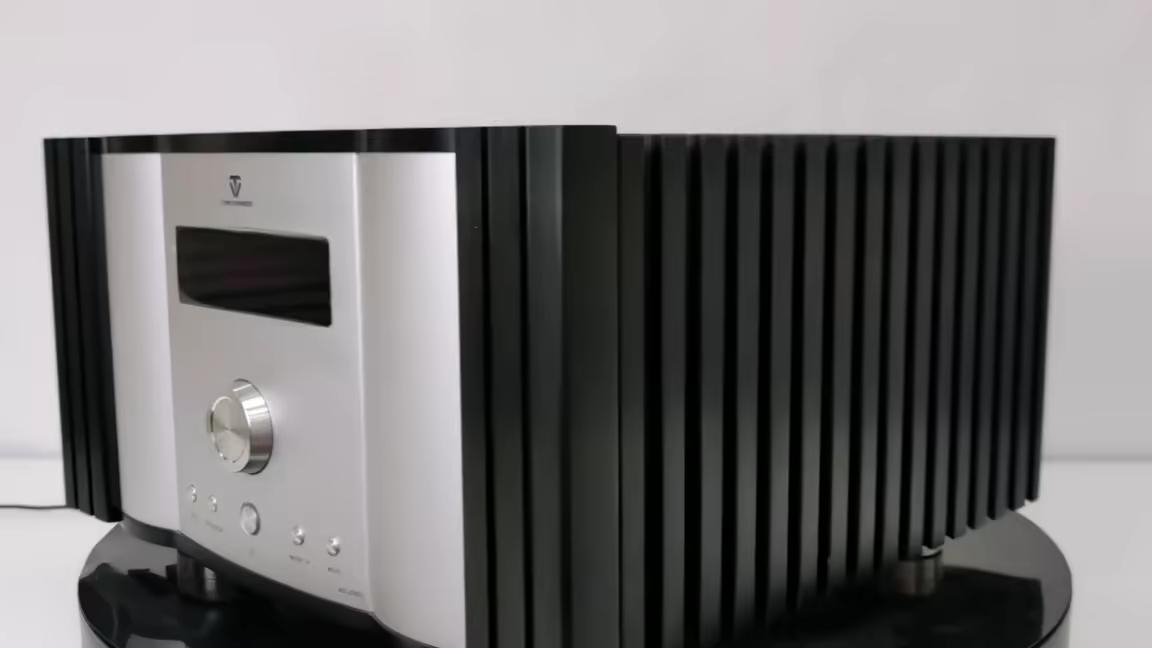
Tonewinner AD-2PRO+
Which one to buy
Our pick is the AD-1PA+, unless its features would be a dealbreaker; then the AD-2PRO+.
Tonewinner AD-1PA+
Our pick. Choose it if:
- The AD-1PA+'s build matters more to you than the AD-2PRO+'s features.
- You would pay $476 over the AD-2PRO+ for the AD-1PA+'s 9.0 against 8.8 on the rubric.
Tonewinner AD-2PRO+
Choose it instead if:
- The AD-2PRO+'s features matter more to you than the AD-1PA+'s build.
- Keeping $476 matters more to you than the AD-1PA+'s two-step lead over the AD-2PRO+, 9.0 against 8.8.
What matters most to you?
| What matters | Tonewinner AD-1PA+ | Tonewinner AD-2PRO+ |
|---|---|---|
| Sound | 9.0 | 9.2 |
| Technical performance | 9.3 | 8.7 |
| Build & comfort | 9.4 | 8.7 |
| System fit | 8.9 | 9.0 |
| Value | 8.3 | 8.0 |
The widest gap is build & comfort: 9.4 for the AD-1PA+ against 8.7 for the AD-2PRO+. Each column comes from its own review's pros and cons, 14 for the AD-1PA+ and 13 for the AD-2PRO+, and recombines to its headline score, 9.0 and 8.8. How a score is built
Where they differ
Three topics the AD-1PA+ and AD-2PRO+ reviews both discuss, the most decisive first.
Only the AD-1PA+
Only the AD-2PRO+
Power and system matching
The AD-1PA+ review lists two strengths and one flaw here and the AD-2PRO+ review one strength, with no clear edge.
- AD-1PA+, strength: "1200W toroidal transformer + 180,000μF capacitance"
- AD-2PRO+, strength: "240W into 8Ω, handles speakers below 4Ω with ease"
Features and formats
The AD-2PRO+ review lists three strengths here, the AD-1PA+ review two strengths and two flaws.
- AD-2PRO+, strength: "Switchable Class A and Class A/B operation"
- AD-1PA+, flaw: "Class AB sounds drier and more clinical vs Class A"
Build and controls
The AD-1PA+ review lists two strengths and one flaw here, the AD-2PRO+ review one strength and one flaw.
- AD-1PA+, strength: "Massive 43kg overbuilt chassis with side heatsinks"
- AD-2PRO+, flaw: "Generates a lot of heat over time"
Only the AD-1PA+ review discusses circuit design (two strengths); only the AD-2PRO+ review discusses soundstage (one strength, two flaws), connectivity (one strength), tonal balance (one strength), and measured noise (one flaw).
What they have in common
The AD-1PA+ is a power amplifier and the AD-2PRO+ an integrated amplifier, both from Tonewinner, and both have balanced XLR inputs, RCA inputs, switchable Class A and Class AB operation, and real heat output in use. The AD-1PA+ and AD-2PRO+ reviews both fault placement.
On paper
The AD-1PA+ ranks #1 and the AD-2PRO+ #3 of the 3 speaker amps & preamps reviewed here; on value the AD-1PA+ and the AD-2PRO+ both rate Steep. Into 8 Ω, the AD-1PA+ is rated at 100 W Class A / 300 W Class AB and the AD-2PRO+ at 240 W (one channel driven). The AD-1PA+ lists 2 inputs and 1 output; the AD-2PRO+ lists 6 and 2. The AD-1PA+ and AD-2PRO+ spec sheets match on topology (Class A) and class (Switchable Class A / Class AB).
The AD-1PA+ and AD-2PRO+ figures come from Tonewinner's official site.
| Spec | Tonewinner AD-1PA+ | Tonewinner AD-2PRO+ |
|---|---|---|
| Power output | 100 W Class A / 300 W Class AB into 8 Ω · 500 W Class AB (one channel driven) into 4 Ω | 240 W (one channel driven) into 8 Ω |
| THD+N | <0.0016% at 100 W | <0.05% at 1 kHz |
| SNR | >116 dB | >100 dB (A-weighted) |
| Frequency response | 10 Hz - 104 kHz (−3 dB) | 15 Hz - 95 kHz |
| Inputs | Balanced XLR, RCA | USB-B, 2× Optical, Coaxial, RCA, Balanced XLR, MM/MC phono |
| Outputs | Dual A/B speaker binding posts | 2× speaker binding posts, Subwoofer out (RCA/XLR) |
| Weight | 43.00 kg (43000 g) | 40.00 kg (40000 g) |
| Minimum impedance | 2 Ω | <4 Ω capable |
Only the AD-1PA+ review records damping factor, gain, and power supply; only the AD-2PRO+ review records architecture.
How these verdicts were reached
The AD-2PRO+ was reviewed in April 2024 and the AD-1PA+ in July 2025, just over a year later, on one reference chain and rubric. The AD-1PA+ review never mentions the AD-2PRO+, nor the AD-2PRO+ review the AD-1PA+: two separate sessions. The AD-1PA+ and AD-2PRO+ reviews were both re-checked in September 2026.
Questions about the AD-1PA+ and AD-2PRO+
What is the difference between the Tonewinner AD-1PA+ and the Tonewinner AD-2PRO+?
The Tonewinner AD-1PA+ edges the AD-2PRO+ where it is measured, 9.0 to 8.8. In the reviews' own lines, build goes to the AD-1PA+ and features to the AD-2PRO+.
Which should you buy, the Tonewinner AD-1PA+ or the Tonewinner AD-2PRO+?
The AD-1PA+: its 9.0 against the AD-2PRO+'s 8.8 is two steps, a lead the published pick rule keeps even at $476 more.
Which has the more useful features, the AD-1PA+ or the AD-2PRO+?
The AD-2PRO+, narrowly: its review lists three strengths on features, the AD-1PA+ review two strengths and two flaws.
Which is better built, the AD-1PA+ or the AD-2PRO+?
The AD-1PA+, narrowly: its review lists two strengths and one flaw on build, the AD-2PRO+ review one strength and one flaw.
Is the AD-1PA+ worth $476 more than the AD-2PRO+?
On the pick rule, yes: the AD-1PA+'s 0.2 lead over the AD-2PRO+ is two steps, more than the rule trades for $476. In the reviews' own lines, it buys the AD-1PA+'s build and circuit design over the AD-2PRO+.
Where they rank
In Best Speaker Amps and Preamps the AD-1PA+ ranks #1 and the AD-2PRO+ #3; only the AD-1PA+ makes Best Reference-Grade Audio Gear (#7).
AD-1PA+ #1 - Best Overall AD-2PRO+ #3 3 picks
Best Reference-Grade Audio Gear
AD-1PA+ #7 AD-2PRO+ not listed 10 picks
All speaker amps & preamps matchups All speaker amps & preamps reviews