
Bass Reflex vs Sealed Speakers: What the Port Does
A bass reflex speaker has a tuned port, a tube or slot in the cabinet, that lets the back of the woofer reinforce the bass at the bottom of its range. It is the most common speaker design because it plays deeper and louder from a given box. A sealed, or closed-box, speaker gives that up for a gentler roll-off, tighter timing and easier placement near a wall.
- By Jakub Charkiewicz
- Published
- 3 min read
Glossary definition
- Bass Reflex
- A speaker enclosure with a tuned port or slot that allows the rear wave to reinforce bass output, extending low-frequency response. Compared with a sealed box it trades deeper extension for a steeper rolloff below the port tuning and a slower bass decay.
What the port does
A woofer moving forward also pushes air backward into the cabinet. In a sealed box that rear wave is trapped and absorbed. In a bass reflex design the cabinet has an opening, a port, and the air inside the port and the air in the box form a resonator, the same effect that makes a bottle hum when you blow across it.
The designer tunes that resonance to a chosen frequency near the bottom of the speaker's range. Around it, the air in the port moves strongly and in step with the front of the cone, adding output exactly where a small woofer would otherwise be running out. At the tuning frequency itself, the port does most of the work and the woofer barely moves, which also lowers its distortion there.
What a ported speaker gains
Deeper bass from the same box. A port typically extends a speaker's usable bass meaningfully below what the same woofer manages sealed.
More level for the same power. Because the port adds output rather than wasting the rear wave, ported speakers are generally more sensitive, and they play louder before the woofer reaches its limits. Our Triangle Australe EZ review credits its front-firing port with both better bass extension and higher sensitivity.
What it costs
A steeper roll-off. Below the tuning frequency a ported speaker's output falls away quickly, at roughly 24 dB per octave against a sealed speaker's 12, and the woofer, no longer controlled by the air in the box, can flap freely on very low content.
Timing. A resonator stores energy and releases it a little late. Ported bass can sound slightly slower and less defined than sealed bass, particularly on fast, deep bass lines.
Port noise. At high levels the air through a small port moves fast enough to chuff or whistle. Flared ports and slots reduce it.
Where the port points
Rear ports fire into the wall behind the speaker, so the distance to that wall changes the bass a great deal. Too close and the bass turns boomy and thick; move the speakers out and it tightens. Foam bungs, often supplied, partly seal the port to tame bass in a small room.
Front ports fire into the room, which makes the speaker far easier to place near a wall.
Down-firing ports and slots use the floor or the plinth as the boundary and sit somewhere between.
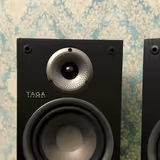
In our catalogue the rear-ported speakers include the Taga Harmony DIAMOND B-60 v.3, which vents its tweeter into the same cabinet volume, and the front-ported ones include both Triangle floor-standers.
Sealed speakers
A sealed, or closed-box, speaker rolls off gradually, at around half the slope of a ported one, and that gentle slope happens to blend well with the natural bass boost a room adds, so sealed speakers often sound fuller in a room than their specification suggests. Their bass is tight and well timed, and they are indifferent to the wall behind them. The costs are lower sensitivity and less extension from a given box.
Our Diora Acoustics Chors 5 review is the sealed example in the catalogue, a closed-box floor-stander, and it makes the placement point directly: with no port, the speakers can sit somewhat close to the rear or side walls without the low end falling apart.
Choosing and placing
Neither design is better; they are different trades. A ported speaker suits a room where it can stand out from the wall and you want deep bass and headroom from a modest amplifier. A sealed speaker suits a room where the speakers must sit near a wall, or a listener who values tight, well-timed bass over the last few hertz. Either way the room's own resonances shape the bass more than the port does, and the site's room mode calculator shows where they fall.
Reviewed gear that shows this
5 reviews in the catalogue. Every score is anchored to the same published reference list.

What our reviews say about bass reflex
2 reviews raise it in their pros and cons: one line credits it and one faults it. each quoted as its review states it.
- Strength:
Closed-box floor-stander - rare design choice
- Diora Acoustics Chors 5, 8.5/10 - Flaw:
Tweeter not in separate sealed enclosure (also vented)
- Taga Harmony DIAMOND B-60 v.3, 8.2/10
Compared head to head
Comparisons between products on this page, each weighing the two reviews side by side.
Put it to use
Visualizer
Why does the bass sound wrong in my room?
Map every standing wave resonance up to 300Hz in rectangular, L-shaped, round, and arched-ceiling rooms. Canvas visualizer shows nodes and antinodes. Tells you where to sit and where to place bass traps.
Room Mode Calculator
Buying guide
Best Speakers
A speaker is the one component in the chain that has to move air in your actual room, which is why the spec sheet tells you less here than anywhere else. Buy for the room you have and the amplifier you own, not for the showroom.
6 ranked picks, led by the Diora Acoustics Chors 5
Keep reading
Glossary
Bookshelf Speaker
A compact loudspeaker, usually two-way, made to sit on a stand or a shelf and trading bass extension for size and placement freedom. The name misleads: a real shelf loads the bass unevenly and smears imaging, so a stand is almost always the better answer.
Full explanation
Glossary
Room Mode
A standing wave resonance at a frequency determined by room dimensions; axial modes (one dimension) are the strongest and most audible. Below a few hundred hertz in a domestic room, modes shape more of the bass you hear than the speakers do.
Full explanation
Glossary
Crossover
A network of filters that divides the audio signal into frequency bands before each reaches its appropriate driver, passive (in the speaker) or active (before the amp).
Full explanation