
Bookshelf vs Floor-Standing Speakers: Which Suits Your Room
A bookshelf speaker is a compact loudspeaker made to sit on a stand, a desk or a shelf; a floor-standing speaker is tall enough to stand on the floor, with a cabinet big enough to play deeper bass without a subwoofer. The real difference is cabinet volume, and it decides bass extension, maximum level and how much of the room the speakers can fill.
- By Jakub Charkiewicz
- Published
- 3 min read
Glossary definition
- Bookshelf Speaker
- A compact loudspeaker, usually two-way, made to sit on a stand or a shelf and trading bass extension for size and placement freedom. The name misleads: a real shelf loads the bass unevenly and smears imaging, so a stand is almost always the better answer.
The real difference is air
A speaker's woofer needs air behind it to work against, and the amount of air decides how low the speaker can play. A bookshelf cabinet of ten or twenty litres, usually with one five- to seven-inch woofer, typically reaches down to somewhere around 45 to 60 Hz. A floor-standing cabinet of fifty litres or more, often with two or three woofers, can reach into the 30s and play the same bass louder, because several drivers share the work.
Everything else follows from that. Both kinds can have the same tweeter, the same midrange quality and the same imaging. Where they part company is the bottom octave, maximum level and how big a room they can fill before running out of steam.
Floor-standing: what the extra cabinet buys
Bass extension and weight. The obvious gain: deeper, fuller bass without a subwoofer, and the lowest notes of a pipe organ or an electronic track with real body.
Level and ease. With more cone area, each driver moves less for the same volume, so a floor-stander stays cleaner and more relaxed at high levels.
No stands. The tweeter already sits near ear height when you are seated.
The costs are size, price and placement. Deeper bass means stronger interaction with the room's standing waves, and a large speaker pushed close to a wall can turn boomy. Floor-standers also vary more than their category suggests: our reviews include a two-way closed-box floor-stander with fast, port-free bass, and one judged light for its class at 14 kg per speaker.
Bookshelf: what the smaller box buys
Placement freedom. A small cabinet is easier to position well: out from the wall, at the right height, angled at the listener. Imaging often benefits, because a narrow cabinet diffracts less sound off its edges.
Price. Money that would go into a larger cabinet goes into better drivers or a better amplifier instead.
Room fit. In a small or medium room, a bookshelf speaker's limited bass is often an advantage, because it excites the room's worst resonances less.
The trade is the bottom octave. For music with deep bass, or for home cinema, a bookshelf pair usually wants a subwoofer; our Taga Harmony DIAMOND B-60 v.3 review recommends one for home theatre. Active bookshelf models, with the amplifier built in, remove the need for a separate amplifier altogether.
The name misleads
Despite the name, a bookshelf speaker should rarely go on a bookshelf. Enclosed in a shelf, the cabinet couples to the surrounding wood and the wall behind it, which bloats and smears the bass and blurs the stereo image. Rigid stands that bring the tweeter to ear height, with the speakers some distance from the wall, do more for a bookshelf speaker than almost any upgrade. Where the port is matters too: a rear-ported speaker needs more space behind it than a front-ported or sealed one.
Choosing between them
Start with the room, not the speaker. A small room, or one where the speakers must sit near a wall, favours a good bookshelf pair, perhaps with a subwoofer later. A medium or large room, listened to at realistic levels, favours floor-standers. The site's room mode calculator shows where your room's bass resonances fall, which is the single best predictor of how much deep bass you can actually use.
Reviewed gear that shows this
6 reviews in the catalogue. Every score is anchored to the same published reference list.
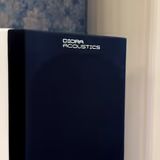 Diora Acoustics Chors 5 Highly Recommended $2,499/pair 8.5
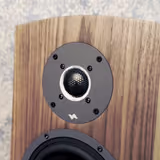 Taga Harmony DIAMOND B-60 v.3 Recommended $1,099/pair 8.2
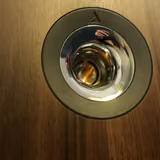 Triangle Australe EZ Recommended $4,999/pair 8.1
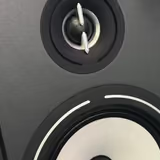 Triangle Borea BR09 Recommended $1,099/pair 8.0
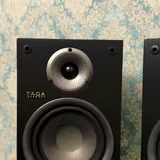 Taga Harmony TAV-500B v.2 Recommended €249/pair $270/pair approx. 7.9
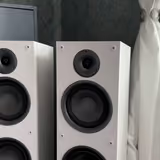 Taga Harmony TAV-607F Recommended €699/pair $755/pair approx. 7.9
What our reviews say about bookshelf speaker
2 reviews raise it in their pros and cons: one line credits it and one faults it. each quoted as its review states it.
- Strength:
Closed-box floor-stander - rare design choice
- Diora Acoustics Chors 5, 8.5/10 - Flaw:
14kg per speaker is light for a floor-stander
- Taga Harmony TAV-607F, 7.9/10
Compared head to head
Comparisons between products on this page, each weighing the two reviews side by side.
Put it to use
Visualizer
Why does the bass sound wrong in my room?
Map every standing wave resonance up to 300Hz in rectangular, L-shaped, round, and arched-ceiling rooms. Canvas visualizer shows nodes and antinodes. Tells you where to sit and where to place bass traps.
Room Mode Calculator
Buying guide
Best Speakers
A speaker is the one component in the chain that has to move air in your actual room, which is why the spec sheet tells you less here than anywhere else. Buy for the room you have and the amplifier you own, not for the showroom.
6 ranked picks, led by the Diora Acoustics Chors 5
Keep reading
Glossary
Bass Reflex
A speaker enclosure with a tuned port or slot that allows the rear wave to reinforce bass output, extending low-frequency response. Compared with a sealed box it trades deeper extension for a steeper rolloff below the port tuning and a slower bass decay.
Full explanation
Glossary
Crossover
A network of filters that divides the audio signal into frequency bands before each reaches its appropriate driver, passive (in the speaker) or active (before the amp).
Full explanation
Glossary
Room Mode
A standing wave resonance at a frequency determined by room dimensions; axial modes (one dimension) are the strongest and most audible. Below a few hundred hertz in a domestic room, modes shape more of the bass you hear than the speakers do.
Full explanation