
Class A, AB and D amplifiers: what the letters mean
An amplifier's class describes how its output stage is biased. In Class A the output devices conduct through the whole signal cycle, so there is no crossover distortion, but most of the power drawn ends up as heat. Class AB uses a smaller bias and hands the waveform between devices, and Class D switches its transistors fully on and off for high efficiency. No letter guarantees a sound.
- By Jakub Charkiewicz
- Published
- Updated
- 6 min read
Glossary definition
- Class A
- An amplifier topology where the output transistors or tubes conduct current at all times, eliminating crossover distortion at the expense of significant heat and inefficiency.
What an amplifier's class describes
Every power amplifier ends in an output stage: the transistors or tubes that push current into the speaker. The class letter says how long each of those devices conducts during one cycle of the signal. A Class A device conducts for the whole cycle. In Class B each device handles half, and Class AB sits between the two. Class C conducts for less than half and belongs in radio transmitters.
Class D works another way. Its output transistors switch fully on and fully off, and the D was simply the next free letter, with no link to "digital". None of these letters names a sound. They describe where the heat goes and which kind of error the designer has to control.
Why Class A amplifiers run hot
A Class A stage carries a large, steady current whether music is playing or not, set high enough that no output device ever switches off, even at full output. The signal rides up and down on top of that current. Because the stage draws roughly the same power at all times, whatever doesn't reach the speaker becomes heat, and it produces the most heat when it is playing nothing.
Theory caps the share of power that reaches the speaker at 25% for the simplest single-ended stage and 50% for a push-pull or transformer-coupled one. Music averages a small fraction of full power, so in real listening the figure is a few percent. A single-ended tube amplifier is Class A by necessity, because its one output device carries the whole waveform and can never turn off.
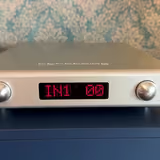
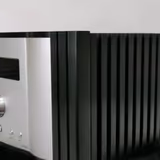
The Tonewinner AD-1PA+ shows the cost. It draws 260 to 300 W from the wall in Class A and 70 to 110 W in Class AB, carries machined heatsinks down both sides and weighs 42 kg. At line level the same bias is cheap, which is why Class A is common in preamplifiers and headphone amps: the Denafrips Hades 12th, a pure Class A preamp, draws 25 W in use.
Push-pull stages and crossover distortion
Push-pull is the escape from that heat. Two devices, or two banks of them, share the work: one pushes current into the speaker on the positive half of the waveform and the other pulls it back on the negative half. The halves mirror each other, so much of the even-order distortion each device makes cancels at the output. A push-pull stage can still run in Class A with both devices always conducting, but it no longer has to.
Remove the standing current and it becomes Class B, with each device conducting for exactly half the cycle, and the theoretical efficiency rises to about 78%. The problem is the handover. A transistor needs a small turn-on voltage before it conducts, so near the zero crossing neither device is fully on and the waveform picks up a kink each time it passes through zero.
That kink is crossover distortion. It produces high-order harmonics that sit far above the note and are poorly masked by it, and because the kink has a fixed size, it becomes a larger share of the signal as you turn the volume down. Clipping gets worse when you play loud, and crossover distortion gets worse at low volume. The harmonic distortion explainer covers how those harmonics show up in a THD figure.
How Class AB keeps the first watts in Class A
Class AB is Class B with the gap closed. A small standing current keeps both devices conducting through the zero crossing, so at low output neither turns off and the amplifier is running in Class A. As the signal grows, each device cuts off for part of the cycle. Most linear amplifiers work this way.
"The first watts in Class A" describes that region. Raising the bias stretches it, at the price of more heat at idle. The limit is a current, so a Class A figure quoted into 8 Ω is roughly halved into 4 Ω. On reasonably sensitive speakers, average listening levels often need only a watt or so, which leaves the peaks to cross into Class AB.
"Class A/AB" on a spec sheet means a high-bias Class AB design, or one that switches between the two, like the AD-1PA+ and the Tonewinner AD-2PRO+. The useful number is how far the Class A region reaches, and into what load.
Bias current and why it drifts
Bias current is the current through the output stage with no signal present, and it slides a push-pull amplifier along the whole scale: none gives Class B, some gives Class AB, and enough to cover the full output swing gives Class A. It fixes the idle heat, so designers choose it deliberately. In many transistor stages there is an optimum setting for the handover, and adding bias short of full Class A can measure worse.
Bias also moves with temperature. A bipolar transistor conducts more as it warms, which unchecked would run away, so output stages carry a temperature sensor on the heatsink, and some take a while to settle after switch-on. Output tubes drift over months as they age, which is why fixed-bias tube amplifiers need periodic adjustment.
Class D, the switching amplifier
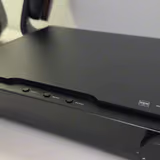
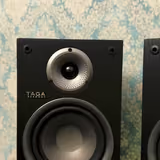
A Class D stage switches its transistors fully on and off, typically several hundred thousand times a second, and varies the width of the pulses to follow the music. A filter after the switches removes the switching frequency and leaves the audio. A switch that is fully on or fully off wastes very little, so Class D amplifiers commonly reach 80 to 90% efficiency, run cool and fit a lot of power in a small box. The Taga Harmony TAV-500B v.2 puts 2 x 40 W RMS into 4 Ω inside one of its own bookshelf cabinets, fed by a 24 V, 4 A supply.
Early Class D earned a poor reputation with distortion that rose through the treble and output filters that reacted to the speaker. Faster switching and feedback taken after the filter fixed most of that, and good current designs match or beat linear amplifiers on distortion and noise. On designs without that feedback, the treble response still depends on the speaker's impedance.
Does the class change the sound?
Class A is cleaner in one respect by construction: with no handover it cannot make crossover distortion at any level. Beyond that the class guarantees little, because a well-biased Class AB stage with feedback keeps crossover distortion very low, and power into your speaker's load, output impedance, noise and behavior near clipping all vary more between designs than between classes.
Listening is where it gets argued. The AD-1PA+ review heard Class A as more dimensional and Class AB as drier, while the AD-2PRO+ review found both modes neutral and preferred Class A in most situations. On a measurement, the difference between two such modes shows up mostly at low output, where the handover happens. How audible it is through speakers, which usually distort far more than the amplifier, is disputed.
For buying, the heat and the power rating decide more than the letter. A Class A amplifier needs open space around it and is often modest in power, so check what your speakers need with the speaker power calculator, and compare candidates in the speaker amplifier guide.
Reviewed gear that shows this
5 reviews in the catalogue. Every score is anchored to the same published reference list.

What our reviews say about Class A
5 reviews raise it in their pros and cons: five lines credit it and two fault it. each quoted as its review states it.
- Strength:
Discrete Class A amp based on HIFIMAN's $3000 Prelude
- HIFIMAN Serenade, 9.3/10 - Flaw:
Significant heat output in Class A mode
- Tonewinner AD-1PA+, 9.0/10 - Strength:
Pure Class A, fully discrete, true balanced signal path
- Denafrips Hades 12th, 9.0/10 - Strength:
Switchable Class A and Class A/B operation
- Tonewinner AD-2PRO+, 8.8/10 - Strength:
Full and rich sound, typical of class A/AB designs
- HIFIMAN EF400, 7.5/10
Compared head to head
Comparisons between products on this page, each weighing the two reviews side by side.
Put it to use
Calculator
How many watts do my speakers need?
How many watts your speakers need at the chair, by sensitivity, distance, room gain, and crest-factor headroom. Inverse-square law done for you.
Speaker Wattage Calculator
Buying guide
Best Speaker Amps and Preamps
This guide is for anyone choosing amplification for a pair of passive hi-fi speakers. Its three picks are a power amp, a preamp and an integrated amp, so settle first what your system is missing: a preamp that switches inputs and sets the volume, a power amp that drives the speakers, or an integrated that does both.
3 ranked picks, led by the Tonewinner AD-1PA+
Sources and further reading
- Texas A&M ECEN 326 lecture 8: Output stages and power amplifiers
Lecture notes · Texas A&M University · PDF
University lecture on push-pull output stages, crossover distortion, biasing to remove the dead zone, and amplifier-class efficiency.
- Caballero (2004): A class-D-tracking-rail class-A audio power amplifier
Thesis · Massachusetts Institute of Technology
Thesis: Class A is low-distortion but under 50% efficient, Class D over 85%, and signal-tracking rails recover efficiency.
- Putzeys (2005): Simple self-oscillating class D amplifier with full output filter control
Paper · Audio Engineering Society · Paid full text
Convention paper on a Class D amplifier whose single feedback loop is taken after the output filter.
- Wikipedia: Power amplifier classes
Encyclopedia · Wikipedia
Keep reading
Glossary
Preamplifier
The stage that selects an input, sets the volume and hands a line-level signal to a power amplifier. Owning the volume control is the point: the preamp fixes the gain structure of the whole chain, which is why it earns a separate box in systems with several sources.
Full explanation
Glossary
Crossover
A network of filters that divides the audio signal into frequency bands before each reaches its appropriate driver, passive (in the speaker) or active (before the amp).
Full explanation
Glossary
Harmonic Distortion
Distortion products at integer multiples of the input frequency; even-order harmonics (2nd, 4th) are generally less audible than odd-order (3rd, 5th). Measured together as THD, the order of the harmonics matters as much as the total, and a single percentage hides it.
Full explanation