
Comb filtering: why reflections make speakers sound hollow
Comb filtering is the row of evenly spaced peaks and notches that forms when a sound reaches you twice, directly and again off a nearby surface a fraction of a millisecond to a few milliseconds later. It sounds hollow and shifts when you move your head. EQ can't remove it; absorbing, scattering or avoiding the reflection can.
- By Jakub Charkiewicz
- Published
- Updated
- 6 min read
Glossary definition
- Comb Filtering
- The frequency-response pattern produced when a direct signal mixes with a delayed reflection, alternating peaks and notches every few hundred Hz, audible as hollowness and coloration in the affected band.
How a reflection carves notches
A speaker sends sound in more directions than the one pointed at you. Some of it reaches the side walls, the floor, the ceiling or a desk and bounces back toward your seat. That copy has traveled further, so it arrives late, and your ears receive the sum of the two.
What the sum does depends on frequency. Where the delay equals a whole number of cycles, the reflection arrives in step and adds to the direct sound. Where it equals half a cycle, or one and a half, it arrives inverted and cancels part of it. The delay is fixed while every frequency has a different cycle length, so the result alternates all the way up the spectrum: peak, notch, peak, notch, at even spacing. Drawn on a linear frequency axis the pattern looks like the teeth of a comb, and signal engineers model it the same way, as a direct signal plus one delayed, quieter copy.
Where the notches land
The delay comes from the extra distance the reflection travels, and the speed of sound, about 343 m/s, turns that distance into frequencies. With d the extra path in meters, the first notch sits at f = 343 / (2 x d), the next ones at three, five and seven times that frequency, and the notches are 343 / d hertz apart.
| Extra path | Delay | First notch | Notch spacing |
|---|---|---|---|
| 10 cm | about 0.3 ms | about 1.7 kHz | about 3.4 kHz |
| 34 cm | about 1 ms | about 500 Hz | about 1 kHz |
| 1 m | about 2.9 ms | about 170 Hz | about 343 Hz |
The shorter the extra path, the higher and wider apart the notches, so a reflection off a surface close to the speaker or to you, a desk being the usual one, does its damage in the midrange and treble.
How deep the notches go depends on how loud the reflection is next to the direct sound. A reflection as loud as the direct sound would cancel it completely at each notch. One 6 dB down swings the response by about +3.5 and -6 dB, and one 10 dB down still leaves ripples of about +2.4 and -3.3 dB. The EBU's standard for critical listening rooms asks for every early reflection arriving within 15 ms of the direct sound to sit at least 10 dB below it between 1 and 8 kHz.
What comb filtering sounds like
Hollow, phasey and a little boxed-in, with a stereo image that won't settle. The tell is that it moves. Shift your head a few centimeters and the path lengths change, the notches slide to new frequencies, and the tone shifts with them. Sweep the delay continuously and you get flanging, the studio effect, which is a comb filter in motion; in a room the delay is fixed for each head position, so you hear a coloration instead of an effect.
Two ears soften it. Each ear hears a slightly different comb, and the brain partly smooths the coloration of a single reflection, so it sounds milder than a measurement at one point would suggest. How much a home listening room should absorb its side-wall reflections is argued over: critical-listening standards limit early reflections, while lateral reflections also add a sense of space that some listeners prefer. The notch arithmetic above is not in dispute, and neither is the rule that a reflection close to the direct sound in both time and level colors it most.
The first reflection and how to find it
Of all the reflections in a room, the first to arrive are usually the strongest, because they have traveled the least and bounced only once, off a side wall, the floor, the ceiling or a desk. They arrive a few milliseconds behind the direct sound, too soon to be heard as an echo, so the ear fuses them with it and the result reads as a change in the sound itself.
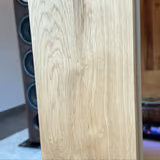
The Ortvik Parametric Tower review describes this at its own listening seat: a bounce arriving "a couple of milliseconds later" that the brain blends with the direct sound, leaving a listening position so narrow that leaning slightly to one side spoiled it. With a tower standing at that reflection point, the review heard the clarity improve at once.
Finding them takes a mirror and a helper. Sit in the listening seat while someone slides a mirror flat along the side wall; wherever you can see a speaker's tweeter in it, that spot is a first reflection point. The same trick works on the ceiling, and on a desk between you and the speakers.
Treating reflections, and what EQ can't do
An absorber at the reflection point takes energy out of the bounce before it comes back. Depth decides how low that reaches. The Ekustik Woody Queen comes in three depths, and its maker rates the 5 cm version at NRC 0.75 and the 15 cm one at NRC 0.94, with absorption down to 100 Hz. A thin panel works mostly in the treble and leaves the midrange notches in place, and the acoustic panel calculator plots the absorption of any thickness and air gap against frequency.
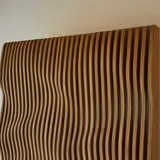
A diffuser scatters the reflection in time and direction, so it no longer arrives as one clean copy that can draw one clean comb. The Ortvik tower does both at once, with a slatted diffusing face over a thin absorptive layer, which is why its review is clear that it absorbs no bass.
Geometry costs nothing. Toeing the speakers in sends less of their output toward the side walls, and moving them further from a wall makes the reflection arrive later and weaker. EQ can't help: boosting a notch boosts the reflection too, so the two still cancel, and the notches sit at different frequencies in every seat, so a correction for one head position is wrong a few centimeters away.
The wall behind the speakers does the same thing lower down. A speaker 1 m from it sends its bass back with about 2 m of extra path, which cuts a notch near 86 Hz, a job for deep absorption or a different distance. Below about 200 Hz this merges with the room's resonances, which the room modes page explains. In our listening room, Woody Queen panels hang on the wall directly behind the speakers and Ortvik towers stand at the first reflection points, as how we test describes.
Comb filtering in microphone recordings
A microphone has one capsule and no brain behind it to smooth anything, so it records comb filtering at full depth. On a desk it picks up a voice directly and again off the desk surface a fraction of a millisecond later, which puts the notches in the voice range. Two microphones picking up one source at different distances do the same when they're mixed.
The Austrian Audio OC16 is built around keeping one reflection out: its review explains that inside a normal basket, sound bounces off the frame and reaches the diaphragm again a split second late, so the OC16's open basket removes as much of the frame as possible. The same review warns that a microphone this detailed records an untreated room as clearly as it records you, and suggests getting closer, using its 160 Hz filter or treating the room.
Working closer raises the direct sound far more than the reflection. The FIFINE K688, a cardioid dynamic microphone, captures mainly the zone in front of it, and its review notes that it needs close, on-axis technique to sound its best.
Reviewed gear that shows this
2 reviews in the catalogue. Every score is anchored to the same published reference list.
What our reviews say about comb filtering
2 reviews raise it in their pros and cons: two lines credit it and no fault it. each quoted as its review states it.
- Strength:
Open Acoustics basket keeps basket reflections off the diaphragm
- Austrian Audio OC16, 8.7/10 - Strength:
Cardioid dynamic capsule rejects fan noise, keyboards and room reflections
- FIFINE K688, 7.2/10
Put it to use
Calculator
Will this acoustic panel actually work?
Plot the absorption coefficient of any porous acoustic panel from 20 Hz to 8 kHz. Thickness, flow resistivity, and air-gap depth into NRC, SAA, and a frequency curve. Presets for Owens Corning 703, Rockwool RW3, GIK 242, Auralex foam.
Acoustic Panel Calculator
Buying guide
Best Hi-Fi Accessories
This guide is for anyone adding acoustic treatment, power filtering, cables or network gear to a hi-fi system that already works. Name the problem before you pick a product, and price the fix against the system it goes into: most of the cable and power reviews here heard small gains that take a resolving system to show.
13 ranked picks, led by the Synergistic Research PowerCell 14
Sources and further reading
- Stanford CCRMA: Feedforward comb filters
Reference · Stanford University
Shows that a direct signal summed with one delayed, attenuated copy is a feedforward comb filter, a model of a single echo.
- EBU Tech 3276: Listening conditions for the assessment of sound programme material
Standard · European Broadcasting Union · PDF
Asks for early reflections arriving within 15 ms to sit at least 10 dB below the direct sound from 1 to 8 kHz.
- Wikipedia: Comb filter
Encyclopedia · Wikipedia
Keep reading
Glossary
Room Mode
A standing wave resonance at a frequency determined by room dimensions; axial modes (one dimension) are the strongest and most audible. Below a few hundred hertz in a domestic room, modes shape more of the bass you hear than the speakers do.
Full explanation
Glossary
Ground Loop
An unwanted current path through the ground conductor between two devices, creating a 50/60Hz hum that's audible through the audio chain. Cured by galvanic isolation, ground lifts (carefully), or routing every device through a single grounded point.
Full explanation
Glossary
Power Conditioning
Any treatment of the AC mains supply before it reaches audio equipment, filtering noise, blocking DC, surge protection, or balancing voltage. Benefits range from "obvious" to "imaginary" depending on the listener and the implementation.
Full explanation