
What a preamplifier does, and when you need one
A preamplifier selects the source you hear, sets the volume and sends a line-level signal to the power amplifier, which drives the speakers. An integrated amplifier puts both stages in one box. You need a preamp stage when you switch between several analog sources or your DAC has no volume control; otherwise a DAC with its own volume control can feed a power amp directly.
- By Jakub Charkiewicz
- Published
- Updated
- 6 min read
Glossary definition
- Preamplifier
- The stage that selects an input, sets the volume and hands a line-level signal to a power amplifier. Owning the volume control is the point: the preamp fixes the gain structure of the whole chain, which is why it earns a separate box in systems with several sources.
What the preamp does in a hi-fi chain
A preamp sits between your sources and the power amplifier and does three jobs. It switches between inputs, it sets the volume, and it sends the result on at line level, a volt or two, with enough drive for the cable and the power amp's input. The power amp then supplies the voltage and current a speaker needs.
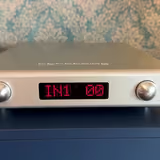
Everything a preamp handles is a small signal, so its enemies are noise, hum and anything that changes the signal on its way through. The Denafrips Hades 12th lists 0.00045% THD and a 122 dB signal-to-noise ratio from a pure Class A, fully discrete circuit with its own 80VA transformer and linear supply. Its inputs are deliberately few, two XLR and one RCA, and both of its outputs are live at once, so it can feed two amplifiers without a cable swap.
Other things called a preamp
The word turns up in three other places, each for a different job.
- A phono stage, often sold as a phono preamp, raises a turntable cartridge's output of a few millivolts, or a fraction of a millivolt for a low-output moving-coil, to line level. It also applies the RIAA equalization curve, which reverses the bass cut and treble boost applied at the cutting lathe.
- A microphone preamp raises a microphone's output to line level and usually supplies 48 V phantom power for condenser microphones. Audio interfaces have them built in.
- In EQ software, the preamp is a gain setting applied before the filters, usually turned down to leave room for boosts, as the gain page explains.
How passive and active preamps differ
A passive preamp is a selector switch and an attenuator, with no power supply. With a resistive attenuator, the usual kind, it can only turn the signal down, and the source has to drive everything after it: the attenuator, the interconnect and the power amp's input together. Its output impedance also moves with the volume setting. A potentiometer's output impedance peaks at a quarter of its track resistance, so a 10 kΩ passive can present 2.5 kΩ to the cable, and the cable's capacitance forms a low-pass filter with it. The cable capacitance calculator shows where the treble starts to fall for a given run.
An active preamp adds a powered buffer, and often gain. The buffer's low output impedance keeps the cable and the power amp's input from loading the source. Active doesn't have to mean gain: the Hades is active and runs at unity gain. Its volume control is a 60-step relay ladder, and its relays click as it changes step, which its review lists as a con for anyone who wants silent volume changes.
Matching a preamp to the power amp
Three figures decide whether the two suit each other: the voltage the power amp needs for full output, the voltage the preamp can deliver, and the impedances at the join.
The first follows from the power amp's rating and gain. Tonewinner rates the Tonewinner AD-1PA+ at 330 W per channel into 8 Ω and quotes 29.5 dB of gain. 330 W into 8 Ω takes about 51 V, and 29.5 dB is a factor of about 30, so the amplifier reaches its rated power from about 1.7 V at its input. A DAC that delivers 2 V rms gets there even through a unity-gain preamp. An amplifier with less gain or more power needs more voltage, which is where a preamp with gain helps.
The impedances at the join rarely cause trouble between active solid-state boxes. Those preamps usually have output impedances of a few hundred ohms or less, and power amp inputs are commonly in the tens of kilohms. Passive preamps and some valve stages sit much higher, and that's when the power amp's input impedance needs checking. Where both boxes offer XLR, the balanced page explains what an XLR connection from end to end changes.
Why some systems split preamp and power amp
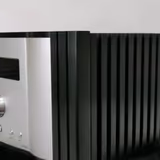
Separates put each stage in its own box with its own supply, where an integrated amplifier usually shares one. The engineering case for them is distance: the small-signal circuits sit away from a power amp's large transformer and the heavy current it draws. The AD-1PA+ carries a 1200 W toroidal transformer and 180,000 µF of filter capacitance, and its review heard it with Tonewinner's matching AD-1PRE+ preamp, which has a phono stage built in.
Separates also let you replace one half at a time, a preamp with more inputs or a bigger power amp for harder speakers, and they let you put the power amp beside the speakers at the end of a long interconnect, which an active preamp drives easily. The costs are an extra box, another power cord, a pair of interconnects and the matching above. The speaker power calculator works out how many watts your speakers need at your seat, which decides the power amp half.
What an integrated amplifier combines
An integrated amplifier is a preamp and a power amp in one chassis, usually sharing one power supply. The maker has already matched the gain of one stage to the input of the other, and no interconnect runs between them.
The Tonewinner AD-2PRO+ shows how much one box can hold. Rated at 240 W into 8 Ω with one channel driven, it adds a DAC fed by USB, two optical inputs and a coaxial one, an MM/MC phono input, subwoofer outputs on RCA and XLR, and two pairs of speaker terminals, while its analog inputs bypass the DAC and stay analog. It weighs 35.9 kg and generates a lot of heat over time. Its THD figure, below 0.05% at 1 kHz, covers the whole unit, DAC included, which is worth remembering when you compare it with a figure quoted for a power amp alone.
You give up the option of replacing one half, unless the amplifier has pre-out and main-in sockets, which let you use its preamp with another power amp or its power amp with another preamp. And the preamp section shares its box with the power transformer, the closeness that separates are built to avoid.
Do you need a preamp at all?
If your sources are all digital and your DAC has a volume control, it can drive a power amp or active speakers directly, and it already does a preamp's jobs. A headphone amplifier can take the role too: the HIFIMAN Serenade has RCA and XLR line outs for use as a preamp or a DAC, and a pair of analog RCA inputs.
You need a preamp stage, in its own box or inside an integrated amplifier, when:
- a turntable or another analog source has to be switched alongside the digital ones;
- your DAC has a fixed output and leaves the volume to whatever follows it;
- you use very efficient speakers and hear hiss at low volume. Digital attenuation leaves the DAC's own analog noise where it was, and the power amp amplifies it at full gain, while an analog volume control after the DAC turns the hiss down with the music. The bit depth page covers what digital volume costs in bits.
The best speaker amps and preamps guide ranks the power amplifiers, integrated amplifiers and preamps reviewed here.
Reviewed gear that shows this
3 reviews in the catalogue. Every score is anchored to the same published reference list.

What our reviews say about preamplifier
2 reviews raise it in their pros and cons: two lines credit it and no fault it. each quoted as its review states it.
- Strength:
Matching AD-1PRE+ preamp with built-in phono stage
- Tonewinner AD-1PA+, 9.0/10 - Strength:
Bypass mode for a fixed-level, preamp-friendly output
- Fosi Audio ZD3, 7.1/10
Compared head to head
Comparisons between products on this page, each weighing the two reviews side by side.
Put it to use
Calculator
How many watts do my speakers need?
How many watts your speakers need at the chair, by sensitivity, distance, room gain, and crest-factor headroom. Inverse-square law done for you.
Speaker Wattage Calculator
Buying guide
Best Speaker Amps and Preamps
This guide is for anyone choosing amplification for a pair of passive hi-fi speakers. Its three picks are a power amp, a preamp and an integrated amp, so settle first what your system is missing: a preamp that switches inputs and sets the volume, a power amp that drives the speakers, or an integrated that does both.
3 ranked picks, led by the Tonewinner AD-1PA+
Sources and further reading
- IEC 60268-3: Amplifiers
Standard · International Electrotechnical Commission · Paid full text
The IEC standard that sets which amplifier characteristics are specified, such as gain and output, and how each is measured.
- IEC 61938: Guide to the recommended characteristics of analogue interfaces
Standard · International Electrotechnical Commission · Paid full text
IEC guidance on the voltages and impedances of analog interfaces, so components from different makers connect and match.
- Wikipedia: Preamplifier
Encyclopedia · Wikipedia
Keep reading
Glossary
Class A
An amplifier topology where the output transistors or tubes conduct current at all times, eliminating crossover distortion at the expense of significant heat and inefficiency.
Full explanation
Glossary
Balanced
A signal transmission method using two opposite-polarity signal lines plus a ground; noise induced on both lines is canceled at the differential input.
Full explanation
Glossary
DAC
Digital-to-Analog Converter, a device that translates binary audio data into an analog electrical signal that can be amplified and heard. Every digital source has one built in; an external DAC earns its place when that one is noisy, lacks the outputs you need, or cannot feed your amplifier cleanly.
Full explanation