
R-2R DACs: how a resistor ladder turns bits into voltage
An R-2R DAC converts audio with a ladder of resistors in just two values, R and 2R, one rung per bit, so each bit adds half as much voltage as the bit above it and the whole sample is built in one step. Its accuracy rests on how closely those resistors match, which is why a good ladder is costly to build and rarely measures as cleanly as the best delta-sigma chips.
- By Jakub Charkiewicz
- Published
- Updated
- 5 min read
Glossary definition
- R-2R
- A DAC architecture using a resistor ladder network with only two resistance values, often associated with a more "natural" tonal character than delta-sigma designs.
How the ladder builds a voltage
Each bit of a sample drives one rung of the ladder. The rung is a 2R resistor that a switch connects either to a reference voltage or to ground, and plain R resistors join the rungs into a chain. Every junction looks into the same resistance further down the chain, so each rung's share of the output is half the share of the rung above it, the same weighting a binary number uses.
With a 3-bit ladder and a 1-volt reference, the top bit contributes 0.5 V, the next 0.25 V and the last 0.125 V, so the code 101 comes out at 0.625 V. A 16-bit or 24-bit ladder works the same way with more rungs, and it produces the full value in one step, sample after sample.
The two values are what make the design buildable. A converter with one resistor per bit, each double the last, would need a 32,768-to-1 spread of values for 16 bits, and matching values that far apart to the precision required is impractical. The ladder asks for only R and 2R, which can be made and matched as a set.
Why resistor matching sets the accuracy
The halving has to be exact, and the top rung carries half the full output. A 16-bit step is 1/65,536 of full scale, about 0.0015%, and a 24-bit step is one part in 16.7 million. An error in the largest rungs changes the size of the steps where they switch, most of all at the middle of the range, where the top bit turns on as every bit below it turns off.
In a plain ladder that midpoint is where the waveform crosses zero, so the error lands where quiet signals spend their time. It stays the same size at any level, which makes it a bigger share of a quiet passage than of a loud one.
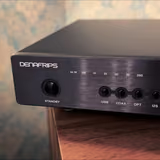
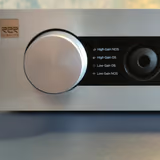
The Denafrips Enyo 15th review cites hand-matched resistors with a 0.01% tolerance and low thermal effect. One part in 10,000 is a tight tolerance for a resistor, yet an error that size in the top rung would still come to about three 16-bit steps. Makers deal with it by sorting resistors by hand, as Denafrips does, by trimming them in production, or by correcting known errors in other ways. Resistors also drift with temperature and age, so the match has to hold for years. And the bottom rungs of a 24-bit ladder are far smaller than the matching errors of its top ones, so a 24-bit figure describes the data the ladder accepts more than the accuracy it reaches.
Discrete ladders and ladders on a chip
A ladder can be built from separate resistors on a circuit board, as the Enyo 15th's is, or formed on a chip. Resistors made side by side on one piece of silicon match each other closely even when their absolute values vary, which lets a ladder shrink to fit a small desktop unit or, in HIFIMAN's Svanar Wireless, a pair of earphones.
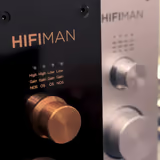
HIFIMAN's Himalaya converters are ladders of this kind. The HIFIMAN EF400 review describes a resistor ladder array on a chip that takes PCM up to 192 kHz at 32 bits, and the EF500 and Serenade use Himalaya designs too. The HIFIMAN EF499 uses an R-2R chip from Philips instead, and its review lists that as a con, since it isn't the Himalaya design of the dearer units.
The resistor idea also turns up where nothing is converted. The Denafrips Hades 12th on the product list below is a preamp, and its "R2R" is a volume control: relays switch between 60 discrete resistors, a design its review describes as derived from Denafrips' ladder DACs.
What NOS mode changes
A ladder can also convert at the file's own sample rate, holding each value until the next one arrives, with no oversampling at all. A delta-sigma converter can't, since it depends on oversampling. The Enyo 15th, EF400 and EF499 all let you switch between oversampling (OS) and non-oversampling (NOS).
Without the digital filter, two things change, and both show up on a measurement. Holding each sample rolls off the top octave: at 44.1 kHz the output is about 3 dB down at 20 kHz. And the output carries mirror images of the music above half the sample rate, so a 20 kHz tone leaves another at 24.1 kHz, not far below the tone itself, for the analog stage to deal with. There's also no digital filter to ring ahead of a transient. The EF400's review notes that NOS often measures worse unless an external oversampling filter does the job.
Heard, the reviews point the same way. On the EF400, oversampling sounded busier and more detailed, and NOS cleaner, warmer and a touch wider, a difference the review calls audible but not huge. On the EF499, oversampling was more refined and NOS more organic and relaxed, and the reviewer prefers NOS.
The Enyo's review suggests a third route: leave the DAC in NOS and upsample in software such as HQPlayer, which the Enyo accepts at up to 1536 kHz over USB and I²S. At that rate the droop and the images move far above the audio band, and the filtering happens in the computer.
Ladder measurements and the ladder sound
The ladder DACs reviewed here don't measure like the cleanest chip designs, and their reviews say so. The EF400's 118 dB SNR and 0.002 to 0.004% THD+N are called unimpressive, the EF499's 0.008% THD+N is called nothing to be concerned about in a resistor ladder, and the Enyo 15th, at 115 dB SNR, is "not a measurement monster". Those THD+N figures sit 82 to 94 dB below the test signal, while the cleanest delta-sigma designs are rated 20 dB or more lower.
Heard, the same reviews describe warmth, texture and a natural sound, and the Enyo's review would choose it over any delta-sigma DAC for the system it was heard in. Whether the ladder itself causes that character is argued over. A finished DAC also differs in its filter, clock, output stage, power supply and voicing, and comparing finished products changes all of them at once.
Choosing an R-2R DAC
If you shop by measurements, a delta-sigma DAC gives you lower figures for the money. If you want the character these reviews describe, or the choice of NOS, look at ladders: NOS needs a converter that builds each sample directly, and every DAC reviewed here with a true NOS mode is an R-2R design. The delta-sigma SMSL DL100 lists a NOS-style filter, and its review says that filter isn't real NOS. Judge it on everything else a DAC has to get right too, its inputs, its outputs and how well they suit your amplifier. The DAC guide ranks the converters reviewed here on one scale, ladder and delta-sigma alike.
Reviewed gear that shows this
6 reviews in the catalogue. Each score is set against its own category's reference.
What our reviews say about R-2R
8 reviews raise it in their pros and cons: 7 lines credit it and 2 fault it. 6 are shown, each quoted as its review states it.
- Strength:
Proprietary Himalaya Pro R2R DAC for a natural, non-clinical sound
- HIFIMAN Serenade, 9.3/10 - Flaw:
Not the typical HIFIMAN Himalaya R2R architecture
- HIFIMAN EF499, 8.1/10 - Strength:
True balanced R2R ladder with 0.01% tolerance resistors
- Denafrips Enyo 15th Anniversary, 9.1/10 - Flaw:
Not a basshead DAC - tight, but no deep R2R-style weight
- Fosi Audio ZD3, 7.1/10 - Strength:
60-step relay-based stepped attenuator (R2R volume)
- Denafrips Hades 12th, 9.0/10 - Strength:
First Himalaya R2R DAC chip at this price point
- HIFIMAN EF500, 8.2/10
Compared head to head
Comparisons between products on this page, each weighing the two reviews side by side.
Put it to use
Sources and further reading
- HyperPhysics: R-2R ladder DAC
Reference Georgia State University
Shows a ladder built from only R and 2R resistors, and why a converter with one weighted resistor per bit needs too much precision.
- Wikipedia: Resistor ladder
Encyclopedia Wikipedia
Keep reading
DAC
Digital-to-Analog Converter, a device that translates binary audio data into an analog electrical signal that can be amplified and heard.
Delta-Sigma
The dominant DAC architecture today, using high oversampling and noise shaping to push quantization noise above the audible range.
Sample Rate
How many audio samples are captured per second; 44.1kHz captures frequencies up to 22.05kHz (Nyquist limit), well above the 20kHz hearing limit.