
Room modes: why the bass changes from seat to seat
A room mode is a standing wave between a room's surfaces, at frequencies set by its dimensions: the strongest sit at 343 divided by twice a length, width or height in meters, and at whole multiples of that. Below about 200 Hz in most homes the modes act one at a time, so bass swells and vanishes at fixed spots, and moving the seat or the speakers is the cheapest way to change it.
- By Jakub Charkiewicz
- Published
- Updated
- 6 min read
Glossary definition
- Room Mode
- A standing wave resonance at a frequency determined by room dimensions; axial modes (one dimension) are the strongest and most audible. Below a few hundred hertz in a domestic room, modes shape more of the bass you hear than the speakers do.
How a standing wave forms between two walls
Play a steady low note in a room and the sound crosses to the far wall, reflects, comes back, reflects again and sets off once more. At most frequencies the returning waves arrive out of step with the new ones and no strong pattern builds up. At some frequencies the round trip takes a whole number of cycles, every reflection lands in step with the last, and the room resonates.
What forms is a standing wave, a pattern that stays in place. At its antinodes the pressure swings hardest, and at its nodes it barely moves. The walls themselves are always antinodes, so every mode is at its loudest against the surfaces that create it.
Between the two walls of one dimension, the frequencies follow a single relation:
f = n x c / (2 x L)
L is the distance in meters, c the speed of sound, about 343 m/s at room temperature, and n the mode number, 1, 2, 3 and so on. The first mode has one node, halfway between the walls. The second has two, a quarter of the way in from each wall, with a peak in the middle. A room 5 m long has length modes at 34.3, 68.6 and 102.9 Hz, and further up in steps of 34.3 Hz.
Axial, tangential and oblique modes
Modes between one pair of opposite surfaces are axial modes, one family each for the length, the width and the height. A room also supports tangential modes, which travel around four surfaces in two dimensions, and oblique modes, which use all six. In a rectangular room they all come from one formula, with p, q and r the mode numbers along the length L, width W and height H:
f = (c / 2) x sqrt((p / L)^2 + (q / W)^2 + (r / H)^2)
Set two of the three numbers to zero and it becomes the axial relation above. In a room 5 m long, 4 m wide and 2.5 m high, the first tangential mode, one step along the length and one across the width, falls at about 55 Hz, and the first oblique mode at about 88 Hz.
A rule of thumb from the acoustics textbooks puts tangential modes about 3 dB weaker than axial ones and oblique modes about 6 dB weaker, which is why the axial modes get most of the attention. The room mode calculator lists every mode below 300 Hz for your dimensions, and it also solves L-shaped, round and vaulted rooms, which the formula above doesn't cover.
Where individual modes stop mattering
The number of modes climbs steeply with frequency. At the bottom of the range they're spread out and each one is heard on its own. Higher up they overlap and blur into the room's reverberation. The Schroeder frequency estimates where that change happens: 2000 times the square root of the reverberation time in seconds divided by the room's volume in cubic meters.
The 5 × 4 × 2.5 m room holds 50 m³. With a reverberation time of 0.5 s it lands at 200 Hz, and treatment that brings the decay down to 0.3 s lowers it to about 155 Hz. Below that line the bass you hear is a handful of resonances with gaps between them. Above it, reflections and reverberation shape the sound, and those call for different treatment, which the comb filtering page covers.
What modes do to the bass at your seat
Near a peak, notes close to the mode's frequency play louder than their neighbors and ring on after the speaker stops. You hear it as boom, as a bass line in which one or two notes jump out, or as bass that sounds slow. Near a node the same notes thin out or disappear. The pattern is fixed to the room, so walking a meter can take you from one to the other while the speakers stay exactly where they were.
Some positions are predictable. A seat halfway down the room sits in the node of every odd-numbered length mode and on the peak of every even one, so the deepest length mode goes missing there. A seat against the back wall sits on the peak of every length mode at once, and the bass there turns heavy. Corners are peaks for every mode in a rectangular room, so a speaker in a corner drives all of them as hard as it can.
Proportions that spread the modes
When two dimensions share a simple ratio, their modes land on the same frequencies and add up. The 5 × 4 × 2.5 m room shows it: 5 m is twice 2.5 m, so the second length mode and the first height mode both fall at 68.6 Hz, and the fourth length and second height modes meet at 137.2 Hz. The fifth length mode and the fourth width mode coincide again at 171.5 Hz.
The EBU's specification for critical listening rooms limits the length and width relative to the height to keep the low-frequency modes evenly spread, and asks for no ratio between two dimensions within 5% of a whole number. You can't move your walls, but the same arithmetic tells you which notes your room will exaggerate before you place anything.
Moving the seat and the speakers
Position costs nothing, so start there. Keep the seat off the room's halfway point and away from the back wall, then move it and the speakers in steps of 10 or 20 cm while a bass line walks up and down the scale. The calculator's pressure map shows where each mode peaks and dips in your room.
Pulling speakers out from the walls helps too. Triangle recommends the Triangle Australe EZ for rooms above 30 m², and its review found that, pulled away from the walls, it works in much smaller rooms with good bass extension and no boom. How close a speaker can sit to the wall behind it also depends on where its port points, which the bass reflex page explains.
More than one subwoofer gives you more control. Two subwoofers at the midpoints of opposite walls, driven together, cancel the odd-numbered modes between those walls, and multi-subwoofer layouts are used to even out the bass across several seats for that reason.
Bass traps and EQ for what remains
Absorbing a mode takes depth. A porous absorber works on the velocity of the sound wave, which is zero at a wall and greatest a quarter wavelength out from it; at 60 Hz that's about 1.4 m. Membrane and resonant traps work on pressure instead, so they belong where the pressure peaks, in the corners.
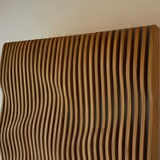
The treatment reviewed here shows the limit. The 15 cm Ekustik Woody Queen is rated by its maker as effective from 100 Hz, and with the panels on the wall behind the speakers its review heard the boominess largely disappear and kick drums turn tight and fast. A dimension would have to be shorter than about 1.7 m for its first mode to reach 100 Hz, though, so the lowest modes of any listening room sit below that rating. The Ortvik Parametric Tower has a thin absorptive layer, and its review is clear that it does nothing for the bass.
EQ can cut a peak at your seat: a parametric filter set to the mode's frequency brings a booming note back into line. It can't fill a null, because at a node the room cancels whatever extra the speaker sends, so a boost only spends amplifier headroom. Any correction also holds only for the seat it was set for. Headphones skip all of this, and the EBU's specification notes that the room has practically no influence on headphone listening. The best hi-fi accessories guide ranks the acoustic treatment we've reviewed.
Reviewed gear that shows this
2 reviews in the catalogue. Every score is anchored to the same published reference list.
What our reviews say about room mode
4 reviews raise it in their pros and cons: four lines credit it and one faults it. each quoted as its review states it.
- Strength:
NRC up to 0.94 - 94% sound absorption
- Ekustik Woody Queen, 9.0/10 - Flaw:
No bass absorption - the absorptive layer behind the slats is thin
- Ortvik Parametric Tower, 8.5/10 - Strength:
Driver Vibration Absorption System reduces cabinet resonance
- Triangle Borea BR09, 8.0/10 - Strength:
Cardioid dynamic capsule rejects fan noise, keyboards and room reflections
- FIFINE K688, 7.2/10
Put it to use
Visualizer
Why does the bass sound wrong in my room?
Map every standing wave resonance up to 300Hz in rectangular, L-shaped, round, and arched-ceiling rooms. Canvas visualizer shows nodes and antinodes. Tells you where to sit and where to place bass traps.
Room Mode Calculator
Buying guide
Best Hi-Fi Accessories
This guide is for anyone adding acoustic treatment, power filtering, cables or network gear to a hi-fi system that already works. Name the problem before you pick a product, and price the fix against the system it goes into: most of the cable and power reviews here heard small gains that take a resolving system to show.
13 ranked picks, led by the Synergistic Research PowerCell 14
Sources and further reading
- EBU Tech 3276: Listening conditions for the assessment of sound programme material
Standard · European Broadcasting Union · PDF
Sets limits on listening-room proportions, with no dimension ratio within 5% of a whole number, to spread the low-frequency room modes evenly.
- Penn State acoustics animations: Standing longitudinal sound waves
Reference · Pennsylvania State University
Animates standing sound waves in pipes, showing the pressure and displacement pattern that fixed boundaries create.
- Wikipedia: Room modes
Encyclopedia · Wikipedia
Keep reading
Glossary
Comb Filtering
The frequency-response pattern produced when a direct signal mixes with a delayed reflection, alternating peaks and notches every few hundred Hz, audible as hollowness and coloration in the affected band.
Full explanation
Glossary
Bass Reflex
A speaker enclosure with a tuned port or slot that allows the rear wave to reinforce bass output, extending low-frequency response. Compared with a sealed box it trades deeper extension for a steeper rolloff below the port tuning and a slower bass decay.
Full explanation
Glossary
Bookshelf Speaker
A compact loudspeaker, usually two-way, made to sit on a stand or a shelf and trading bass extension for size and placement freedom. The name misleads: a real shelf loads the bass unevenly and smears imaging, so a stand is almost always the better answer.
Full explanation