SPL: Decibels, Loudness and How Loud Is Too Loud
SPL (sound pressure level) is how loud a sound is, measured in decibels against the quietest pressure human hearing can detect. It is the number behind a speaker's sensitivity, a headphone's power needs, a microphone's maximum level and every safe-listening guideline, and because decibels are logarithmic, small numbers describe big changes.
- By Jakub Charkiewicz
- Published
- 3 min read
Glossary definition
- SPL
- Sound Pressure Level, measured in dBSPL relative to 20 micropascals (the threshold of hearing); conversation is ~60dB, live rock is ~110dB, pain threshold is ~130dB.
What a decibel of SPL is
Sound is a tiny, rapid variation in air pressure. SPL measures it on a logarithmic scale against 20 micropascals, roughly the faintest sound a young, healthy ear can hear at mid frequencies, which is 0 dB SPL. A quiet room sits around 30 dB, conversation around 60 dB, a busy street around 80 dB, a loud rock concert around 110 dB, and pain begins near 130 dB.
The scale is logarithmic because hearing is. The loudest sound an ear tolerates carries millions of times the pressure of the quietest, and decibels compress that range into numbers that follow how loudness is actually perceived.
How decibels add up
Three rules cover almost every practical question.
+6 dB doubles the pressure. Twice the sound pressure is 6 dB more.
+3 dB doubles the power. Twice the amplifier power gives only 3 dB more. Ten times the power gives 10 dB, which listeners describe as roughly twice as loud. That is why going from a 50-watt to a 100-watt amplifier changes the maximum level far less than the numbers suggest.
-6 dB per doubling of distance. In open space, a speaker heard from twice as far away is 6 dB quieter. In a real room reflections make up part of the loss, so the drop is smaller, but distance still costs level quickly.
SPL on a spec sheet
Speaker sensitivity is the SPL a speaker produces with one watt at one metre. A speaker rated at 90 dB/W/m reaches 90 dB at a metre on one watt; each doubling of power adds 3 dB, each doubling of distance takes 6 dB away. Put those together and you know how much amplifier a room really needs, which is what the site's speaker power and SPL-distance calculators work out.
Headphone sensitivity does the same job at the ear, in dB per milliwatt or per volt. Every headphone review here that publishes impedance and sensitivity states the power the model needs to reach 110 dB peaks, a level loud passages of dynamic music touch even when the average is far lower.
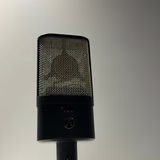
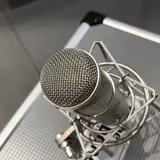
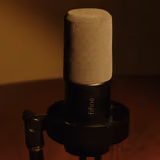
Maximum SPL on a microphone is the loudest sound it can take before its own distortion becomes significant. It is the figure that decides whether a microphone survives a kick drum, a guitar cabinet or a shouting vocalist without a pad. Our microphone reviews quote it, from 130 dB on the FIFINE K688 and the t.bone SCT 2000 to 148 dB on the Austrian Audio OC16.
How loud is too loud
Hearing damage depends on level and time together. The World Health Organization's safe-listening guidance is built on a weekly sound dose equivalent to about 80 dB for 40 hours a week for adults, and every 3 dB above that halves the safe time: 83 dB for 20 hours, 86 dB for 10, and so on up. At the levels a portable player can reach, around 100 dB, the weekly allowance is used up in well under an hour.
Two practical consequences for headphone listening. Average level matters more than peaks, so music that sounds loud all the time is the risk, not the occasional crescendo. And isolation helps: noise cancelling or a good seal lets you listen at a lower level in a noisy place, which does more for your hearing than any specification. The site's safe-listening calculator turns a headphone's sensitivity and your volume into a safe daily time.
Reviewed gear that shows this
3 reviews in the catalogue. Every score is anchored to the same published reference list.
What our reviews say about SPL
2 reviews raise it in their pros and cons: two lines credit it and no fault it. each quoted as its review states it.
- Strength:
148 dB max SPL - past the inside of a kick drum, with no pad needed
- Austrian Audio OC16, 8.7/10 - Strength:
130 dB max SPL takes whispers and shouting without distorting
- FIFINE K688, 7.2/10
Put it to use
Calculator
How loud will it be at my chair?
Calculate the exact SPL at any listening distance from your speakers. Enter sensitivity, wattage, and distance. Covers inverse square law and room gain.
SPL Distance Calculator
Buying guide
Best Speakers
A speaker is the one component in the chain that has to move air in your actual room, which is why the spec sheet tells you less here than anywhere else. Buy for the room you have and the amplifier you own, not for the showroom.
6 ranked picks, led by the Diora Acoustics Chors 5
Keep reading
Glossary
Bass Reflex
A speaker enclosure with a tuned port or slot that allows the rear wave to reinforce bass output, extending low-frequency response. Compared with a sealed box it trades deeper extension for a steeper rolloff below the port tuning and a slower bass decay.
Full explanation
Glossary
Bookshelf Speaker
A compact loudspeaker, usually two-way, made to sit on a stand or a shelf and trading bass extension for size and placement freedom. The name misleads: a real shelf loads the bass unevenly and smears imaging, so a stand is almost always the better answer.
Full explanation
Glossary
Crossover
A network of filters that divides the audio signal into frequency bands before each reaches its appropriate driver, passive (in the speaker) or active (before the amp).
Full explanation