
Stealth Magnets: What HIFIMAN Changed in the Planar Driver
Stealth Magnets are HIFIMAN's reshaped magnet bars for its planar magnetic headphones. The bars sit in the path of the sound leaving the diaphragm, and rounding them off is meant to let that sound pass with less diffraction and turbulence. It is one ingredient of a headphone, not a sound of its own, and the reviews here bear that out.
- By Jakub Charkiewicz
- Published
- 4 min read
Glossary definition
- Stealth Magnets
- HIFIMAN's reshaped magnet bars for its planar magnetic headphones: rounded rather than rectangular, so the sound leaving the diaphragm passes through the magnet array with less diffraction and turbulence, which HIFIMAN describes as acoustically transparent.
The problem they are meant to solve
A planar magnetic driver is a thin film hung between rows of magnets, and the sound it makes has to get out through the gaps between those rows. That is the part of the design a dynamic driver does not have: the magnets are not tucked away behind the diaphragm, they sit on the path the sound takes out.
A conventional magnet bar has a rectangular cross-section. Flat faces and sharp edges are exactly what a sound wave does not pass cleanly: some of it reflects back toward the film, some of it bends around the edges, and the waves leaving neighbouring gaps interfere with each other. Our Arya Unveiled review puts it plainly: rectangular magnets physically block the sound coming off the diaphragm and create turbulence. How much that matters depends on the frequency, because a wavelength that is large next to the bar barely notices it, while a short one in the treble does.
What HIFIMAN changed
The Stealth Magnet is the same job done by a bar with a rounded profile, shaped so the wave slides past rather than bouncing off. HIFIMAN's own phrase for the result, quoted in our HE1000 Stealth review, is "acoustically invisible". The magnets still drive the film; what the shape is meant to change is how much of the sound they disturb on the way out.
The claims attached to it are lower distortion, a cleaner treble and more transparency. Those are the maker's claims, and they describe the intent, not a measured result on any particular model.
Which headphones have them
Almost every HIFIMAN planar reviewed here does, from the $109 HE400se at the bottom of the range to the flagships at the top. The HE400se review makes the point that the technology used to be kept for expensive models and no longer is. The exception is the Sundara: as far as its review can tell it does not use them, and that review is explicit that you should not buy it expecting them, nor skip it for lacking them.
The list further down is every reviewed headphone that has them, highest score first, and the spread of those scores is itself the most useful fact on this page.
What the reviews actually heard
If the magnets decided the sound, headphones that share them would share a character. They do not.
- The Edition XS is the Stealth Magnets version, the one that is supposed to fix harsh, sibilant highs, and on some tracks its treble still goes plasticky and sibilant.
- The Arya Stealth has a stage that is not especially wide, and imaging its review calls unbeatable. The review repeats a claim that the magnets shrink the stage; one headphone cannot settle whether they are the reason.
- The HE400se has them at $109 and is still narrow, a little muffled and short of the clarity of the more expensive models. The magnet design alone does not buy you an expensive sound.
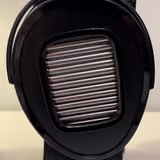
- The Arya Unveiled is where the idea is pushed furthest: no grille on the outside and magnets meant to stay out of the way, which its review describes as a driver close to floating in free air.
Stealth Magnets, the diaphragm and the grille are three different things
HIFIMAN usually ships three technologies together, and reviews and spec sheets list them in one breath: the magnet shape, a very thin diaphragm (NEO Supernano on some models, a nanometer-thickness film on others) and the Window Shade grille on the outside of the cup.
They do different jobs. The grille shields the driver while keeping the back of the cup as open as possible, and is meant to cut the reflections there. The diaphragm is what moves, and a thinner, lighter film is what the reviews keep crediting with speed and micro-detail; the Sundara review says in so many words that the diaphragm is doing that work on a headphone that has no Stealth Magnets at all. The magnets are about the path out. When a review credits "Stealth Magnets" with a sound, it is usually crediting the whole package.
Does it matter when you buy?
Treat it as a line on the spec sheet, not a reason on its own. Headphones that share it land far apart on this site's scale, and the one HIFIMAN planar without it is recommended on its own merits. The tuning, the fit and the price decide more than the magnet shape does; read the review of the headphone, not the feature list.
Reviewed gear that shows this
10 reviews in the catalogue, highest-scoring 6 shown. Every score is anchored to the same published reference list.





What our reviews say about Stealth Magnets
7 reviews raise it in their pros and cons: six lines credit it and one faults it. 4 are shown, each quoted as its review states it.
- Strength:
Stealth Magnets and Window Shade Grills retained
- HIFIMAN Ananda Nano, 8.6/10 - Flaw:
Does not include Stealth Magnets
- HIFIMAN Sundara, 9.0/10 - Strength:
Stealth Magnets + nanometer diaphragm + Window Shade grille
- HIFIMAN HE1000 Stealth, 8.5/10 - Strength:
Stealth Magnets technology at just over $100 - hard to believe
- HIFIMAN HE400se, 7.6/10
Compared head to head
Comparisons between products on this page, each weighing the two reviews side by side.
Put it to use
Keep reading
Glossary
Planar Magnetic
A driver using a thin membrane with embedded conductors suspended between magnets, producing sound from the entire surface for very low distortion.
Full explanation
Glossary
Sub-Bass
Frequencies below approximately 60Hz; felt as much as heard, sub-bass conveys pipe organ fundamentals, kick drum body, and concert hall size. Many headphones and small speakers roll off here, so extension below 40Hz is one of the clearest differences between price tiers.
Full explanation
Glossary
Dynamic Driver
The most common transducer type, using a voice coil in a magnetic gap to push a cone or dome diaphragm, the same principle as a traditional loudspeaker.
Full explanation