Audiophile buying guides: the shortlist, by category.
13 buying guides across headphones, speakers, DACs, headphone amps, speaker amps & preamps, sources and accessories, plus one that ranges across the whole catalogue. Each card below names the #1 pick and its score, what the picks cost from cheapest to dearest, how many made the list and when it last moved. Every pick is one of our scored reviews, ranked by score alone - never by placement.
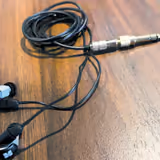
Everything downstream can only preserve what the source hands it. This list holds three different kinds of front end, a reclocker for playback and interfaces and microphones for recording, and the first decision is which kind your problem actually needs.
Two hundred dollars buys more headphone than it has any right to. It also buys a very specific set of compromises, the same ones almost every time, and the useful thing to know is which one each pick asks you to accept.
An in-ear at $150 does not have to fund a headband, two cups, pads and a yoke out of the same money, so almost all of it goes into drivers and tuning. That is why this bracket punches so far above its price, and why the complaints here are about fit and cables rather than about resolution.
DAC measurement is a solved problem, which leaves implementation as the only variable that still moves: the analog output stage, the power supply, the conversion topology. Choose by the connections your system needs first, and by character second.
An amplifier's job is to deliver clean voltage and current to whatever load you put on it, and headphone loads span four orders of magnitude. Buy for the hardest headphone you own and the most sensitive one, because an amp that suits both is the difficult part.
Five hundred dollars is where headphones stop apologising. The tonal compromises that define the budget tier are largely gone by this price, and what replaces them is a choice of character, and of fit, rather than a list of flaws.
Accessories are where audio spends the most money on the least evidence. The useful question is not which cable or conditioner is best, but which problem you actually have, because room treatment, power, cabling and networking fix different ones by very different amounts.
IEMs are the most price-efficient way into audiophile listening: a competent $100 in-ear can outperform a $500 over-ear on tonality and resolution. What the money buys above that is less about drivers than about fit, tuning maturity and the source you pair them with.
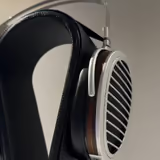
Stage, imaging, and honesty - the open-back form factor has owned audiophile listening for forty years for a reason. The price is isolation in both directions, so buy one for a quiet room, and choose the driver type before the brand.
Planar magnetic is the driver that quietly took over audiophile headphone listening over the last decade. It buys control, extension and low distortion, and asks for weight and a capable amplifier in return.
Reference is the highest verdict on our scale: the piece is the benchmark in its category, the unit other gear in the same class gets compared against. This is every product that reached 9.0 or higher, across categories, and what a 9.0 means in each.
Amplification for loudspeakers, judged into real speaker loads rather than on a spec sheet: what separates amplifiers is how they behave when the impedance drops and the music gets loud, not the wattage printed on the box. Headphone amps are a different job and live on their own list.
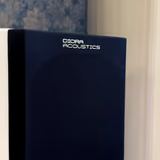
A speaker is the one component in the chain that has to move air in your actual room, which is why the spec sheet tells you less here than anywhere else. Buy for the room you have and the amplifier you own, not for the showroom.
#1 pickDiora Acoustics Chors 5
8.5
6 picks
€249/pair≈ $270/pairapprox. to $4,999/pair
Updated
View the shortlist
How a piece earns its spot on a shortlist.
Most "best of" lists online are populated by guessing what a generic reader wants and writing entries backwards from that. The guides on this site work the opposite way around: every pick is a piece already in the catalogue, with a published score, a documented listening window, and a verdict on its own permanent review page. The shortlist is a re-shuffle of an existing archive, not a list invented for the occasion.
Picks come from the existing review archive.
A guide only includes pieces that already have a long-form review on this site. No "we have not heard it, but here is what the marketing says" entries. The review itself is the source document; the guide is a curated index into it. If a piece worth recommending has not been reviewed yet, the review gets written before the guide gets updated.
Ranking inside a guide follows the score, not the brand.
Picks are ordered by the same 0-10 score the standalone reviews use, anchored to the published reference list for that category. A 9.0 placed third in a list earned its position against the other 9.0+ entries above it, and you can audit the reasoning by reading the full review for each. Brand pedigree and manufacturer relationships do not move pieces up or down the list.
Guides do not ship until the catalogue can fill them.
Each guide declares its own floor: the number of reviews that must clear its filters before the list counts as a shortlist. Below that floor no page is published and no link to it exists. 8 of these 13 guides use the house floor of 5. Best Audio Sources, Best Budget Headphones, Best Budget IEMs, Best Headphone Amplifiers and Best Speaker Amps and Preamps set theirs at 3 and 4, because those categories have not yet produced 5 qualified candidates. A short list here is short because the archive behind it is, and the pick count on every card says so - it is never a longer list trimmed to fit.
Guides update when the reviews under them update.
When a new piece lands on the reference list, the guides that draw from that category get a re-shuffle. When an existing review's score is moved (because a new benchmark reset what the score band means), the guide ordering moves with it. The "Updated" date on each card is the date of the most recent material change to its picks, not a faked annual refresh.
Looking at this without a guide?
Buying guides are a starting point, not the whole map. If a guide does not match your specific budget, category, or use-case, the next moves are usually one of these:
Browse the full review archive: the entire catalogue, filterable by category, verdict, and score. The guides are a curated subset of this; the archive is the superset.
Open a side-by-side comparison: pick two pieces from the catalogue and read them head-to-head on the same chain, same listener, same reference list. Useful when a guide narrows your choice to two and you need the deciding factor.
Use the free audio tools: amplifier-power calculators, room-mode visualiser, ABX blind test, and a frequency-training trainer. The tools answer "what amp do I actually need" and "can I really hear the difference"; the guides answer "what is worth buying right now".
Read the editorial standards: the full methodology, the published reference list, and the scoring rubric the guides ultimately roll up to.