
The Best Headphone Amplifiers in 2026: Tested & Ranked
An amplifier's job is to deliver clean voltage and current to whatever load you put on it, and headphone loads span four orders of magnitude. Buy for the hardest headphone you own and the most sensitive one, because an amp that suits both is the difficult part.
- By Jakub Charkiewicz
- 4 tested picks
- Updated
- Score floor: 7.5/10
- Prices $299 to $999
The short version
The HIFIMAN Serenade (9.3/10, $999) tops our ranking of the best headphone amplifiers. For a lot less money, the HIFIMAN EF499 (8.1/10, $299) takes best value. The runner-up is the HIFIMAN EF500 (8.2/10, $549). 4 picks in all, ranked by score from 7.5 to 9.3/10.
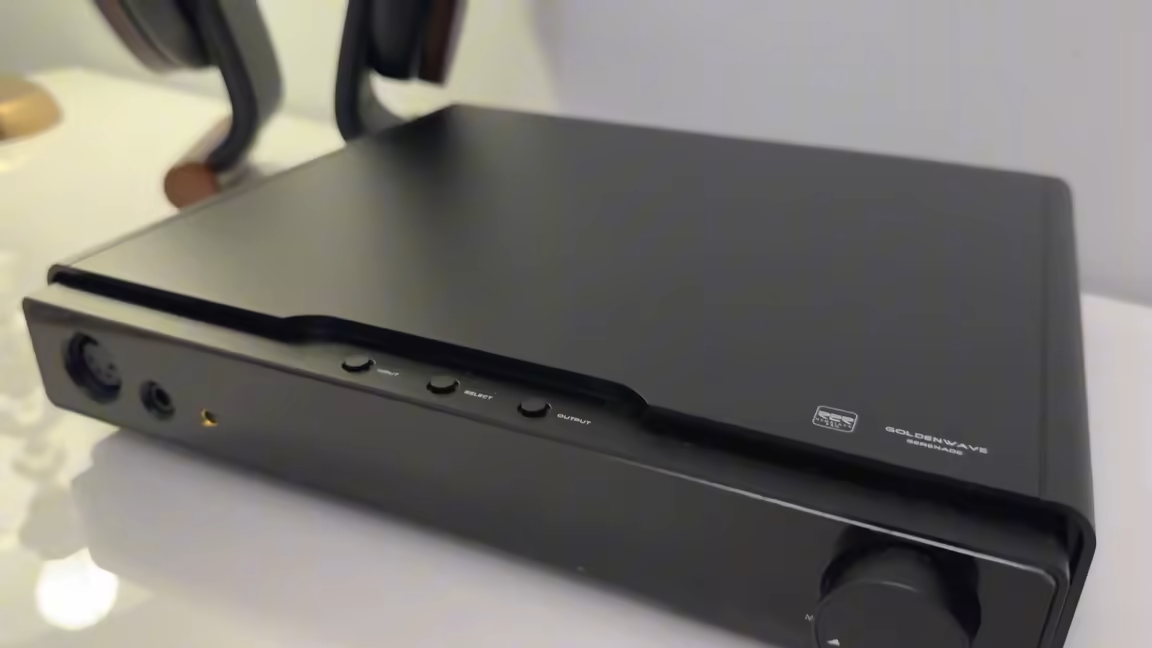
Best Overall
HIFIMAN Serenade
HIFIMAN's all-in-one R2R DAC, discrete Class A amp, and hi-res network streamer in one 3kg box - lush, musical, and powerful enough to drive almost anything.
- Score 9.3
- Verdict Reference
- Price $999
At a glance
The 4 picks by price
By price
- $200-500 2 picks Top-scoring: the HIFIMAN EF499 (8.1/10)
- $500-1,000 2 picks Top-scoring: the HIFIMAN Serenade (9.3/10)
The 4 picks, ranked
HIFIMAN Serenade
HIFIMAN's all-in-one R2R DAC, discrete Class A amp, and hi-res network streamer in one 3kg box - lush, musical, and powerful enough to drive almost anything.
- Power output: 4 W balanced / 2.8 W single-ended into 32 Ω
- Inputs: USB, Optical, Coaxial, Ethernet, Bluetooth, RCA (analog)
- Outputs: XLR + RCA line out, 4-pin XLR, 4.4 mm, 6.35 mm
- Proprietary Himalaya Pro R2R DAC for a natural, non-clinical sound
- Discrete Class A amp based on HIFIMAN's $3000 Prelude
- Built-in hi-res network streamer (up to 32-bit/768kHz, DSD512)
Watch out: Voiced warm and lush on purpose
HIFIMAN Serenade review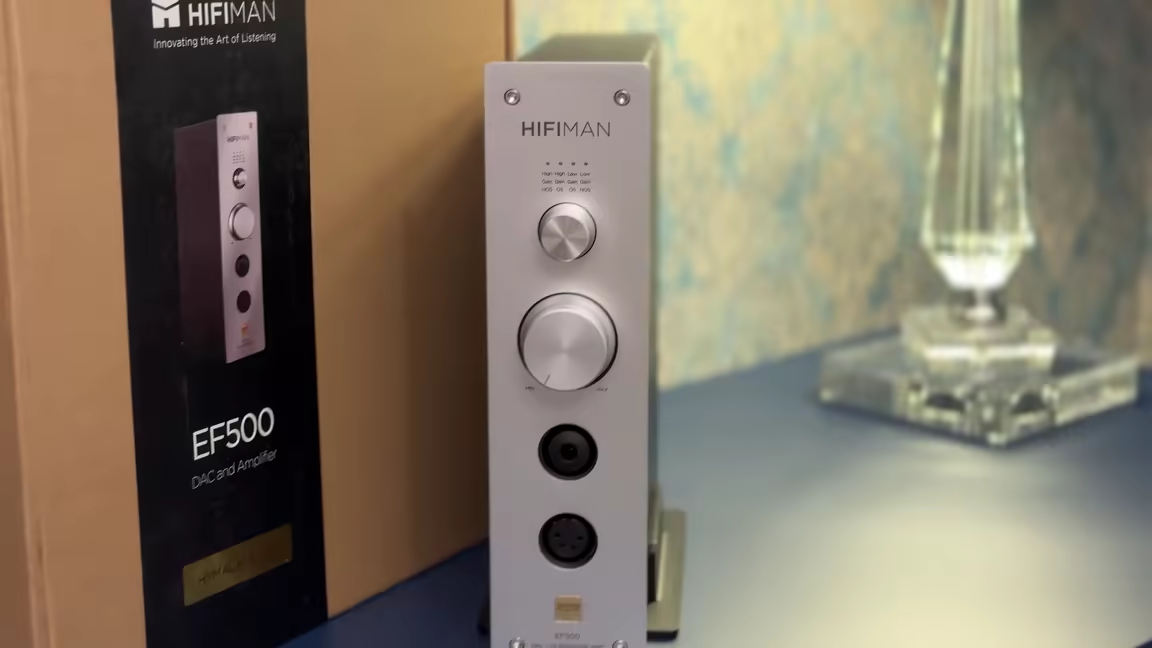
HIFIMAN EF500
The most affordable HIFIMAN unit to feature their proprietary Himalaya R2R DAC chip - 4.5W per channel balanced, network streaming, and a vertical tower form factor.
- Power output: 4.5 W balanced into 32 Ω
- Inputs: USB-B, USB-C, Coaxial, Ethernet (network streaming)
- Outputs: XLR + RCA line out, 4-pin XLR, 6.35 mm
- First Himalaya R2R DAC chip at this price point
- Vertical tower form factor saves desk space
- All-metal chassis with industrial design
Watch out: Gets warm during long sessions with demanding cans
HIFIMAN EF500 review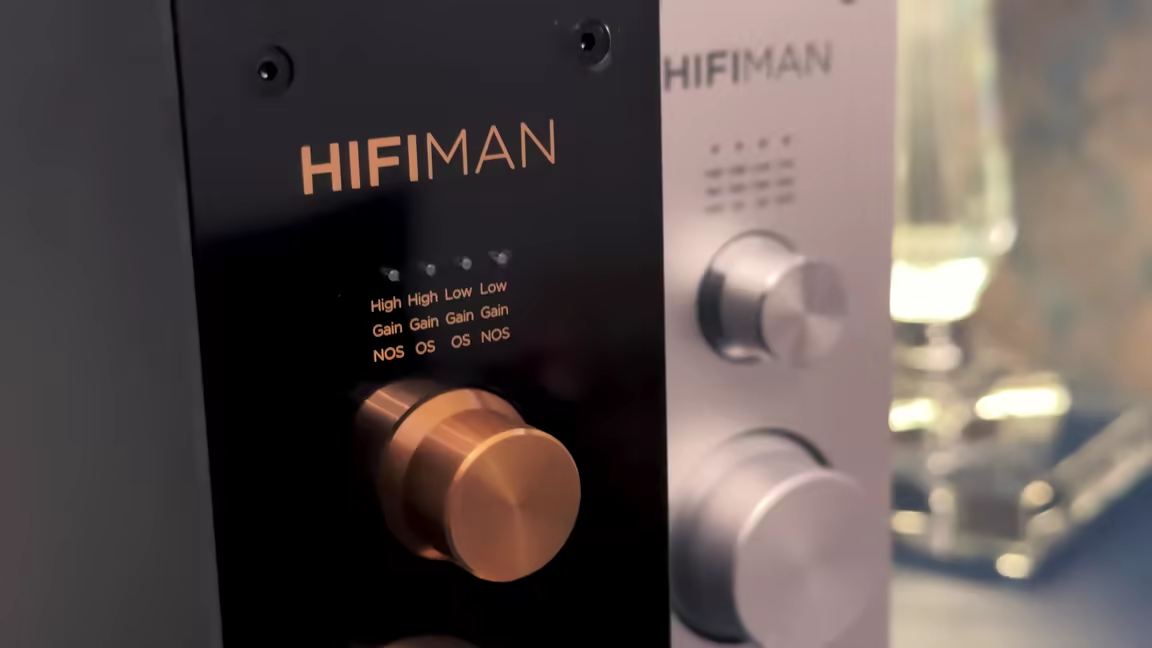
HIFIMAN EF499
A balanced R2R DAC/headphone amp with built-in network streaming for under $300 - warm, musical, and a serious one-box answer to the separates-or-not question.
- Power output: 4.35 W balanced / 1.28 W single-ended into 32 Ω
- Inputs: USB-B, USB-C, Coaxial, Ethernet (network streaming)
- Outputs: XLR + RCA line out, 4-pin XLR, 6.35 mm
- All-metal chassis, no QC issues - HIFIMAN's build has matured
- Smooth, precise volume pot with virtually no wobble
- Doubles as a vertical headphone stand
Watch out: No analog input
HIFIMAN EF499 review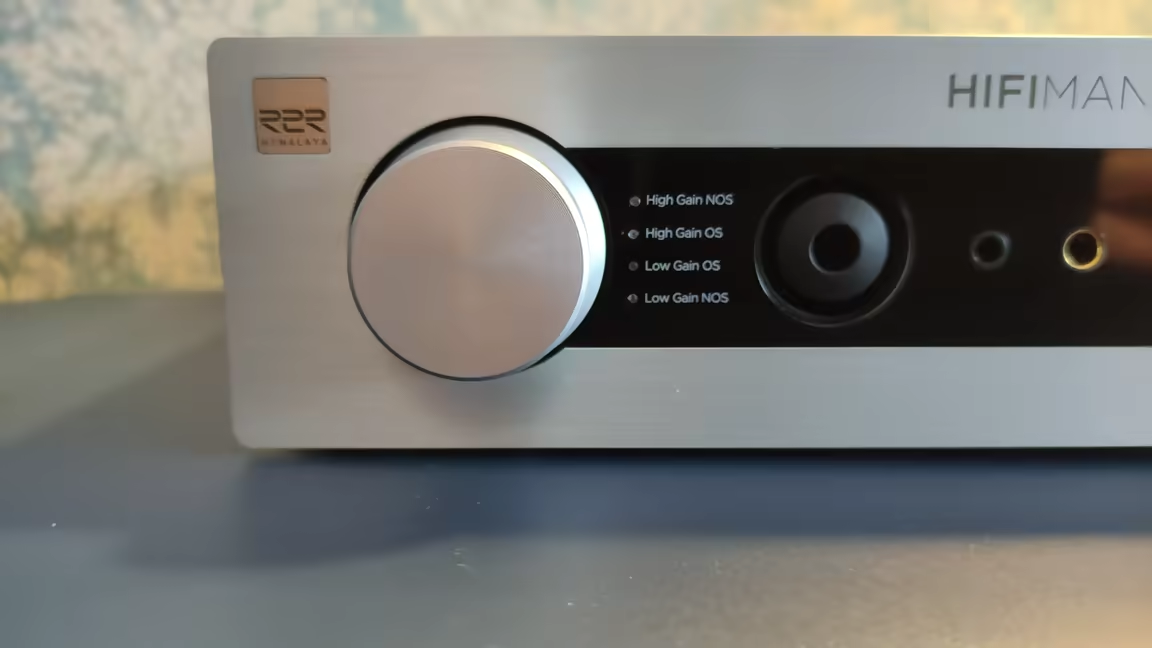
HIFIMAN EF400
An entry-level Class AB amp/DAC with HIFIMAN's Himalaya R2R DAC, fun subjective sound, and a slightly soft character - underpowered for the hardest planar loads.
- Power output: ~3 W measured (4.4 W rated) into 32 Ω
- Inputs: USB-B, USB-C
- Outputs: XLR + RCA line out, 4-pin XLR, 4.4 mm, 6.35 mm, 3.5 mm
- Himalaya R2R DAC with NOS / oversampling option
- Full balanced output - 4-channel mode
- Beautifully built, all-aluminum chassis (~3 kg)
Watch out: Specced 4.4W, but independently measured closer to 3W into 32Ω
HIFIMAN EF400 reviewTorn between two picks?
One pair from this list with a head-to-head page of its own.
Questions buyers ask
How much amplifier power do I actually need?
For the great majority of audiophile headphones in production today, anything above 1W into 32 ohms (balanced) is enough headroom for safe listening levels with dynamic range to spare. The exceptions are HIFIMAN Susvara, some vintage AKG K1000 setups, and a few electrostatic designs which want 2-5W or more. Sensitivity matters more than impedance for power requirements - a 32-ohm headphone at 90 dB/mW needs less drive than a 25-ohm headphone at 85 dB/mW.
Do balanced amplifiers actually sound better than single-ended?
On a well-designed amplifier, going balanced typically lowers the noise floor by 3-6 dB and doubles available voltage swing into the headphone, which matters most on planars below 90 dB/mW. The 'balanced sounds better' rule isn't about balanced topology being inherently superior - it's that balanced outputs are usually the manufacturer's higher-performance circuit, with the single-ended jack being an afterthought.
Should I buy a separate DAC and amplifier or a combo?
If you're spending under $500 total, a competent combo (DAC + amplifier in one box) buys you more performance per dollar than splitting the budget across two units. Above $1,000 total, separates win - mostly because the DAC and amplifier can be optimized independently rather than sharing a power supply and chassis. On this list, the HIFIMAN EF499 ($299) and EF400 ($399) are the entry point if you don't want the separates rabbit hole.
Are tube amplifiers better for some headphones?
Tube amplifiers, especially OTL (output transformerless) designs, have higher output impedance than typical solid-state amps. With low-impedance planar magnetic headphones, that high output impedance flattens the impedance response and can audibly soften bass control. With high-impedance dynamic headphones (300+ ohms, e.g. Sennheiser HD600/650/800), tubes pair beautifully. Match impedance, not topology preference.
What's the difference between a headphone amplifier and a preamp?
A headphone amp drives a low-impedance (16-600 ohm) load through voltage AND current; a preamp drives a high-impedance (10k-100k ohm) line-level input through voltage alone. Some amplifiers do both, pairing a line-level preamp output with a separate headphone output stage. A pure preamplifier like the Denafrips Hades has no headphone output at all - it feeds a power amp and speakers - which is exactly why a speaker preamp does not belong on a headphone-amp list like this one.
A headphone amplifier sounds like it should be a solved problem. You take a line-level signal, multiply it by some gain factor, and deliver enough current to swing the diaphragm. Three transistors and a power supply, fifty years of well-documented topology. Why does the result range from $99 USB sticks to $20,000 dual-mono Class A monsters?
Because "enough current" is doing a lot of work in that sentence. Modern audiophile headphones span four orders of magnitude in power requirements. A 100 dB/mW IEM clips a smartphone output at 30% volume. A HIFIMAN Susvara at 83 dB/mW wants watts rather than milliwatts - roughly 4-6 W into its 60 ohms for 110 dB peaks. An amplifier that handles both gracefully - low noise into the IEM, high current into the Susvara - is genuinely difficult to build.
Every pick here is a one-box DAC and amp
All four picks are HIFIMAN desktop combos with an R2R DAC stage built in, running from the $299 EF499 to the $999 Serenade, and three of the four stream from the network as well. That is what the catalogue holds today, not a rule: a dedicated amplifier that earns its score will join them. It does shape how to read the list, though. You are choosing a whole front end, so the DAC, the inputs and the streaming count as much as the output stage.
A combo is the right buy when the desk is the whole system and you want one box, one power supply and one volume control. It is the wrong buy when you already own a DAC you like, because you would be paying for a second one you will never use.
Matching an amp to your headphones
Three numbers decide whether an amp suits a headphone, and wattage is only one of them.
Power into the headphone's actual impedance. Output is quoted at one load, usually 32 ohms, and a headphone rated at a different impedance gets a different figure. The EF400 is rated at 4.4 W into 32 ohms and was independently measured closer to 3 W, which its review notes is not enough for the HE6se or the Susvara. The headphone power calculator on this site turns a headphone's sensitivity and impedance into the voltage and power it needs.
Output impedance against the headphone's. Keep the amp's own output impedance well below the headphone's, roughly an eighth of it, or the frequency response starts to follow the headphone's impedance curve instead of the recording.
Noise and low-volume behaviour. A sensitive IEM makes an amplifier's hiss audible and puts the volume knob at the bottom of its travel, where channel balance is at its worst. The EF400's review found an imbalance in the first 10% of the volume range, which is exactly where an IEM lives.
Mistakes that are easy to make
Buying the watts for a headphone you do not own. A planar that needs serious power is a real reason to buy a powerful amp; a sensitive dynamic is not, and the extra gain only pushes the usable part of the volume control lower.
Using the single-ended jack on a balanced amp. On most combos the balanced output is the higher-performance circuit, with more voltage swing, and the 6.35 mm jack is the convenience socket. If your headphone can take a balanced cable, that is usually the output the amp was designed around.
Reading the output topology as a sound. Class A, AB and D describe how the output stage handles current. The Serenade is discrete Class A and the EF400 is Class AB, and what separates them on this list is implementation and power, not the badge.
How the amplifiers were heard
Each amplifier drove the hardest planar magnetic load in the catalogue, the most sensitive IEM, and everything in between. We listened for the things measurements only partially capture: how the amplifier handles the moment of a hard transient when its output stage is already near voltage clip, how it behaves on long-decay reverb tails where crossover distortion shows up, and how the headphone's signature holds when you change volume by 20 dB.
A score is against the amplifier's own class and price. A balanced desktop combo scoring well is exceptional as a combo; it is not a claim that it beats $5,000 separates.
Not on this list: portables, dongles and show-floor flagships
We do not review portable amplifiers and DAC dongles here - the listening windows and chain compatibility don't translate cleanly to desktop reviewing. We also do not include manufacturer demonstrators of $20k+ flagship gear that we haven't held in our own listening room for the full review period. When that changes, the pieces show up.
Ranked by score, on the one rubric every review uses: Sound 30%, Technical performance 25%, Build & comfort 15%, System fit 15% and Value 15%. Best Value goes to the pick, other than the winner, with the most score for its price (score against the log of the price). No placement here is sponsored, paid for, or negotiable. How a score is built · Funding and independence · All headphone amps reviews