
The Best Headphones Under $500 in 2026: Tested & Ranked
This list covers wired over-ear headphones from $200 to $500, where every pick is detailed and well made. Decide on the voicing first, from neutral to warm to wide and bright, then check the pads and headband against your own head, because comfort is where these picks differ most.
By Jakub Charkiewicz Published Updated Checked
8 picks 7.5/10 minimum to qualify list prices $269 to $499
The short version
Our top pick among the best headphones under $500 is the HIFIMAN Sundara (9.0/10, list price $299). Our best value pick, the most score for its price after the top pick, is the HIFIMAN Edition XS (8.7/10, list price $269). The runner-up is the HIFIMAN Ananda Stealth (8.8/10, list price $359). 8 picks in all, ranked by score from 7.9 to 9.0/10: 7 open-back and 1 closed-back. This list's $200 to $500 range applies to list prices, and a store price can fall outside it: the HIFIMAN Sundara was $179 at Apos Audio and 2 other stores on Oct 20, 2026.
How we tested this gear
22 headphones reviewed first-hand, 8 ranked here · at least two weeks each · heard sighted against the reference at each price. 22 headphones in this guide's field, every one reviewed first-hand and linked from this page: 8 ranked, and 14 listed below the picks with the rule that kept each off. Every one has a video review on the channel, where the product is shown and heard. Jakub Charkiewicz (21) and Bastien Beauchamp (1), each review signed by the person who tested it. At least two weeks of daily listening before a score is committed, typically four to eight weeks for flagship gear, and never a first-impressions verdict. The system the reference chain runs on, in Jakub Charkiewicz's listening room: Every piece is compared head-to-head with the reference unit at its price tier on the same chain, sighted and with levels set by ear. No pick was compared blind and none was measured here: a score is the writer's judgment against the product's own price tier, and a small difference between two picks is an impression a blind test (ITU-R BS.1116) would be needed to confirm. ITU-R BS.1116-3, IEC 60318-4 and Olive et al. (2018), each listed with what it is used for on the about page.The chain, the room, the protocol and the evidence
What was tested
Reviewed by
How long
Test chain
Power and digital
Protocol
Standards cited
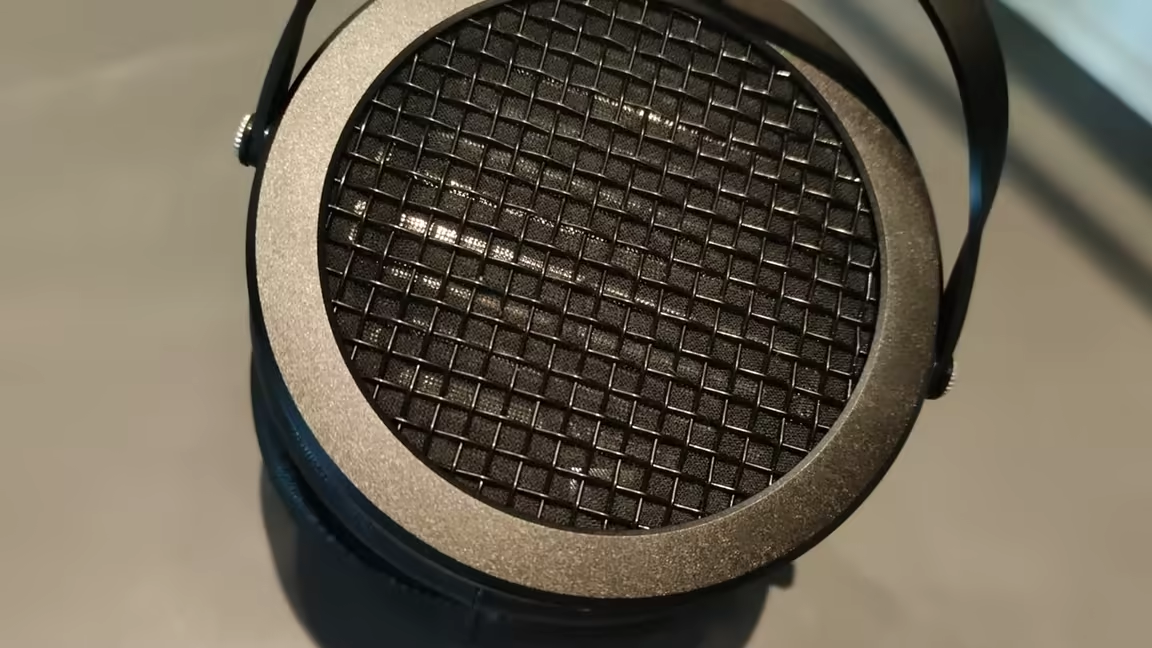
Best Overall: the highest score of the 8
HIFIMAN Sundara
An amazing value proposition - the latest Sundara revision performs exceptionally well at $299 in the open-back planar market. It's just a steal.
- Score 9.0
- Verdict Highly Recommended
- List price $299

At a glance
| # | Pick | List price | Award |
|---|---|---|---|
| 1 | Sundara | $299 | Best Overall |
| 2 | Ananda Stealth | $359 | |
| 3 | 105 Silva | $499 | |
| 4 | Edition XS | $269 | Best Value |
| 5 | Ananda Nano | $499 | |
| 6 | Luan | $299 | |
| 7 | Verum 1 | $349 | |
| 8 | Atheia | $349 |
The 8 picks, ranked
HIFIMAN Sundara
An amazing value proposition - the latest Sundara revision performs exceptionally well at $299 in the open-back planar market. It's just a steal.
- Sound: Wide stage, analytical
- Impedance: 32 Ω
- Sensitivity: 92 dB/mW
- Weight: 342 g
- List price: $299
- Lowest price now: $179 at Apos Audio and 2 other stores on , outside this list's $200 to $500 range; the list goes by the review's list price, $299
- Balanced and neutral tonality - never boring
- Outstanding micro-detail retrieval, especially for the price
- Great wide and decently accurate soundstage
Watch out: Inner pad diameter likely too small for many ears
HIFIMAN Sundara review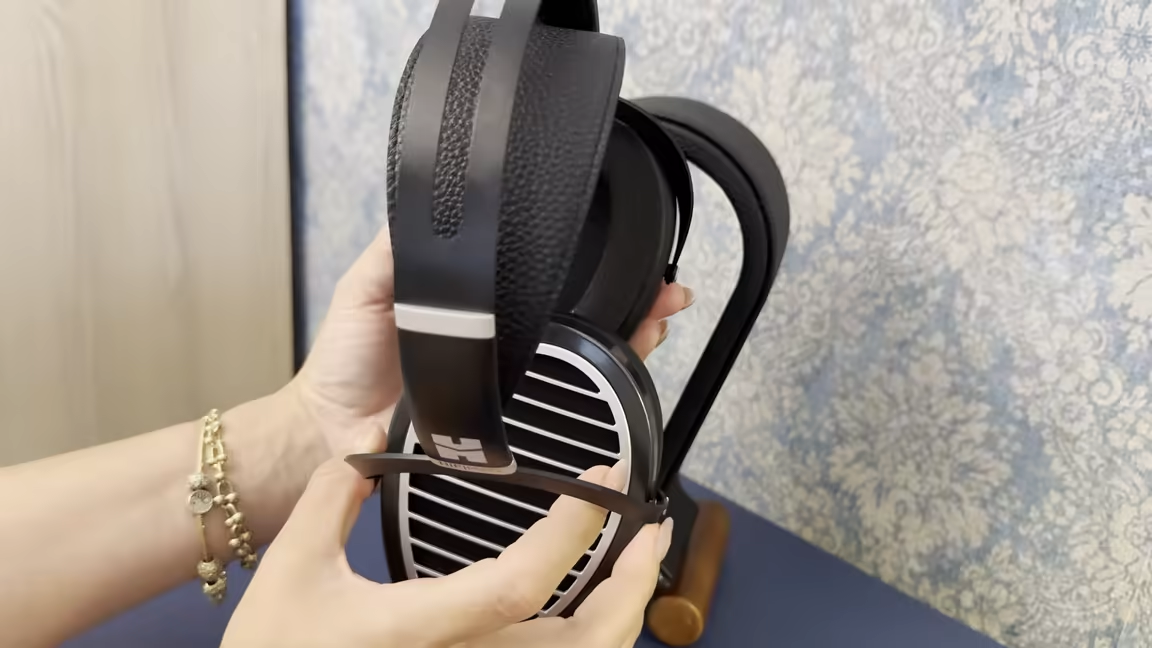
HIFIMAN Ananda Stealth
An overlooked HIFIMAN planar at $359 with a slightly warm tonality, fantastic imaging, and a 'pleasantly wet' sound that beats the Edition XS in almost every way.
- Sound: Warm
- Impedance: 16 Ω
- Sensitivity: 93 dB (reference not stated)
- Weight: 398 g
- List price: $359
- Lowest price now: $249 at Apos Audio and 3 other stores on
- Slightly warm tonality - rare for HIFIMAN
- Fantastic instrument and vocal placement within the soundstage
- Linear bass extension down to 20Hz
Watch out: Inner foam isn't very soft
HIFIMAN Ananda Stealth review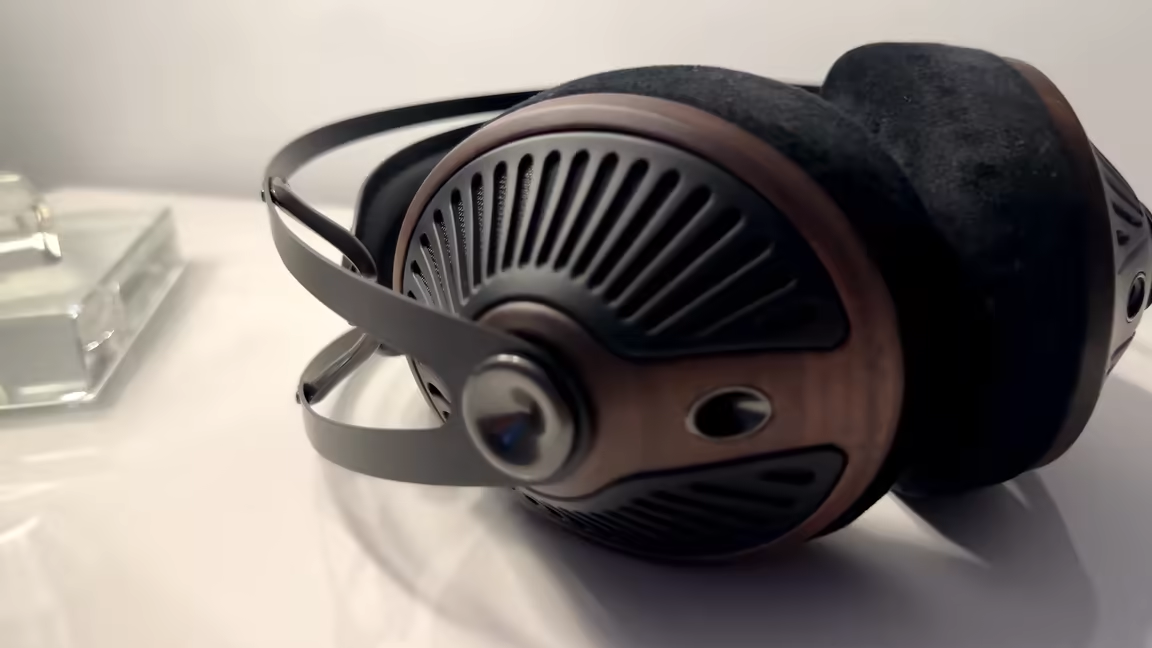
Meze 105 Silva
A $499 open-back dynamic with hand-polished walnut cups, a custom 50mm carbon fiber-reinforced dome driver, and a warm, fun, easy-to-drive tuning that punches well above its price.
- Sound: Bass-heavy, energetic
- Impedance: 42 Ω
- Sensitivity: 112 dB (reference not stated)
- Weight: 354 g
- List price: $499
- Lowest price now: $499 at Apos Audio and 4 other stores on
- Hand-polished walnut earcups with intricate radial grille
- Custom 50mm driver with carbon fiber-reinforced W-dome and titanium-coated torus
- Self-adjusting elastic suspension headband - zero hotspots
Watch out: Musical, warm tuning
Meze 105 Silva review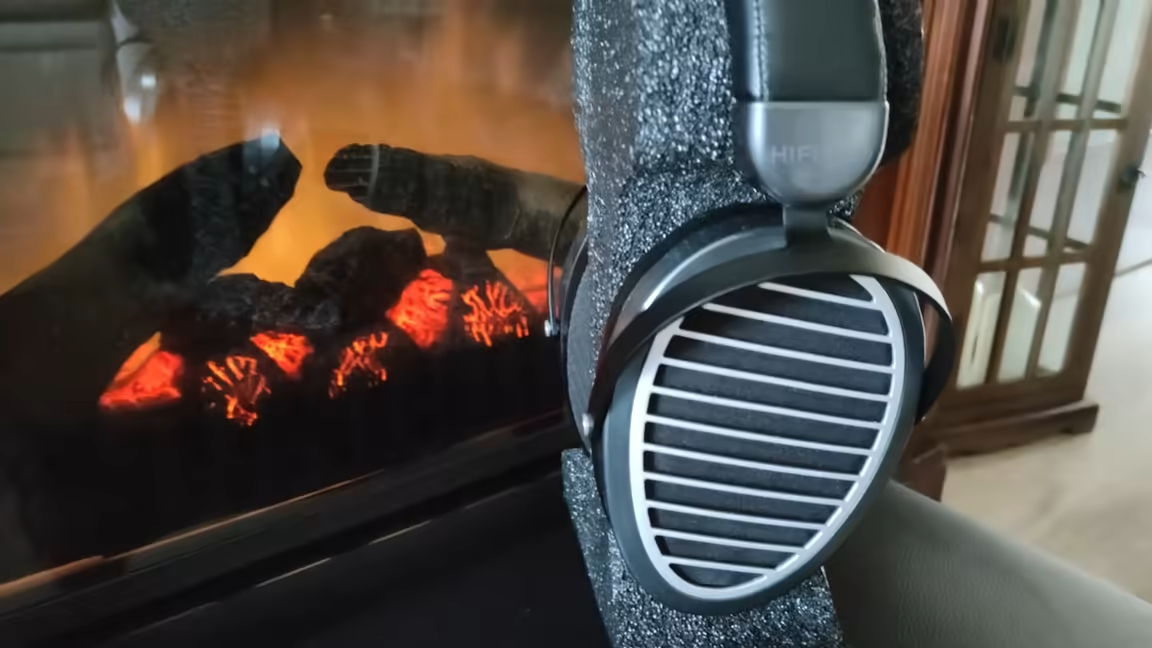
HIFIMAN Edition XS
An exceptional open-back planar at $269 with a sound signature that's hard to find elsewhere - held back only by a controversial headband design choice.
- Sound: Wide stage
- Impedance: 18 Ω
- Sensitivity: 92 dB/mW
- Weight: 405 g
- Award: Best Value, the most score for its price after the top pick
- List price: $269
- Lowest price now: $209 at Apos Audio and 2 other stores on
- Unique, pretty earcup design
- Large, deep earcups fit any ear shape
- Bass extends to 20Hz, clean and free of distortion
Watch out: Solid headband (no suspension strap) creates a hotspot after a few hours
HIFIMAN Edition XS review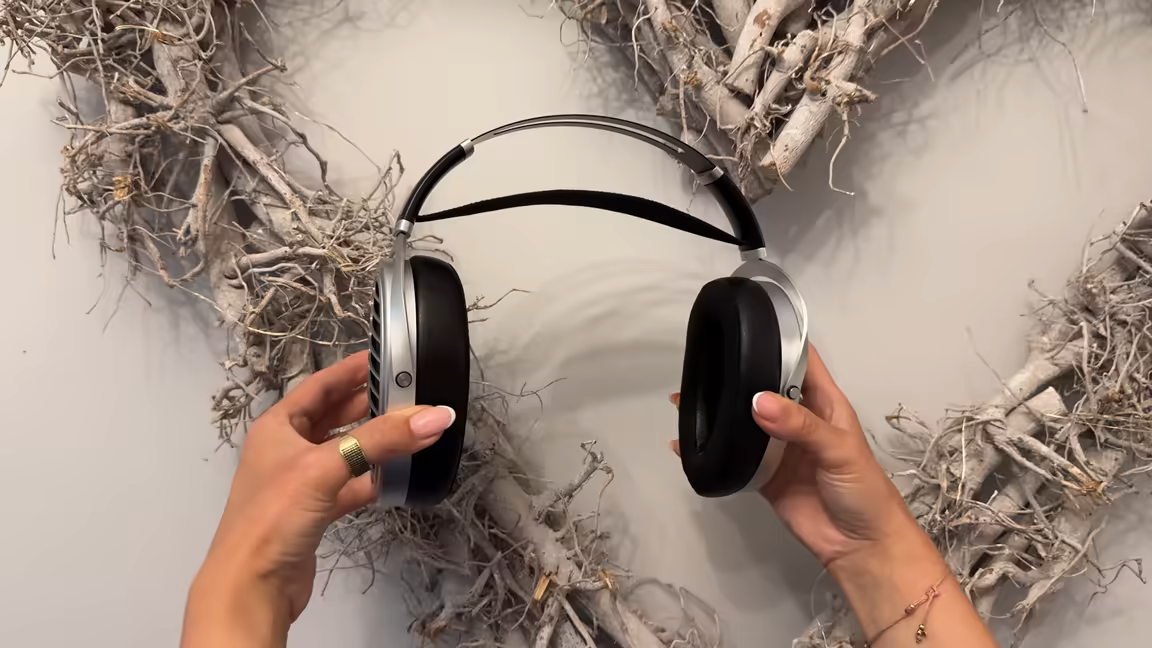
HIFIMAN Ananda Nano
A nanometer-thickness diaphragm trickled down into the Ananda line - one of the best picks in its price range, with detailed treble that can occasionally cross the line.
- Sound: Bright, wide stage
- Sensitivity: 94 dB (reference not stated)
- Driver: Planar magnetic
- List price: $499
- Lowest price now: $319 at Bloom Audio and 1 other store on
- Nanometer-thickness diaphragm at $500 - previously Susvara-only tech
- Stealth Magnets and Window Shade Grills retained
- Bass extends linearly to 20Hz
Watch out: Treble can cross into too-bright territory for some
HIFIMAN Ananda Nano review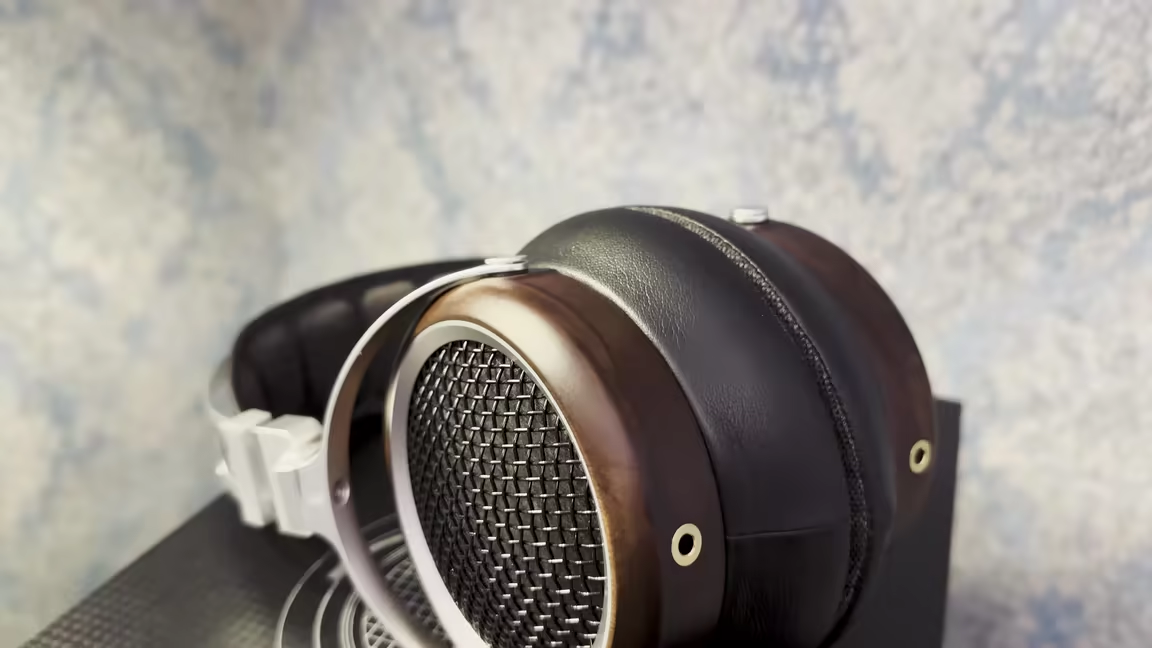
Sivga Luan
A semi-open dynamic with real wood cups and a natural, chocolatey midrange - $360 at launch, now $299.
- Sound: Warm
- Impedance: 38 Ω
- Sensitivity: 100 dB (reference not stated)
- Driver: Dynamic
- List price: $299
- Lowest price now: $299 at Audio46 on
- Looks and feels like a $500+ headphone for $299
- Real wood earcups with smooth blacked-out metal grills
- Suspension headband with Dekoni-style soft elements - zero hotspots
Watch out: Bass rolls off below ~45Hz
Sivga Luan review
Verum Audio Verum 1
A $349 open-back planar that goes the opposite direction from most of the market - smooth, refined highs, full warm mids, and ruler-flat bass to 20Hz.
- Sound: Warm, intimate stage
- Impedance: 8 Ω
- Sensitivity: 107 dB/mW
- Weight: 475 g
- List price: $349
- Stunning wooden earcup design with metal cut-out grills
- Real leather pads, magnetically attached for easy swap
- Smart 90-degree cable that stays off your shoulders
Watch out: 8Ω impedance demands real current from the amplifier
Verum Audio Verum 1 review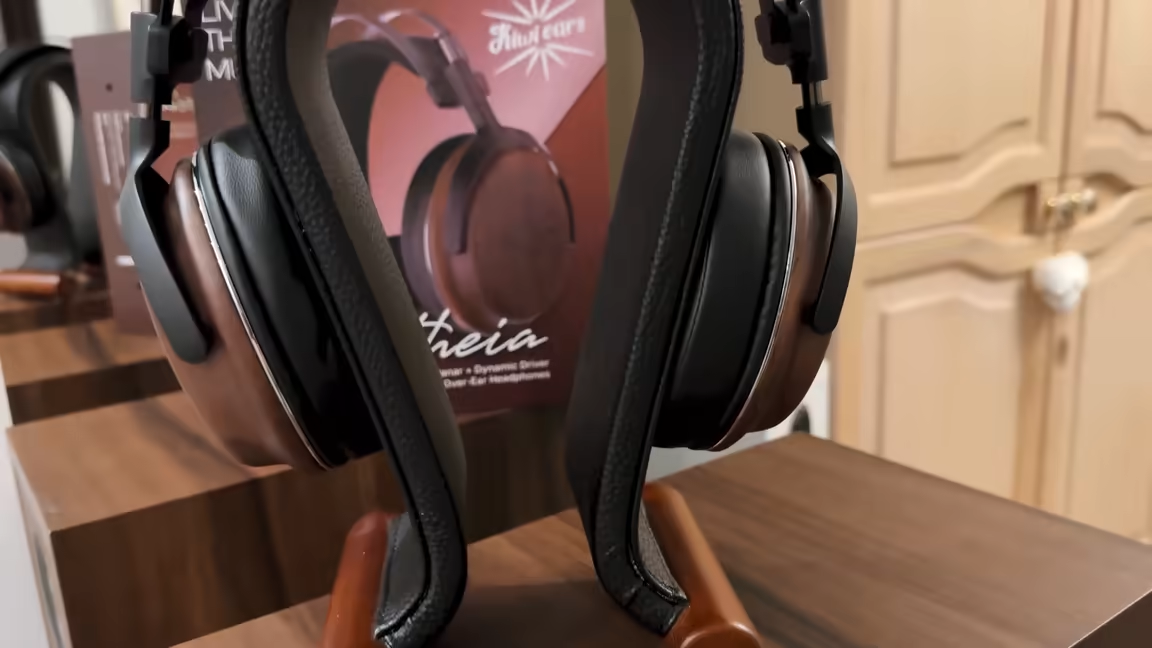
Kiwi Ears Atheia
A closed-back hybrid headphone pairing a 50mm dynamic driver with a 14.5mm planar - dynamic slam on the bottom, planar speed on top, in a walnut and aluminum chassis.
- Sound: Bass-heavy, wide stage
- Impedance: 32 Ω
- Sensitivity: 102 dB/mW
- Driver: 50 mm dynamic + 14.5 mm planar (hybrid)
- List price: $349
- Lowest price now: $349 at Bloom Audio on
- Walnut wood earcups with aluminum brackets
- Hybrid: 50mm dynamic + 14.5mm planar magnetic
- Surprisingly wide soundstage for a closed-back
Watch out: Vegan leather pads feel a bit generic
Kiwi Ears Atheia reviewBy type
- Open-back 7 picks Top-scoring: the HIFIMAN Sundara (9.0/10)
- Closed-back 1 pick The Kiwi Ears Atheia (7.9/10)
Torn between two picks?
6 pairs from this list with a head-to-head page of their own.
#1 HIFIMAN Sundara 9.0 #2 HIFIMAN Ananda Stealth 8.8
#1 HIFIMAN Sundara 9.0 #3 Meze 105 Silva 8.7
#1 HIFIMAN Sundara 9.0 #4 HIFIMAN Edition XS 8.7
#1 HIFIMAN Sundara 9.0 #5 HIFIMAN Ananda Nano 8.6
#2 HIFIMAN Ananda Stealth 8.8 #4 HIFIMAN Edition XS 8.7
#2 HIFIMAN Ananda Stealth 8.8 #5 HIFIMAN Ananda Nano 8.6
Also reviewed in this field
14 more reviews from the same field that this list does not rank, and the rule that kept each off the list.
- OneOdio Max 1 (Mixed, 7.0, under this list's 7.5 minimum score)
- HIFIMAN HE-R9 (Mixed, 6.9, under this list's 7.5 minimum score)
- HarmonicDyne Eris (Mixed, 6.8, under this list's 7.5 minimum score)
- HIFIMAN Sundara Closed-back (Mixed, 6.8, under this list's 7.5 minimum score)
- HIFIMAN HE1000se (Reference, 9.3, $1,700, outside this list's $200 to $500 range)
- HIFIMAN Arya Organic (Highly Recommended, 9.2, $1,099, outside this list's $200 to $500 range)
- HIFIMAN Arya Unveiled (Highly Recommended, 9.1, $1,299, outside this list's $200 to $500 range)
- OLLO Audio X1 (Highly Recommended, 8.9, $549, outside this list's $200 to $500 range)
- HIFIMAN Arya Stealth (Highly Recommended, 8.7, $759, outside this list's $200 to $500 range)
- HIFIMAN HE1000 Stealth (Highly Recommended, 8.5, $1,119, outside this list's $200 to $500 range)
- Sivga Anser (Recommended, 8.0, $199, outside this list's $200 to $500 range)
- Sivga Robin SV021 (Recommended, 7.8, $149, outside this list's $200 to $500 range)
- HIFIMAN HE400se (Recommended, 7.6, $109, outside this list's $200 to $500 range)
- Sivga SV021 Pro (Recommended, 7.6, $179, outside this list's $200 to $500 range)
Questions buyers ask
Do headphones in this price range need an amplifier?
Only one of these needs a real amplifier: the Verum Audio Verum 1, an 8-ohm planar whose review starts it at about 2 W per channel. The Meze 105 Silva ships with a USB-C DAC and amp dongle, the Edition XS is fine from a dongle, and the Sundara and Ananda Stealth play loud from a phone, though a basic dongle or a clean amp improves both. The Ananda Nano gets loud easily but sounds best on a smooth-sounding amp.
Should I buy the HIFIMAN Sundara or the Edition XS?
The Sundara, unless your ears are large or you want the clearest separation. Its suspension strap and firm clamp spread its 342 grams, where the Edition XS rests its 405 grams on a solid band that builds a hotspot after a few hours. The Edition XS has the roomier cups, deep enough for any ear, and separates instruments more clearly, with a wide stage and a V-shaped tuning whose highs can turn sibilant. The Sundara is balanced and neutral, with strong dynamics and outstanding micro-detail.
Which of these suit large ears or glasses?
For large ears, the HIFIMAN egg-shaped cups: the Edition XS's are large and deep enough for any ear, the Ananda Stealth's fit almost any ear with room to spare, and the Ananda Nano has some of the largest cups and pads its reviewer had seen. The Sundara's pad opening is small for many ears, and most ears touch the Kiwi Ears Atheia's pads. For glasses, the Meze 105 Silva's velour pads seal without trapping heat, and its reviewer wears glasses.
Is there a good closed-back headphone under $500?
The Kiwi Ears Atheia is the one closed-back on this list, at $349. It pairs a 50 mm dynamic driver with a 14.5 mm planar, and its stage is surprisingly wide for a sealed cup, close to a semi-open design, with bass that digs deeper than some pricier planars. It gives up some midrange: vocals are clean but slightly recessed and honky, the tone is thin, and its added reverb can blur busy mixes. The other sealed headphones reviewed at this price are listed below the picks with the reason each missed.
Which voicing to buy at this price
Every headphone here is detailed and well made, so the choice comes down to how you want music to sound.
For neutral, start with the HIFIMAN Sundara: balanced with a slight warm tint, strong dynamics and outstanding micro-detail for its price. The Sivga Luan is mostly neutral too, a semi-open dynamic with extra warmth in the mid-bass and a natural, detailed midrange its review singles out as its strength, though its bass rolls off below about 45 Hz.
For warmth, there are three routes. The HIFIMAN Ananda Stealth leans slightly warm, which its review calls rare for HIFIMAN, and places voices and instruments precisely. The Meze 105 Silva goes further, with forward mid-bass, extra sparkle in the treble and a review that says plainly it isn't a reference for spotting flaws. The Verum Audio Verum 1 has the smoothest top end on the list, almost impossible to make sibilant, with full, forward mids, bass flat to 20 Hz and a fairly closed-in stage.
For width and detail, the HIFIMAN Edition XS is broadly V-shaped with a wide stage, clean bass to 20 Hz and highs that can turn plasticky and sibilant on some songs, and it places vocals oddly far back, as if from behind your head. The HIFIMAN Ananda Nano has the widest stage in its class, very accurate imaging and a treble its reviewer found slightly past the line.
If you need a sealed cup, the Kiwi Ears Atheia is the only closed-back here: a hybrid with a 50 mm dynamic driver for the bass and a 14.5 mm planar above it, a stage surprisingly wide for its type, and slightly recessed, honky mids.
What the extra $200 over the Sundara buys
The Sundara costs $299 and tops this list, so each dearer pick has to earn its premium on something specific.
The two $499 headphones buy different things. The 105 Silva buys a finished object: hand-polished walnut cups, an elastic suspension headband, velour pads, a modular build held together with screws, and a box with a USB-C DAC and amp dongle, a hard case and a braided cable its review sees no reason to replace. The Ananda Nano buys stage width, imaging and a nanometer-thickness diaphragm that only HIFIMAN's flagship Susvara carried a few years ago, and it asks you to accept a firm clamp and a hot top end in return.
Between them, the Ananda Stealth at $359 adds warmth, imaging and roomy cups, and its review puts it ahead of the Edition XS on presentation, imaging and bass extension. The Verum 1 and the Atheia, both $349, each buy one specific thing: the smoothest treble here, or a sealed cup.
The cheapest route runs the other way. The Edition XS costs $269, and even the Sundara's review concedes that it separates instruments more clearly.
Headbands and clamp decide long sessions
Check the headband before you commit to hours of listening. The Edition XS has a solid band with no suspension strap and too little clamp, so its 405 grams rest on your crown and build a hotspot after a few hours. Its adjustment may also not go small enough for smaller heads, which leaves the cups sitting too low. The Ananda Nano has a suspension strap but clamps significantly harder than the Ananda Stealth, and its reviewer suggests stretching it on a stand or over a few books. The Sundara clamps firmly as well, which spreads its 342 grams, and its strap doesn't swivel.
The easiest to wear for hours have self-adjusting or padded straps. The Luan's suspension band carries soft padded elements and left its reviewer free of hotspots for hours at a stretch, and its cups swivel and tilt silently. The 105 Silva's elastic band fits itself to your head, and at 354 grams it's light for a wooden headphone. The Ananda Stealth pairs a suspension strap with a gentle clamp at 398 grams. Of the five picks whose reviews give a weight, the Verum 1 is the heaviest at 475 grams, carried on a soft leather strap, with magnetic leather pads that swap in seconds. The Atheia's strap adjusts itself on stretchy bands, but its small cups can leave your ears warm after a couple of hours.
Two picks that care about the amplifier
Most of this list is easy to drive. The 105 Silva ships with its own USB-C dongle and gains little from anything dearer, the Edition XS is fine from a dongle or a cheap amp, the Luan gets by on budget gear, the Atheia runs from most DACs and portables though a better amp tightens it noticeably, and the Sundara runs from a phone, though its review hears some benefit in clean external amplification. The Ananda Stealth plays from a phone too, though its review treats a basic dongle as the minimum.
Two picks need planning. The Verum 1 is 8 ohms and 107 dB/mW, so it gets loud from almost anything, but its low impedance asks for current, and its review sets the starting point at about 2 W per channel; with more power its bass tightens and its stage widens. The Ananda Nano needs a smooth amp more than a powerful one. A bright-sounding amp piles onto its treble, and an amp with a slightly rolled-off top suited it best in its review.
To see what your own source can deliver, the headphone power calculator converts a pick's sensitivity and impedance into the power it needs at your listening level.
What sits outside the $200 to $500 band
Below $200, the budget headphones guide ranks the over-ears, and the two lists never share a pick. Above $500, the open-back guide and the planar guide carry on into the flagships. In-ear monitors are ranked on the IEM guide. The one wireless over-ear reviewed here, the €179 OneOdio Max 1, sits below this price band. The sealed headphones reviewed in this price band that missed the list are named below the picks with the rule that kept each off, and the Atheia is the one closed-back that cleared it.
Ranked by score, on the one rubric every review uses: Sound 30%, Technical performance 25%, Build & comfort 15%, System fit 15% and Value 15%. Best Value goes to the pick, other than the winner, with the most score for its price: its score divided by log10(price + 9), on the review's list price. No placement here is sponsored, paid for, or negotiable.
How a score is built Funding and independence All headphone reviews
Sources
- IEC 60268-7: Headphones and earphones
Standard International Electrotechnical Commission Paid full text
How the impedance, sensitivity and frequency response that headphone makers publish are defined. The figures quoted here are published ones; nothing is measured in-house.
- Olive (2022): The perception and measurement of headphone sound quality: what do listeners prefer?
Paper Acoustical Society of America
What listeners prefer in a headphone, from the research that measured how far a tuning can lean warm, bright or V-shaped before preference drops.
- NYU perception lecture notes: Auditory pathways and sound localization
Lecture notes New York University
How the ear places a sound from the timing and level differences between the two ears, the cues behind soundstage and imaging.