
The Best IEMs (In-Ear Monitors) in 2026: Tested & Ranked
IEMs are the most price-efficient way into audiophile listening: a competent $100 in-ear can outperform a $500 over-ear on tonality and resolution. What the money buys above that is less about drivers than about fit, tuning maturity and the source you pair them with.
- By Jakub Charkiewicz
- 7 tested picks
- Updated
- Score floor: 7.5/10
- Prices $99 to $499
The short version
The HIFIMAN RE2000 PRO Silver (8.8/10, $349) tops our ranking of the best IEMs. The runner-up is the Kiwi Ears Belle, Cadenza II, Orchestra II (8.1/10, $30 to $350), which also takes best value. 7 picks in all, ranked by score from 7.6 to 8.8/10: 4 dynamic, 2 balanced armature and 1 hybrid.
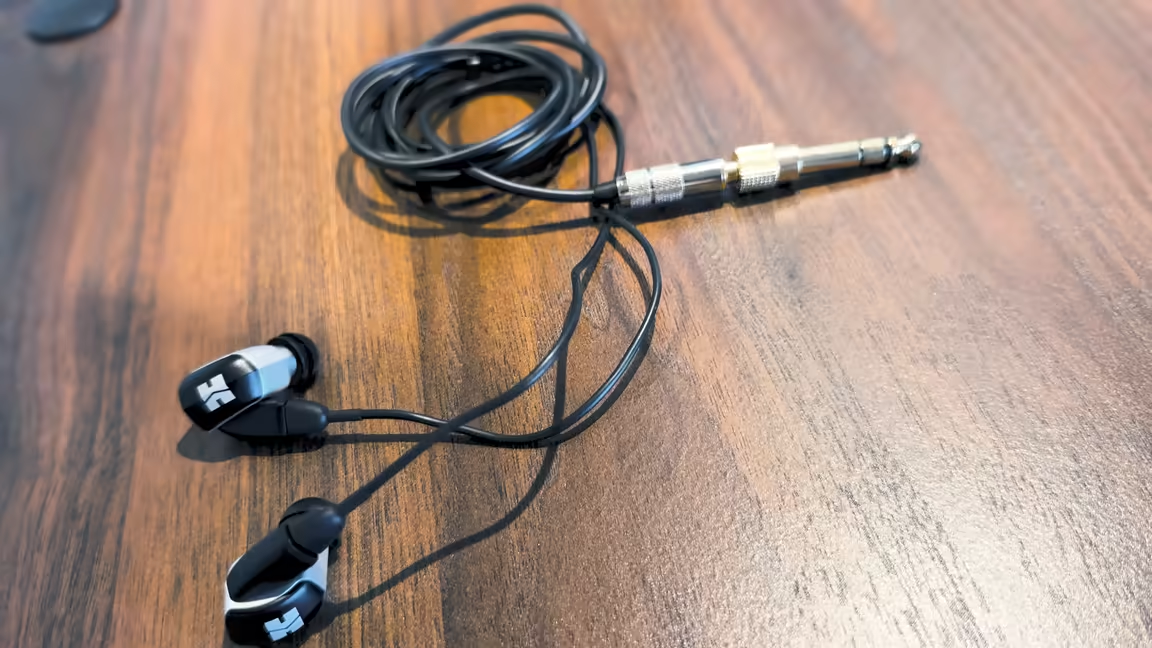
Best Overall
HIFIMAN RE2000 PRO Silver
An older HIFIMAN flagship IEM with the same topology driver as the RE800 but a CNC-machined aluminum shell - by far the most detailed IEM I've ever heard at $350.
- Score 8.8
- Verdict Highly Recommended
- Price $349
At a glance
| # | Pick | Price | Award |
|---|---|---|---|
| 1 | RE2000 PRO Silver | $349 | Best Overall |
| 2 | Belle, Cadenza II, Orchestra II | $30 to $350 | Best Value |
| 3 | Orchestra Lite | $249 | No award |
| 4 | RE800 Silver | $99 | Best Budget |
| 5 | E-PROTOTYPE | $149 | No award |
| 6 | Svanar Wireless | $499 | No award |
| 7 | EM6L | $109 | No award |
The 7 picks by driver and price
By driver
- Dynamic 4 picks Top-scoring: the HIFIMAN RE2000 PRO Silver (8.8/10)
- Balanced armature 2 picks Top-scoring: the Kiwi Ears Belle, Cadenza II, Orchestra II (8.1/10)
- Hybrid driver 1 pick The Simgot EM6L (7.6/10)
By price
- Under $200 3 picks Top-scoring: the HIFIMAN RE800 Silver (8.0/10)
- $200-500 3 picks Top-scoring: the HIFIMAN RE2000 PRO Silver (8.8/10)
The 7 picks, ranked
HIFIMAN RE2000 PRO Silver
An older HIFIMAN flagship IEM with the same topology driver as the RE800 but a CNC-machined aluminum shell - by far the most detailed IEM I've ever heard at $350.
- Sound: Analytical, aggressive
- Impedance: 60 Ω
- Sensitivity: 103 dB
- Driver: Single dynamic (topology diaphragm)
- Topology diaphragm with nanoparticle coating
- Aviation-grade aluminum shell - no plastic
- CNC-machined for refined fit and acoustic properties
Watch out: Unusual shape takes time to fit perfectly
HIFIMAN RE2000 PRO Silver review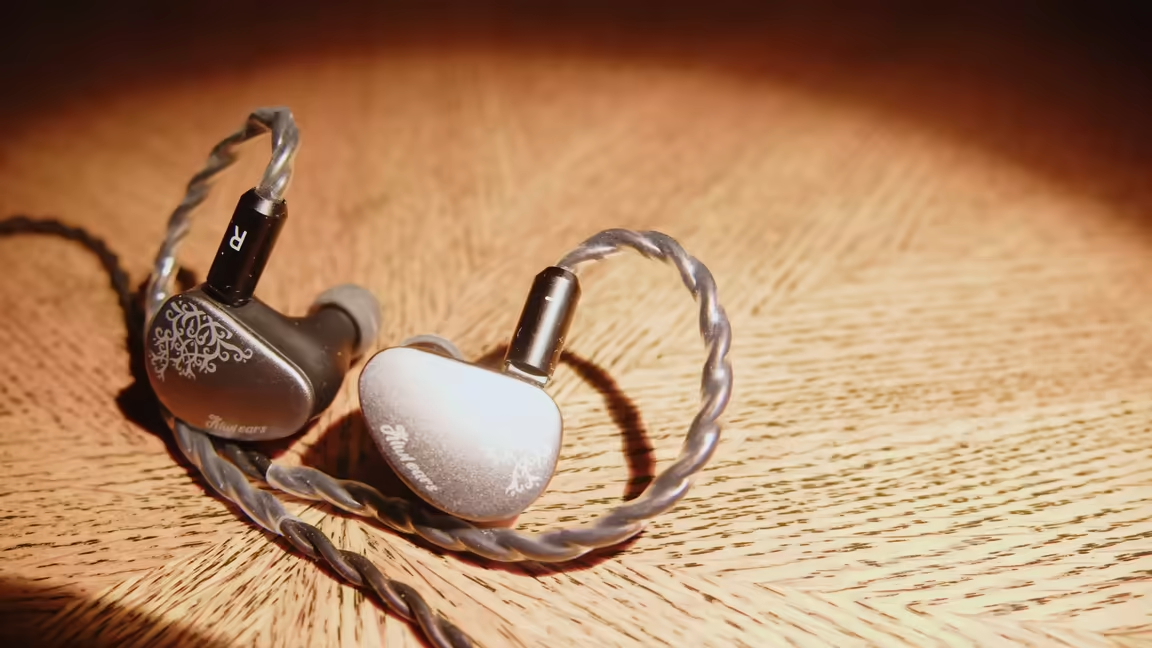
Kiwi Ears Belle, Cadenza II, Orchestra II
Three Kiwi Ears IEMs head-to-head - the $30 Belle with a mic, the $50 Cadenza II with KARS 2.0, and the 10-BA $350 Orchestra II flagship. Which is the value pick?
- Sound: Analytical, aggressive
- Driver: Balanced armature
- Orchestra II's 10 balanced armatures stay coherent and linear
- Cadenza II's KARS 2.0 labyrinth tube tightens the low end
- Orchestra II ships with 3.5mm + 4.4mm balanced cables and a case
Watch out: Belle's ear tips are a real fight to fit and swap
Kiwi Ears Belle, Cadenza II, Orchestra II review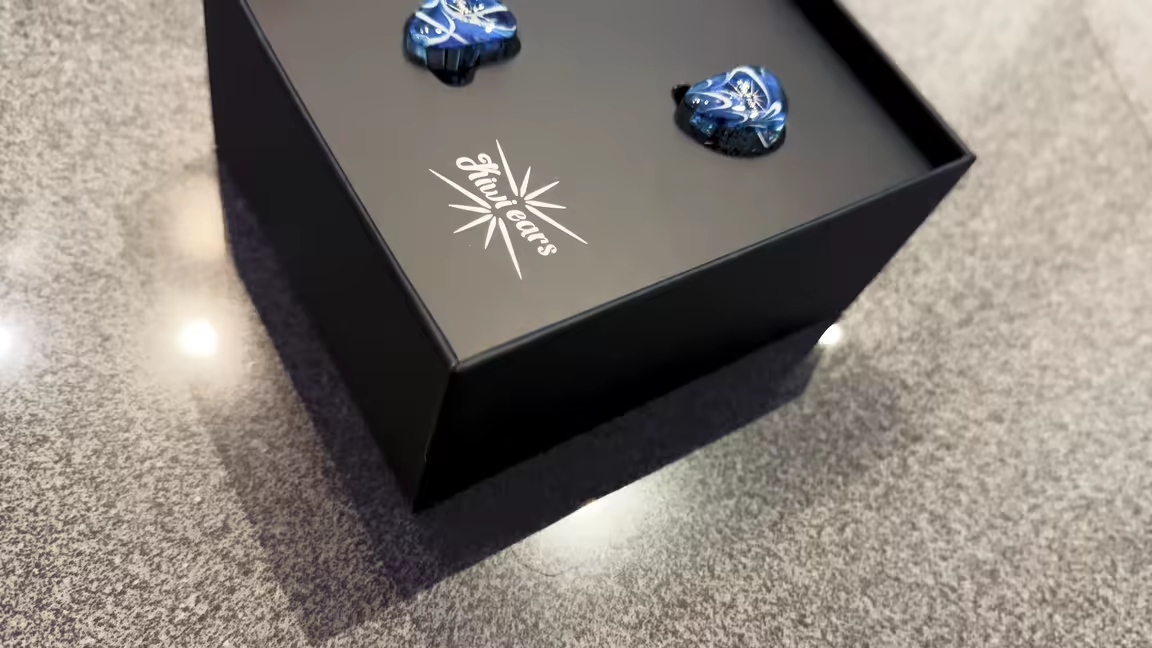
Kiwi Ears Orchestra Lite
An 8-balanced-armature IEM with a 3-way crossover at $250 - mid-forward, naturally warm, with depth-focused staging that's the opposite of most IEMs in its class.
- Sound: Bass-heavy, analytical
- Impedance: 16 Ω
- Sensitivity: 112 dB
- Driver: 8 balanced armature, 3-way crossover
- 8 balanced armature drivers with 3-way crossover
- Semi-transparent shell exposing internals - gorgeous
- 4-core 7N OFC braided stock cable included
Watch out: Thick nozzle due to driver count
Kiwi Ears Orchestra Lite review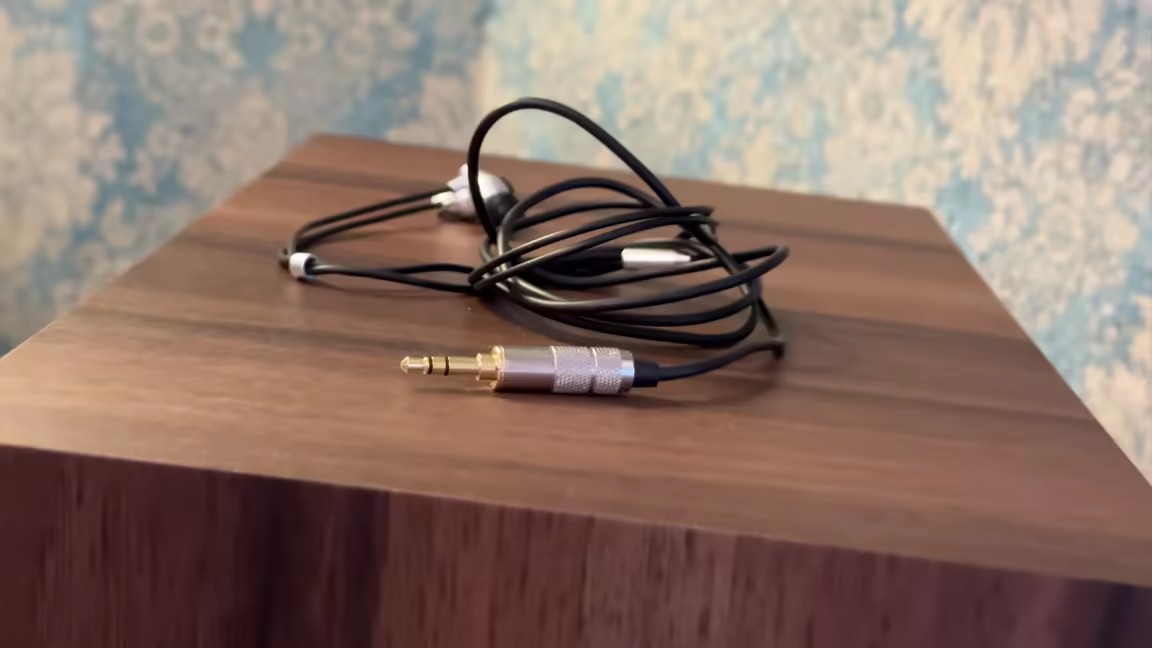
HIFIMAN RE800 Silver
An older flagship IEM with topology driver tech, now $100 (down from $600) - audiophile-grade performance with surprisingly wide staging and an interesting non-target tuning.
- Sound: Bass-heavy, wide stage
- Impedance: 60 Ω
- Sensitivity: 105 dB
- Driver: Dynamic
- Wider soundstage than most full-size headphones
- Razor-sharp imaging
- Excellent dynamic punch with coherent localization
Watch out: Non-detachable cable
HIFIMAN RE800 Silver review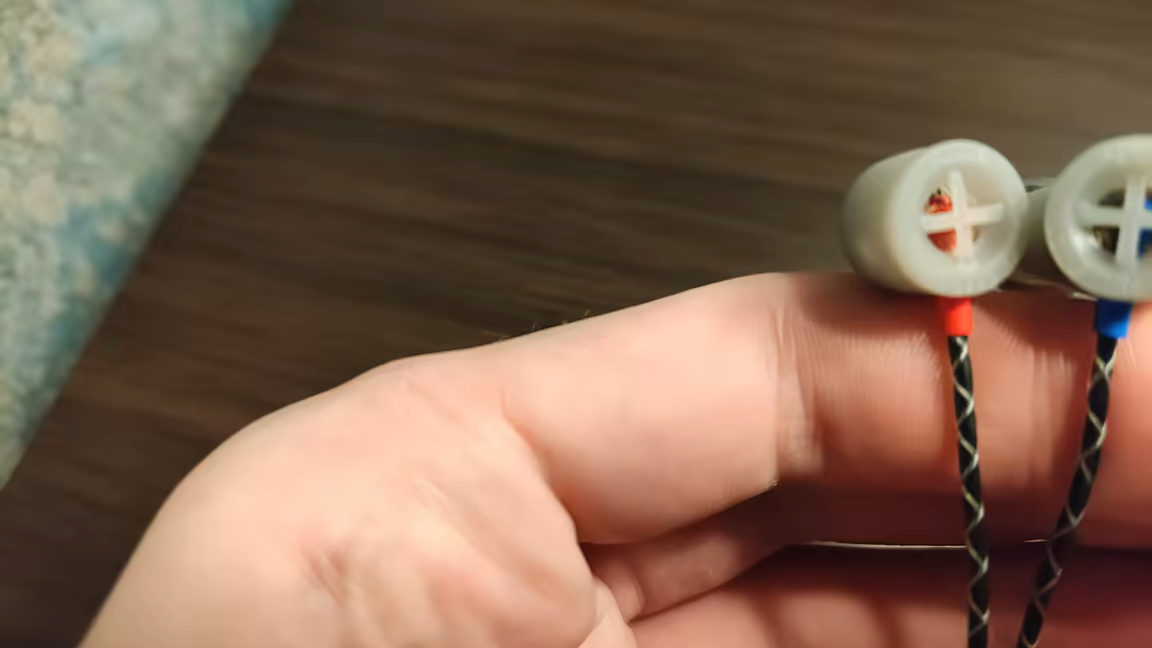
Flare Audio E-PROTOTYPE
Unlike anything you've heard or seen. The E-PROTOTYPE goes to extremes - both positive and negative - using proprietary technologies you won't find anywhere else.
- Sound: Wide stage, analytical
- Driver: Dynamic
- Astonishing detail retrieval without getting sharp
- Impeccable dynamic range with long, satisfying decay
- 3D-printed in the UK with professional-grade equipment
Watch out: Tonality is a love-or-hate situation
Flare Audio E-PROTOTYPE review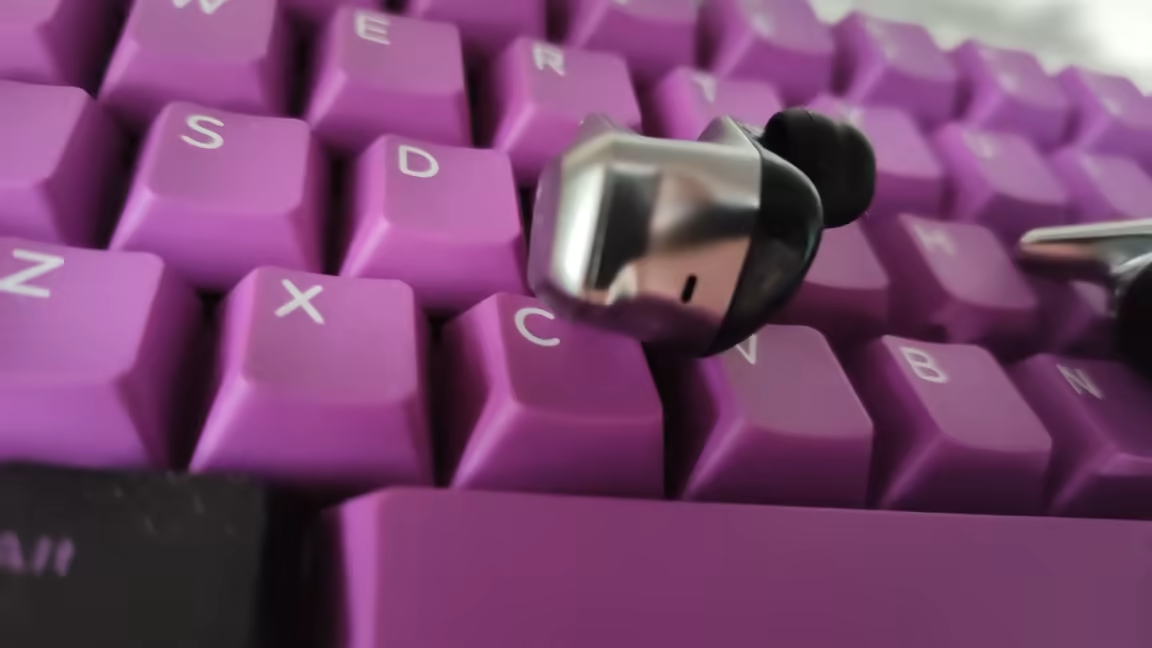
HIFIMAN Svanar Wireless
A $500 single dynamic driver TWS with an R2R DAC and LDAC. It's both lacking and feature-packed at the same time - and it actually delivers where it matters.
- Sound: Wide stage, analytical
- Driver: Single dynamic (topology diaphragm)
- Built-in R2R DAC - same approach as HIFIMAN's desktop amps
- Bluetooth 5.2 with LDAC support (24-bit/192kHz)
- Stable connection - no issues like some other wireless IEMs
Watch out: ANC isn't amazing for the price
HIFIMAN Svanar Wireless review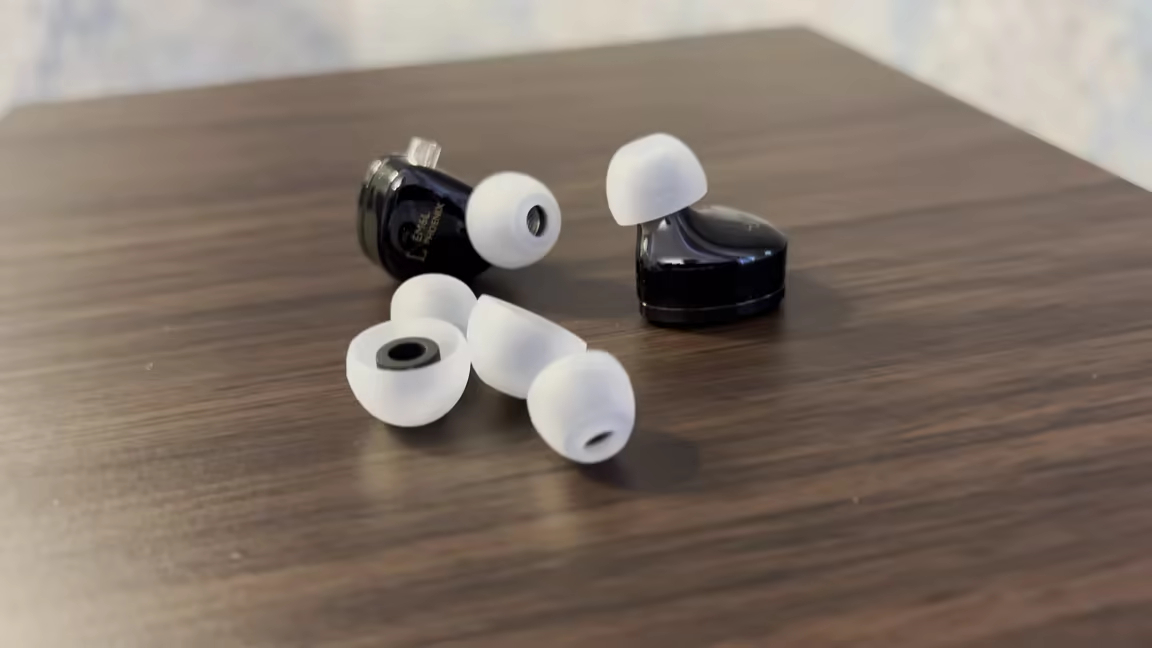
Simgot EM6L
A budget hybrid IEM with 1 dynamic + 4 BA drivers, a 3-way crossover, and an attempt at the Harman 2019 target - mostly successful, with a fun 'weirdly big' soundstage.
- Sound: Wide stage, aggressive
- Impedance: 26 Ω
- Sensitivity: 119 dB/V
- Driver: 1 dynamic + 4 balanced armature, 3-way crossover
- Small shell - great fit for smaller ears
- OFC silver-plated braided cable included (rare at this price)
- Treble is smooth without losing amplitude
Watch out: Mid-bass has extra energy that can sound bloaty
Simgot EM6L reviewTorn between two picks?
One pair from this list with a head-to-head page of its own.
Questions buyers ask
Are IEMs really better than over-ear headphones at the same price?
At the budget end, often yes. A $100 IEM benefits from being mass-produced at scale by manufacturers like Moondrop, Truthear, Kiwi Ears, and Simgot, each iterating on driver tuning every few months. A $100 over-ear headphone is competing against the same brands at scale plus the entire used market for previous-generation flagship over-ears. IEMs also avoid the acoustic problem that closed-back headphones have - the trapped air volume behind a closed ear cup tunes the headphone's bass; an IEM seals directly to the canal and gets a much more predictable bass response.
Do I need a balanced cable and amplifier for IEMs?
No. IEMs are sensitive enough (95-115 dB/mW typically) that any phone, laptop, or sub-$100 dongle DAC drives them to deafening levels with headroom to spare. Balanced cabling can lower the noise floor by 3-6 dB if your IEM is extraordinarily sensitive (>110 dB/mW) and your source has a balanced output worth using. For most IEMs on most sources, single-ended 3.5mm is electrically and audibly equivalent.
Hybrid driver vs. single dynamic - which is better?
Both can be implemented brilliantly. Single-dynamic IEMs (the HIFIMAN RE2000 PRO Silver, the RE800 Silver and the Flare Audio E-PROTOTYPE on this list) have a coherence advantage - one driver moves uniformly across the whole frequency range. Hybrid IEMs (a dynamic driver plus balanced armatures, like the Simgot EM6L) can target a more sculpted response with each driver optimized for its band, but the crossover between drivers can introduce phase artifacts audible as 'discontinuity' in the upper mids. We score on result, not topology - and on this list the top pick is a single dynamic driver.
What's the Harman IEM target, and should I care?
The Harman target is a frequency response curve developed by Sean Olive at Harman through large-scale listener preference research - it represents the response most listeners prefer when comparing IEMs in blind A/B tests. Most modern IEMs above $100 target some variant of it. 'Targets Harman' on a spec sheet means the manufacturer has tuned to a known preference curve; it doesn't mean every listener will prefer that IEM, and it doesn't account for the wide individual variation in ear-canal geometry. Use it as a tuning sanity-check, not a quality guarantee.
How do I get a good seal with IEMs?
Three steps, in order. First, work through every tip size in the box and pick the largest that comfortably seals - small tips leak bass, oversized tips fatigue the ear canal. Second, twist the IEM into place rather than pushing it straight in - the ear canal isn't a straight tube and a twist follows its natural curve. Third, if no included tip works, try Comply foam tips or SpinFit (third-party silicone tips with rotating nozzles) - both fix seal issues that the stock tips can't solve.
The IEM market in 2026 is the most price-efficient corner of audiophile audio. Tooling for high-quality micro-drivers has dropped enough in cost over the last decade that a $100 in-ear monitor today competes on raw fidelity with a $500 over-ear headphone from five years ago. The Chi-Fi manufacturing scene - Moondrop, Truthear, Simgot, Kiwi Ears, KZ - iterates on driver tuning every few months, and the result is a flood of new products at every price tier, most of them merely competent and a few of them genuinely outstanding.
Several of the IEMs here were loaner units, which is disclosed on each individual review page. None of them was scored with that in mind.
Driver types, and who each one suits
The spec sheet leads with the driver configuration, and on this list all four kinds are represented. None is better on principle; each suits a different listener.
A single dynamic driver is the coherent choice: one diaphragm covers the whole range, so there is no crossover to get wrong. The top pick, the HIFIMAN RE2000 PRO Silver, is a single dynamic, and so are the RE800 Silver and the Flare Audio E-PROTOTYPE. It suits a listener who values texture and natural bass over a sculpted response.
All balanced armatures trade some of a dynamic driver's bass texture for speed and control. The Kiwi Ears Orchestra Lite splits eight armatures across a three-way crossover and comes out mid-forward and naturally warm, which suits vocal-led listening more than bass-led music.
A hybrid pairs a dynamic driver for the low end with armatures above it. The Simgot EM6L puts one dynamic and four armatures behind a three-way crossover, and its review shows the risk of the format: a crossover that does not fully integrate its drivers leaves mid-bass energy where the vocals should be.
True wireless swaps the cable for a radio, a DAC and a battery in each shell. The HIFIMAN Svanar Wireless does that with an R2R DAC and LDAC, and it suits a listener who wants one device for the commute and the desk and accepts that battery life will one day decide how long it lasts.
When an over-ear is the better buy
An IEM is not the right answer for everyone at any price. If you want the out-of-head stage that an open-back produces, no universal in-ear will give you the same thing, and the open-back guide is the better starting point. If in-ears are uncomfortable for you after an hour, tuning cannot fix that. And if you listen for long sessions at home and never leave the desk, the isolation an IEM is built around buys you nothing.
How the IEMs were heard
Listening was always primary. Every IEM was heard on multiple sources - a desktop balanced chain, a portable DAC dongle, and a smartphone direct - because an in-ear's job is to perform across the range of sources people actually use, not just the optimal one. For an IEM, build and comfort mean cable quality, connector type, housing durability and what is in the box, and system fit means how much it asks of whatever is driving it.
A 9.0 on this list would mean a reference-class IEM at its price tier, and no IEM has reached one on this scale yet. That reflects where the in-ears we have heard sit, not a bias against the form factor, and the day one does, it will lead this list.
What each price tier buys in an in-ear
Below $100, you're buying tuning. Modern budget IEMs use the same balanced-armature and dynamic-driver IP as flagship products from a few years ago. What you don't get: a great cable (most include a serviceable but cheap-feeling one), modular connectors (many are fixed), or quality tips (most include three sizes of mediocre silicone).
Between $100 and $300, the variable becomes tuning sophistication and driver count. A well-tuned single-dynamic IEM in this tier competes on tonality with multi-driver designs that cost twice as much, and multi-driver designs start showing meaningful technicality advantages from about $200, especially for resolution in the upper mids and lower treble.
Between $300 and $600, you're buying technicality - resolution, microdynamics, decay accuracy - more than tonal sophistication. The tuning curves in this tier are mature; the differences are how well each design separates simultaneous low-level information. The HIFIMAN RE2000 PRO Silver at $349 leads this list because it's that rare thing - a single-dynamic IEM in this tier that competes on technicality with multi-driver IEMs costing more.
Not on this list: custom in-ears
Custom in-ear monitors (CIEMs with shells moulded to your ear impressions) are left out. The review process needs to span multiple impression sessions and the resulting price-to-performance curve is fundamentally different from universal-fit IEMs. CIEMs are reviewed when we have them on the chain, but they don't appear in universal-IEM rankings.
For the sub-$200 end of this list on its own, with the fit and cable trade-offs that decide that bracket, see the budget IEM guide.
Ranked by score, on the one rubric every review uses: Sound 30%, Technical performance 25%, Build & comfort 15%, System fit 15% and Value 15%. Best Value goes to the pick, other than the winner, with the most score for its price (score against the log of the price). Best Budget goes to the highest-ranked pick not already awarded in the cheapest quarter of the list. No placement here is sponsored, paid for, or negotiable. How a score is built · Funding and independence · All headphones reviews