
The Best Microphones in 2026: Tested & Ranked
A microphone records the room it stands in as faithfully as the voice in front of it, so the first choice is not a brand but a capsule: a dynamic for a noisy room and a close voice, a condenser for a quiet room and detail, a tube condenser for character. These are the microphones that earned a recommendation.
- By Jakub Charkiewicz
- 3 tested picks
- Published
- Score floor: 7.0/10
- Prices $68.99 to $449
The short version
The Austrian Audio OC16 (8.7/10, $449) tops our ranking of the best microphones. For a lot less money, the FIFINE K688 (7.2/10, $68.99) takes best value. The runner-up is the t.bone SCT 2000 (8.1/10, $231). 3 picks in all, ranked by score from 7.2 to 8.7/10.
How we tested this gear
3 microphones reviewed first-hand, 3 ranked here · at least two weeks each on a real voice in a real room. 3 microphones in this guide's field, every one reviewed first-hand and linked from this page: 3 ranked. Every one has a video review on the channel, where the product is shown and heard. Jakub Charkiewicz (2) and Bastien Beauchamp (1), each review signed by the person who tested it. At least two weeks of daily listening before a score is committed, typically four to eight weeks for flagship gear, and never a first-impressions verdict. No single chain: each recording review names the chain it was recorded on in its own text; the reviewers record on different chains, so no single rig is true of all of them. Each piece is judged against a reference at its own price tier, on what it captures from a real source rather than on its specification sheet. A score is always judged against the product's own price tier, and the same weighted rubric scores every category.The chain, the room, the protocol and the evidence
What was tested
Reviewed by
How long
Test chain
Protocol
For this list
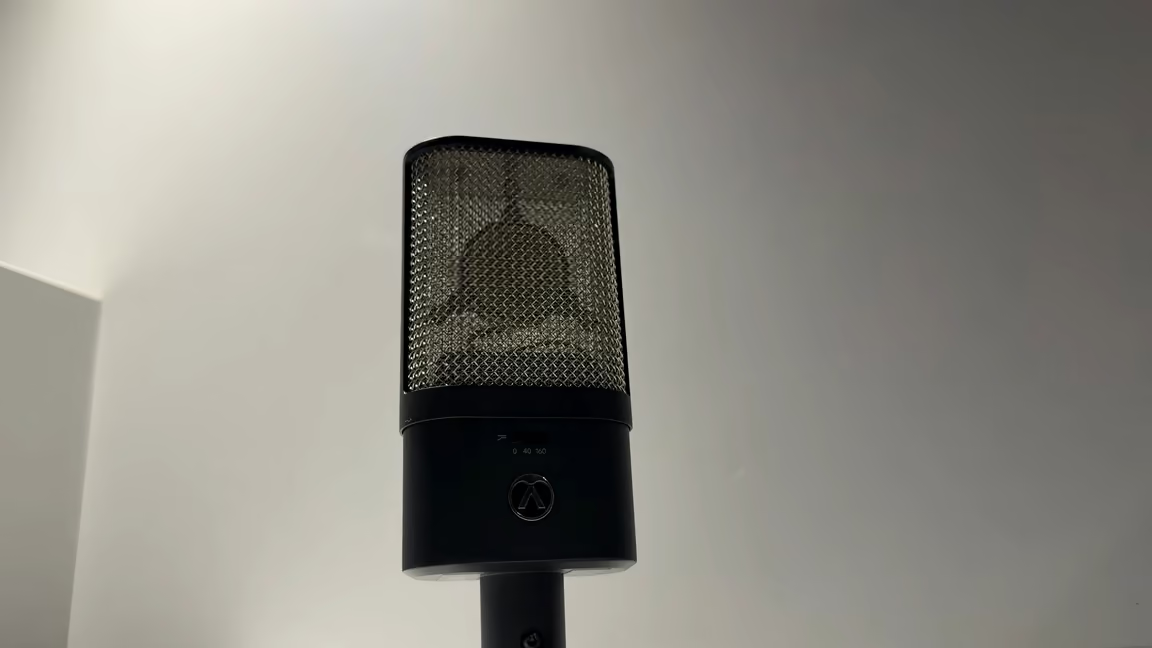
Best Overall
Austrian Audio OC16
A $449 cardioid condenser built around the CKR6, a ceramic-ring capsule hand-assembled and measured in Vienna: 148 dB max SPL, 14 dB(A) self-noise, one high-pass filter.
- Score 8.7
- Verdict Highly Recommended
- Price $449
At a glance
The 3 picks by price
By price
- Under $200 1 pick The FIFINE K688 (7.2/10)
- $200-500 2 picks Top-scoring: the Austrian Audio OC16 (8.7/10)
The 3 picks, ranked
Austrian Audio OC16
A $449 cardioid condenser built around the CKR6, a ceramic-ring capsule hand-assembled and measured in Vienna: 148 dB max SPL, 14 dB(A) self-noise, one high-pass filter.
- Sound: Bright, analytical
- Polar pattern: Cardioid
- Self-noise: 14 dB(A)
- Max SPL: 148 dB
- CKR6 ceramic-ring capsule, hand-assembled and individually measured in Vienna
- The same capsule Austrian Audio screws into the $899 OC18
- 148 dB max SPL - past the inside of a kick drum, with no pad needed
Watch out: One polar pattern, one switch and no pad
Austrian Audio OC16 review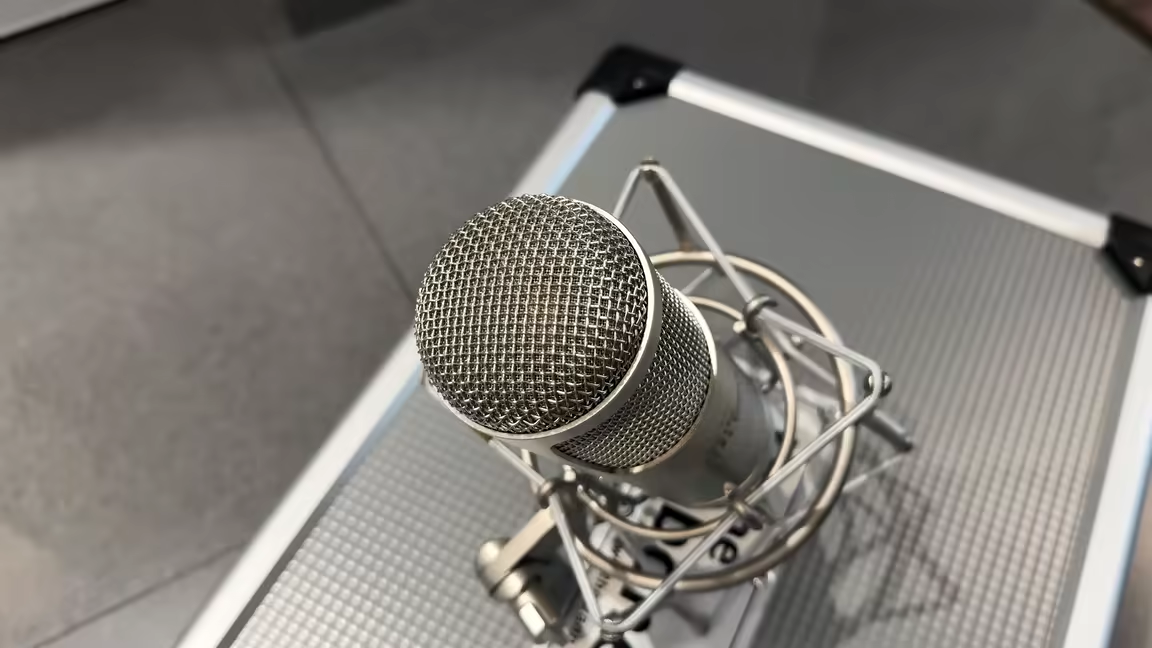
t.bone SCT 2000
A large-diaphragm tube condenser at $231 with a real 12AX7B tube, nine polar patterns, gold-sputtered diaphragm, and a sound that competes with mics 3-5x the price.
- Sound: Warm, wide stage
- Self-noise: 16 dB
- Type: Tube
- Connector: 7-pin (to external PSU)
- Real, user-replaceable 12AX7B vacuum tube inside the mic
- 1.07" gold-sputtered large-diaphragm capsule
- Nine selectable polar patterns from the PSU
Watch out: Needs external PSU
t.bone SCT 2000 review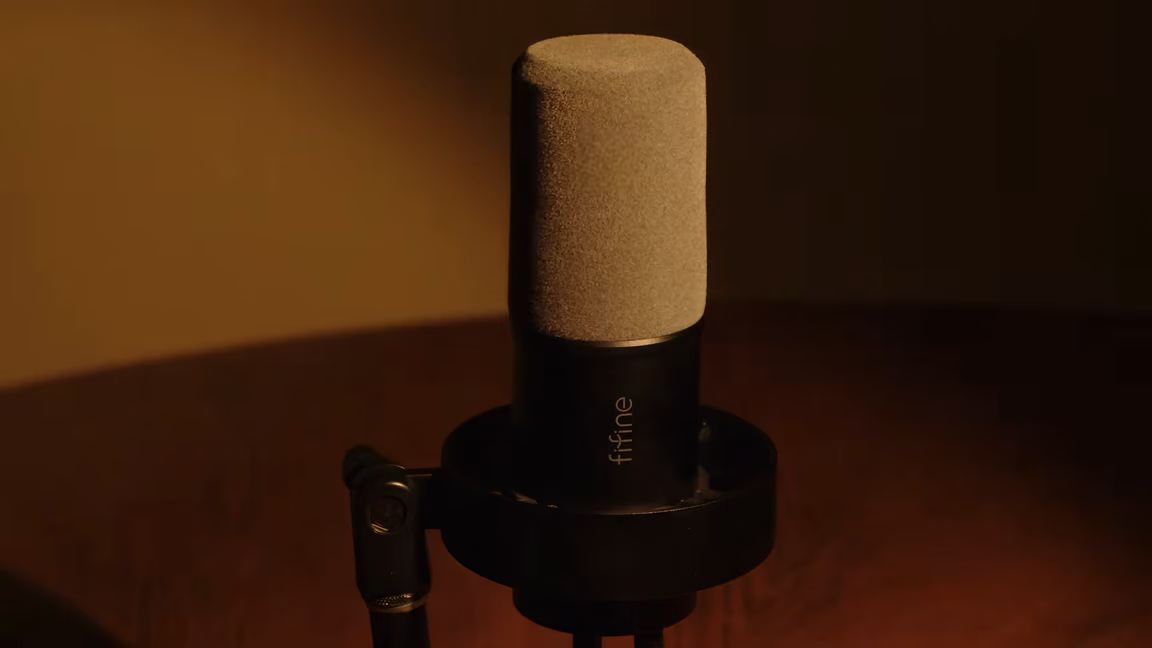
FIFINE K688
A dynamic broadcast microphone with both XLR and USB-C outputs, so the audio interface is already inside it: cardioid rejection, 130 dB max SPL, on-body gain and mute.
- Sound: Analytical, aggressive
- Polar pattern: Cardioid
- Max SPL: 130 dB
- Type: Dynamic (moving coil)
- XLR and USB-C outputs - the audio interface is already inside the mic
- Metal body and metal shock mount at a budget price
- Cardioid dynamic capsule rejects fan noise, keyboards and room reflections
Watch out: Frequency response stops at 50 Hz and 16 kHz
FIFINE K688 reviewQuestions buyers ask
Which of these suits podcasting or streaming best?
The FIFINE K688. It is a dynamic cardioid, so it hears the voice close to it and far less of the fan, the keyboard and the room around it, and it has a USB-C output with the interface already inside, so it plugs straight into a computer with no second box. Gain, headphone monitoring and a tap-to-mute button sit on the body. Its response stops at 50 Hz and 16 kHz, which is built for speech and is the reason it is not the one for music.
Which is the one for recording a singing voice?
It depends on the voice and the room. The t.bone SCT 2000 is a large-diaphragm tube condenser that makes a voice sound finished before any processing, with nine polar patterns from its power supply, and it can be too smooth for clinical work. The Austrian Audio OC16 is more neutral through the mids with a bright top and a lean low end, which suits a full voice and does nothing to thicken a thin one. Both are condensers, so both want a quiet, treated room.
Is the OC16 worth paying roughly twice the SCT 2000's price?
For detail and headroom, yes: its CKR6 capsule is hand-assembled and measured in Vienna, it takes 148 dB without a pad and its self-noise is 14 dB(A). For character and features, no: the SCT 2000 has a real tube, nine patterns and a flattering sound for less money, where the OC16 has one pattern, one switch and no pad. They are different tools rather than a cheaper and a better version of the same one.
Why is there no audio interface on this list?
Because an interface does a different job from the microphone it records, and this list ranks microphones against microphones. The one interface reviewed so far, the Yellowtec PUC2 Mic LEA, sits on the microphones and recording hub with its own verdict. The K688 is the exception that proves the point: it has an interface built in, and it is ranked here as a microphone.
Most microphone advice starts with the spec sheet, and the spec sheet is the least useful place to start. A capsule's frequency response, self-noise and maximum level describe what it can do in a quiet room with a perfect source in front of it. What decides whether a microphone works for you is the room you actually have, the voice or instrument you are putting in front of it, and how close to the capsule you are willing to work.
That is why the three microphones here are not a cheaper and a dearer version of the same thing. They are three answers to three different rooms.
The capsule decides before the price does
A dynamic microphone moves a coil. It is less sensitive, which sounds like a drawback until you record in a real home: it picks up the voice two inches from the grille and very little of the fridge, the fan or the reflections off the desk. The FIFINE K688 is built on exactly that principle, and it is why it sounds usable in a room nobody has treated.
A condenser is a charged diaphragm next to a backplate. It is more sensitive and more detailed, and it hears everything - including the room. The Austrian Audio OC16 is a clear example: a detailed, slightly bright capsule with a lean low end that records an untreated room just as clearly as it records you. In a quiet, treated space that is what you want. In a bare one it is a problem the microphone cannot solve.
A tube condenser adds a valve to the signal path, and with it a smooth, flattering harmonic lift. The t.bone SCT 2000 sounds finished before you touch an equaliser, which is a gift on a vocal and a drawback when you want the recording to stay neutral.
USB, XLR, or both
An XLR microphone needs something to amplify it and turn it into a file: an audio interface or a mixer, and phantom power if it is a condenser. A USB microphone has that interface built into its body. The K688 has both outputs, and in the side-by-side test in its review the USB path came out fuller than the XLR path, most likely because the built-in interface is shaping the tone.
That makes the first purchase simpler than it looks. If the microphone is for speech and a computer is the destination, a USB microphone is a complete chain. Buy an interface when you want better preamps, more inputs, or a workflow a USB microphone cannot give you - automatic levelling and zero-latency monitoring, in the case of the Yellowtec PUC2 Mic LEA.
Reading the three numbers that matter
Self-noise is the hiss the microphone makes on its own. The OC16's 14 dB(A) is quiet enough for close detail work; the SCT 2000's 16 dB is impressively low for a tube microphone, though not pro-grade silent. On a loud source it does not matter at all.
Maximum SPL is how loud a source can get before the microphone's own electronics distort. The OC16 takes 148 dB, past the inside of a kick drum, with no pad. The K688 and the SCT 2000 are rated to 130 dB, which is plenty for a voice and a guitar amplifier and not a drum kit at close range.
Output level is how much signal the microphone sends down the cable, and it decides how hard your interface's preamp has to work. The OC16 puts out 11 mV/Pa, roughly ten times an SM7B, so a budget interface has gain to spare - and a careless gain setting clips the interface rather than the microphone.
The mistakes that cost the most
Buying a condenser for a room that is not ready for one. The more detailed the microphone, the more clearly it records the echo. Treat the wall behind you, or work closer with a dynamic, before spending more on a capsule.
Counting features instead of listening. Pads, patterns and switches are cheap to add. The OC16 has one pattern, one filter and no pad and is still the most capable microphone here; the feature list said nothing about the capsule.
Buying the interface first. If the microphone is USB, you already own one. Add a separate interface when the microphone, or the job, actually needs it.
Blaming the microphone for the gain setting. Distortion on a loud take is usually the preamp clipping. Set the gain so the loudest moment peaks well below full scale, and a hot condenser behaves.
Ranked by score, on the one rubric every review uses: Sound 30%, Technical performance 25%, Build & comfort 15%, System fit 15% and Value 15%. Best Value goes to the pick, other than the winner, with the most score for its price (score against the log of the price). No placement here is sponsored, paid for, or negotiable. How a score is built · Funding and independence · All microphone and recording reviews