
The Best Speaker Amplifiers and Preamps in 2026: Ranked
Amplification for loudspeakers, judged into real speaker loads rather than on a spec sheet: what separates amplifiers is how they behave when the impedance drops and the music gets loud, not the wattage printed on the box. Headphone amps are a different job and live on their own list.
- By Jakub Charkiewicz
- 3 tested picks
- Updated
- Score floor: 7.5/10
- Prices $1,369 to $3,175
The short version
Our top pick among the best speaker amps and preamps is the Tonewinner AD-1PA+ (9.0/10, $3,175). The runner-up is the Denafrips Hades 12th (9.0/10, $1,369), which also takes best value. 3 picks in all, ranked by score from 8.8 to 9.0/10: 1 power amp, 1 preamp and 1 integrated amp.
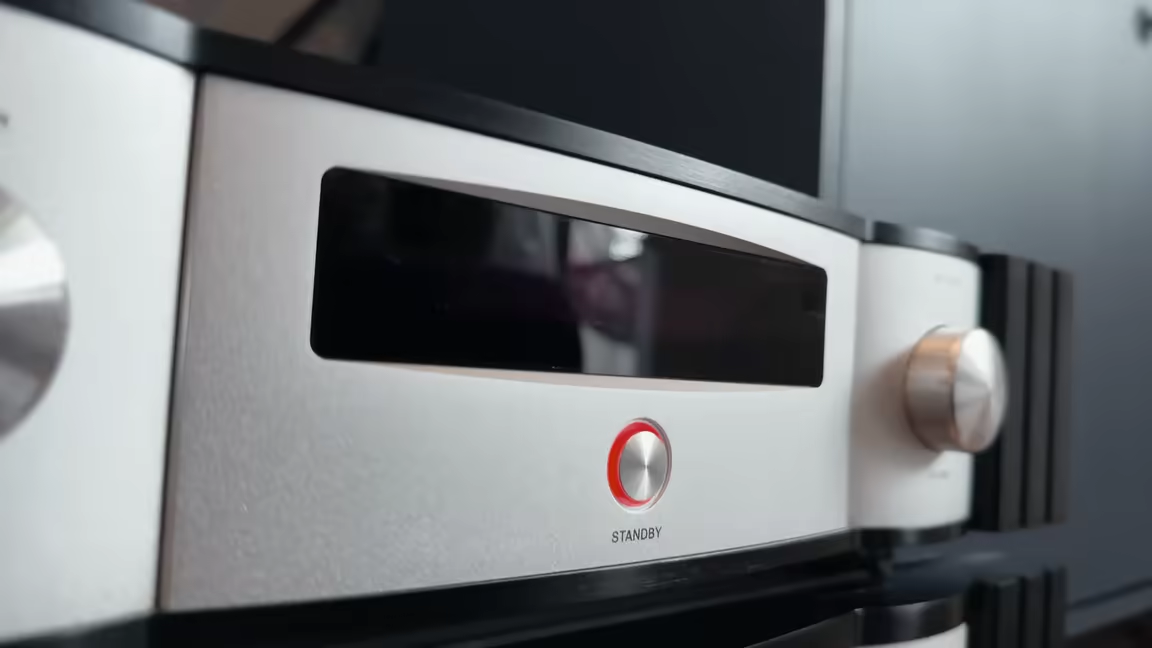
Best Overall
Tonewinner AD-1PA+
A 43kg switchable Class A/AB power amplifier paired with a fully balanced preamp - 100W Class A or 500W Class AB into 4Ω with serious bass control and golden-hued mids.
- Score 9.0
- Verdict Highly Recommended
- Price $3,175
At a glance
| # | Pick | Price | Award |
|---|---|---|---|
| 1 | AD-1PA+ | $3,175 | Best Overall |
| 2 | Hades 12th | $1,369 | Best Value |
| 3 | AD-2PRO+ | $2,699 | No award |
The 3 picks by type and price
By type
- Power amplifiers 1 pick The Tonewinner AD-1PA+ (9.0/10)
- Preamplifiers 1 pick The Denafrips Hades 12th (9.0/10)
- Integrated amplifiers 1 pick The Tonewinner AD-2PRO+ (8.8/10)
By price
- $1,000-2,500 1 pick The Denafrips Hades 12th (9.0/10)
- $2,500 + 2 picks Top-scoring: the Tonewinner AD-1PA+ (9.0/10)
The 3 picks, ranked
Tonewinner AD-1PA+
A 43kg switchable Class A/AB power amplifier paired with a fully balanced preamp - 100W Class A or 500W Class AB into 4Ω with serious bass control and golden-hued mids.
- Power output: 100 W Class A / 300 W Class AB into 8 Ω · 500 W Class AB (one channel driven) into 4 Ω
- Inputs: Balanced XLR, RCA
- Outputs: Dual A/B speaker binding posts
- 8 pairs of Hi-Fi transistors per channel - 60A capacity
- 1200W toroidal transformer + 180,000μF capacitance
- Stable down to 2Ω - drives demanding speakers
Watch out: Significant heat output in Class A mode
Tonewinner AD-1PA+ review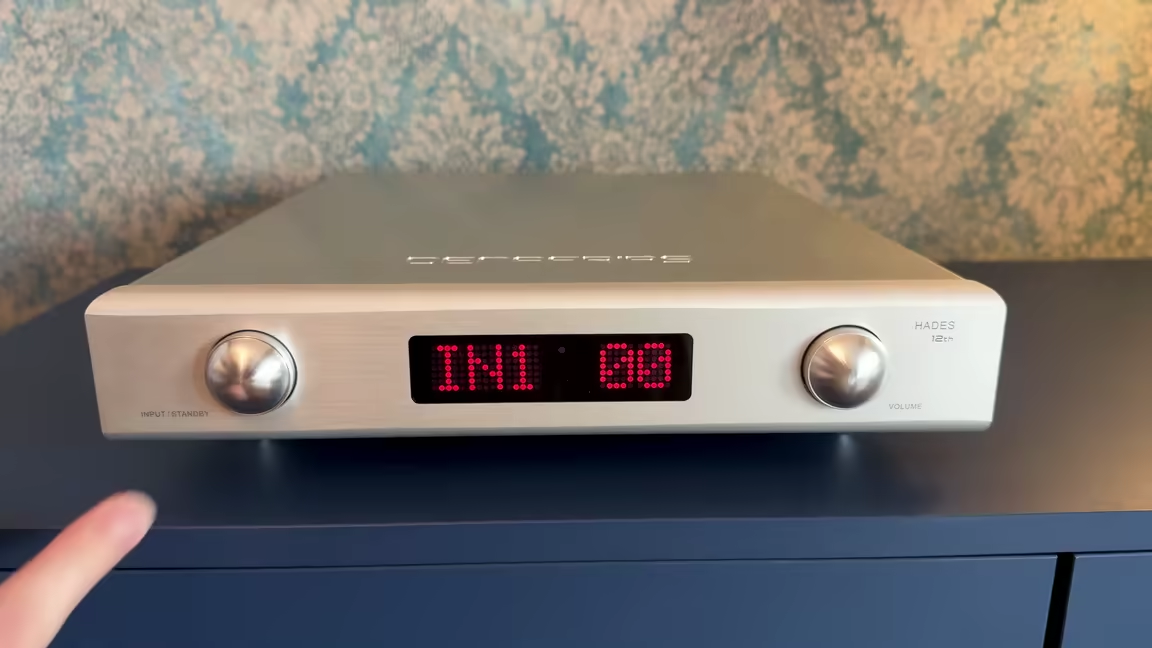
Denafrips Hades 12th
A pure Class A, fully balanced, true discrete preamp with a 60-step relay-based resistor ladder volume control - perfect channel balance, 0.00045% THD, 122dB SNR.
- Inputs: 2× balanced XLR, 1× RCA
- Outputs: Balanced XLR, RCA
- Topology: R2R ladder
- Pure Class A, fully discrete, true balanced signal path
- 80VA O-core transformer with discrete linear PSU
- 0.00045% THD, 122dB SNR - whisper-quiet background
Watch out: Three feet instead of four
Denafrips Hades 12th review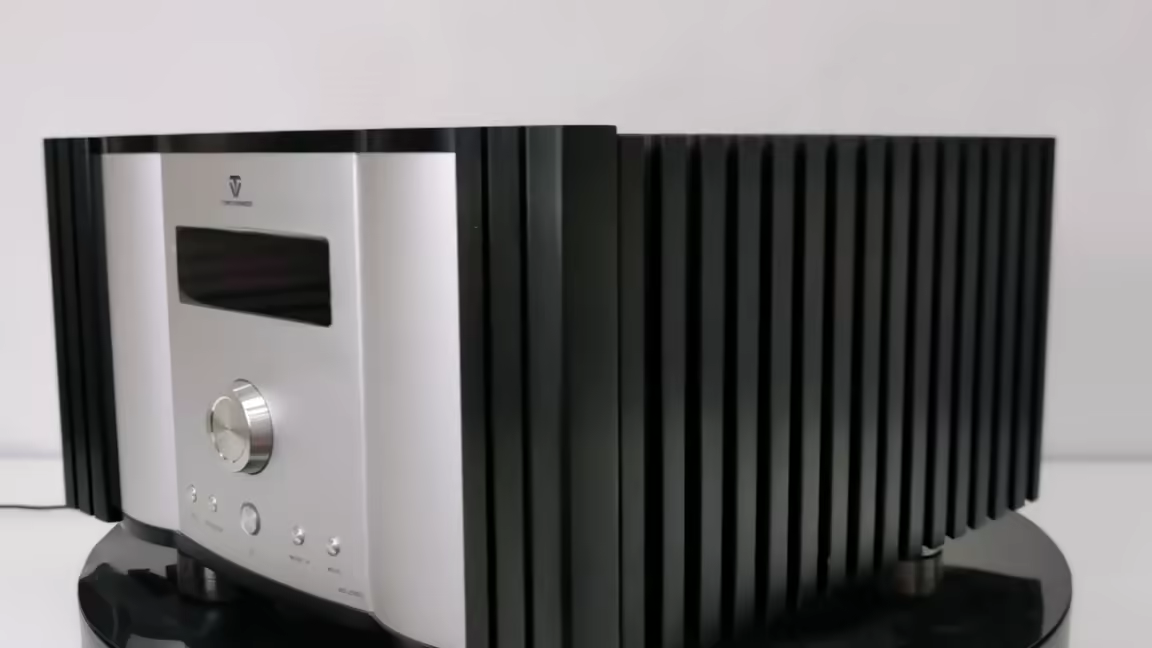
Tonewinner AD-2PRO+
A 40 kg, 240W integrated amp with switchable Class A and Class A/B modes, neutral tonality, and the kind of dynamic headroom that pairs well with virtually any speaker.
- Power output: 240 W (one channel driven) into 8 Ω
- Inputs: USB-B, 2× Optical, Coaxial, RCA, Balanced XLR, MM/MC phono
- Outputs: 2× speaker binding posts, Subwoofer out (RCA/XLR)
- Massive 40 kg / 80 lb solid build with large heatsinks
- Switchable Class A and Class A/B operation
- 240W into 8Ω, handles speakers below 4Ω with ease
Watch out: Center image can be a little fuzzy
Tonewinner AD-2PRO+ reviewTorn between two picks?
One pair from this list with a head-to-head page of its own.
Questions buyers ask
Why are preamps on the same list as power amps?
Because they are bought for the same job: getting a loudspeaker driven properly. A line preamp sets level and handles switching before the power stage, an integrated does both in one box, and a power amp does only the output half. You cross-shop them against each other constantly when you plan a system, so ranking them together reflects how the decision actually gets made. What we never do is mix them with headphone amplifiers, which drive a load two or three orders of magnitude different and are judged on a separate list for that reason.
How many watts do I actually need?
Fewer than most people assume, and it depends on speaker sensitivity far more than on room size. Every 3 dB of extra sensitivity halves the power needed for the same level, so an 88 dB speaker asks for roughly four times the amplifier of a 94 dB one. The speaker power calculator on this site does the arithmetic against your own numbers, including crest factor and listening distance, and it will usually tell you that headroom, not raw wattage, is what you were missing.
Does amplifier class matter to the sound?
It matters less than the implementation and more than nothing. Class A runs its output devices continuously, which costs a great deal of heat and power to avoid one specific distortion mechanism. Class AB switches, and modern designs handle that transition well enough that it is rarely the limiting factor. Class D is now good enough that it wins on efficiency without an obvious penalty in most systems. Two amps of the same class can sound entirely different; the class tells you about the engineering trade-off, not the result.
Should I buy an integrated or separates?
An integrated is the right default. It removes an interconnect, a chassis, a power cord and a purchasing decision, and at any given budget more of the money goes into the parts that matter. Separates earn their keep when you want to upgrade one half at a time, when you need a preamp's switching and outputs, or when the power amp has to sit near the speakers and the preamp near you.
Loudspeaker amplification is the part of a system where the specification sheet is least useful. Power output is quoted into a resistor at a frequency and a distortion figure that the manufacturer chose; a loudspeaker is not a resistor, its impedance swings with frequency, and the moments that expose an amplifier are transient and brief. An amp that measures identically to another can run out of composure in a completely different place.
So this list is built from listening into real speaker loads, not from published numbers. What gets scored is what the amplifier does when a difficult passage arrives: whether the bottom end stays defined, whether the stage holds together, and whether anything hardens as the level goes up.
Listening into real loads
Each amplifier drove the reference speakers at matched levels. Where an amp offers more than one mode, each mode was listened to separately rather than averaged into one verdict, which matters on this list: both Tonewinner units switch between Class A and Class AB operation, and the two modes are not the same amplifier.
A power supply and a chassis are most of what you are buying in an amplifier. They decide how it behaves under load and whether it is still working in a decade, so build here is the least cosmetic it is anywhere on the site. The rubric is the same one every review uses; this is simply the category where build and behaviour are hardest to separate.
The catalogue here is deliberately small. Amplifiers take longer to evaluate than almost anything else, because the failure modes only show up on specific material at specific levels, and a piece that seems flawless for a week can reveal itself in the second. Nothing goes on this list until it has been through that.
Matching an amp to a speaker
The pairing question comes down to two numbers on the speaker and one behaviour of the amp. Sensitivity tells you how much level a watt buys, and it is logarithmic: 3 dB more sensitivity halves the power requirement. Nominal impedance tells you roughly how hard the amp has to work, and the minimum impedance, which fewer manufacturers publish, tells you where it will actually struggle.
The behaviour that matters is what the amplifier does as impedance drops. An amp that nearly doubles its output into half the impedance is behaving like a voltage source, which is what most speakers are designed to expect. One that does not will sound tonally different on a demanding load, usually thinner through the bass, and no amount of power rating fixes that.
If you want the arithmetic rather than the principle, the speaker power calculator on this site takes sensitivity, impedance, distance and target level and returns the wattage you actually need with headroom included.
Where amplifier purchases go wrong
Buying watts instead of current. A large number on the box says little about how the amp copes with a 4-ohm speaker whose impedance dips further on bass notes. Look for output quoted into 4 ohms as well as 8, and for how close the figure comes to doubling.
Buying more gain than the system can use. A preamp with a lot of output feeding a sensitive power amp squeezes the whole usable range into the first few steps of the volume control, and the bottom of a potentiometer's travel is where its channel balance is worst. A fine-grained control like the 60-step relay ladder on the Denafrips Hades 12th is one answer; matching gain in the first place is the other.
Paying twice for the same box. An integrated with a DAC and an MM/MC phono stage already inside, as the Tonewinner AD-2PRO+ has, can replace two or three separate purchases. Price the whole chain you would otherwise build before comparing it with a bare power amp.
Treating the amplifier class as a sound. The letter names how the output devices conduct, not what the amplifier will sound like. Implementation decides the sound, which is why the two modes of one amplifier were judged separately rather than assumed.
Preamps, integrateds and power amps
These three are on one list because you shop them against each other. An integrated amplifier is the sensible default for most systems: one box, one power supply, one purchase, and at any given budget the largest share of the money in the parts that make sound.
Separates make sense for specific reasons rather than as a general upgrade. A dedicated preamp buys you switching, outputs, and a volume implementation that a compact integrated cannot fit. A separate power amp can sit next to the speakers on short cable runs while the preamp stays where you sit. If neither of those describes your system, an integrated at the same total price will usually beat the pair.
What none of these are is a headphone amplifier. A headphone presents a load between roughly 8 and 600 ohms at a fraction of a watt; a loudspeaker asks for tens of watts into a swinging load of a few ohms. The two jobs share a name and almost nothing else, so they are never ranked together on this site.
Ranked by score, on the one rubric every review uses: Sound 30%, Technical performance 25%, Build & comfort 15%, System fit 15% and Value 15%. Best Value goes to the pick, other than the winner, with the most score for its price (score against the log of the price). No placement here is sponsored, paid for, or negotiable. How a score is built · Funding and independence · All speaker amps & preamps reviews