
3 Audiophile Tweaks That Actually Work
Three real tweaks that improve a high-end system without swapping speakers or amps - audiophile network/USB/digital cables, AC power conditioning, and parallel filtering.
When we want to improve our HiFi stereo systems, we often think about new speakers or electronics. But there are other things you can try - audiophile tweaks and additions that can take your system to the next level. Today, I’m going to share three secrets with you. The last one might really surprise you.
DH Labs Cables
When we’re looking to get the best sound, we often think about the big components. But today, we’re looking at lesser-known aspects.
Reunion Cat8 Ethernet Cable
First up is the DH Labs Reunion Cat8 Ethernet cable. Some say they make no difference to the sound, while others swear by them. The sonic improvement I experienced was in the clarity and focus. It was as if a fine layer of digital haze had been lifted. The instruments seemed a touch more defined in space, and there was a subtle increase in the overall sense of quietness between the notes, allowing micro-details to become more apparent. It wasn’t a night-and-day change, but the cumulative effect of using higher-quality Ethernet cables across my network setup was noticeable enough to make me a believer that, in the right system, they can contribute to a slightly more refined sound.
Silversonic HDMI 2.1 Cable
Next, we have the DH Labs Silversonic HDMI 2.1 cable. This isn’t just for audio - it’s for high-end video too. It can handle really high resolutions, up to 10K, and fast frame rates. The build feels like a regular cable, but for lengths over 3 meters, they’ve used a combination of optical and traditional wiring to make sure there’s no loss of signal.
In my system, I use them for my I²SInter-IC Sound - a digital audio interface standard using separate lines for data, bit clock, and word clock. Used inside DACs natively; some high-end DACs expose I²S via HDMI for connection to dedicated transports. connection. It resulted in an increase in sonic purity. The soundstageThe perceived three-dimensional acoustic space in a stereo recording - width beyond the speakers, depth front-to-back, and sometimes height information. opened up a bit, and there was a greater sense of instrumental separation, where the edges of the notes seemed cleaner, and the overall presentation felt more articulate and less congested.
Mirage USB Cable
Moving on, we have the DH Labs Mirage USB cable. USB connections can introduce audible noise or ground loops into the audio signal. This actually separates the wires for the audio data and the power. They’re separately shielded, and there are four shields in total. The connectors feel high quality, and the cable is rather thick. In terms of sound, the Mirage USB is very transparent, allowing a lot of detail to come through, especially with high-resolutionA system's ability to retrieve and reproduce fine detail in the recording; high resolution reveals micro-dynamics, spatial cues, and timbral nuance. audio files. It’s designed to minimize reflections, which is important for accurate digital sound. However, it mostly just allows for high-quality files to be fully transmitted over the USB connection.
D-750 Digital Coax Cable
Then, we have the D-750 Digital Coax cable. If you’re using a separate digital transport or streamer connected to a DACDigital-to-Analog Converter - a device that translates binary audio data into an analog electrical signal that can be amplified and heard., this is the kind of cable you’d use. It’s built to maintain a consistent 75 Ohm impedanceThe total opposition (resistance + reactance) a speaker or headphone presents to the driving current, measured in ohms and varying with frequency.. It uses a super solid, silver-coated copper core and a special type of insulation. The shielding is also designed to really reject noise. This cable can bring improvements like smoother highs, tighter bass, and a fuller midrangeThe frequency range from approximately 250Hz to 5kHz where most musical information, vocals, and instrument fundamentals reside.. For a digital connection, this seems like a well-regarded option, especially when it feels like it can last a lifetime.
Air Matrix Cryo Interconnects
Finally, let’s move on to analog interconnects - the AirThe sense of spaciousness and extension above 10kHz; "airy" recordings reveal the acoustic space of the venue, and "airy" headphones resolve that space accurately. Matrix Cryo. The original Air Matrix has been known to produce impressive results in any system. Looking at the build, it features multi-strand, silver-coated Continuous Crystal copper conductors. What’s interesting is their proprietary ultra low-loss Air-PTFE dielectric, which is 60% air. This energizes soundstage detail and depth, creating more focus. Furthermore, these cables are cryogenically treated. This is meant to enhance spatial cues, widen the soundstage, and create more vivid imagingThe ability to place individual instruments in precise, stable positions within the soundstage - good imaging means you can "point" to a violin in the mix..
iFi Silent Power
My second secret isn’t about anything flashy or well-known. We’re looking at two clever little boxes from iFi Audio: the DC BlockerA device placed in series with the AC mains that removes any DC offset on the power line, preventing toroidal transformers in audio equipment from saturating and humming. Cheap fix for "buzzing transformer" symptoms.+ and the LAN iPurifier Pro.
iFi DC Blocker+
Let’s start with the DC Blocker+. You know that annoying, low-level humAudible low-frequency interference (usually 50Hz, 60Hz, or harmonics) caused by ground loops, induced AC fields, or transformer leakage. The most common form of "noise" in audio chains and often the easiest to track down. or buzz? Not from your speakers, but coming directly from your amplifier itself? Especially amps with big toroidal transformers? That’s often caused by tiny bits of DC voltage contaminating your AC power. This little guy is like a specific medicine for that problem. You just plug it in between your amp’s power socket and your power cord. Inside, it’s smartly designed to filter out that nasty DC without messing up the power delivery or safety. It’s built tough and feels solid with good connectors.
And the result? In my experience, it kills that transformer hum dead, or at least makes it way, way quieter. And it’s not just about getting rid of the noise - my system actually sounds better, maybe a bit clearer and more open. It just lets your amp breathe and do its job properly.
iFi LAN iPurifier Pro
But what about the noise coming from your internet connection? Enter the iFi LAN iPurifier Pro. This thing is pretty high-tech under the hood.
Its main trick is Optical Galvanic IsolationElectrical isolation between circuit sections via transformer, optocoupler, or capacitor coupling - allows signal transfer while blocking DC and breaking ground loops.. Basically, it takes the network signal, turns it into light, shoots it across a tiny gap, and turns it back into an electrical signal on the other side. That physical gap stops noise from travelling down the cable into your sensitive audio gear.
It also actively cleans up the timing of the data signal itself, fighting jitterTiming irregularities in the digital audio clock that cause correlated noise sidebands, audible as a subtle smearing or loss of focus.. Build-wise, it’s a solid metal box with chamfered edges that feels premium, and even has status lights on the front. You just plug it in line before your network streamer or media player. It needs power via a USB-C connection, which also means you could upgrade its power supply from the included one.
What does it do for the sound? Backgrounds get quieter, allowing more detail through. The sound gets more natural, with less ‘digital glareAn unpleasant emphasis in the upper midrange (~2-4kHz) that makes voices and instruments sound strident or pushed forward. Often a sign of crossover error or an unhappy driver-amplifier interaction.’. It’s more relaxing, and just more engaging. Even regular streaming like Spotify can apparently benefit if your system is revealing enough, but please use it with lossless files. It basically aims to deliver the cleanest possible data stream to your player.
These little problem-solvers show it’s not always about spending thousands on new amps or speakers.
Vera-Fi Audio Parallel AC Filters
What about the overall quality of the AC power feeding your entire system? This brings us to our third, and perhaps most intriguing, secret tweak: parallel AC power conditioningAny treatment of the AC mains supply before it reaches audio equipment - filtering noise, blocking DC, surge protection, or balancing voltage. Benefits range from "obvious" to "imaginary" depending on the listener and the implementation., specifically looking at some interesting devices from Vera-Fi Audio - the SnubWay Noise Defender and the Main Stream Master Class.
Now, when most people think of power conditioners, they often picture big boxes that everything plugs into, filtering the power in series. But there’s another approach called parallel conditioning. Instead of putting a filter directly in the path of the electricity going to your gear, these devices plug into a spare outlet on the same circuit as your audio system.
SnubWay Noise Defender
Let’s start with the SnubWay Noise Defender. It uses something called a “snubber” circuit. In very simple terms, snubbers are designed to suppress voltage spikes and high-frequency noise that can ride along your AC power lines. This electrical ‘hash’ can get into your sensitive audio components and subtly degrade the sound, making it sound less clear, maybe a bit grainy or edgy. The SnubWay is designed to plug into an outlet near your system and essentially absorb or dissipate that high-frequency noise, cleaning up the power in parallel. And physically, it’s not just a cheap plastic box. It is housed in solid metal enclosures, giving it a surprising heft and a really sturdy, premium feel.
Main Stream Master Class
Then you have the Main Stream Master Class Dynamic. While it also plugs into a spare outlet, it employs a broader range of filtering techniques, still working in parallel, to clean up the AC waveform and reduce noise across a wider spectrum. It’s designed to handle the changing power demands of your audio system without limiting the current. It’s built just like the SnubWay - again, reassuringly heavy, suggesting quality components inside. They share that same quality aesthetic, with those distinctive transparent plugs. The idea is to lower the overall noise floor on the AC line, allowing your components to perform better, drawing cleaner power without restricting their dynamics.
What Parallel Conditioners Actually Do
What do these parallel conditioners do for the sound? When you reduce the electrical noise feeding your gear, you often hear improvements like a ‘blacker’ background - meaning silences are more silent. This allows fine details, subtle ambient cues, and micro-dynamicsSmall-scale dynamic gradations within individual notes and phrases; limited by noise floor and the ability to resolve low-level detail. in the music to emerge more clearly. You might perceive better instrument separation, a more stable and defined soundstage, and a smoother, less ‘electronic’ sound overall.
Because they work in parallel, they achieve this without squashing the dynamic peaks or altering the tonal balanceThe overall perceived distribution of energy across bass, midrange, and treble; correct tonal balance is the foundation of accurate reproduction. in the way some series filters might. It’s a less common approach, but one that offers significant sonic benefits without the downsides of series filters, especially regarding current delivery to amplifiers.
Watch the full review
More accessories reviews

Ekustik Woody Queen Review: Don't Buy Cheap Acoustic Panels
Handmade Czech acoustic panels with a luxurious wood frame and PET felt core - true broadband absorption to 100Hz, zero fiberglass, and a 0.94 NRC rating.
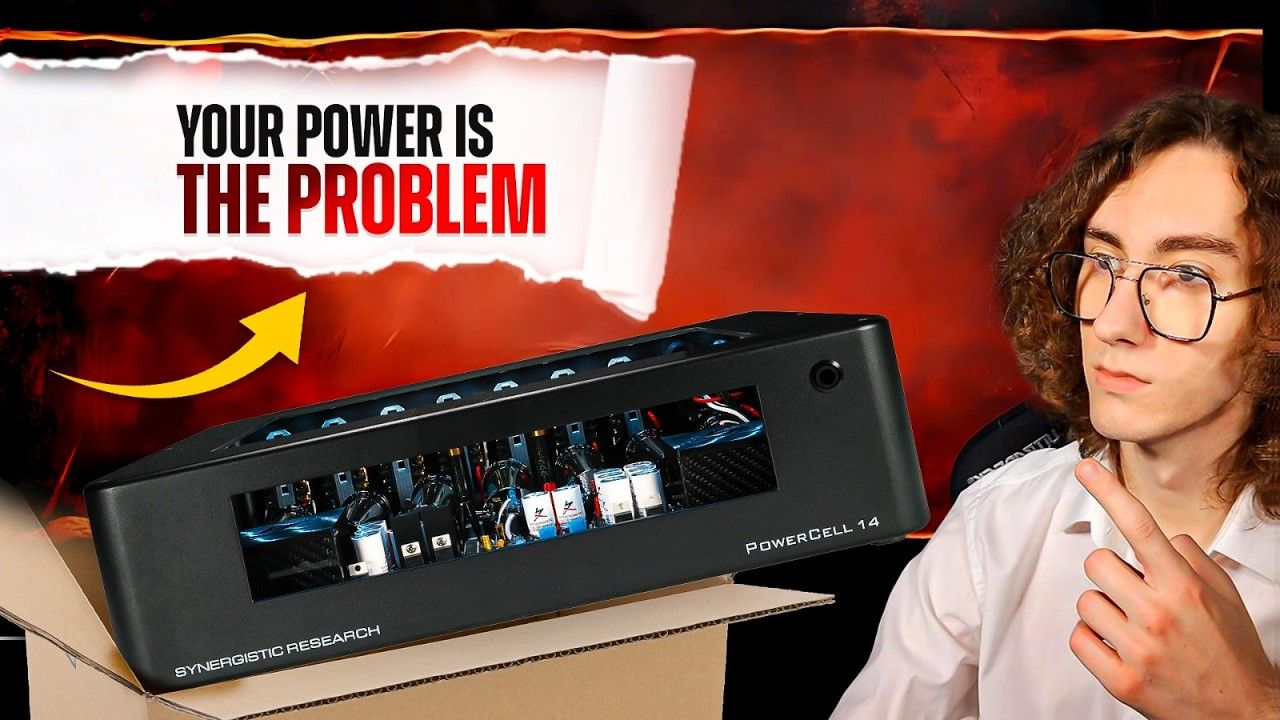
Synergistic PowerCell 14 Review: A $15K Power Strip?
A 14-outlet flagship power conditioner with seven SRX folded EM cells, ULF+DC biasing, graphene treatment, and a silver matrix ground strap - a tier above any 'power strip'.
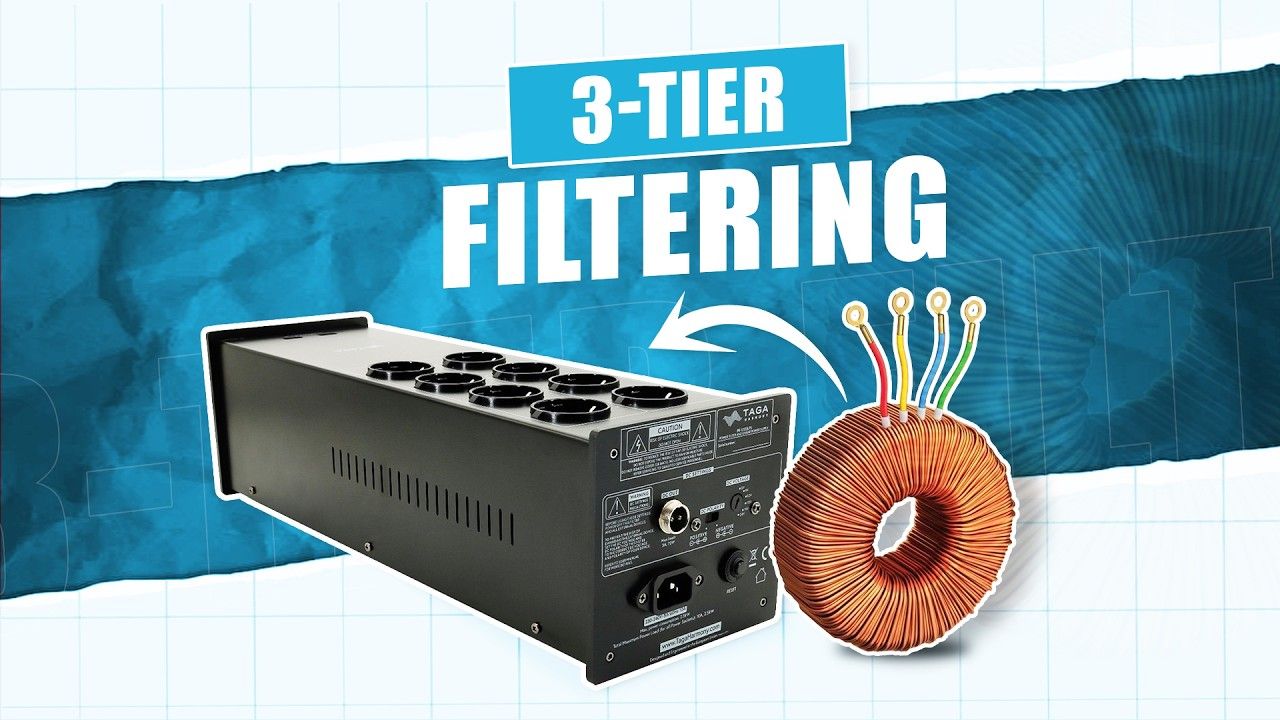
Taga PF-1000LPS Review: 5 Reasons You Need This
A serious 8-outlet power conditioner with a linear DC/USB supply, 3-tier filtering, audiophile fuses, and a phase detector - real protection and a measurable noise drop.