Austrian Audio OC16 Review: A $449 Condenser With a Hand-Built Vienna Capsule
A $449 cardioid condenser built around the CKR6, a ceramic-ring capsule hand-assembled and measured in Vienna: 148 dB max SPL, 14 dB(A) self-noise, one high-pass filter.
higher than 73% of everything we have tested
- Standout
- CKR6 ceramic-ring capsule, hand-assembled and individually measured in Vienna
- Watch out for
- One polar pattern, one switch and no pad
- Better alternative
- Denafrips Hermes 12th Anniversary: $450 more, scores 0.2 higher.
Is it for you?
- You want the balance to lean bright, with the detail pushed forward
- You're treble-sensitive
Tick anything that sounds like you.
Austrian Audio OC16 - reviewed by Jakub Charkiewicz for The Audio Stuff. Score 8.7 out of 10, Highly Recommended. Full review: https://theaudiostuff.com/reviews/austrian-audio-oc16/
Pick #2 of 5 in our Best Audio Sources guide, where 1 product ranks above it.
In 2017, Samsung shut down AKG's Vienna operation. Twenty-two engineers refused to quit - this $449 mic is their revenge.
Design and Build Quality: A Flat Slab, Not a Tube
Strong point: Metal build with no rattles, plus shockmount, clip and semi-rigid case in the box
Watch out: The bulky elastic shockmount is thin plastic and sags under an unsupported XLR
The shape is the first surprise. Almost every condenser in this class is a round tube. The OC16 is a flat black slab with round edges, and it generally looks like nothing else on a mic stand. Given who founded this company, people expect a C414 lookalike. It isn't one.
The weight is the second surprise. It's compact, and heavier than the size suggests. It's a metal construction, and nothing rattles when you shake it. I'll be honest though - it doesn't feel hand-built, and it isn't. Austrian Audio moved assembly of their affordable models to China a few years back to hit prices like this, and the OC16 feels exactly like that done right. The one part that never left Vienna is the capsule, and we'll get there.
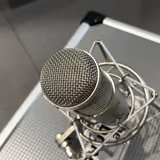
The bundle is where they got generous. In the box you get an elastic spider style shockmount, a small hard clip mount, and a hard storage case that has foam inside with a mesh pocket. The case is of reasonable quality, semi-rigid, keeps its shape, and I wouldn't worry about it if I traveled with it in my backpack. The clip might look like an afterthought, but it's the piece you'll grab most, because it fits where the elastic mount can't.
The elastic mount is the only weak link of the whole package. It's bulky, yet the plastic is rather thin. If you hang a thick XLR off the back without strain relief, the whole cage sags and twists under the cable. It still does its job, it keeps stand rumble out, and plenty of brands at this price hand you a clip and nothing else.
Finally, the warranty - two years standard, but three if you spend a minute registering.
Features: One Switch, and a Capsule That Never Left Vienna
Strong point: CKR6 ceramic-ring capsule, hand-assembled and individually measured in Vienna
Watch out: One polar pattern, one switch and no pad - beaten on feature count by far cheaper mics
On a comparison chart, the OC16 loses to mics costing a third as much. You get one polar pattern, one switch, and no pad, while a $150 Audio-Technica gives you more things to click. So if you shop by feature count, I'll save you a few minutes right now - this isn't your mic. Because the whole argument for this microphone is a single component, the one I said never left Vienna.
AKG's most famous capsule was the CK12, the brass ring capsule inside the C12 and the early C414s. When one came out right, it went on to make records you've definitely heard. The problem was "when". It was so hard to build consistently that AKG eventually redesigned it in nylon, and a lot of engineers will tell you something got lost in that move.
So when those 22 engineers started their own adventure at Austrian Audio, this was one of the first problems they tackled. They kept the idea and threw out the brass, building the ring from ceramic instead, which doesn't drift and can be machined to tolerances brass never allowed. The result is the CKR6. Each one is assembled by hand in Vienna and individually measured before it's allowed to leave the building, and it's the exact same part they screw into the $899 OC18. If you were waiting for the revenge part from the intro, you're looking at it.
Everything else on this mic exists to stay out of that capsule's way. The see-through headbasket is what they call Open Acoustics, and it's not a styling choice. Inside a normal basket, sound bounces off the frame and hits the diaphragm again a split second late, smearing things. Their fix was to delete as much basket as physically possible. The one switch on this mic is a high-pass filter with two settings, 40 and 160 hertz, and you'll hear what both do later on.
And the pad isn't missing by accident, it's missing because the mic doesn't need one. This thing will be totally fine sitting right next to a cranked amp, and the actual number it tolerates will be disclosed in just a moment. It's a silly number.
Technical Specs: 148 dB of Headroom, 14 dB of Hiss
Strong point: 11 mV/Pa output, about ten times an SM7B, so a budget interface has gain to spare
The mysterious number is 148 decibels, that's how much sound pressure it can tolerate. Everybody can read that from the spec sheet, yet almost nobody explains it, so here's what that means.
Max SPL is how loud a sound can get before the mic stops capturing it cleanly. Past that point the circuit inside runs out of juice and the output becomes distorted. The mic will just stop telling the truth and introduce unwanted "character". As for some kind of scale... A snare from two inches (or 5 centimeters) away peaks around 125. Inside a kick drum you're pushing 140, which happens to be where human ears take permanent damage instantly, not over time. Those are the loudest jobs in recording, and they're the whole reason pad switches were invented. This mic takes 148dB without it. In practice, nothing you own can clip it, unless you try on purpose. It means every distorted take you've ever recorded clipped somewhere else, and I'll show you where in a second.
The bottom of the sheet says 14 dB(A) of self-noise. That's the mic's own hiss. Any computer fan, fridge, or even the AC will mask the self noise completely.
Something fun about those numbers, is that the loudest sound this mic can take has about five million times the pressure of the noise floor it creates. I checked that twice, because it looks like a typo. Five million.
Sensitivity is the last number worth caring about - 11 millivolts per pascal. That's just how strong a signal it sends down the cable, and 11 is a lot. The SM7B, the mic that made half its users buy gain boosters, puts out about a tenth of that. A basic Scarlett, or Behringer audio interface runs this one with a bunch of gain headroom.
And that's where your distorted takes come from. A signal this hot with improperly set gain clips the interface, not the mic, so learn how to properly set your gain.
The OC16 is Cardioid only, has a regular XLR port, and weighs 335 grams. Which leaves frequency response, 20 to 20,000 hertz.
Sound Quality: Lean Bass, Neutral Mids, a Bright Top
Strong point: Presence lift, sibilance dip and air lift already built into the response
Watch out: Leans bright, so fresh strings or cheap cymbals can get edgy
Every mic in this class prints those exact same numbers, and none of them sound alike. What matters is the shape in between, so let's go bottom to top.
The low end is generally flat, and honestly, a little lean for my taste - you get exactly the bass the source produced, and no added warmth on top. It's great on boomy sounding stuff, although less flattering on a thin voice. Luckily the fix is built into the physics - get closer. Every cardioid gets bassier up close - and because the low end here is so well-controlled, that proximity becomes an actual bass knob. When you lean in the voice fills out, when you back off and it gets more neutral.
40 works below almost anything a voice produces, its job is rumble, footsteps and outside noise. On phone, or laptop speakers you can't hear it at all anyway. 160 is the one you can clearly hear. From a distance it makes the voice thinner, but right up on the mic it just removes the extra muddiness.
The mids are mostly neutral, maybe pulled back ever so slightly. That helps nasal or mid-heavy voices, and it's part of why guitars sit in a mix so easily. But if you're after that thick, forward, vintage midrange, this is not that microphone.
The top end is where you can tell someone really thought about this. There's a small push around 5 kilohertz for presence. Then a deliberate dip between 6 and 7, exactly where S sounds get sharp. Then it comes back up around 12 for air. That's the EQ most engineers would apply to a vocal afterwards, except here it's built into the mic.
That's why voices come out sounding a bit finished already, and any professional singers will immediately like it in their headphones. But to be fair - this mic leans bright, and bright is a matter of taste. On sources that are already sharp, like an acoustic with fresh strings or cheap cymbals, that top end can get edgy - though it's not nearly as extreme as LEWITT microphones, the legendary Sony C-800G or Manley mics. So if you usually boost treble while mixing, go easy, some of it is already in there.
One warning that comes with any mic this detailed - it records your room just as accurately as it records you, and thanks to that open basket, whatever leaks in from the sides sounds just as clear. It can be great on a drum kit, but possibly a bit undesirable in an untreated bedroom. Although having such even off-axis roll-off helps in post production more than it hurts, it's an important thing to be aware of. If your room isn't great, you can get closer, flip the 160 Hz filter on, or finally acoustically treat your place a bit, because this mic will pick up whatever you leave in there.
And since we started with the Samsung story, let's finish it. They decided this sound wasn't worth keeping. Here we are, nine years later, where it's built more consistently than AKG ever managed, it costs $449, and honestly - I think they won.
Sound signature
How it sounds, by the numbers we use: auto-derived from the language used across the full review. Each axis runs from one descriptor to its opposite; the polygon's shape is the signature's fingerprint - pulled out toward whichever side the review's language leans, pulled in toward centre when it sits balanced.
- Warm ↔ Bright Leans bright
- Relaxed ↔ Analytical Leans analytical
- Polite ↔ Aggressive Leans aggressive
- Lean ↔ Bass-heavy Sits close to centre
- Intimate ↔ Wide stage Neutral, no clear signal in the review language
Never sure what "bright, analytical, aggressive" actually sounds like? This plays a short synthesised loop flat, then with those leanings dialled in, so you can hear the difference the words are describing. It is an illustration of the vocabulary, not a recording of the OC16 and not a measurement.
Not sure which signature suits you? Find yours with a blind A/B test
Watch the video review
Subscribe on YouTube (opens in new tab)Prefer to read? The written review above is a complete text version - everything covered in the video is in the article.

- 0:00 The Best Condenser Microphone Under $500? (opens in new tab)
- 0:18 Design & Build Quality - Shockmount, Metal Construction, Weight, Flat Shape (opens in new tab)
- 2:19 Features - High Pass Filter, Open Acoustics Concept, Ceramic CKR6 Capsule (opens in new tab)
- 4:51 Technical Specs - XLR Connector, Polar Pattern, Sensitivity, Self Noise, Max SPL (opens in new tab)
- 7:30 Sound Quality - Unique Presence Boost, Midrange Control, Proximity Effect, Linear Bass (opens in new tab)
New gear lands on @TheAudioStuff (opens in new tab) first - every written review gets a video companion on the same chain.
Common questions about the OC16
Is the Austrian Audio OC16 worth it?
Yes. It scored 8.7/10, Highly Recommended, higher than 73% of everything we have tested, against a catalogue median of 8.1. On value it rates fair: mid-pack for the price in sources. Price: $449.
Who should buy the Austrian Audio OC16, and who should skip it?
Buy it if you want the balance to lean bright, with the detail pushed forward. Skip it if you're treble-sensitive.
What else have you tested that is close to the Austrian Audio OC16?
There is no head-to-head page for this one yet, and nothing we have scored sits close enough in price to call a direct rival. The nearest reference points in the same category: the Yellowtec PUC2 Mic LEA at 8.6/10, the Denafrips Hermes 12th Anniversary at 8.9/10, and the t.bone SCT 2000 at 8.1/10.