Denafrips Enyo 15th Review: A True Balanced R2R DAC at $699
A $700 true balanced R2R ladder DAC with an O-Core transformer, I²S input, and a natural, musical sound that easily competes with delta-sigma converters costing far more.
higher than 92% of everything we have tested
Value Steep. You are buying performance here, not value.
- Standout
- Thick anodized aluminum chassis
- Watch out for
- I²S pinout isn't standardized
- Closest rival
- Henry Audio DA 256: leans more analytical, $1,000 more, scores 0.9 lower.
Is it for you?
- You want the balance to lean warm, with the top end eased
- You want every last bit of treble detail
- $699 has to buy value as well as performance
Named Best Overall in our Best DACs guide, ahead of 7 others.
R2R DACs are associated with expensive, high-end audio devices that provide a distinct sound compared to delta-sigma converters. The Denafrips Enyo 15th is priced at just $700 - rather low for an R2R DAC. But is this budget option a smart choice? Let's check it out.
Design & Build Quality: Thick Aluminum, Zero Plastic
It's clear that Denafrips has paid much attention to the physical aspects of this DAC. This isn't just about how it sounds - it's about the entire experience.
The first thing you'll notice is the redesigned chassis. It's constructed from thick aluminum. This isn't thin sheet metal - it's substantial and feels incredibly solid. It's very heavy, probably in part because of the big O-Core transformer. Regardless, it's dense, nothing rattles inside and there's no ringing when you tap it. The anodized finish, combined with a brushed texture, gives it a sleek, premium look and also provides a durable, scratch-resistant surface. You won't scratch it easily like some super smooth, thin, painted metal surfaces.
The front panel is clean and minimalist, featuring only the necessary elements. There's a standby button, some functionality controls, input selectors, and a mute button - none of which have any plastic parts. As you can see that seems to be a trend with all Denafrips electronics - they hate plastic, and not just low-quality crap, they hate every type of plastic - and I love that approach. These buttons have a strong tactile feel. They're firm and responsive, with almost no wiggle or play.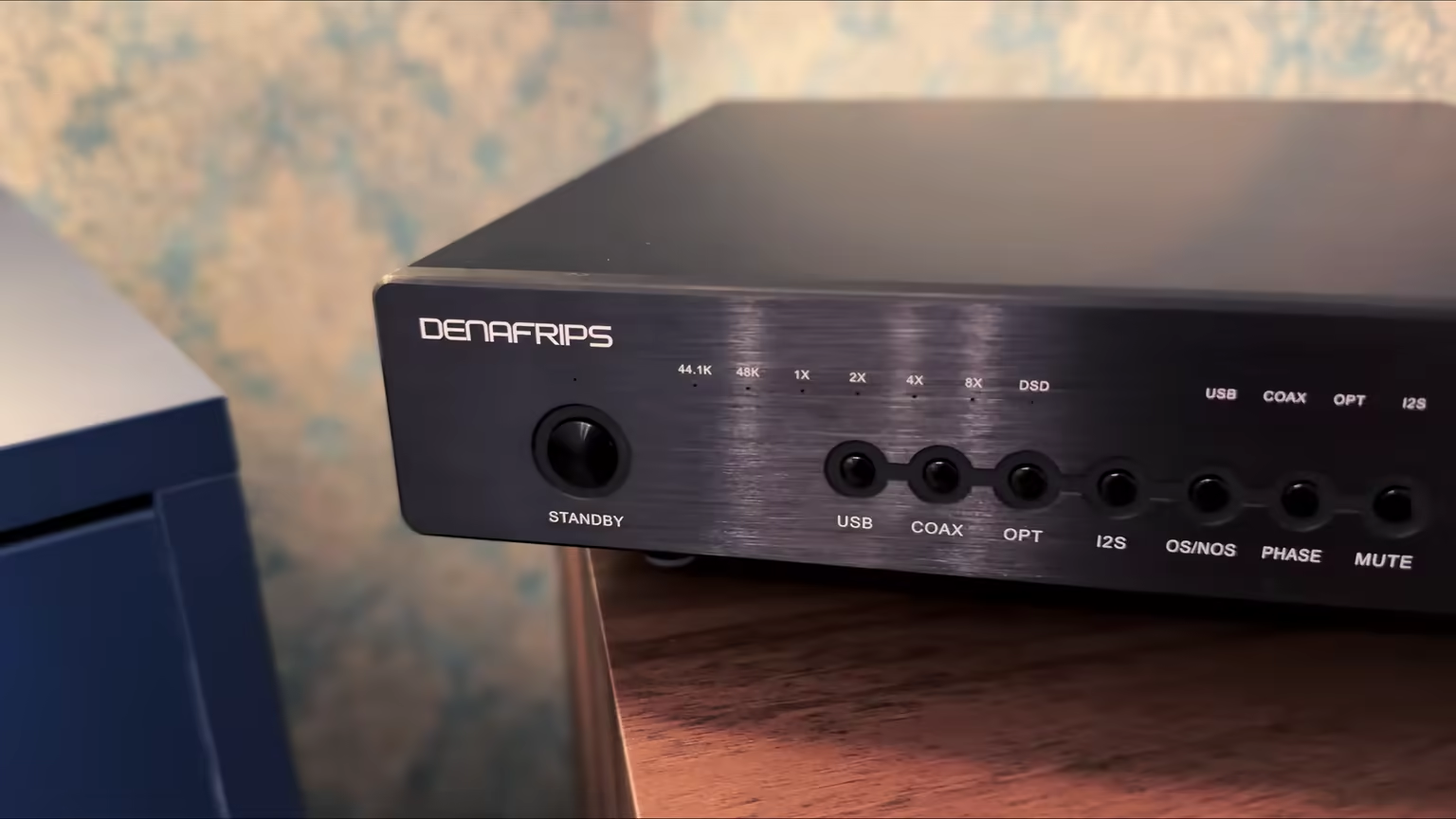 (view larger)
On the front, we also have indicator LEDs that glow in red. They are just about perfect brightness to be seen easily and not to be annoying or disturbing, even at night, when it's dark. I used to have a device in my bedroom, that had blue lights so bright, I had to plug it out every time I wanted to sleep, here you get none of that - they nailed it.
Now, let's take a look at a seemingly small detail that makes a big difference in the overall stability and possibly even sound performance of the Enyo: the feet. This might seem trivial, but it's an important aspect of build quality, especially for audio equipment. It utilizes a four-foot design. This is a significant improvement over some other Denafrips models, which have used a three-foot configuration. While a tripod design can be somewhat stable, it's inherently more susceptible to rocking and I'm not a fan. If having 3 feet instead of 4 is beneficial to sound in any way, then I guess it's fine - but here they went with 4, which's of course better for stability.
Each foot incorporates a rubber or silicone insert - you get some extra in the box, in case you lose them, as they are friction-fitted. This material matters for several reasons. First, it provides excellent grip. This prevents the DAC from sliding around on your shelf or stand, even if it's a slightly polished or smooth surface. This is particularly important when connecting or disconnecting cables, as you don't want the unit shifting around and sliding away from you.
The last important element on the bottom is the voltage selector. They make universal devices that work all around the world with just a switch of... a switch.
Inputs & Outputs: USB, Coax, Optical, and I²S
First, we have the USB input - this is probably the most common way to connect a computer or laptop. It supports high-resolution audio formats and is generally plug-and-play with most operating systems.
Next is the Coaxial input. This uses a standard RCA connector and transmits digital audio via an electrical signal. It's a common connection for CD transports, DVD players, and other digital audio sources.
We also have the Optical input, also known as TOSLINK. This uses light to transmit the digital signal. It's often used for connecting TVs and gaming consoles.
What's interesting though, the Enyo 15th includes an I²S input. This is a digital connection that separates the clock and data signals, resulting in potentially lower jitter and improved sound quality compared to other digital inputs. I²S is the best digital connection, but it's important to note that it's not standardized, so you'll have to mess with the pinout modes, but you absolutely can do that to match your source and make it work.
Finally, we have single-ended RCA outputs and balanced XLR outputs. Both are very high quality with those large, extended RCAs and Neutrik-branded XLRs.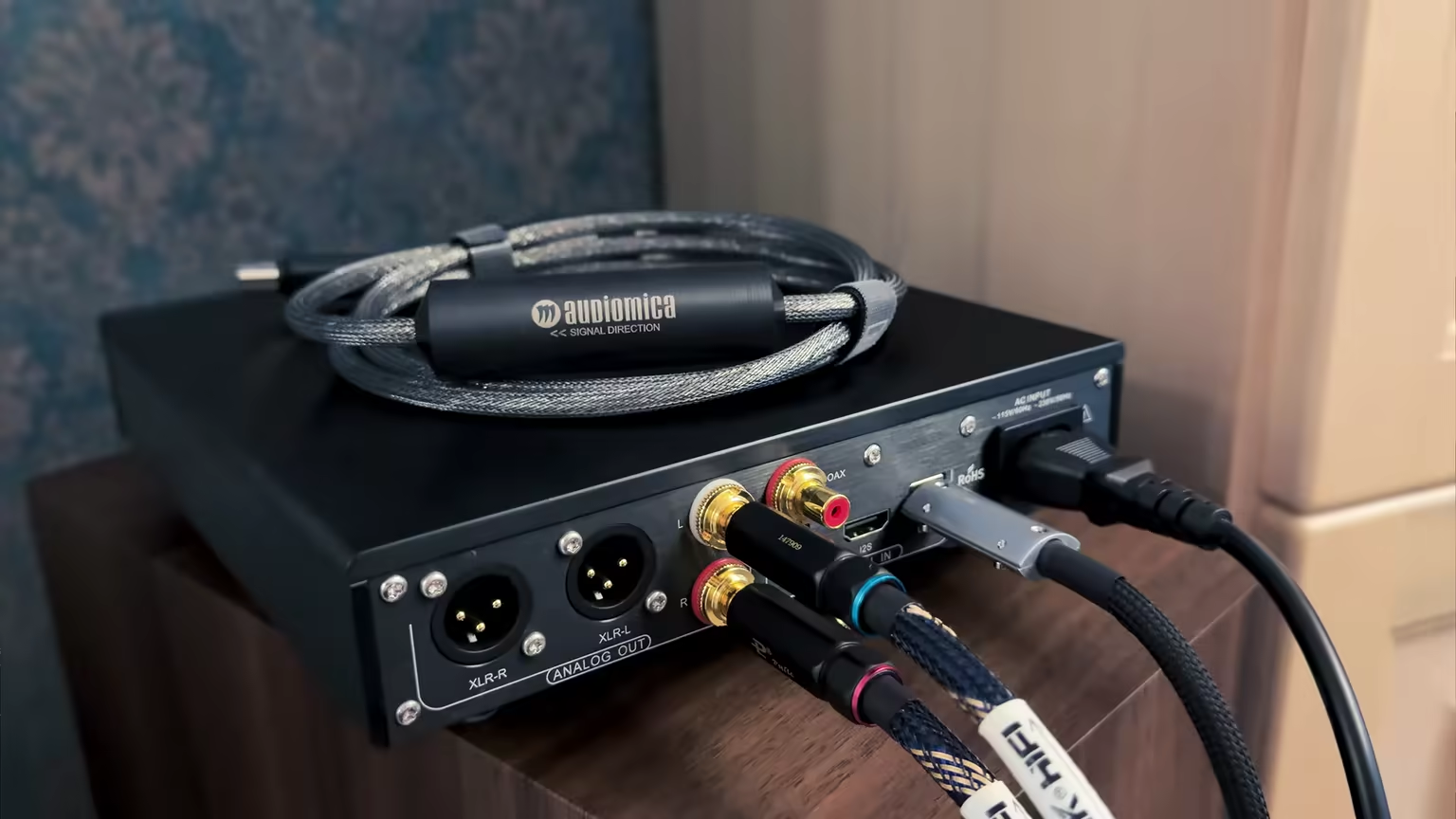 (view larger)
Technologies: R2R Ladder, NOS Mode, O-Core Power
This DAC isn't just about high-quality components - it's about the specific design choices that Denafrips has made.
The heart of the Enyo 15th is its true balanced R2R ladder DAC design. This is a fundamentally different approach to digital-to-analog conversion compared to more common delta-sigma DACs. R2R DACs use a network of precisely matched resistors to convert digital signals into analog. Each resistor in the 'ladder' network represents a binary bit, and the combination of these resistors creates a precise analog voltage. This architecture is known for its natural, analog-like sound, which is smoother and more musical than delta-sigma designs.
The Enyo 15th also offers selectable oversampling (OS) and non-oversampling (NOS) modes, as well as slow and sharp filter options. Oversampling increases the sampling rate of the digital signal before conversion, which can help reduce aliasing artifacts. NOS mode, on the other hand, performs the conversion without oversampling, which only R2R DACs can do, resulting in more 'raw', warm, and direct sound. The slow and sharp filters further allow you to fine-tune the sound to your preferences and system synergy.
The power supply is the foundation of any audio device, and a high-quality transformer is essential for delivering clean and stable power to the sensitive circuitry. Denafrips has chosen to use a 60VA O-Core transformer, and there's a good reason for that. O-Core transformers have a unique shape that minimizes electromagnetic interference (EMI) and electromagnetic fields (EMF). This matters in audio equipment because these types of interference can introduce unwanted noise into the audio signal.
As this is the 15th-anniversary edition, Denafrips has also implemented several key upgrades, including a fuse upgrade, circuit optimization, and the use of upgraded decoupling and custom capacitors. These enhancements further refine the performance and contribute to the improved sound quality compared to the standard Enyo.
Technical Specifications: DSD1024, 115dB SNR, 0.01% Resistors
While technical specs don't always tell the whole story, they do provide some valuable insights into the DAC's capabilities. The Enyo 15th uses a true balanced 24-bit R2R ladder DAC design with 6-bit DSD processing. This ladder utilizes low thermal effect, high-precision hand-matched 0.01% tolerance resistors. That's key to the accuracy and linearity of the R2R conversion process.
In terms of digital format support, it handles DSD up to DSD1024 and PCM up to 1536kHz, specifically through the I²S and USB inputs - it means that you can use the NOS mode and have lots of fun with upsampling your files using HQPlayer.
The analog outputs offer 2.0Vrms on RCA and 4.0Vrms on XLR, with output impedances of 625Ω and 1250Ω, respectively. These output levels are standard for most audio equipment.
Finally, we have some key performance metrics: a signal-to-noise ratio of 115dB, a dynamic range greater than 119dB, and a stereo crosstalk of -124dB. It's not a measurement monster, but for a budget R2R DAC it does amazing.
Sound Quality: Natural, Musical, with Serious Bass
Now, for the most important part: how does it sound? If it's so cheap, so well built, so good measuring, it must sound trash, right? But no - this is where the magic happens, and I have to say, I'm absolutely in love with this DAC. It's truly a special listening experience.
From the very first notes, what strikes you is the naturalness and musicality of the sound. It doesn't sound digital or sterile like some chip-based DACs can. Instead, it presents music with a sense of warmth, texture, and realism that's incredibly engaging. It's almost like the musicians are right there in the room with you.
Let's start with the bass, as that's what it truly shines at - if I had to pick one thing I love about it, it'd be just that. The Enyo delivers bass with remarkable extension and control. It digs deep, reaching down into the sub-frequency rumbles with authority. You can feel the bass, not just hear it. But it's not just about quantity - it's about quality. The bass is tight, defined, and textured, with very little bloat and no muddiness. It provides a solid foundation for the music without overpowering the other frequencies. It's not as clean as some other gear, but some like it dirty and rough - even I do!
The midrange, where vocals and many instruments reside, is simply stunning. Vocals sound incredibly natural and lifelike, with a palpable sense of presence and emotion. Instruments like guitars, pianos, and saxophones have a rich, organic tone that's incredibly pleasing to the ear. There's a level of detail and nuance in the midrange that I haven't heard from many other DACs.
Soundstage and Imaging: Wide, Layered, Beyond the Speakers
The soundstage is another area where the Enyo 15th excels. It creates a wide and spacious soundstage, extending well beyond the boundaries of the speakers. Instruments are placed precisely within this soundstage, with a clear sense of separation and air between them. This creates a truly immersive and three-dimensional listening experience.
And that's the real deal - having a resistor ladder, rather than some tiny chip, helps A TON. I'd go as far as to say that you can't have good depth and seriously good width on any chip-based electronics. It truly adds a layer of depth and dimensionality to the music, while it's rather shallow, it's not 2D. You can hear the layers of instruments and vocals, and it creates a much more realistic and engaging presentation.
It's hard to put into words just how much I enjoy listening to music through the Enyo 15th. It's a DAC that connects you with the music on an emotional level. It's not just about technicalities - it's about the feeling, the emotion, the connection. It's a DAC that I can listen to for hours on end without fatigue, simply lost in the music.
Is the Enyo 15th Worth It?
So, the big question: is the Denafrips Enyo 15th worth it? In my opinion, absolutely. This DAC offers a truly exceptional listening experience, combining a natural and musical sound signature with solid build quality and a complete feature set. For my system, and for my personal preferences, I would choose the Enyo 15th over any delta-sigma DAC, any day of the week.
Sound signature
Derived from the words this review uses: each axis runs between two opposite descriptors, and the shape leans toward whichever side the writing does.
- Warm ↔ Bright Leans warm
- Relaxed ↔ Analytical Leans relaxed
- Polite ↔ Aggressive Neutral, no clear signal in the review language
- Lean ↔ Bass-heavy Neutral, no clear signal in the review language
- Intimate ↔ Wide stage Leans wide stage
Hear what "warm, relaxed, wide stage" means: a short synthesised loop, flat and then with those leanings. An illustration of the words, not a recording of the Enyo 15th Anniversary.
Not sure which signature suits you? Find yours with a blind A/B test

Watch the video review
Subscribe on YouTube (opens in new tab)Prefer to read? The written review above covers everything in the video.

- 0:00 Are R2R Ladder DACs Better? How about budget DACs? (opens in new tab)
- 0:18 Design & Build Quality (Anodized Aluminum Scratch-Resistant Finish, Front Panel Controls, Feet) (opens in new tab)
- 3:34 Inputs & Outputs (Asynchronous Digital, Optical Fiber, I2S, High-Quality Analog Outputs) (opens in new tab)
- 4:36 Technologies (15th Anniversary Upgrades, Special Resistors, NOS, Oversampling Filters, PSU) (opens in new tab)
- 6:32 Technical Specification (True Balanced Construction, Precision, THD+N, SNR, PCM, DSD Rates) (opens in new tab)
- 7:43 Sound Quality (Musicality, Warmth, Bass Extension, Midrange Texture, Treble Smoothness, 3D) (opens in new tab)
Common questions about the Enyo 15th Anniversary
Is the Denafrips Enyo 15th Anniversary worth it?
Yes. It scored 9.1/10, Highly Recommended, higher than 92% of everything we have tested, against a catalogue median of 8.1. On value it rates steep: better value exists in DACs, so you are buying performance here, not value. Price: $699.
Who should buy the Denafrips Enyo 15th Anniversary, and who should skip it?
Buy it if you want the balance to lean warm, with the top end eased. Skip it if you want every last bit of treble detail, and $699 has to buy value as well as performance.
What else have you tested that is close to the Denafrips Enyo 15th Anniversary?
There is no head-to-head page for this one yet, and nothing we have scored sits close enough in price to call a direct rival. The nearest reference points in the same category: the Henry Audio DA 256 at 8.2/10, the SMSL DL100 at 8.2/10, and the SMSL DO100 PRO at 8.0/10.
Is the Enyo 15th's I²S input worth the hassle?
Yes, if your source has one. I²S separates the clock and data signals, which means potentially lower jitter and better sound than any other digital connection - it is the best input on the box. The catch is that the standard is not standardised: the pinout varies between manufacturers, so you will have to work through the pinout modes to match your source. You absolutely can make it work, it is just not plug-and-play the way USB is.
Does the Enyo 15th's high output impedance matter?
It depends entirely on what you feed. The outputs are 625Ω on RCA and 1250Ω on XLR, which is high - the usual rule is that the load downstream should be at least ten times the source impedance, so a power amplifier or preamp with a low input impedance can roll off the bass here. Most modern gear is fine. Check the input impedance of whatever comes next before you buy, because this is the one specification that can genuinely bite.
Is the Enyo 15th's bass clean?
Not entirely, and I like it that way. It digs deep with real authority - you feel the sub-bass rather than just hearing it - and it stays tight, defined and textured with very little bloat and no muddiness. But it is not as clean as some other gear at the price, and if your priority is a perfectly sterile bottom end you will hear that. Some people like it dirty and rough. I am one of them, and it is the single thing I love most about this DAC.
What do the OS, NOS, slow and sharp modes do?
They let you tune the converter to your system rather than accept one voicing. Oversampling raises the sample rate before conversion, which helps suppress aliasing artefacts. NOS converts without it - something only R2R designs can do - and gives a rawer, warmer, more direct sound. The slow and sharp filters are a further adjustment on top. None of it is a gimmick; it is the reason the same box can suit two very different systems.
Does the Enyo 15th measure well?
Well enough, and that is not what it is for. Signal-to-noise is 115dB, dynamic range is better than 119dB and stereo crosstalk is -124dB - not a measurement monster, and genuinely impressive for a budget R2R design. Treble extension falls short of the best delta-sigma converters. What the ladder buys you instead is the resistor precision: hand-matched 0.01% tolerance resistors with low thermal drift, which is what makes an R2R conversion linear.
Why does the Enyo 15th have four feet?
Stability, and it is a real improvement over the three-foot configuration some other Denafrips models use. A tripod is stable in principle but inherently more prone to rocking. Each foot takes a friction-fitted rubber insert - spares come in the box, since they can be lost - and the grip keeps a heavy unit from sliding on a polished shelf when you are pushing stiff cables into the back. Small detail, and it is the kind that separates considered design from assembled parts.
Can the Enyo 15th replace a much more expensive delta-sigma DAC?
For my system and my preferences, I would take it over any delta-sigma DAC any day of the week. The sound is natural and musical rather than digital or sterile, the midrange is stunning, and the soundstage extends well beyond the speakers with genuine depth and layering. My honest view is that you cannot get depth and width like this from a chip-based design. If you want the cleanest possible measurements, that is a different purchase.
If you're interested in this
All 8 DACs reviewsClosest alternatives