
Denafrips Hades 12th Review: The R2R Preamp That Changes Things
A pure Class A, fully balanced, true discrete preamp with a 60-step relay-based resistor ladder volume control - perfect channel balance, 0.00045% THD, 122dB SNR.
higher than 86% of everything we have tested
Value Steep. You are buying performance here, not value.
- Standout
- Precision-machined thick aluminum chassis, no flex
- Watch out for
- Three feet instead of four
Is it for you?
- You are adding one piece to a system that already works
- You have a rack or a deep desk to give it
- You want one box that covers the whole chain
- It has to share a small desk, or move
Named Best Value in our Best Speaker Amps and Preamps guide.
You've probably heard of R2R DACs - known for their detail, texture, and musicality. But did you know some high-end preamps use the same resistor ladder concept for volume control? The Denafrips Hades 12th preamplifier does that - and it just might outperform traditional potentiometers in every way.
Design & Build Quality: Over-Engineered Aluminum
At a little over $1,300, the Denafrips Hades 12th might not be the most expensive preamp out there - but when you unbox it, it instantly feels like it is. True to Denafrips' reputation for over-engineering, this is a serious piece of gear in both design and execution.
The entire chassis is carved from thick, precision-machined aluminum. It feels solid, dense, and completely free of flex. The brushed finish has a fine texture that resists fingerprints and looks every bit as premium as higher-priced alternatives. No unnecessary decoration here - just clean lines with perfect symmetry.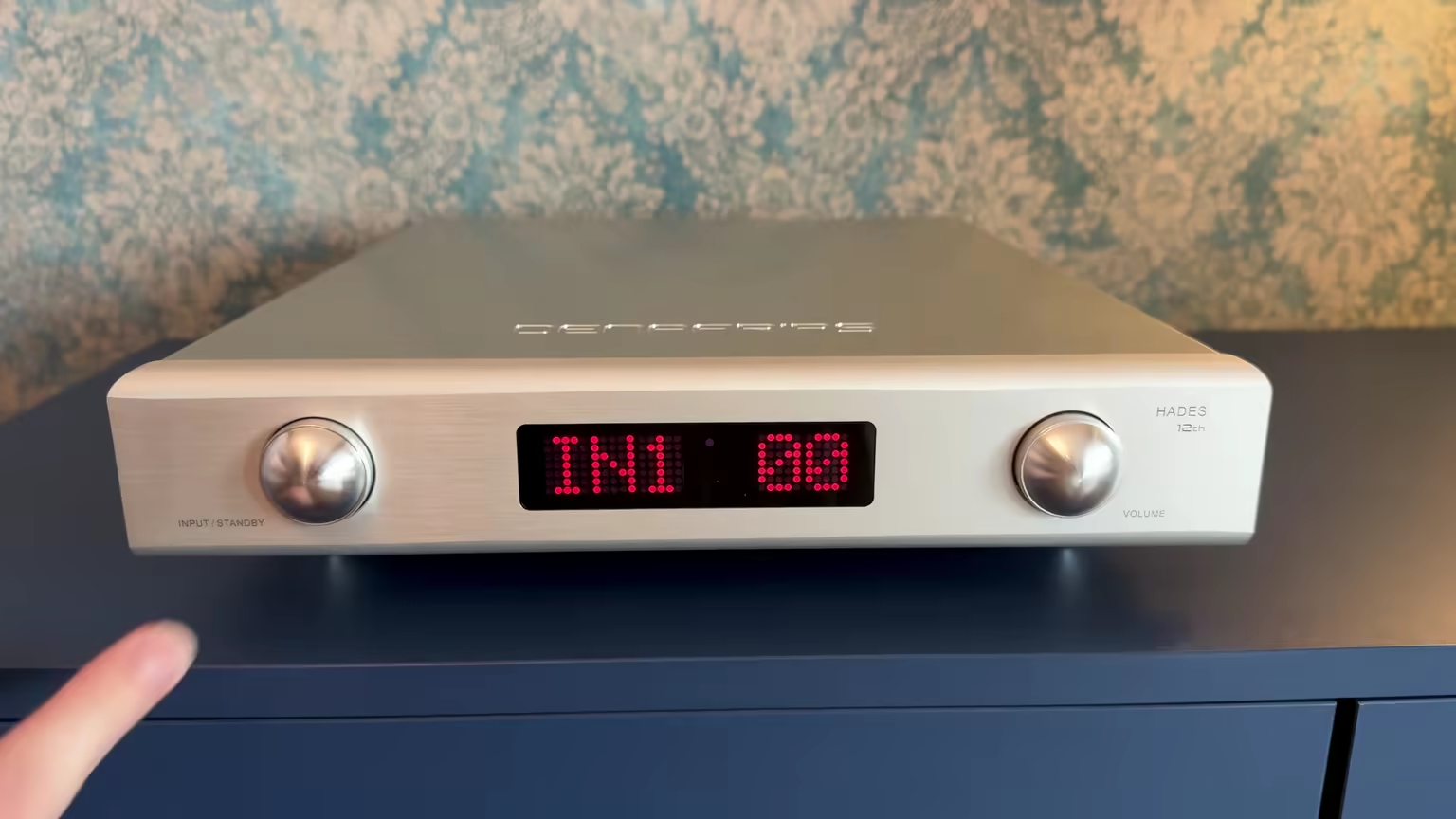 (view larger)
There's a subtle, purposeful elegance to how everything is laid out. The input and volume knobs have a matching weight and resistance to them - they don't just turn, they glide with a soft tactile click at every step. That isn't just satisfying - it corresponds to the 60-step relay-based volume control. Each click feels precise and deliberate. It makes you fully aware of the volume being changed.
Instead of the usual four feet, Denafrips went with three. While I don't love that approach, it has quite a few advantages. Three feet mean no wobble, even on slightly uneven surfaces. It also gives the unit a bit of isolation and mechanical grounding that's more stable than you'd expect. The whole thing sits firmly wherever you place it, and at 9 kilograms, it's not going to shift around easily.
Up front, you'll find a compact digital display that shows your current volume and input. You can control its brightness to make it visible across the room, but not so bright it's distracting. And then there's the remote - which isn't an afterthought. It's solid aluminum, matching the look and feel of the Hades itself. It has real weight to it, and the buttons give a firm, confident click. Setup is simple, switching inputs is instant, and there's no lag or glitchiness to deal with. It's a minimalist unit, but not in a way that sacrifices practicality. Everything you need is there - no screen clutter, no bloated features you'll never use. At this price, many preamps are still using off-the-shelf enclosures or cheap components, but not this one.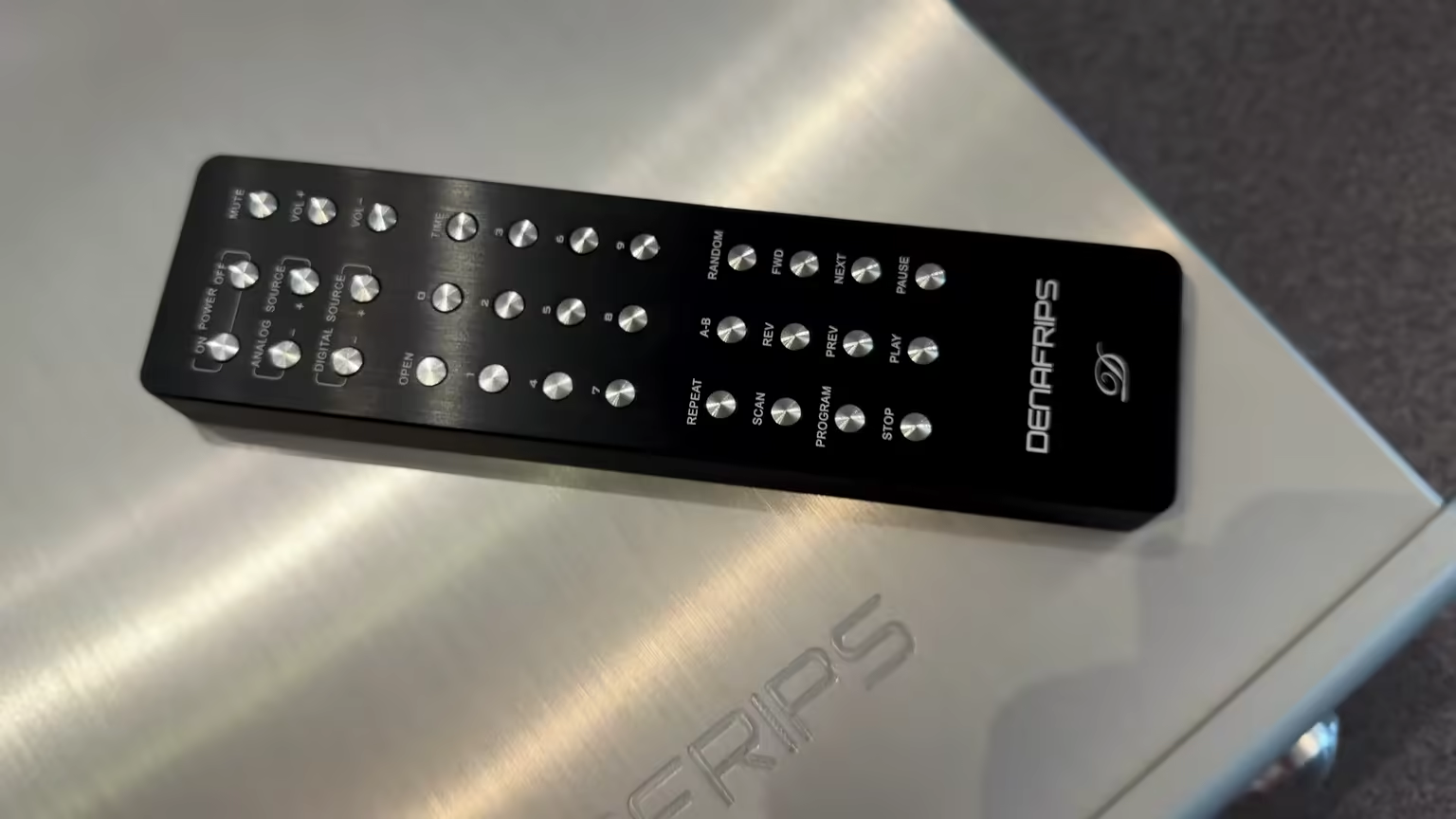 (view larger)
Inputs & Outputs: Deliberately Simple, Always Active
The Denafrips Hades keeps things simple on connectivity. On the input side, it offers two fully balanced XLR inputs and one single-ended RCA input. The XLR inputs are ideal for modern DACs and balanced sources, offering better common-mode rejection and lower noise, especially in systems with long cable runs or in electrically noisy environments. The RCA input adds flexibility, making it easy to integrate legacy gear or components without a balanced output.
On the output side, both balanced XLR and single-ended RCA connections are provided. These are always active, meaning you can feed different amplifiers, switch between systems, or test gear without swapping cables. All connections are solid, tight-fitting, and built to last.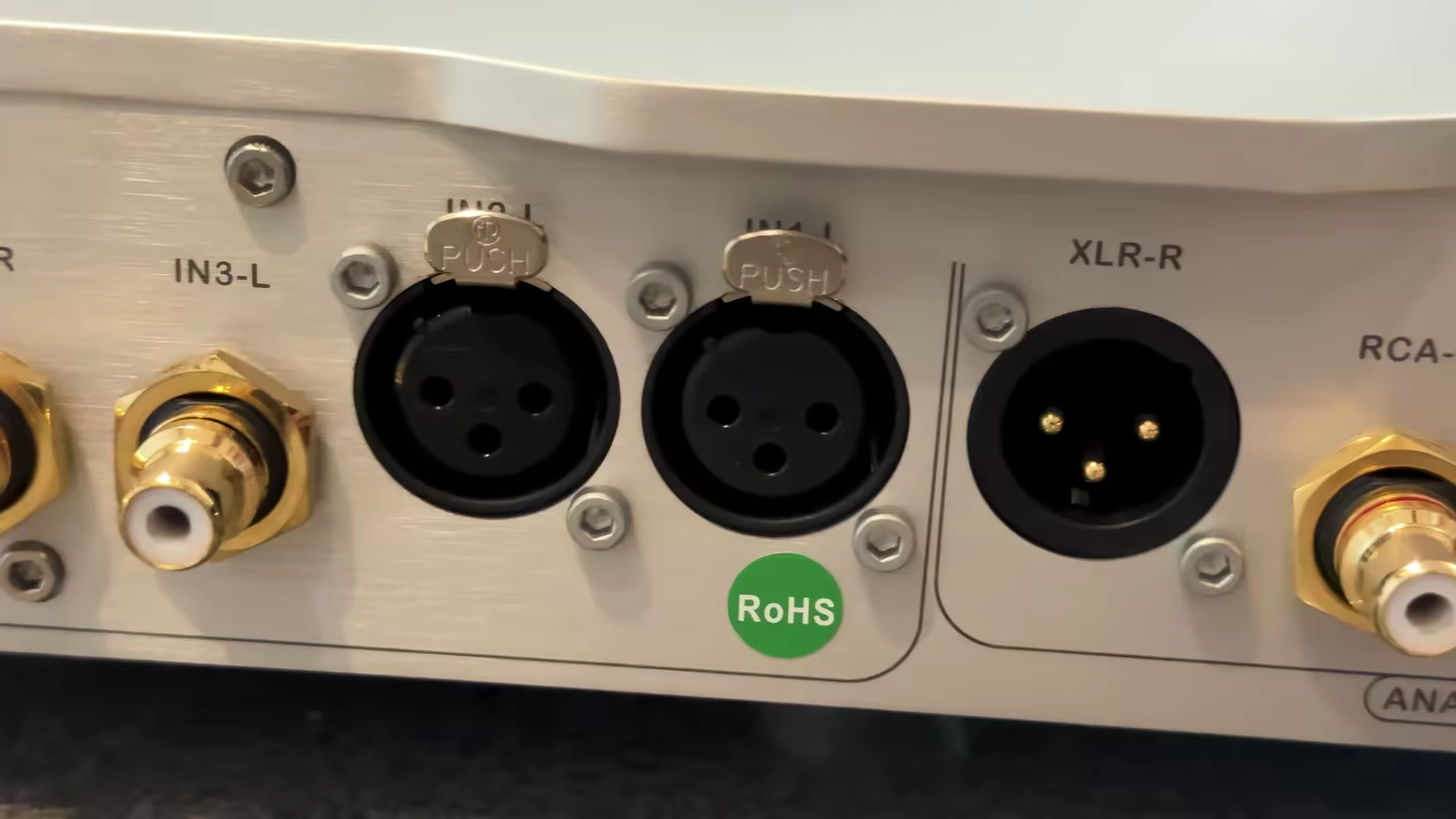 (view larger)
Technologies: The 60-Step Relay Volume Ladder
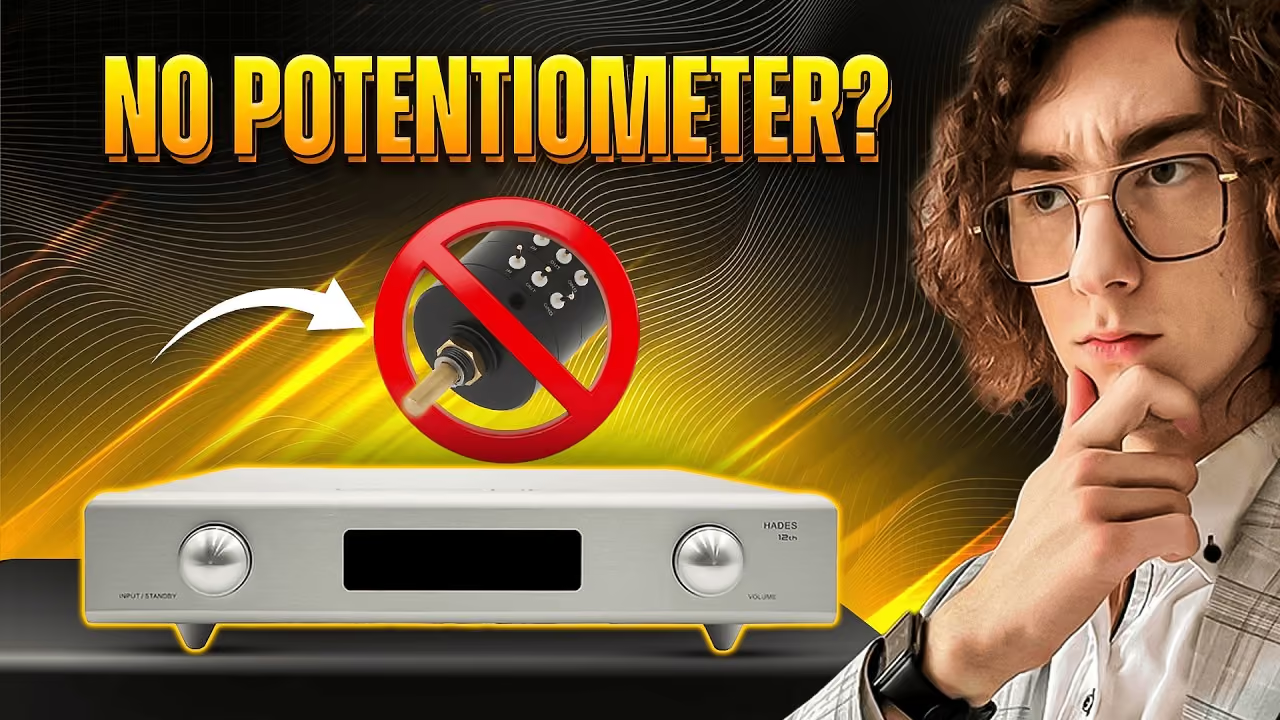
The most important part of the Hades is a relay-controlled stepped attenuator - a sophisticated, resistor-based volume control derived from Denafrips' R2R DAC experience. Instead of relying on a traditional potentiometer, this design switches between 60 discrete resistors using relays. The result? Accurate volume control, perfect channel balance, and no signal degradation.
It brings real sonic benefits: clarity, precision, and low-level detail retrieval at any listening level. The tactile clicks you hear when adjusting volume are relays engaging, because each step is physically switching a resistor in the signal path.
Power delivery is another key area where Denafrips goes above and beyond. The Hades uses a large 80VA O-core transformer - a custom-made component selected for its low noise and excellent regulation. Combined with a discrete linear power supply and tightly regulated internal voltage, this keeps the signal path ultra-clean and free from interference.
There's also a strategic decision to avoid gain - the Hades operates at unity gain, meaning it doesn't amplify the signal, it simply passes it along cleanly and transparently. It ensures compatibility with a wider range of amplifiers and source components without the risk of clipping or tonal coloration. But it also means that you might need to crank up the volume more than you expect on some lower gain amps.
Technical Specifications: 0.00045% THD, 122dB SNR
The Denafrips Hades is a pure Class A, fully discrete, true balanced preamp. That means there are no op-amps, no chips, and no shortcuts in the signal path - just carefully matched components operating in a linear, low-distortion fashion.
The internal volume control uses high-precision, through-hole resistors, offering an ultra-low THD of just 0.00045%, even at high volumes. That's an extremely low distortion figure, especially for an analog preamp, and it contributes to the clean, uncolored sound.
The signal-to-noise ratio sits at an impressive 122dB, which means background hiss and noise are practically non-existent, even in high-efficiency systems. You'll notice how quiet your system becomes between notes - an often-overlooked but highly revealing trait.
Output impedance is 200Ω for RCA and 400Ω for XLR, making the Hades compatible with a wide range of downstream amplifiers without any concern for loading or frequency roll-off. It doesn't matter whether your amp is solid state or tube, sensitive or power-hungry, the Hades will drive it.
With a frequency response of 10Hz to 85kHz, the Hades comfortably exceeds the range of human hearing, which means no part of the audible spectrum is rolled off - neither the sub-bass nor the air in the treble.
Power consumption is modest: 1 watt at idle, and 25 watts during operation, which is efficient for a Class A design.
Sound Quality: Space, Black Background, No Coloration
If you think preamps are supposed to be invisible, the Denafrips Hades will have you rethinking that. Not because it colors the sound - it doesn't - but because its presence is felt in how it refines and elevates the entire listening experience. Spatial cues, image stability, dynamic energy, tonal clarity - the Hades has a way of pulling you into the music without ever trying to impress.
One of its most standout qualities is the sense of space. This isn't just wide stereo separation - it's about the depth, the layering, the precise placement of instruments. You get a clear sense of front-to-back positioning and dimensionality. Imaging is laser-sharp without feeling forced, and the stage extends well beyond the speakers without ever becoming diffuse or vague.
There's also an unmistakable black background at play here - that dead-silent foundation that lets micro-details and decay trails hang in the air. Quiet passages feel intimate and controlled but explosive moments land with surprising impact.
Tonally, the Hades walks a smart line between neutrality and listenability. It's not warm, but it's not cold either. It offers a flat and honest frequency response, but there's a faint touch of smoothness in the treble that keeps things from sounding clinical. Cymbals, strings, and vocals all sound natural and present, without the exaggerated shimmer or sharpness you sometimes get with other gear in this price range. There's no midrange coloration, no softened bass, and no overly romantic presentation - just clarity and balance.
Dynamics: It Doesn't Shout, It Hits
Dynamics are another area where this preamp subtly excels. It doesn't shout, but it does hit - and hit hard when needed. Macro dynamics feel alive and uncompressed, while microdynamics come through with fluidity and resolution.
Verdict: More Room for the Music to Breathe
Across genres the Hades consistently managed to get out of the way and let the music come through. But when it comes to soundstaging, depth, and dynamic ease, it does more than simply step aside - it gives everything just a little more room to breathe.
Watch the video review
Subscribe on YouTube (opens in new tab)Prefer to read? The written review above covers everything in the video.
- 0:00 Are R2R Preamps The BEST for HiFi? (opens in new tab)
- 0:23 Design & Build Quality (Aluminium Chassis, Remote Control, Vibration Isolation Feet, LED Display) (opens in new tab)
- 2:38 Inputs & Outputs (Furutech IEC Power Inlet, High-Quality Analog Inputs + Outputs) (opens in new tab)
- 3:37 Technologies (60-Step Attenuator, R2R Volume Control, Unity Gain, Pure Class A, Balanced Topology) (opens in new tab)
- 5:09 Technical Specs (Discrete Components, Through-Hole Resistors, THD+N, Signal-to-Noise Ratio, Dynamic Range) (opens in new tab)
- 6:46 Sound Quality (Black Background, Refinement, Tonal Balance, Sharp Imaging, Dynamics) (opens in new tab)
Common questions about the Hades 12th
Is the Denafrips Hades 12th worth it?
Yes. It scored 9.0/10, Highly Recommended, higher than 86% of everything we have tested, against a catalogue median of 8.1. On value it rates steep: better value exists across the catalogue, so you are buying performance here, not value. Price: $1,369.
Who should buy the Denafrips Hades 12th, and who should skip it?
Buy it if you are adding one piece to a system that already works, and you have a rack or a deep desk to give it. Skip it if you want one box that covers the whole chain, and it has to share a small desk, or move.
What is a relay-based stepped attenuator, and why does it matter?
It is volume control built the way an R2R DAC is built. Instead of a potentiometer, the Hades switches between 60 discrete resistors using relays - so each step physically places a different resistor in the signal path. The clicks you hear as you turn the knob are those relays engaging. What you get for it is accurate volume control, perfect channel balance at every level, and no signal degradation, which is exactly where cheap pots fall down at low volume.
Do the Hades 12th's relay clicks become annoying?
They are audible, and whether that bothers you is a genuine preference rather than a fault. Every volume change produces a soft tactile click as a relay switches, and I find it satisfying - it makes you fully aware you have changed something, and the knob glides rather than merely turning. If you want silent, continuous volume adjustment, this is the wrong architecture and you should know that before ordering rather than after.
Will the Hades 12th play loud enough with my amplifier?
It should, but check your amplifier's gain first. The Hades runs at unity gain by design - it does not amplify, it passes the signal through cleanly and transparently, which is what makes it compatible with a wide range of amplifiers without risk of clipping or tonal colouration. The trade is that on a low-gain amplifier you may find yourself turning the volume further up than you expect. Output impedance is 200Ω on RCA and 400Ω on XLR, so loading is not a concern with anything sensible.
Are three feet a problem on the Hades 12th?
I do not love the choice, and in practice it works. Three feet cannot wobble, even on a slightly uneven surface, and they give the unit a degree of isolation and mechanical grounding that is more stable than you would guess. At 9 kilograms nothing is shifting it anyway. My reservation is about principle more than experience - four feet would be more stable, and the Enyo 15th moved to four for exactly that reason.
Does the Hades 12th colour the sound?
No, and that is the point - though calling it invisible undersells it. Tonally it walks a line between neutral and listenable: not warm, not cold, a flat and honest response with a faint smoothness in the treble that stops it turning clinical. No midrange colouration, no softened bass, no romantic gloss. What it adds is not tone but space - depth, layering, front-to-back placement, and laser-sharp imaging that extends beyond the speakers without going vague.
Is the Hades 12th's connectivity too simple?
It is deliberately minimal: two balanced XLR inputs and one RCA in, with XLR and RCA out. The XLRs suit modern balanced DACs and long cable runs; the RCA input is there so legacy gear still fits. The useful detail is that both outputs are always active, so you can feed two amplifiers, switch between systems or test gear without ever swapping a cable. If you need a lot of inputs, look elsewhere - this is a preamp, not a switcher.
Can you turn off the Hades 12th's display?
Not completely, and that is the one ergonomic complaint I have. You can adjust the brightness across a wide range - bright enough to read across a room, dim enough not to distract - but there is no full off. For a unit likely to live in a dedicated listening room with the lights down, a true blackout would have been better. The remote, by contrast, is excellent: solid aluminium, real weight, firm buttons and no lag.