
Denafrips Hermes 12th Review: Are DDC Reclockers Snake Oil?
A serious DDC with OCXO clocking, FIFO reclocking, dual I²S outputs, and two BNC clock inputs - removes the veil between your source and DAC without coloring the sound.
higher than 84% of everything we have tested
Value Steep. You are buying performance here, not value.
- Standout
- Heavy, all-metal chassis with virtually no plastic
- Watch out for
- Wide footprint
Is it for you?
- You want a big, out-of-your-head stage
- You want vocals right in front of you
- $899 has to buy value as well as performance
Named Best Overall in our Best Audio Sources guide, ahead of 4 others.
DDCs, or Digital-to-Digital Converters, are a controversial addition to HiFi setups. Some say it's useless snake oil, while others swear it improves the audio quality tenfold. When I got my hands on the Denafrips Hermes 12th, I had to find out.
Design & Build Quality: Heavy Metal, No Plastic
This is an area where Denafrips consistently shines, and the Hermes is no exception. Right off the bat, you can feel the heft. This isn't some lightweight plastic box with a raspberry pi inside. It's a substantial piece of equipment, reflecting the quality of the components inside and the solid construction. First impressions matter, and the Hermes 12th doesn't disappoint.
The front panel, made from high-quality aluminum, is available in two classic finishes: black and silver. Both options will complement any audio setup, as those are rather neutral colors. The black version, which we have here, offers a sleek and modern look, while the silver option provides a more traditional hi-fi vibe. The rest of the chassis is constructed from sturdy metal, ensuring durability and shielding against unwanted interference from the outside world. Denafrips always makes their components with virtually no plastic parts, and this one is no different.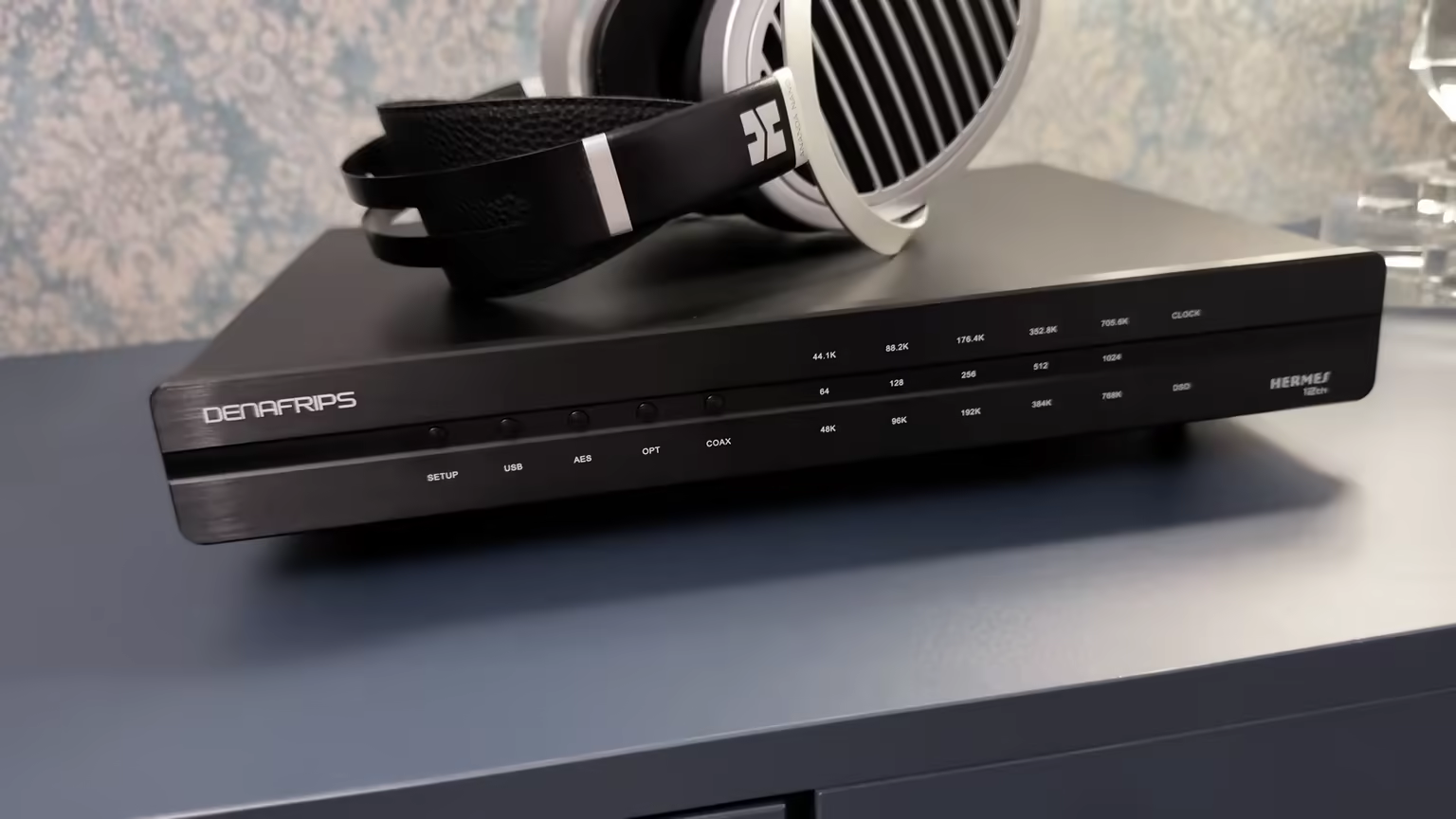 (view larger)
The Hermes 12th isn't just about looks, though. It's built to last. The solid construction inspires confidence, and you can tell that this unit is designed to be a long-term investment in your audio system. Some cheap devices out of China just feel like they're gonna break in a month - this one isn't one of them. The device's weight is also reassuring, indicating the quality of the components inside and enclosure.
While we can't delve too deep into the internal design without taking it apart, as I'm kinda scared that I'll break something - Denafrips is known for using high-quality components in their products, plus they include pictures of the inside on their website. Looking at them, the Hermes 12th is no exception, featuring an oversized 80VA O-Core shielded transformer and multiple sets of ultra-low noise, precision linear power regulators. This ensures that all circuits receive a clean and stable power supply, which is key to optimal performance.
In terms of size, the Hermes 12th is relatively compact, making it easy to integrate into your existing setup. It's not too large or bulky, so you shouldn't have any trouble finding a spot for it on your rack. However, for desktop setups, it's a bit wide, which can be problematic for some.
Overall, this DDC impresses with its build quality and design. It's a well-crafted piece of equipment that exudes quality and sophistication. The minimalist aesthetic, combined with the solid construction, makes it a standout in its class. One thing I especially appreciate here regarding its appearance is the way it can fit in almost every setup with all styles of electronics.
Inputs & Outputs: Dual I²S, AES/EBU, and Clock BNCs
The Hermes offers a generous selection of inputs and outputs, giving you plenty of options to integrate it into your system. This flexibility is key for optimizing your digital audio chain.
Starting with the inputs, we have the standard power connector, of course. Then, for digital audio, we've got a USB input, which is ideal for connecting directly to your computer for playback from streaming services or your personal music library. Next, we see an AES/EBU input, a professional-grade balanced connection often used with high-end digital sources. Optical TOSLINK provides another option for connecting digital sources, particularly those where electrical isolation is beneficial. A Coaxial input is also included for compatibility with a wide range of digital devices. Finally, and this is a key feature for advanced setups, we have two Clock BNC inputs. These allow you to connect an external clock, like Denafrips' own clock, to further refine the timing and reduce jitter, taking your digital audio performance to the next level.
Moving on to the outputs, the Hermes 12th again offers a good variety. We have a Coaxial output, providing a standard digital connection to your DAC. An Optical output mirrors the input option, offering flexibility in connecting to different devices. Now, here's where things get interesting. The Hermes 12th features two I²S outputs: one over RJ45 and the other over HDMI. I²S is a digital audio connection that transmits the digital audio data and clock signals separately, minimizing jitter and improving sound quality. Having both RJ45 and HDMI options ensures compatibility with a broader range of DACs that support I²S. Finally, we have two AES/EBU outputs. These balanced outputs can be used to connect to two separate DACs for bi-amping or other advanced configurations.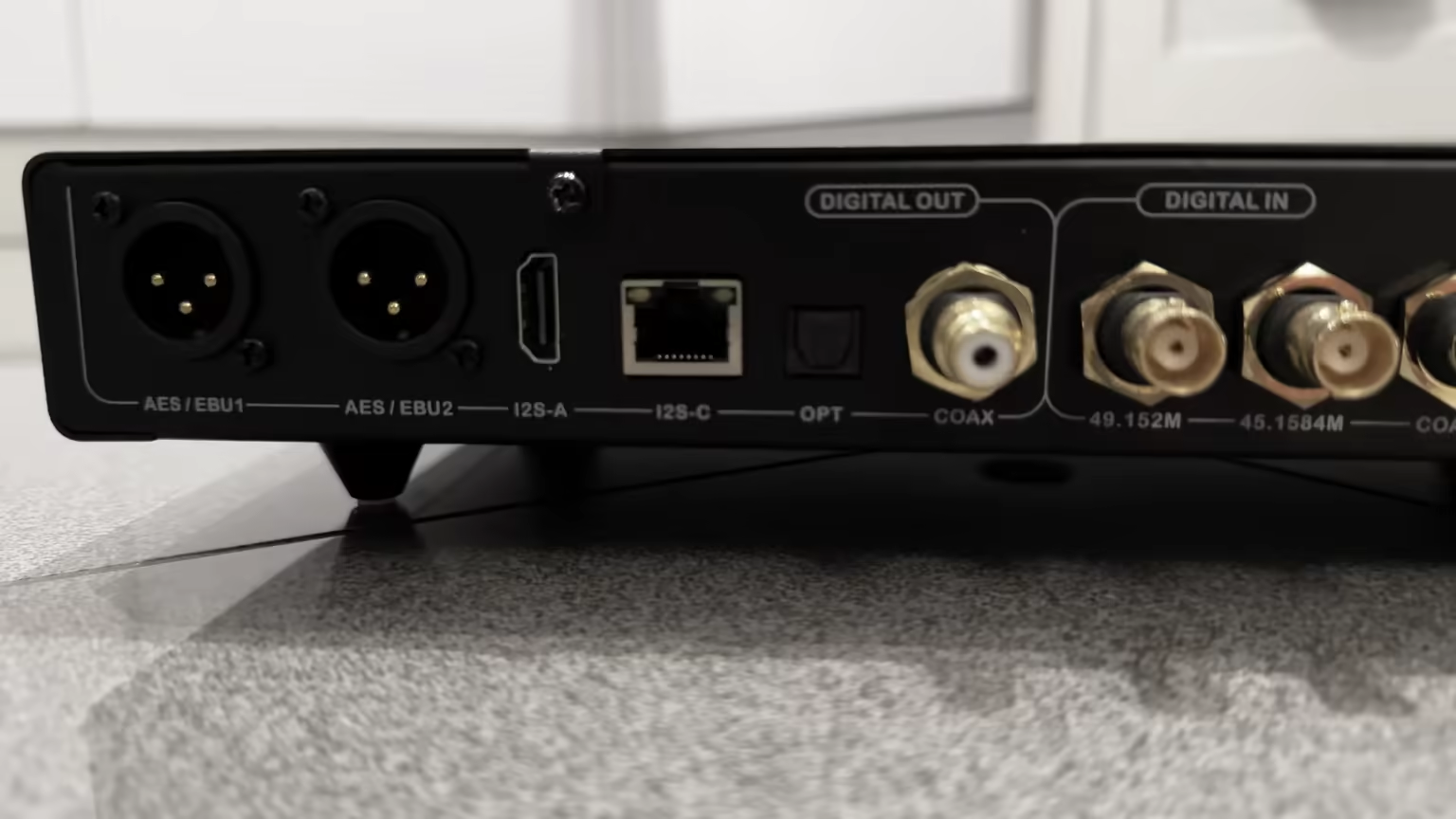 (view larger)
Features: OCXO Clocking and FIFO Reclocking
One of the standout features is the variable, selectable I²S output. You can actually select between different I²S pin configurations. This key feature ensures compatibility with various DACs, even those with non-standard I²S implementations, which are unfortunately quite common. With this feature, you can make it work with everything.
For the serious audiophile, this DDC provides the option to use external clocks. With dedicated clock BNC inputs, you can connect a high-quality external clock, like Denafrips' own, to further refine the timing accuracy of the digital signal. This can result in an even more significant reduction in jitter and an improvement in overall sonic performance.
Speaking of clocks, the Hermes utilizes a superior-quality OCXO, or Oven-Controlled Crystal Oscillator. This clock maintains a very stable temperature for the crystal oscillator, resulting in extremely precise clocking and minimal phase noise. This high-precision internal clock is a key foundation for its exceptional performance.
A critical element is the implementation of a FIFO buffer and reclocking. FIFO buffering isolates the incoming digital data from the timing of the source, minimizing the influence of jitter from the source device. The reclocking stage is used to generate a new, extremely accurate clock signal for the outgoing digital audio stream. This combination effectively eliminates jitter and ensures a solid digital signal is sent to your DAC.
Sound Quality: No Color, Just a Lifted Veil
The Denafrips Hermes 12th DDC isn't designed to impart a particular "color" or flavor to the audio. Its strength lies in what it reveals - the inherent character of your DAC, but elevated, refined, and turned up to 11. It's less about adding something new and more about removing the obstacles that prevent your DAC from performing at its best.
It's as if a veil has been removed from the music, revealing a newfound clarity and focus. Details that were previously subtle or masked become more prominent, yet without any harshness or artificiality. This increased clarity extends across the entire frequency spectrum. It doesn't boost up the treble range even the slightest bit. Though still, cymbals shimmer with realism, the subtle nuances of high-pitched vocals are rendered with exceptional clarity. The highs become more simply defined.
The bass frequencies also benefit significantly. The Hermes tightens up the low end, providing a more controlled and defined bass response. This isn't about adding more bass - it's about making the existing bass more precise and impactful. The low frequencies become less "sloppy" and more integrated with the rest of the sonic picture in a more time-accurate manner.
Soundstage and Imaging: Wider, Deeper, More Secure
The soundstage, that three-dimensional space where the music unfolds, expands with the Hermes in the chain - it's a noticeable improvement. The soundstage becomes wider, deeper, and more immersive. Instruments are placed more securely within the sonic landscape, with less movement and uncertainty. The imaging, the ability to pinpoint the location of instruments, is also enhanced, contributing to a greater sense of realism.
Perhaps the most significant improvement is in the overall sense of naturalness and musicality. The Hermes seems to inject a sense of life and vitality into the digital audio stream. The music flows more effortlessly, with a greater sense of ease and dynamics. This makes for a more engaging and enjoyable listening experience, reducing listening fatigue and allowing you to connect with the music on a deeper level. It's sort of like tube gear but with no coloration or any downsides.
Verdict: Not Snake Oil
So... the Hermes 12th is not snake oil - it provides a clear improvement to the sound quality.
Sound signature
Derived from the words this review uses: each axis runs between two opposite descriptors, and the shape leans toward whichever side the writing does.
- Warm ↔ Bright Neutral, no clear signal in the review language
- Relaxed ↔ Analytical Leans analytical
- Polite ↔ Aggressive Neutral, no clear signal in the review language
- Lean ↔ Bass-heavy Neutral, no clear signal in the review language
- Intimate ↔ Wide stage Leans wide stage
Hear what "analytical, wide stage" means: a short synthesised loop, flat and then with those leanings. An illustration of the words, not a recording of the Hermes 12th Anniversary.
Not sure which signature suits you? Find yours with a blind A/B test
Watch the video review
Subscribe on YouTube (opens in new tab)Prefer to read? The written review above covers everything in the video.
- 0:00 Do You NEED A DDC For Audio? (opens in new tab)
- 0:17 Design & Build Quality (Anti-Vibration Feet, EMI Blocking Enclosure, Internal Component Quality) (opens in new tab)
- 3:27 Inputs & Outputs (Digital I2S Audio Protocol, Professional Balanced AES/EBU, Coaxial) (opens in new tab)
- 5:37 Features (Selectable I2S Pinouts, External HiFi Clock BNC Inputs, XOCO Clocking, FIFO Buffer) (opens in new tab)
- 7:07 Sound Quality (Lack Of Coloration, Transparency, "A DAC Upgrade", Resolution, Clarity) (opens in new tab)
Common questions about the Hermes 12th Anniversary
Is the Denafrips Hermes 12th Anniversary worth it?
Yes - 8.9/10, Highly Recommended, higher than 84% of everything we have tested, against a catalogue median of 8.1. On value it rates steep: better value exists in sources, so you are buying performance here, not value. Price: $899.
Who should buy the Denafrips Hermes 12th Anniversary, and who should skip it?
Buy it if you want a big, out-of-your-head stage. Skip it if you want vocals right in front of you, and $899 has to buy value as well as performance.
What else have you tested that is close to the Denafrips Hermes 12th Anniversary?
No matchup page yet, and no close price match in the catalogue either. The nearest things we have scored in the same category: the Douk Audio U2 Pro at 6.5/10.
Are DDCs snake oil?
This one is not, and I went in expecting to find otherwise. The category is genuinely controversial - some people call it useless, others claim tenfold improvements, and both camps are usually arguing without having tried one. My finding with the Hermes is a clear improvement, and the shape of it is specific: nothing is added, something is removed. It is like a veil lifting off the music rather than a tone control being turned.
Will the Hermes 12th fix a bad DAC?
No, and this is the most important thing to understand before buying one. It imparts no colour and no flavour of its own; what it does is reveal the inherent character of your DAC, elevated and refined. If that character is not what you want, the Hermes will give you more of it rather than less. Buy it to get the best out of a converter you already like. Do not buy it hoping to rescue one you do not.
What do OCXO and FIFO reclocking actually do?
They attack jitter from two directions. The OCXO is an oven-controlled crystal oscillator - it holds the crystal at a stable temperature, which gives extremely precise clocking and very low phase noise. The FIFO buffer then isolates incoming data from the source's own timing, and the reclocking stage generates a fresh, highly accurate clock for the outgoing stream. Together they mean your DAC receives a signal whose timing owes nothing to whatever computer sent it.
Why does the Hermes 12th have two I²S outputs?
Because I²S is the best digital connection and the least standardised one. There is an RJ45 output and an HDMI output, which covers the two physical connectors DACs actually use, and the pin configuration is selectable on top of that - so non-standard implementations, which are unfortunately common, can still be made to work. Between the two sockets and the pinout modes, you can get this talking to essentially anything.
What are the two BNC clock inputs for?
Adding an external master clock, which is the upgrade path beyond the internal OCXO. You connect a high-quality external clock - Denafrips make their own - and the timing accuracy of the digital signal is refined further, reducing jitter beyond what the onboard oscillator manages. It is a genuine route to more performance rather than a spec-sheet flourish, but be honest with yourself about the total: a clock and the cables it needs push the cost well past the price of the Hermes.
What does the Hermes 12th change about the sound?
Definition rather than balance. Details that were subtle or masked become prominent without any harshness, and the clarity extends across the whole spectrum - it does not lift the treble in the slightest, yet cymbals shimmer more realistically. The bass tightens rather than grows: less sloppy, more time-accurate, better integrated. The soundstage gets wider and deeper, and instruments sit more securely with less drift. It reminds me of what tube gear does, minus the colouration and the downsides.
Will the Hermes 12th fit a desktop?
On a rack, easily. On a desk, it is a bit wide, and that is the one practical complaint. It is not tall or deep enough to be unwieldy, and the neutral black or silver aluminium front panel suits any style of system, but the footprint is the thing to measure before ordering. There is no display either - just input and output indicators - so it does not need to be visible to be usable.
If you're interested in this
All 6 sources reviewsClosest alternatives