Flare Audio E-PROTOTYPE Review: Best-in-Class Bass, Love-or-Hate Mids
Unlike anything you've heard or seen. The E-PROTOTYPE goes to extremes - both positive and negative - using proprietary technologies you won't find anywhere else.
higher than 34% of everything we have tested
Value Excellent. It is one of the best-value pieces we have scored.
- Standout
- Possibly the best low-end of any IEM I've heard
- Watch out for
- Tonality is a love-or-hate situation
- Better alternative
- HIFIMAN RE2000 PRO Silver: $200 more, scores 0.8 higher.
Is it for you?
- You want a big, out-of-your-head stage
- You want the most performance per dollar on the list
- You want vocals right in front of you
Pick #3 of 4 in our Best Budget IEMs guide.
These earphones are unlike anything else you've heard or seen. They go to extremes - both positive and negative ones. They use proprietary in-house developed technologies that you can't find anywhere else.
Flare Audio E-PROTOTYPE... let's take a closer look.
Is It Comfortable? 3D-Printed, Strangely Shaped
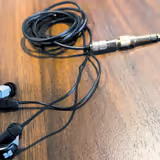
They come with a thin, rubbery cable that doesn't feel very premium, but at least it doesn't tangle easily, like some aftermarket IEM cables I have tried. It ends with a single-ended 3.5mm slim plastic connector. There is no way to use them balanced - and for the worse, the cable is non-detachable. It's just a cable, and what's good about it is that it's lightweight and seems durable, plus on the website they said that they stress-tested it (somehow). Enough about it.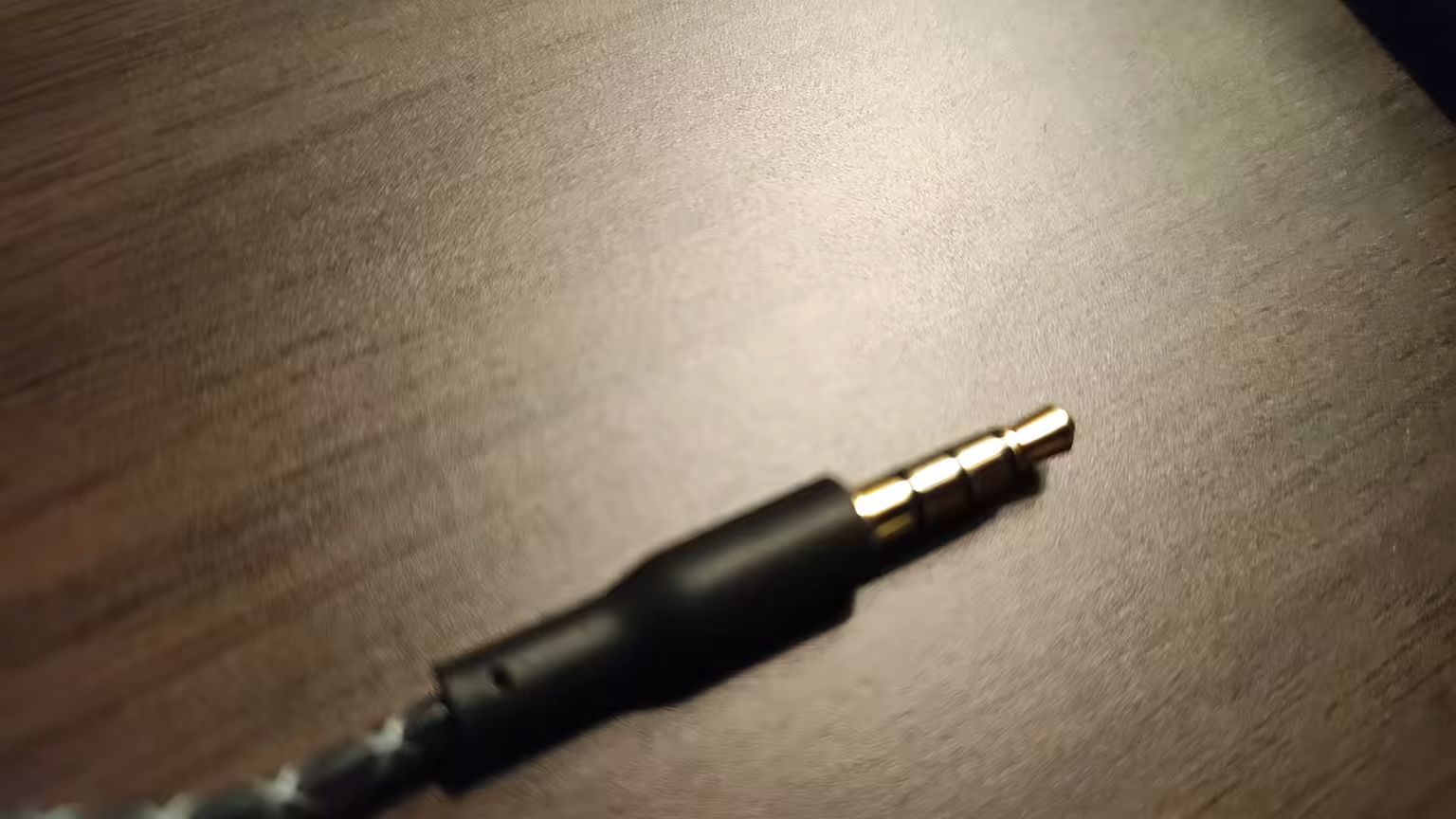 (view larger)
Let's move to the actual earpiece build quality, as it's interesting to say the least. They 3D-print it, and you may be like "What the hell, I don't want expensive, high-end IEMs to be 3D-printed!" - and that's fair. Flare Audio has a model that is both cheaper and fully made out of metal, if you care about it. But this is a prototype, a proof of concept made to show off what their technology is capable of and to support further research and development.
Moreover, as you can imagine, it's not printed with a standard cheap filament on a regular 3D printer. They use professional-grade equipment and materials to make them. The final result is a decently rigid-feeling capsule with a smooth texture and no roughness usually associated with 3D printing. As a bonus, they're very lightweight, unlike their full-metal brother. And, if it's important to you, they're not made in China - they produce them in their headquarters in the United Kingdom.
Their shape is the weirdest I have ever seen, and that's for a reason. They researched the internal shape of our ears and its effect on distortion. The effect of our ears on the frequency response is common knowledge at this point, but they wanted to go further, exploring the distortion produced by the human ear shape, and realized that our ears can distort the sound by as much as 20%. That's why they developed their "Mirror Image Sound™ Technology" - their shape is so weird to overcome the issues inside our ears. At least that's their explanation.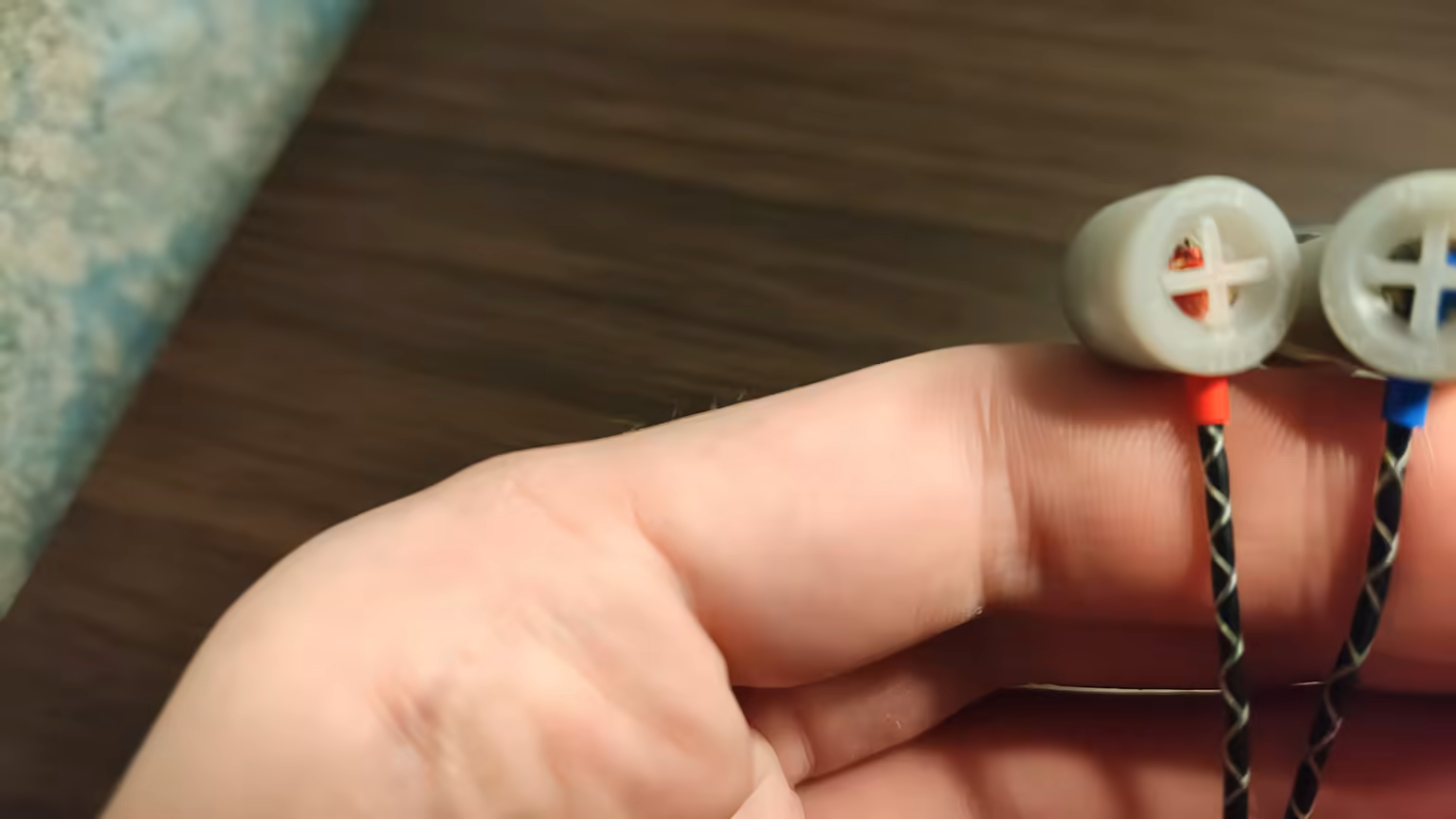 (view larger)
Is it even comfortable though? I didn't experience any major comfort-related issues while using them, but due to their shape being somewhat unusual, it may vary from person to person. As my ears are internally slightly asymmetrical, I faced one problem - I had to position the left earpiece in a very specific range of depth and angle, otherwise the sound would be greatly attenuated, which is something I have yet to encounter with other in-ear monitors. Nevertheless, once I got the fit right, I could use them for extended periods without any significant discomfort.
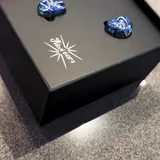
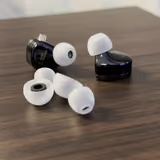
What you get in the box is a pack of replacement tips in different sizes and a hard carrying case. It has some stealth "FLARE" branding and feels very solid - I would trust it to protect my portable audio gear. It should fit some tiny dongle beside your earphones. If you need something bigger, Flare Audio offers a large hard carrying case that is rectangular, feels even better than the tiny model due to its softer internal finish, and is very affordable. It should fit around 2 to 3 pairs of IEMs with no issue, and if you're lucky, a dongle or two tiny ones are also very likely to make it inside at the same time. It's just perfect for traveling.
Sound Quality (Tonality): Best-in-Class Bass, Odd Mids
They're tuned in a very, very specific way - almost in an odd way. You will either love it or hate it. I definitely would NOT recommend buying it as your only IEM with this kind of tuning. But as a complementary IEM, its tuning is unlike everything else I have ever heard.
As always, people's preferences vary, and to accommodate that, Flare Audio is offering a 100-day return window - which is just amazing to see. They're so sure of their products and they're not forcing customers to own them if they don't like them.
Let's start with the bass. The E-PROTOTYPEs have, in a way, THE best low-end of any IEM, or even headphones, I have ever heard. There's a lot of bass and it's keeping its integrity very well. The bass is extremely well layered, resolving, and so punchy, no matter the source I paired it with.
I think these earphones must have met the HIFIMAN HE-R9 at some point and took some inspiration from their duality and bipolarity, but they've taken it even further by pushing the extremes of both the positive and negative sides! Either way, the bass is definitely on the good side. If I were to pick one single thing that the Flare Audio E-PROTOTYPEs do well, way above their league, it would be the bass region. It hits hard, doesn't fall apart even despite its amount, and extends extraordinarily low, with some audible roll-off occurring in the 20-something Hz region.
The mids do not fit my preferences very well. They're tonally recessed yet peaky and unnatural. It makes the timbre take a huge hit in my opinion - although the instruments sound mostly engaging and fun.
Due to the treble region, I tend to find their tuning clockwise-tilted, with a slight V-shaped tendency. It often gets hidden by the bass - although it's not very boosted, when a song asks for it, it can pack an incredible amount of detail. They're kind of smooth-sounding, not necessarily due to their amount. Something else must be affecting them, because it's really unlike everything else I have ever heard.
Sound Quality (Technical Performance): Where It Flexes
Technical performance is where the E-PROTOTYPE flexes its muscles the most. I'd assume that its proprietary technology makes it like that.
Let's start with the sound separation - it's ideal. The instruments, vocals, background stuff - everything is exceptionally well separated and doesn't blend, pretty much no matter how busy or loud it gets.
Detail retrieval is at an astonishing level given the treble amount that we have. They are truly squeezing the most out of it, and I like it. These are some of the most resolving IEMs that don't get very sharp out of everything I've tried.
The soundstage is neither accurate nor wide in any direction, no matter what you do. It's pretty intimate, which is not a bad thing in itself - the vocals have the potential to sound as if someone is singing right next to your ear.
The dynamic range of this IEM is impeccable - it can hit and punch extremely hard. It tends to be rather a point of impact than a slam wall. It sounds very fast yet slow. Let me explain - the punch is there, but there's something that comes after the punch: a super long, detailed, and satisfying decay that is just impossible not to notice.
Timbre - if you have not noticed up to this point, it's not the biggest selling point of this product. Well... it's not a selling point at all. The E-PROTOTYPEs tend to make things sound off or slightly plasticky, likely because of the shell's material. It's not terrible, but if you're a timbre chaser, stay away from these.
Sound signature
Derived from the words this review uses: each axis runs between two opposite descriptors, and the shape leans toward whichever side the writing does.
- Warm ↔ Bright Neutral, no clear signal in the review language
- Relaxed ↔ Analytical Leans analytical
- Polite ↔ Aggressive Leans aggressive
- Lean ↔ Bass-heavy Neutral, no clear signal in the review language
- Intimate ↔ Wide stage Leans wide stage
Hear what "analytical, aggressive, wide stage" means: a short synthesised loop, flat and then with those leanings. An illustration of the words, not a recording of the E-PROTOTYPE.
Not sure which signature suits you? Find yours with a blind A/B test
Watch the video review
Subscribe on YouTube (opens in new tab)Prefer to read? The written review above covers everything in the video.
- 0:00 What is it? (opens in new tab)
- 0:18 Build Quality & Comfort (Stress tested 3.5mm cable) (opens in new tab)
- 0:53 Uniquely Shaped 3D Printed Shell (opens in new tab)
- 1:52 Mirror Image Sound™ Technology - Less THD and BETTER Sound? (opens in new tab)
- 3:01 Accessories Included - Replacement Eartips, Hard IEM Carrying Case (opens in new tab)
- 3:45 Sound Quality (Tuning, Tonality) - Bass, Mids, Treble Balance (opens in new tab)
- 6:04 Technical Performance - Sound Separation, Soundstage, Dynamics, Punch, Slam, Detail Retrieval, Speed, Timbre (opens in new tab)
Common questions about the E-PROTOTYPE
Is the Flare Audio E-PROTOTYPE worth it?
Yes, for the right listener - 8.0/10, Recommended, higher than 34% of everything we have tested, against a catalogue median of 8.1. On value it rates excellent: top 17% for the price in headphones, so it is one of the best-value pieces we have scored. Price: $149.
Who should buy the Flare Audio E-PROTOTYPE, and who should skip it?
Buy it if you want a big, out-of-your-head stage, and you want the most performance per dollar on the list. Skip it if you want vocals right in front of you.
What else have you tested around the price of the Flare Audio E-PROTOTYPE?
No head-to-head page for this one yet. The closest reference points we have scored in the same bracket: the Simgot EM6L at 7.6/10.
Should the E-PROTOTYPE be your only IEM?
No, and I would say that as plainly as possible. The tuning is so specific that you will either love it or hate it, and I would not recommend buying it as your only in-ear on those terms. As a complementary earphone alongside something conventional, it offers a presentation unlike anything else I have heard. Flare Audio give you a 100-day return window, which is an unusually confident thing to offer and tells you they know the tuning divides people.
Why is the E-PROTOTYPE shaped so strangely?
Flare Audio researched the internal shape of the human ear and its effect on distortion - not just on frequency response, which is well understood, but on distortion itself, and they concluded our ears can distort sound by as much as 20%. The shape exists to work around that, which they call Mirror Image Sound Technology. That is their explanation. What I can tell you is that it is the weirdest shape I have seen on an earphone and that something about this design does produce results I have not heard elsewhere.
Is the E-PROTOTYPE hard to fit?
It took me some work, and the problem was specific. My ears are slightly asymmetrical internally, and I had to position the left earpiece within a narrow range of depth and angle - outside it, the sound was greatly attenuated, which is something I have not encountered on any other in-ear. Once the fit was right I could wear them for long stretches with no real discomfort. Because the shape is so unusual, expect your experience to differ from mine.
Is the E-PROTOTYPE's 3D-printed shell a downgrade?
Not in the hand. It is printed on professional-grade equipment with professional materials rather than cheap filament on a hobby printer, and the result is rigid, smooth, and free of the roughness printing usually leaves. It is also very light, unlike its full-metal sibling - Flare Audio make a cheaper all-metal model if that matters to you. They are produced at the company's UK headquarters. This one is explicitly a proof of concept, built to show what the technology can do.
What is actually wrong with the E-PROTOTYPE?
Mids and timbre, and I would not soften either. The midrange is tonally recessed yet peaky and unnatural, and the timbre takes a real hit as a result - things come out sounding slightly plasticky, most likely because of the shell material. It is not terrible, and instruments still sound engaging and fun. But if you chase timbre, stay away. The soundstage is intimate rather than wide too, which is not a flaw in itself and does put vocals right beside your ear.
Is the E-PROTOTYPE's bass really that good?
It is the best low end I have heard from any in-ear, and arguably from any headphone. There is a lot of it and it keeps its integrity completely: extremely well layered, resolving and punchy, regardless of what I paired it with. It hits hard, it does not fall apart despite the quantity, and it extends extraordinarily low with some audible roll-off starting in the 20-something Hz region. If I had to name one thing this earphone does far above its league, it is this.
Can you use a balanced cable with the E-PROTOTYPE?
No. The cable is non-detachable and single-ended only, ending in a slim 3.5mm plastic connector, so there is no balanced option and no upgrade path. The cable itself is thin and rubbery and does not feel premium, though it is light, seems durable, resists tangling better than some aftermarket cables I have used, and Flare say they stress-tested it. On an earphone this technically capable, the fixed cable is the compromise that stings most.