Fosi Audio ZD3 Review: A $150 DAC With Swappable Op-Amps
A $150 desktop DAC that punches above its price - swappable op-amps, balanced XLR and RCA, HDMI ARC, Bluetooth aptX HD, a 126 dB SNR, and a clean, slightly bright sound.
higher than 11% of everything we have tested
- Standout
- Swappable op-amps
- Watch out for
- Faint hollow echo when you tap or spin the volume knob
- Better alternative
- SMSL DL100: leans weightier low down, $30 more, scores 1.1 higher.
Is it for you?
- You want the balance to lean bright, with the detail pushed forward
- You're treble-sensitive
Pick #6 of 8 in our Best DACs guide.
Budget DACs are supposed to be basic. But the Fosi Audio ZD3 isn't. It packs a feature that totally changes how you can use it in your Hi-Fi setup. Plus it's truly inexpensive, coming at $150.
Build and Design: Sleek Aluminium on a Budget
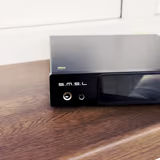
This little box actually looks pretty sleek for what it costs. Fosi went with a clean, all-black anodized aluminium shell. There are subtle orange accents built into the volume knob and some elements of the GUI that give it a surprisingly modern, refined look.
The volume knob itself is a highlight - metal, smooth, and tactile, with just enough resistance to feel good, not flimsy. It feels fine - not anything overly premium, but also it's not poor. Next to it sits a small display - compact but super easy to read from across your desk. It shows whatever you need - input, volume level, and sample rate. The software design is on par with the latest SMSL products, and hugely better than their older offerings.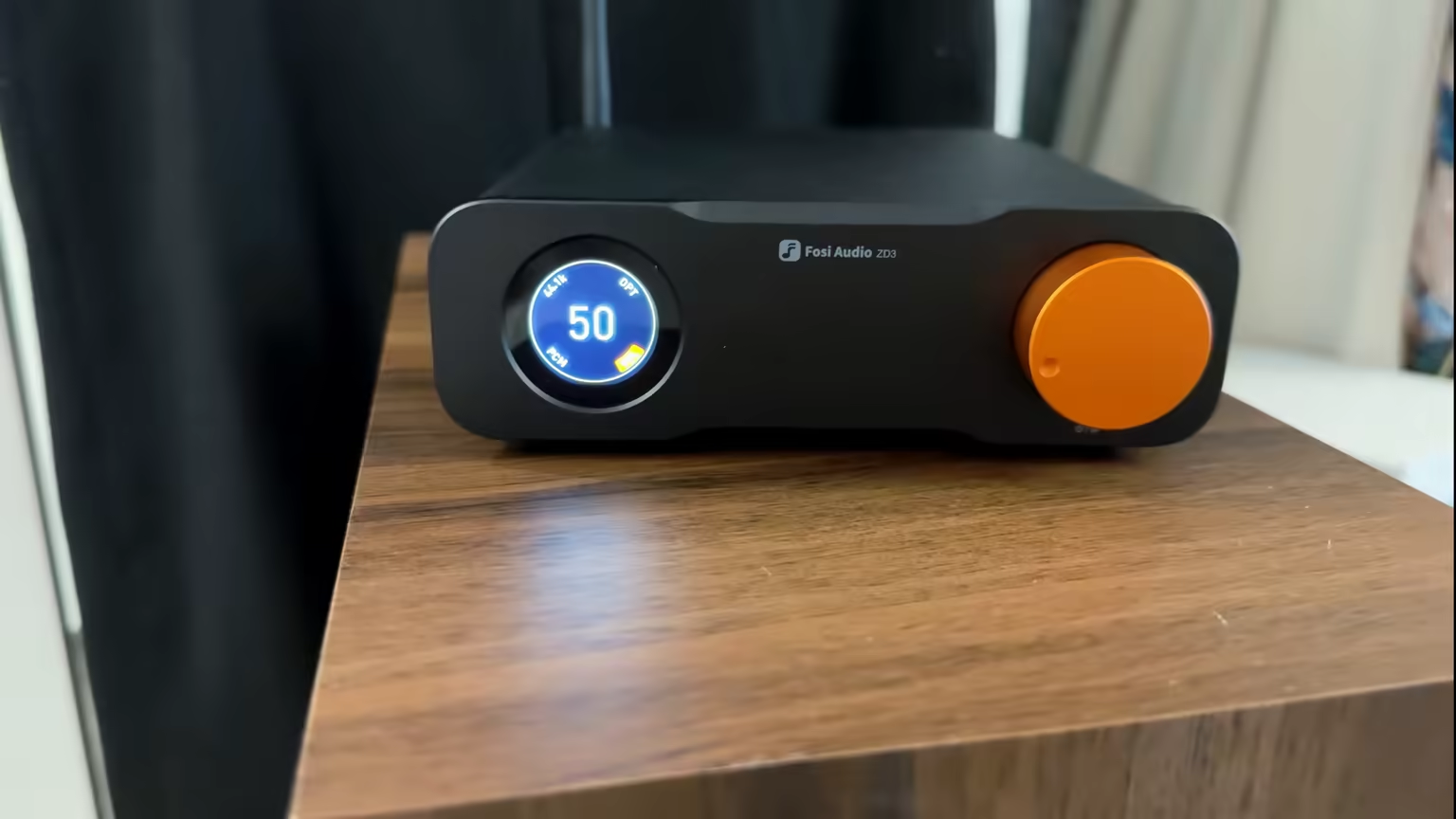 (view larger)
Underneath, the feet hold it steady on the desk and cut down on vibration. The unit's overall weight is light - surely less than a kilo, it's below 700 grams according to the spec sheet. There's just one aspect of this DAC I can't get over.
If you tap or spin the knob quickly, you might catch a subtle echo inside - like a hollow chamber effect. It's faint, quick, and doesn't affect performance, but it does remind you this is a budget-priced desktop unit.
Still, compared to early Fosi units - or brands like Aiyima - the ZD3 feels much more put together. It has no sloppy edges, no misaligned panels, and most importantly, a fit and finish that feels custom made rather than like a generic OEM product. It's a good example of how, even under tight budget constraints, companies can optimize production costs and reinvest that into better design and build quality. I'm genuinely curious to see what $150 DACs will sound and feel like in a 2 or 3 years. Overall, this is one of those units where the look and feel punch somewhat above the price. It doesn't try to mimic luxury gear, but it avoids the cheap, DIY vibe that's all too common in this range. Refinement and incremental improvements is what Fosi went for with this one. It's a clear step up for the brand.
Inputs and Outputs: HDMI ARC, Bluetooth, XLR and RCA
The ZD3 doesn't skimp much when it comes to connectivity. On the input side, you've got all the usual digital suspects, but also a couple of nice surprises. USB is here, of course, handling up to extremely high sample rates if you're feeding it from a computer. You also get optical and coaxial, which are great for things like a CD player or a streamer. One of the more unexpected additions is HDMI ARC, which basically means you can plug it directly into your TV and let the DAC handle the sound - no extra boxes or converters needed. I would personally prefer to have I2S over this HDMI connector, as it is practically the best digital standard protocol, but not everything supports it yet. And if you don't want to run any wires at all, the ZD3 has Bluetooth with aptX HD support, so it's not just basic SBC or AAC.
On the output side, the ZD3 gives you both balanced XLR and standard RCA. The XLRs are a nice touch at this price, letting you hook it up to studio monitors or higher-end amps with a quieter, stronger signal. The RCAs keep things simple and universal, so you can drop it into just about any Hi-Fi setup, or even legacy gear. What's neat is that both sets of outputs are active at the same time, which is handy if you want to feed two different setups, or just keep things flexible without swapping cables around.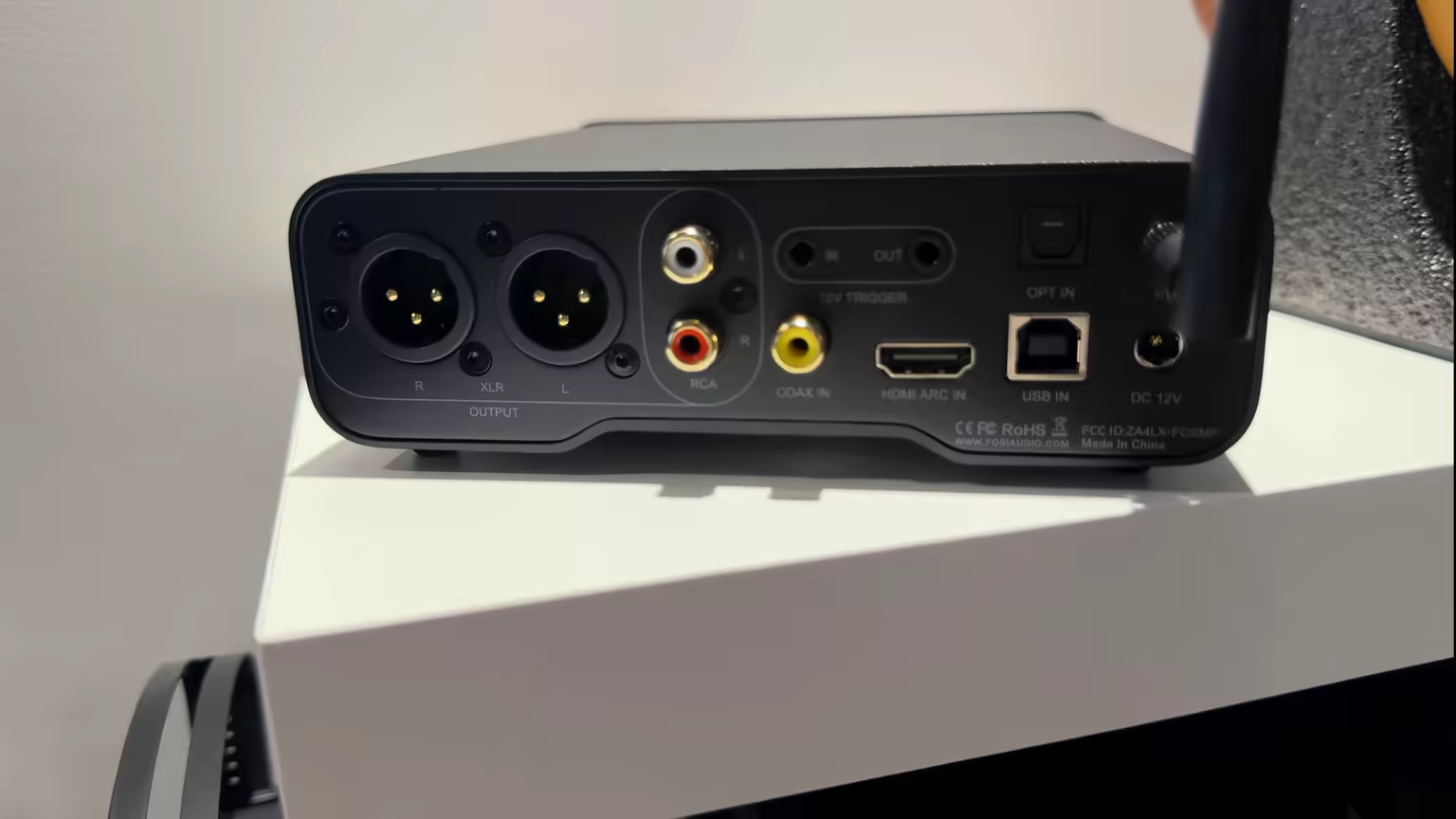 (view larger)
Features: Swappable Op-Amps, Bypass Mode and Triggers
Inside the ZD3 they added some features you normally wouldn't expect at this price. One of the biggest ones is the swappable op-amps. That means you're not locked into the stock tuning of the DAC. You can actually upgrade or tweak the sound later on just by dropping in a different op-amp. For people who like to experiment, or for anyone who wants to slowly step up their system without buying an entirely new DAC, this is a huge plus.
On top of that, the ZD3 is built around an ESS DAC chip, paired with a super common in DACs nowadays, XMOS USB interface, which handles high-resolution formats. Yes, it's a chip-based DAC, but can you expect a discrete topology at this price? I don't think so. This combination makes it work for everything from lossless streaming on your computer to more serious digital sources.
Additionally, Fosi put thought into power delivery - instead of a noisy USB-powered design, the ZD3 uses an external 12V DC power supply for cleaner performance. You're looking at a DAC that has been designed to provide a clean signal. Whether clean is good in this case, we'll see.
Another handy feature is the bypass mode, which lets the ZD3 skip its internal volume control and send out a fixed-level signal. That way, if you're using a dedicated preamp or integrated amp, you're getting the purest, most direct output possible.
You also get trigger in and out, so the DAC can power up in sync with the rest of your system. Switch one device on, and everything else follows - simple and seamless.
Specifications: 126 dB SNR and Standard Output Levels
First up, signal-to-noise ratio, or SNR. The ZD3 clocks in at 126 dB. That's a big number, but simply put, it means the background noise is nearly inaudible. Most DACs in this price range land around 110 dB, so the ZD3 giving you 126 is a solid step up - plenty of room for you to hear the music, not the buzz behind it. And decibels are logarithmic, not linear - so keep that in mind.
Next, let's talk output voltage. This one's handy to know if you're pairing the DAC with different equipment. On the balanced XLRs, it pushes about 5 V rms. The unbalanced RCAs come in just under that, at 2.5 V rms. That means this DAC should not be problematic, as those voltages are pretty much industry standard ones, and not something overly high or unusually low.
Then there's dynamic range, which is around 123 dB according to Fosi's own specs, but I also found a full spec sheet that says it's 126 dB, matching the SNR. Either way, that's excellent. Dynamic range is basically how well the DAC can go from the quietest dips to the loudest peaks without distortion creeping in. This level puts you in the ballpark of DACs that cost a few hundred dollars more.
How Does It Sound? Clean, Neutral, Slightly Bright
The first thing you'll pick up on is how clean the output is. It's whisper-quiet - no noticeable hiss even when you're running it with sensitive gear. And when music plays, there's no distortion even at higher volumes. It's easy to forget there's a budget DAC in the chain, as it doesn't do anything outright wrong.
Tonally, the ZD3 sits mostly in neutral territory - but with a little sparkle at the top end. Vocals come through natural and alive. String instruments have realistic body, and the very top-end detail - like cymbal shimmer or breath - is present without harshness. It's crisp, not shrill.
Bass response is tight and controlled. You won't get deep, booming lows like a high end R2R DAC, but for the price, it holds its own - solid enough to contour rhythm-heavy music and electronic beats without floppiness.
Where it doesn't shine as much is the depth dimension. The soundstage is not claustrophobic, giving you nice left-to-right placement, but the depth - layers that pull you into a virtual space - feels a bit flat. Instruments sit side-by-side without retreating backward into a 3D space. It works, but it doesn't disappear.
That said, it handles dynamics okay. Quiet passages breathe, and louder sections still retain detail without sounding compressed or brittle - just smooth, lively, and responsive. It's a properly designed device, so I wouldn't expect anything else from it. Switching into bypass mode tightens things up. It gives you a more immediate, upfront sound by skipping the internal volume stage. The music feels more present. It's a subtle change, but it's there if you're listening for it. It's also the very reason why I prefer DACs with no volume control - the bypass feature turns this device into pretty much the same thing. At the end of the day, the ZD3 doesn't wow you with super-deep depth or sonic fireworks. Instead, it delivers a reliable, clean, slightly brighter sound that's not so common in this price bracket. For everyday listening - whether it's acoustic tracks or modern electronica - it keeps you engaged without fighting your ears too much.
Sound signature
Derived from the words this review uses: each axis runs between two opposite descriptors, and the shape leans toward whichever side the writing does.
- Warm ↔ Bright Leans bright
- Relaxed ↔ Analytical Neutral, no clear signal in the review language
- Polite ↔ Aggressive Leans aggressive
- Lean ↔ Bass-heavy Leans lean
- Intimate ↔ Wide stage Leans wide stage
Hear what "bright, aggressive, lean, wide stage" means: a short synthesised loop, flat and then with those leanings. An illustration of the words, not a recording of the ZD3.
Not sure which signature suits you? Find yours with a blind A/B test
Watch the video review
Subscribe on YouTube (opens in new tab)Prefer to read? The written review above covers everything in the video.

- 0:00 What Is THE BEST DAC You Can Buy Under $200? (opens in new tab)
- 0:19 Design & Build Quality (OLED Display, Metal Chassis, Tactile Volume Knob, ZD3 Weight) (opens in new tab)
- 2:41 Inputs & Outputs (HDMI ARC, Wireless Bluetooth Audio, High Sample Rate USB, RCA & XLR) (opens in new tab)
- 3:52 Technologies (Bypass Mode, Upgradeable OP-AMPs, ESS DAC Chip, DC Power Supply) (opens in new tab)
- 6:21 Technical Specification (SNR, Output Voltage, Dynamic Range (opens in new tab)
- 7:45 Sound Quality (Clean Output, Neutral Tonality, Bass Performance, Detail Retrieval) (opens in new tab)
Common questions about the ZD3
Is the Fosi Audio ZD3 worth it?
Yes, for the right listener. It scored 7.1/10, Recommended, higher than 11% of everything we have tested, against a catalogue median of 8.1. On value it rates fair: mid-pack for the price in DACs. Price: $150.
Who should buy the Fosi Audio ZD3, and who should skip it?
Buy it if you want the balance to lean bright, with the detail pushed forward. Skip it if you're treble-sensitive.
What else have you tested around the price of the Fosi Audio ZD3?
We have not run it head-to-head against anything yet. In the same category and the same rough money we have scored the SMSL DL100 at 8.2/10, which is the nearest thing to a shortlist until a matchup page exists.
What do swappable op-amps get you on the ZD3?
A tuning option you almost never see at this price. You are not locked into the stock voicing - drop in a different op-amp later and the sound changes with it. For anyone who likes to experiment, or who wants to step a system up gradually without replacing the whole DAC, that is a genuine feature rather than a specification. It is the thing that makes this box interesting rather than merely competent.
Can you plug the ZD3 straight into a TV?
Yes - HDMI ARC is built in, so the DAC handles your television's sound with no extra boxes or converters in between. It is an unexpected inclusion at $150. My own preference would have been I²S over that connector, since it is practically the best digital protocol there is, but not enough gear supports it yet for that to be the sensible commercial choice. USB, optical, coaxial and Bluetooth with aptX HD cover everything else.
What does the ZD3's bypass mode do?
It skips the internal volume stage and sends a fixed-level signal out, which is what you want when a dedicated preamp or integrated amplifier is doing the attenuating. Switching to it tightens things up - the presentation becomes more immediate and upfront, and the music feels more present. It is a subtle change and it is real if you listen for it. It is also why I prefer DACs with no volume control at all; bypass turns this into one.
Does the ZD3 have a deep soundstage?
No, and it is the clearest limitation. Left-to-right placement is fine and the stage is not claustrophobic, but depth feels flat: instruments sit side by side rather than retreating backward into a space. It works, it just never disappears. Everything else about the presentation is clean - whisper-quiet with no hiss on sensitive gear, no distortion at volume, neutral with a little sparkle up top, and tight controlled bass without deep R2R-style weight.
What is the faint echo when you tap the ZD3?
A hollow chamber effect inside the case, and it is the one thing about this DAC I cannot get over. Tap it or spin the knob quickly and you catch it. It is faint, it passes immediately, and it has no effect on performance - it just reminds you that this is a budget desktop unit. Everything else about the fit and finish is a clear step up for Fosi: no sloppy edges, no misaligned panels, and a build that feels designed rather than generic.
Is the ZD3's 126 dB SNR meaningful?
It is a real advantage, with a caveat about how to read it. Most DACs in this bracket land around 110dB, so 126dB is a solid step up and it means the noise floor is essentially inaudible. Decibels are logarithmic rather than linear, so the gap is larger than the numbers suggest. Dynamic range is quoted as 123dB in Fosi's own specs and 126dB in a fuller sheet I found; either figure puts it near DACs costing a few hundred more.
If you're interested in this
All 8 DACs reviewsClosest alternatives