HIFIMAN Ananda Nano Review: Is This an Upgrade vs Ananda Stealth?
A nanometer-thickness diaphragm trickled down into the Ananda line - one of the best picks in its price range, with detailed treble that can occasionally cross the line.
higher than 71% of everything we have tested
- Standout
- Nanometer-thickness diaphragm at $500
- Watch out for
- Treble can cross into too-bright territory for some
- Better alternative
- HIFIMAN Arya Organic: $600 more, scores 0.6 higher.
Is it for you?
- You want a big, out-of-your-head stage
- You want vocals right in front of you
Pick #5 of 12 in our Best Headphones Under $500 guide.
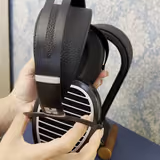
This is the Ananda Nano from HIFIMAN, a fairly new planar magnetic headphone. It's supposed to sound even better than its predecessor, the Ananda Stealth, as it's a newer version that has been upgraded with the nanometer-thickness diaphragm.
Is It Comfortable? Huge Cups, Strong Clamp
It feels decent in the hand, similar to other HIFIMAN headphones, yet a bit less floppy, as there's no cup swivel. It has a new, silver look, but the material of that silver part is still the same - it's plastic. Not that cheap plastic though.
The earcups, as well as the pads, are very big - some of the largest I've seen on any headphones. They can fit almost all ear sizes comfortably, usually with lots of free room. That's something I really appreciate. In addition to that, they're a 3-material hybrid for optimal tuning and breathability. My ears didn't get hot or sweaty in these, so they do the job very well. (view larger)
The headband looks the same as on the Sundara, Ananda Stealth, or the HE6se - it's also a hybrid with a suspension strap, cup tilt, and size adjustment, but no swivel. The lack of swivel wasn't an issue with all the headphones I previously mentioned, however, here there is significantly more clamp force, which I'm not a fan of. It slightly loosened up since I got it, but it's still pretty strong. If you're sensitive to that, keep that in mind, and in case you still decide to buy these, give them lots of stretching on a headphone stand, or you can put a few books between the pads and leave them for some time.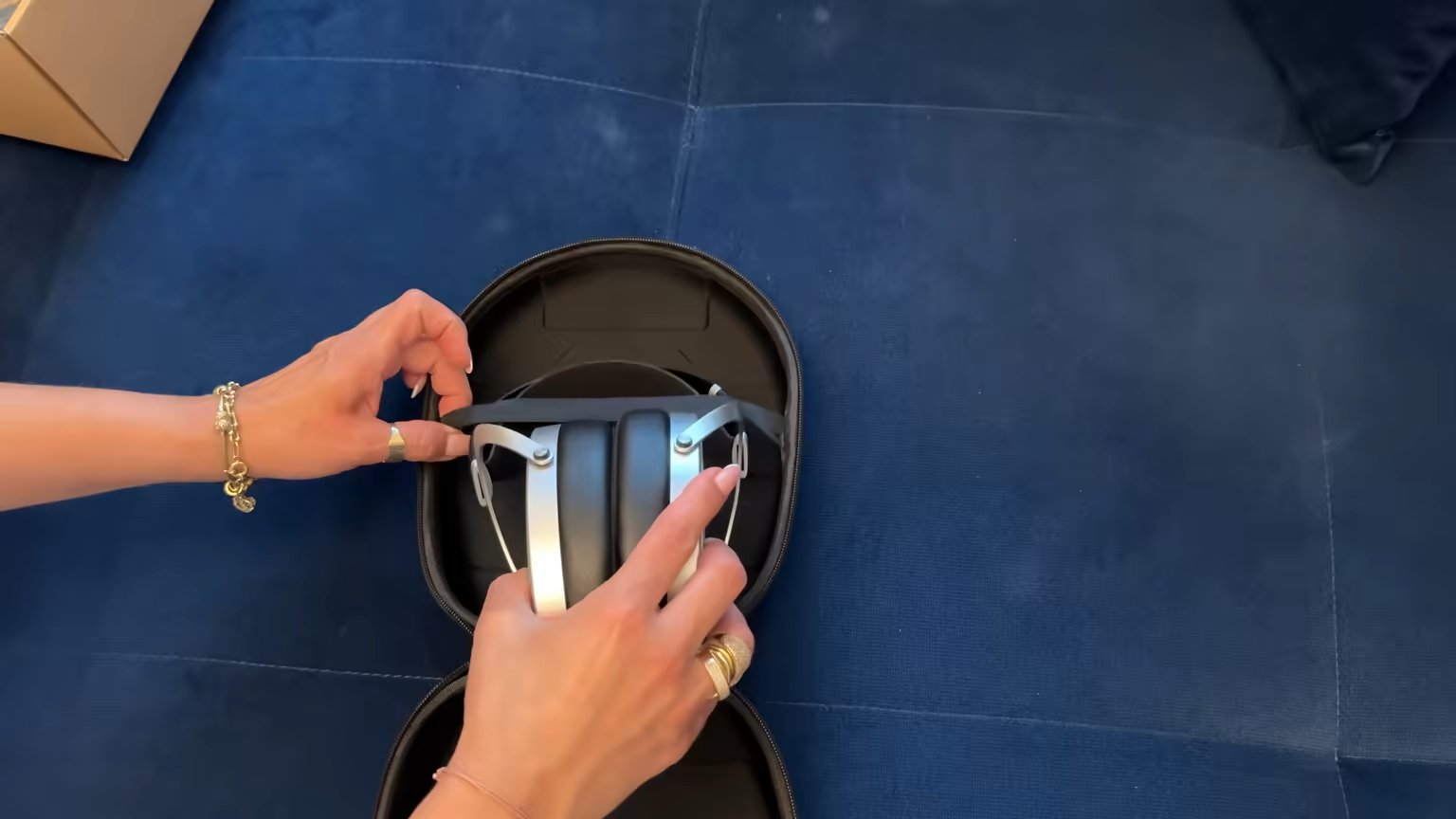 (view larger)
It features a dual 3.5mm jack, one angled forward on each earcup, which allows for either a single-ended or balanced connection. The cable it comes with is just fine - doesn't get in the way most of the time. There's not much more to it, as it's nothing fancy.
Technologies: The Susvara Diaphragm, Trickled Down
The previous version of this headphone was equipped with Stealth Magnets, this one also retains them, assuring acoustic transparency of the magnets. It also retains HIFIMAN's Window Shade Grills, which are meant to reduce sonic reflections for a cleaner sound - and I can already tell you, it does its job. More on that later. (view larger)
But what we haven't seen on any other Ananda before the Nano is the nanometer-thickness diaphragm - hence the name, Ananda Nano. A few years ago, only the most expensive Susvara was equipped with this, but as we all see, things do trickle down indeed. Right now, it is the cheapest headphones to feature that technology, coming at $500.
This means that you can expect even lower distortion, higher transient response, fantastic dynamics, and detail.
Does It Need an Amp? Easy to Drive, Picky on Tone
Its frequency response ranges from 5Hz to 55kHz - that's very good. The sensitivity is 94dB, quite high for a planar magnetic headphone, with a resistance of just 14 ohms. This combination makes running it off a phone easy volume-wise.
While some amplification is recommended to get the most out of these headphones, they can still function without it and get loud enough. However, if you prefer a smoother, less fatiguing sound, then be prepared to invest in a higher-quality amplifier to tame the treble response. It doesn't need to be super powerful, but it needs to provide quality power.
HIFIMAN's EF-series amplifiers paired perfectly with them, because of their smooth sound generally and slightly rolled-off treble. On the other hand, something like the Topping A90 would be one of the worst choices to go with the Ananda Nano, as it makes the problem even worse.
Sound Quality: Punchy Bass, Hot but Detailed Treble
Under some conditions, it's one of the best picks in its price range. But let's start with the tonality.
The bass is well extended, so you can hear 20Hz most of the time, and it's incredibly punchy for a headphone at this price point - especially a planar magnetic one. The midrange is rather linear, not the worst timbre-wise, with a typical dip at around 3kHz.
However, when we come to the treble, there's a lot. It can be too much for some, and for me, it crosses the line slightly. I can stand it, but I'd strongly prefer it if the treble was a bit smoother. Nevertheless, while a bit too sharp, it is incredibly detailed for this price range - it's one of the things it's very good at. The treble is generally tactile and articulate.
Despite the amount, it doesn't get dry like the Deva PRO for example, which I consider to be some of the most dry-sounding headphones from HIFIMAN. Moreover, the hi-hats may be distracting in the mix, potentially drawing attention away from other elements - that goes along with the sharpness.
The soundstage is the best in its class in terms of width. It's pretty wide for what it is, and it's very tall with some depth to it. The way sounds are placed within the soundstage is even more impressive. The imaging is very accurate, but not quite pinpoint, yet it gives you a sense of realistic presentation all around you. If you take into consideration the way it can separate sounds, it becomes something almost unusual for a headphone in this price range.
I'm a big fan of string instruments - the Ananda Nano is great for that with its quick decay and general ability to reproduce string instruments very realistically. It has lots of clarity in everything it does, like voices, real and computer-generated instruments, or any other sounds. In terms of that, it does way better than the previous iteration, the Ananda Stealth.
Sound signature
Derived from the words this review uses: each axis runs between two opposite descriptors, and the shape leans toward whichever side the writing does.
- Warm ↔ Bright Neutral, no clear signal in the review language
- Relaxed ↔ Analytical Leans analytical
- Polite ↔ Aggressive Sits close to centre
- Lean ↔ Bass-heavy Neutral, no clear signal in the review language
- Intimate ↔ Wide stage Leans wide stage
Hear what "analytical, wide stage" means: a short synthesised loop, flat and then with those leanings. An illustration of the words, not a recording of the Ananda Nano.
Not sure which signature suits you? Find yours with a blind A/B test

Watch the video review
Subscribe on YouTube (opens in new tab)Prefer to read? The written review above covers everything in the video.

- 0:00 New and Upgraded HiFiMan Ananda Nano (opens in new tab)
- 0:17 Build Quality & Comfort (Earcups, Pads, Headband Hybrid, Suspension Style Design, Swivel, Clamp, Cable, Balanced / Single-ended connectors) (opens in new tab)
- 2:00 Technologies (Stealth Magnets, Window Shade Grills, Nanometer Thickness Diaphragm from the Susvara) (opens in new tab)
- 2:57 Technical Specifications & Amplifier Pairing (Frequency Response, Sensitivity, Resistance, Volume, Recommended AMPs) (opens in new tab)
- 4:05 Sound Quality (Tonality, Bass Extension, Punch/Slam, Midrange, Timbre, Treble Sharpness, Detail Retrieval, Soundstage Width, Imaging Accuracy) (opens in new tab)
Common questions about the Ananda Nano
Is the HIFIMAN Ananda Nano worth it?
Yes - 8.6/10, Highly Recommended, higher than 71% of everything we have tested, against a catalogue median of 8.1. On value it rates fair: mid-pack for the price in headphones. Price: $499.
Who should buy the HIFIMAN Ananda Nano, and who should skip it?
Buy it if you want a big, out-of-your-head stage. Skip it if you want vocals right in front of you.
What should I consider instead of the HIFIMAN Ananda Nano?
The pieces we have actually run against it: the HIFIMAN Sundara scores 0.4 higher and costs $200 less, the HIFIMAN Ananda Stealth scores 0.2 higher and costs $140 less, and the HIFIMAN Arya Stealth scores 0.1 higher and costs $260 more. Every one of those matchups has its own page in the head-to-head section.
Is the Ananda Nano too bright?
For some people, yes - and being straight about it is the whole point of the score. There is a lot of treble here, and to my ears it crosses the line slightly. I can live with it, but I would much rather it were smoother, and the hi-hats in particular can pull your attention away from everything else in the mix. What saves it is that the treble is genuinely detailed rather than merely lifted, and it never goes dry the way the Deva PRO does. If you already know you are treble-sensitive, this is not the one.
What amplifier pairs well with the Ananda Nano?
Something smooth, and that matters more here than power does. This is an easy load with high sensitivity for a planar, so volume is never the problem - the problem is that a bright amplifier stacks onto an already hot top end. HIFIMAN's own EF-series paired beautifully for exactly that reason: generally smooth, with a slightly rolled-off treble that meets this headphone where it needs meeting. A Topping A90 is close to the worst choice you could make, because it makes the one real flaw worse. Quality of power, not quantity.
Will the Ananda Nano fit large ears?
Comfortably, yes - the cups and pads are among the largest I have put on my head. Most ears will sit inside them with room to spare rather than pressing against the opening, which is the failure mode that ruins smaller planars for a lot of people. The pads are a three-material hybrid tuned for breathability as well as sound, and my ears did not get hot or sweaty in them. Ear size is the one comfort question you do not need to worry about here.
How strong is the Ananda Nano's clamp force, and does it loosen?
Strong, and it is my main complaint about wearing it. There is significantly more clamp here than on the Ananda Stealth or the Sundara, which share the same headband design - and because the cups tilt but do not swivel, there is no second axis to take up the slack. Mine did loosen slightly over time, but it is still pretty strong. If you are sensitive to clamp, stretch them over a headphone stand or park a few books between the pads for a while before you decide.
Does the Ananda Nano really use the Susvara's diaphragm?
The nanometer-thickness diaphragm, yes - that is where the name comes from. A few years ago it was the Susvara's alone, and this is the cheapest headphone to carry it at $500. It keeps the Stealth Magnets and the Window Shade Grills from the previous Ananda too, so nothing was taken away to pay for it. What you actually hear from it is the transient speed and the resolution, and both are unusual at this money.
Should you buy the Ananda Nano or the Ananda Stealth?
It depends entirely on how you feel about treble, not on which is newer. The Nano is the more technical headphone - more clarity, more resolution, more detail, and it genuinely does more than the Stealth in those terms. It is also the brighter one, by enough that it will not suit everyone. If you want to be impressed and you can take a hot top end, take the Nano. If you want something you can put on for hours without thinking about it, the Stealth is the safer buy and always was.
Is the Ananda Nano's plastic build a problem?
Not in use, only in the hand. The silver part is plastic, though not the cheap kind, and it reads as less premium than the price suggests - it is also not really black where the finish implies it should be. In exchange the headphone is light and it feels less floppy than other HIFIMANs, because there is no cup swivel to wobble. This is a company that stopped adding weight for the sake of a premium feel, and on your head that is the right trade.
Does the Ananda Nano leak sound?
Yes, in both directions - it is an open back with Window Shade Grills, and the grilles are open to the room by design. Anyone sitting near you will hear your music clearly and you will hear them, so this is not a headphone for an open-plan office, a shared room or a commute. The soundstage that makes it special is a direct consequence of that openness, so the leakage is not a defect to be engineered out; it is the price of the thing you are buying it for.