
HIFIMAN Ananda Stealth Review: The Overlooked $359 Planar
An overlooked HIFIMAN planar at $360 with a slightly warm tonality, fantastic imaging, and a 'pleasantly wet' sound that beats the Edition XS in almost every way.
higher than 79% of everything we have tested
- Standout
- Slightly warm tonality
- Watch out for
- Inner foam isn't very soft
- Cheaper alternative
- HIFIMAN Edition XS: $90 less, a near-tie on score.
Is it for you?
- You want the balance to lean warm, with the top end eased
- You want more performance per dollar than most of its peers
- You want every last bit of treble detail
Pick #2 of 12 in our Best Headphones Under $500 guide.
HIFIMAN makes lots of planar magnetic over-ear headphones. The Ananda Stealth may seem like nothing special, but it makes a lot of sense being discounted to $360, even though the new Ananda Nano has been released.
Is It Comfortable? Big Egg Cups, Light Frame
It belongs to the series of HIFIMAN headphones with these large, egg-shaped earcups, that can fit pretty much every ear size with lots of free room and very little chance of your ear touching the pads. The pads themselves are slightly asymmetrical to make for a better seal around the ear. They're made out of 3 materials: synthetic leather on the outside, cloth material on the part that goes around your ear, and synthetic perforated leather on the inside. This hybrid of materials allows for the best of all worlds in terms of comfort, breathability, and sound quality.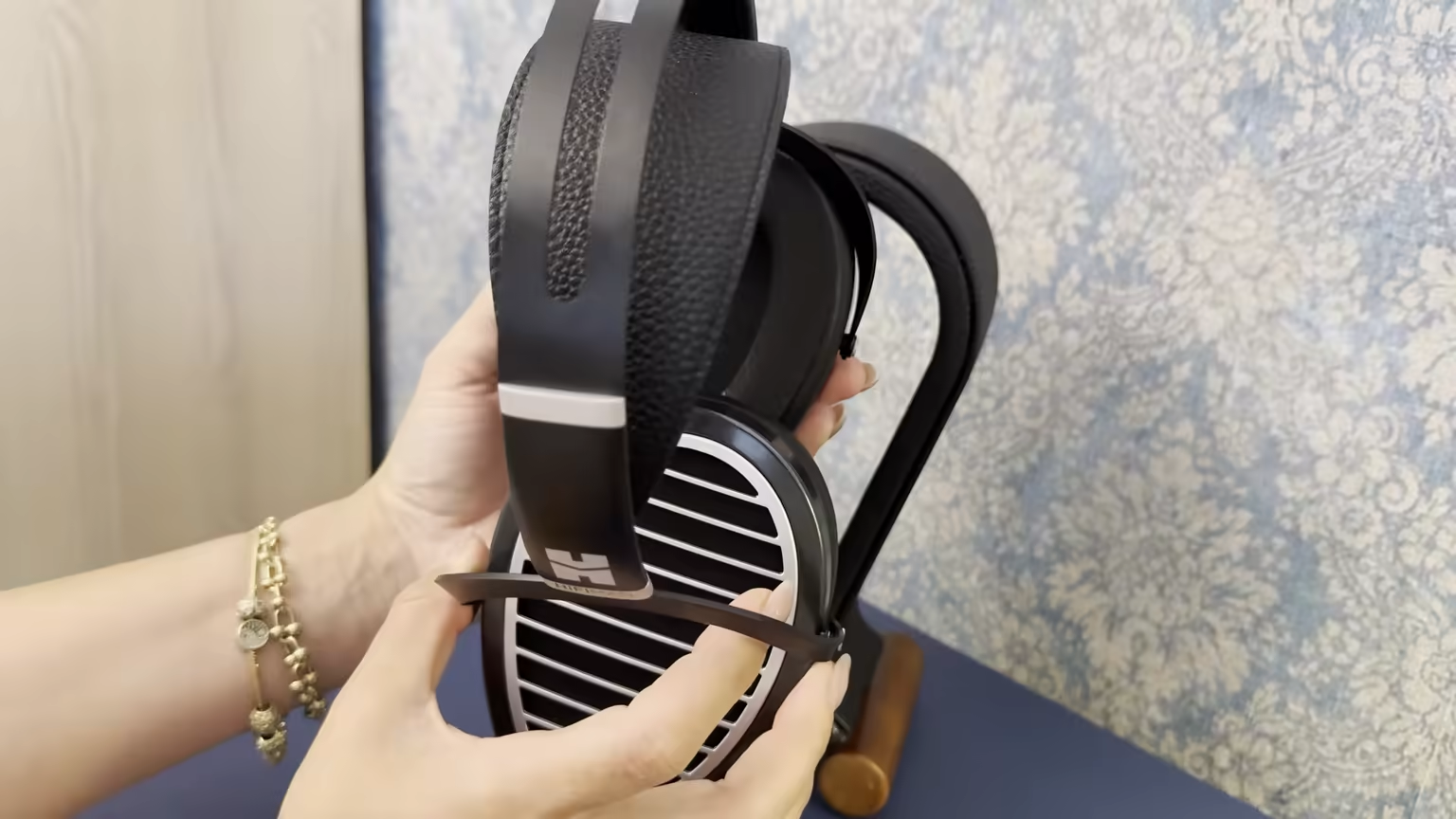 (view larger)
The inner foam isn't very soft - it's rather on the hard side - but that doesn't bother me as much as I thought. I got used to it very shortly after getting these headphones.
The headband used here is also a hybrid in a way. It utilizes a suspension-style design, with a soft strap as the part that's in contact with the top of your head, and a metal (probably steel) frame to hold it all. It offers size adjustment and cup tilt, but unfortunately no cup swivel. That can be an issue for some, but I'm sure it won't be for others. I think I'm somewhere in between. While it's not uncomfortable for me, I think there's some room for improvement with the addition of a cup swivel. The clamp isn't that strong, so the lack of articulation in one axis isn't that noticeable. (view larger)
The way it feels in the hand is very typical of this range of HIFIMAN products. It's not luxurious. But this company is way past the era of QC issues. Nowadays, they're aiming for a lighter weight on their headphones, rather than making them artificially heavier for a seemingly more premium feel - because most of the time, you have your headphones on your head, not in your hands. Because of this, the Ananda Stealth weighs only 400 grams.
For the connectors, there are dual 3.5mm jacks.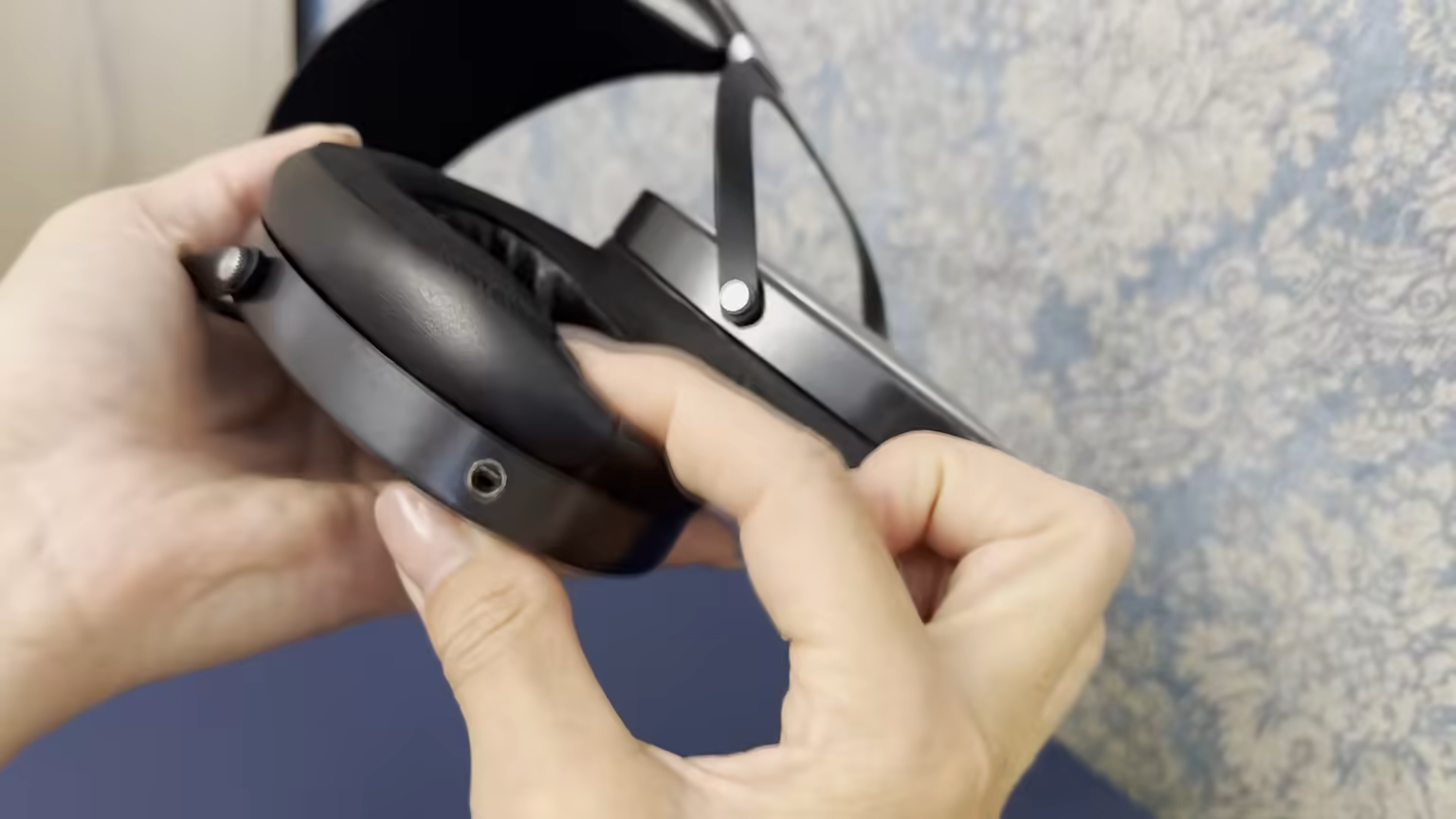 (view larger)
Technical Specifications: Easy to Drive, Stealth Magnets
The frequency response goes from 8Hz all the way up to 55kHz - that's impressive, well beyond the typical human hearing range. The sensitivity is 93dB - pretty high for a planar magnetic headphone - with a resistance of 16 ohms, very low for any headphone. This combination makes it incredibly easy to drive with almost all types of mobile-oriented gear, and even more so with desktop amplifiers. I wouldn't recommend driving it off a phone, as you will see quite an improvement with even the more basic dongles.
As the name suggests, it features Stealth Magnets. If you're not familiar with this technology, it's made to reduce wave diffraction turbulence for more pure sonic characteristics. It also has a NEO Supernano Diaphragm, which is the second thinnest one HIFIMAN makes, coming at 1 to 2 microns thick. This results in a more detailed response and snappier transients.
Sound Quality: Warm for a HIFIMAN, and It Grows on You
The Ananda Stealth doesn't have the wow factor at first, but it slowly starts growing on you.
Its soundstage is not the widest, but the way it can place instruments and vocals in the soundstage it has is fantastic. It's by far my favorite thing about this headphone.
Tonality-wise, it's a bit on the warmer side, which is almost unlike anything else from HIFIMAN. Its bass has very good extension, pretty much linear down to 20Hz - and yes, you can hear 20Hz with no problem on these.
The midrange is more or less neutral, and we of course get the 1.5 to 2kHz dip that's meant to widen the sound field through frequency response.
Besides that, in terms of technicalities, it also does very well. It has a decent sense of depth and scale with a nice punchy and tactile bass.
Regarding resolution, it's more or less on par with the Sundara, meaning it's not the most resolving headphone in the world - not even close. But that's not the point. I'm happy that they didn't make the treble sharp just to achieve a sense of more detail, as this takes away from the fun and relaxing nature of these.
Separation is just fine. It didn't leave me craving for more, as after a certain point, things are clear enough to be easily discernible - and this is already at this point, or past it.
Ananda Stealth vs. Edition XS
If you're wondering if the Edition XS is better than these, or if it's even any different, then let me briefly explain it to you - I was at the same place before I got the Anandas.
The Edition XS is not as good as the Ananda Stealth. Period. It's a bit cheaper, which justifies it, especially since the sonic gap isn't huge. The differences mainly lay in the overall presentation, imaging, and bass extension - in favor of the Anandas.
Also, the Edition XS has one issue: it sounds dry. I'm not sure why that is, but the Anandas don't do that - they're quite, let's call it, "pleasantly wet" in their sound.
Ananda Stealth vs. Ananda Nano
How about the Ananda Nano? Aren't those better?
It is a newer model, with a bit higher price tag and some internal technical improvements - which yes, resulted in great sonic enhancements, but also came at the cost of being too bright, at least for my liking.
That's why it's not as easy to recommend to somebody who doesn't know what they like and what they don't. It's best to try out both, but as a good rule of thumb, I can tell you that if you prefer a more laid-back, chill, and warm presentation, then go for the Ananda Stealth. However, if you're into technicalities more than anything else, or you prefer a bit sharper top end, then definitely go for the Ananda Nano.
Sound signature
Derived from the words this review uses: each axis runs between two opposite descriptors, and the shape leans toward whichever side the writing does.
- Warm ↔ Bright Leans warm
- Relaxed ↔ Analytical Sits close to centre
- Polite ↔ Aggressive Sits close to centre
- Lean ↔ Bass-heavy Neutral, no clear signal in the review language
- Intimate ↔ Wide stage Neutral, no clear signal in the review language
Hear what "warm" means: a short synthesised loop, flat and then with those leanings. An illustration of the words, not a recording of the Ananda Stealth.
Not sure which signature suits you? Find yours with a blind A/B test
Watch the video review
Subscribe on YouTube (opens in new tab)Prefer to read? The written review above covers everything in the video.

- 0:00 Ananda Stealth - The Most OVERLOOKED HiFiMan Headphone (opens in new tab)
- 0:17 Comfort & Build Quality (Suspension Strap, Large Earcups, Hybrid Pads, Swivel, Clamp) (opens in new tab)
- 2:23 Technical Specification (Frequency Response, Impedance, Sensitivity, Amplification, Stealth Magnets, NEO Supernano Diaphragm) (opens in new tab)
- 3:25 Sound Quality (Soundstage, Imaging, Bass Extension, Tonality, Warmth, Midrange, Depth, Scale, Punch, Detail Retrieval, Treble) (opens in new tab)
- 4:54 Comparisons (Ananda Stealth VS Ananda Nano VS Edition XS) (opens in new tab)
Common questions about the Ananda Stealth
Is the HIFIMAN Ananda Stealth worth it?
Yes. It scored 8.8/10, Highly Recommended, higher than 79% of everything we have tested, against a catalogue median of 8.1. On value it rates strong: above average for the price in headphones. Price: $359.
Who should buy the HIFIMAN Ananda Stealth, and who should skip it?
Buy it if you want the balance to lean warm, with the top end eased, and you want more performance per dollar than most of its peers. Skip it if you want every last bit of treble detail.
What amplifier does the HIFIMAN Ananda Stealth need?
The HIFIMAN Ananda Stealth is a 16 Ω load, so the matching rule is the rule of eighths: an amplifier's output impedance should sit at or below 2 Ω, an eighth of the headphone's, or its frequency response shifts audibly and usually in the bass. That is a property of the amp rather than its power rating, so a high-output-impedance tube amp can fail it while a phone jack passes. About 50 mW to reach 110 dB peaks, which is most dongle DACs. The review records 93 dB without saying against what, but it can only be dB/mW here: read as dB/V it would work out to 75 dB/mW, less sensitive than the Susvara and harder to drive than any headphone in production.
What should I consider instead of the HIFIMAN Ananda Stealth?
On the same chain, against the same recordings: the HIFIMAN Sundara scores 0.2 higher and costs $60 less, the HIFIMAN Arya Stealth scores 0.1 lower and costs $400 more, and the HIFIMAN Ananda Nano scores 0.2 lower and costs $140 more. Each of those has a full head-to-head page below.
Ananda Stealth or Edition XS - which should you buy?
The Ananda Stealth, and it is not close enough to agonise over. The Edition XS is cheaper, which justifies its existence, and the sonic gap is not huge - but the Stealth is ahead on presentation, imaging and bass extension, which are the three things you notice over a long listen. The Edition XS also has a specific problem: it sounds dry. The Anandas do not. They are, for want of a better phrase, pleasantly wet. If the price difference is not painful, spend it.
Ananda Stealth or Ananda Nano?
A rule of thumb, because both are good and they fail differently. The Nano is newer, costs more and brings real technical improvements - but it came at the cost of being too bright for my liking. So: if you want a laid-back, chill, warm presentation, take the Stealth. If you care about technicalities above everything else, or you actively like a sharper top end, take the Nano. The Stealth is the one I would hand to somebody who does not yet know which of those they are.
Can you run the Ananda Stealth off a phone?
You can, but I would not. The sensitivity and the low resistance make it easy to drive to volume from almost anything mobile, so nothing will sound broken - but you will hear quite an improvement from even a basic dongle, which is a small enough spend that there is no real argument for skipping it. This is a headphone that rewards a clean feed rather than a powerful one, and the step from a phone jack to a cheap dongle is the biggest single improvement available to it.
Will the Ananda Stealth fit large ears?
Yes, and with room to spare. These are the large egg-shaped cups, which take pretty much any ear size with very little chance of your ear touching the pads at all. The pads are slightly asymmetrical to seal better around the ear, and they are built from three materials - synthetic leather outside, cloth where it meets your face, perforated leather inside - so breathability holds up over a long session. Ear size is simply not one of the risks with this one.
Is the hard inner foam a dealbreaker on the Ananda Stealth?
It is the thing you notice first and stop noticing quickly. The inner foam is firmer than you expect - rather on the hard side - and it does take getting used to. It bothered me considerably less than I thought it would, and I was over it shortly after getting them. It is worth knowing about before you buy, because a first impression in a shop will read worse than a fortnight of ownership does.
Is the Ananda Stealth bright?
No, and that is the reason to be interested in it. It leans slightly warm, which is almost unlike anything else HIFIMAN makes. Crucially, they did not sharpen the treble to manufacture a sense of detail - so the resolution is roughly on par with the Sundara rather than class-leading, and in exchange you get something relaxing and fun that you can leave on. If you have bounced off HIFIMAN before because the top end was too hot, this is the one to try.
Why does the Ananda Stealth not impress immediately?
Because what it does best is not the kind of thing that shows off in the first minute. There is no wow factor here - the soundstage is not the widest, the resolution is not class-leading, and nothing leaps out. What it has is placement: the way it positions instruments and voices inside the stage it does have is fantastic, and that is by far my favourite thing about it. That takes a few records to notice and then you cannot unnotice it. Judge this one after a week, not after a track.
Does the Ananda Stealth leak sound?
Yes, freely and in both directions, because it is an open back. Whoever is next to you hears what you are hearing, and the room comes in to meet it. That puts an office, a shared space or a commute out of reach - this is a headphone for a room you control. The openness is also what lets it place instruments the way it does, so it is not a compromise so much as the deal being offered.