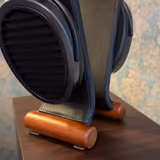
HIFIMAN Arya Unveiled Review: A Planar Too Fragile to Own?
An open-back planar that strips away the outer grill entirely - exposing the driver to deliver dead-silent backgrounds, holographic imaging, and the smoothest Arya treble yet.
higher than 92% of everything we have tested
Value Steep. You are buying performance here, not value.
- Standout
- Grill-less design eliminates micro-reflections off protective metal
- Watch out for
- Driver fully exposed
- Better alternative
- HIFIMAN HE1000se: leans brighter, $400 more, scores 0.2 higher.
Is it for you?
- You want the balance to lean warm, with the top end eased
- You want every last bit of treble detail
- $1,299 has to buy value as well as performance
Pick #3 of 14 in our Best Open-Back Headphones guide.
The HIFIMAN Arya Unveiled takes a massive risk by completely stripping away the outer grills in the name of audio purity. But does this exposed design actually result in better sound, or is it just a recipe for disaster? Let's discuss durability, break down the new 'magnetic veil' technology, and compare it directly to the Arya Organic to see if it's truly the new king of planar magnetics.
Is It Comfortable? Bare Drivers, Best-Ever Comfort
This is physically the most radical change in the Arya lineup history. If you've handled an Arya Organic or the Stealth before, the silhouette here is going to feel very familiar, but the vibe is completely different. HIFIMAN has ditched the wood veneer and gone for a fully blacked-out aesthetic. It's sleek, it's modern, but I have to be honest - holding it in my hands, it feels a bit more utilitarian than 'luxury.'
The ear cups are actually made of glossy black plastic. It's definitely a fingerprint magnet, and if I'm being critical, it doesn't feel premium the way the metal construction on the HE1000 series does. Despite the plastic cups, the assembly itself is good. Everything feels tight, the yokes are smooth, and the swivel mechanism feels solid with no worrying creaks or rattles.
But obviously, we have to talk about the open back. Seeing the raw driver magnet and diaphragm exposed like this is equally cool and terrifying. There is zero protection here. Just the driver staring back at you. And that introduces a new ritual to your listening sessions: the Magnetic Veils.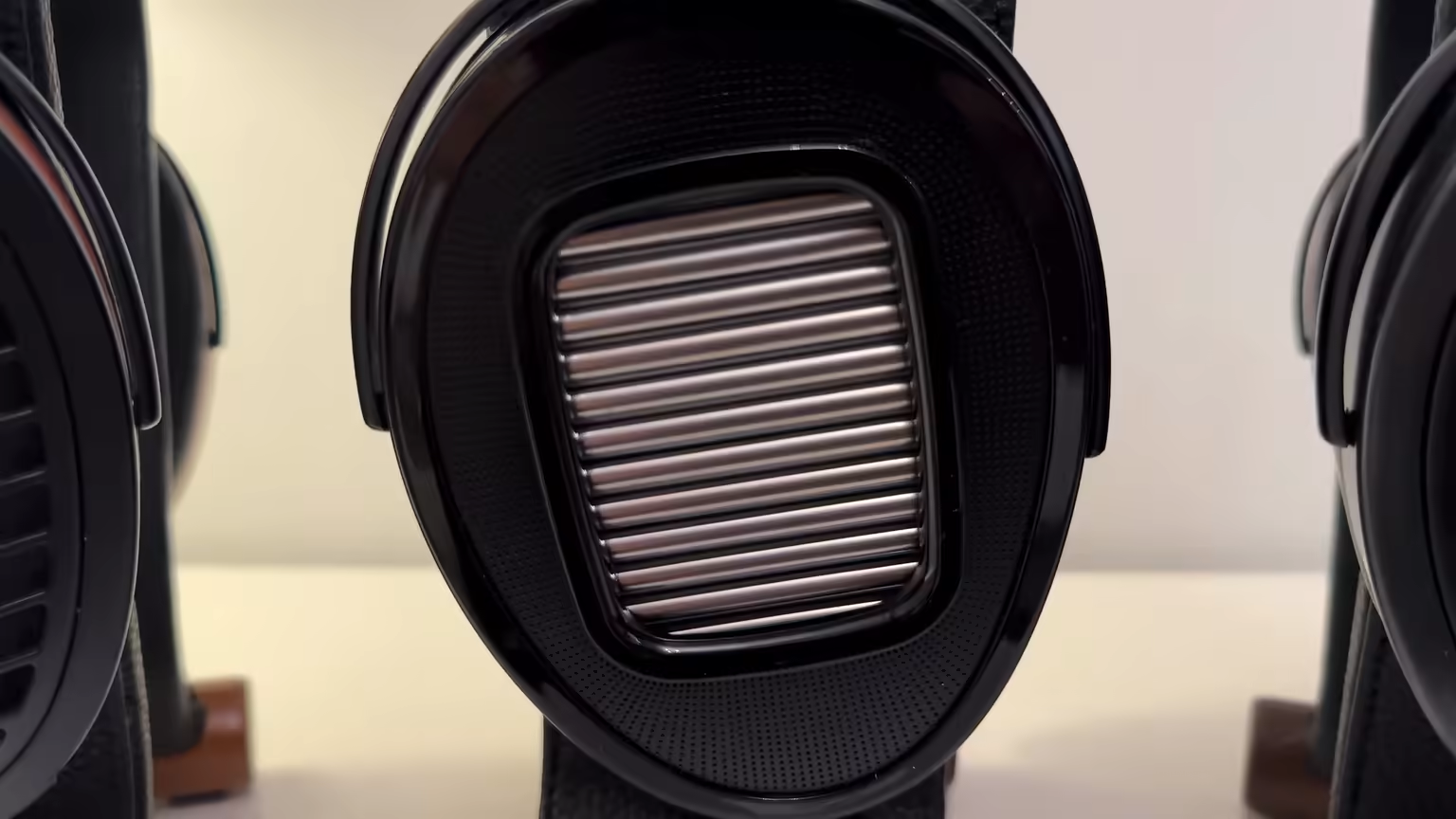 (view larger)
These are the plastic protective covers included in the box. They snap on magnetically to cover the drivers when you aren't listening. In practice, they work really well - the magnets guide them into place satisfyingly, though not super securely. But I'm not going to lie, the anxiety factor is real. Every time I put these down on my desk without the covers, I'm paranoid about a screw flying into the magnets. If you have a messy desk, or pets that shed hair, you are going to need to be disciplined about using these covers. Realistically, it's never a good idea to skip the 'veils' when the Arya is not in use - it's just a bad habit.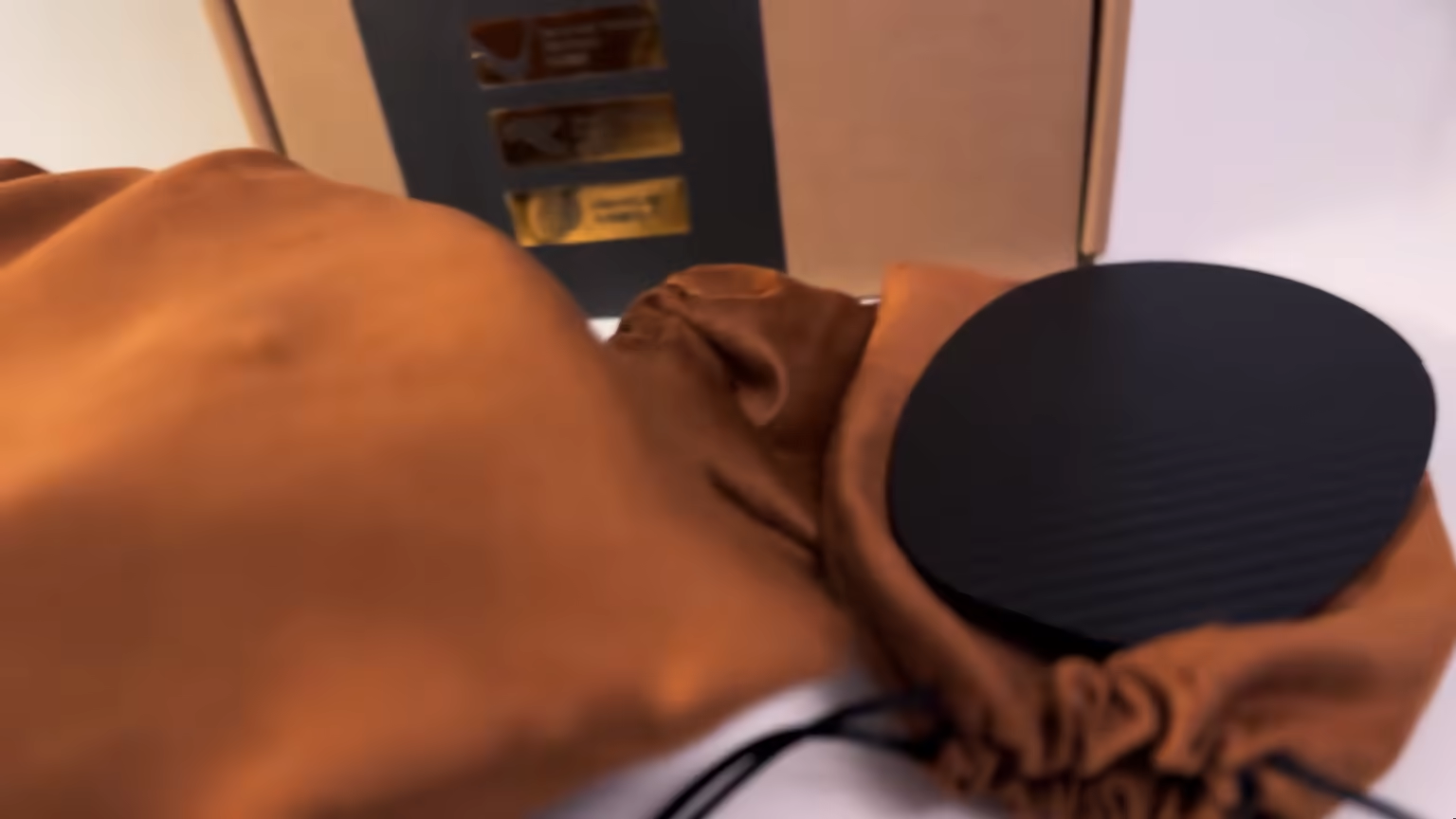 (view larger)
Now, let's talk comfort, which is where HIFIMAN rarely misses. Since they stripped away the grills, the weight has dropped a bit. We are looking at a very manageable weight for a planar this size. Combined with HIFIMAN's signature suspension strap system, the comfort is top-tier. The strap distributes the weight perfectly across the top of your head with zero hot spots, even after three or four hours of use.
The ear pads are the standard asymmetrical hybrid type - pleather on the outside to keep the bass pressure, and fabric on the face so your skin can breathe. They are huge, fully surrounding the ear with plenty of depth. If you have larger ears, you're going to love these. The clamp force is also just right - secure enough that they don't slide around, but light enough that they disappear on your head after a few minutes. Additionally, because it weighs less and is not as clampy compared to the Arya Organic, the Arya Unveiled is noticeably easier to wear for long periods. In my opinion it's the most comfortable headphone I've tried so far.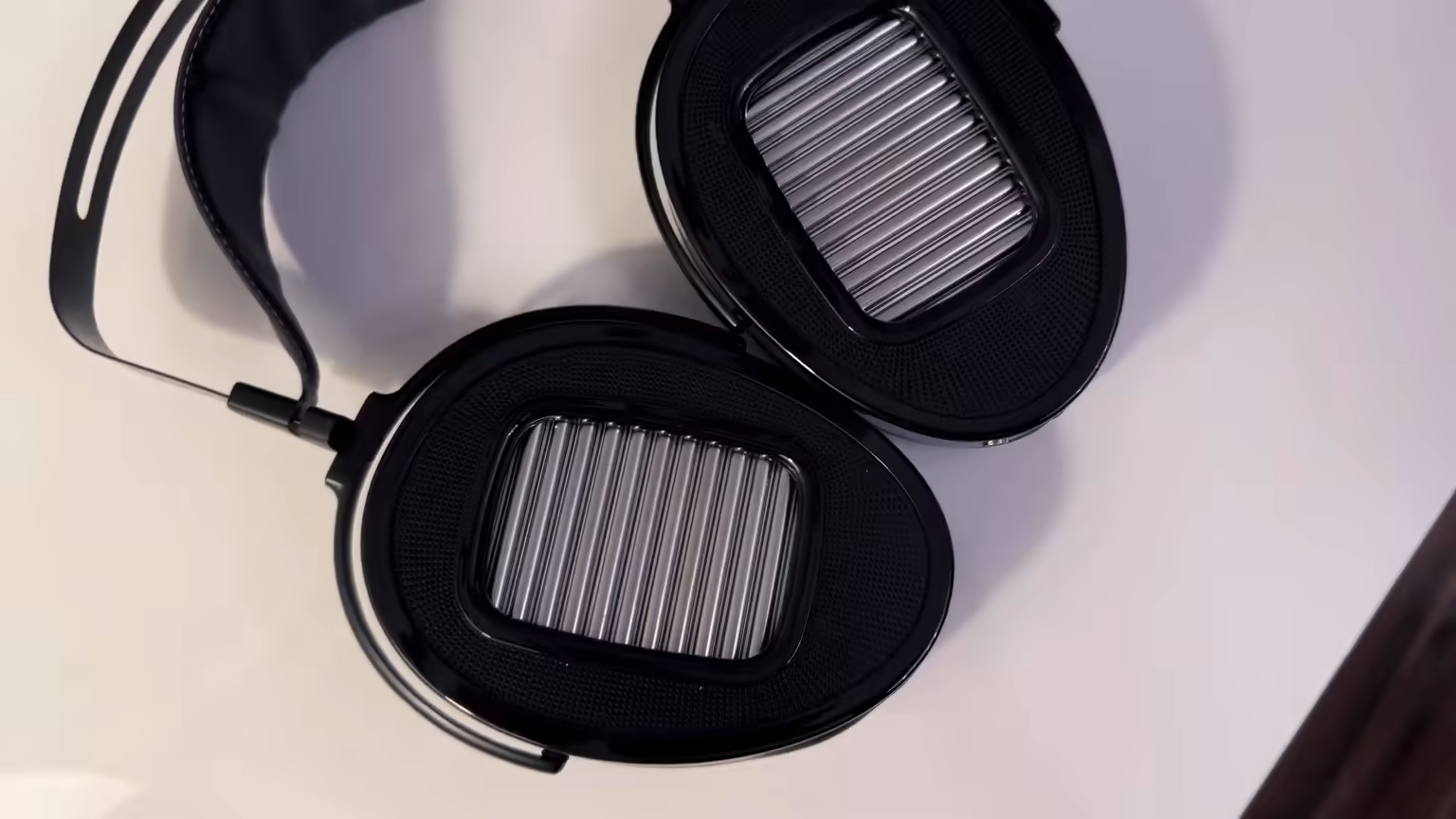 (view larger)
Accessories: Magnetic Veils and a Better Cable
Inside the box, you get the 'Magnetic Veils' we talked about, and you get the stock cable. HIFIMAN has finally moved away from those weird rubber tubing cables of the past. This is a nice, fabric-sleeved crystalline copper cable. It's flexible, it doesn't tangle easily, and it's not microphonic - meaning you don't hear a rubbing noise in the ear cup when the cable moves against your shirt.
Technologies: Why HIFIMAN Deleted the Grill
So, why take the risk? Why leave that delicate driver exposed to the elements? Well, HIFIMAN's argument is that protection comes at a sonic cost.
In previous Arya models, HIFIMAN used the Window Shade system. It was a grill designed to protect the driver while letting as much sound out as possible. But the engineers found that even the best grills still reflect some sound waves back at the driver.
And that brings us to the Nanometer Thickness Diaphragm. The diaphragm inside this headphone is less than a millionth of a meter thick. It is incredibly light and incredibly fast. The problem is, when you have a membrane that sensitive, even microscopic sound waves bouncing off a protective grill can disturb its movement, causing distortion.
So, the 'Unveiled' technology is exactly what it sounds like: by deleting the grill entirely, they've removed the last physical barrier between the driver and the open air. In theory, this eliminates those micro-reflections completely, giving you a wider soundstage and more accurate imaging because the sound waves are traveling away from your ear without hitting a wall.
Working together with that diaphragm are the Stealth Magnets. If you've followed HIFIMAN for a while, you know this tech, but it's key here. Traditional magnets are usually rectangular, and they physically block the sound waves coming off the diaphragm, creating turbulence. HIFIMAN's Stealth Magnets have a rounded shape that allows sound waves to pass through them without generating that interference.
So, when you combine the Stealth Magnets (which don't block sound) with the Unveiled design (which has no grill to reflect sound) this effect compounds. You are left with a driver that is essentially floating in free air. It's a purist approach, the most open out of all open-back headphones.
Does It Need an Amp? 27Ω, Current-Hungry
The Arya Unveiled has an impedance of 27Ω and a sensitivity of 94dB. If you just look at the impedance, you might think your phone can drive that. Don't do it.
While the low impedance means it doesn't need a massive voltage swing like a high-impedance Sennheiser, the 94dB sensitivity tells a different story. These are still current-hungry planar magnetics. They aren't as impossible to drive as a Susvara, but they are significantly harder to drive properly than your average dynamic driver headphone.
If you plug these into a weak source, they will get loud enough, but they will sound thinner, the bass will be sloppy, and the dynamics will feel compressed. To get that 'Unveiled' speed and slam we talked about, you need a dedicated amplifier with good enough current delivery. You don't need a nuclear power plant, but a built-in solution might struggle here. Other than that, they are rather forgiving to the source, as long as it's solid state.
Frequency response is rated from 8Hz all the way up to 65kHz. Obviously, you can't hear up to 65kHz - unless you are a bat - but that extension is usually an indicator of how fast and capable the driver is at transient response. The more interesting number is the 8Hz on the low end. Planar magnetics are famous for their linear bass extension, and as you'll see in the sound section, HIFIMAN isn't lying about this.
Sound Quality: Dead-Silent Background, Linear Bass
Does removing the grills actually make a difference, or is it just marketing? It works. But probably not in the way you expect.
When I first put these on, I expected them to sound 'wider' - like the sound was infinitely escaping into the room. And while the soundstage is sizeable, the real magic here isn't width - it's clarity and smoothness.
Because there is no grill to reflect sound waves back at your ear, the 'background' of the music is dead silent. Notes just appear out of thin air and then vanish instantly without that tiny micro-reverb you get on closed or semi-open headphones. It is spooky how clean the imaging is.
If you are coming from the Arya Organic, you might actually feel like the Unveiled has less bass at first. The Organic has a bit of a mid-bass bloom that makes it sound warm and punchy. The Arya Unveiled flattens that out. It is much more linear. You can feel the sub-bass rumble - but really it's all about texture rather than volume. It is fast, tight, and precise. If you are a bass-head, you might find it a little too polite out of the box. However, because that driver is so fast, it takes EQ like a champ.
Midrange and Treble: Lush Vocals, No HIFIMAN Spice
Historically, HIFIMANs - especially the older Aryas - could sound a bit 'hollow' or distant in the mids. The Unveiled fixes that. Vocals are pushed slightly forward and have a lush, organic density to them that reminds me more of the HE1000se than the Arya Stealth. If you listen to acoustic tracks or jazz, the realism is there. It genuinely sounds like the artist is standing in front of you, rather than you listening to a recording of the artist.
And finally, the treble. This is the big surprise. We all know the 'HIFIMAN Treble' - that sparkly, spicy peak that gives you tons of detail but can fatigue your ears after an hour. On the Arya Unveiled, that sharpness is gone. They have smoothed out the edges significantly compared to the Arya Organic. It doesn't have that 'glassy' edge that's annoying on poorly mastered tracks. It's a more mature, refined tuning. It's less about the extreme detail and more about sounding real.
Verdict: The Best-Sounding Arya
If the Arya Organic is the fun headphone - the Arya Unveiled is the 'truth' headphone. It is more transparent, resolving, and thanks to that grill-less design, the imaging is even more focused. It creates a holographic bubble around your head where you can pinpoint exactly where every instrument is sitting. It is, without a doubt, the best sounding Arya.
Sound signature
Derived from the words this review uses: each axis runs between two opposite descriptors, and the shape leans toward whichever side the writing does.
- Warm ↔ Bright Leans warm
- Relaxed ↔ Analytical Leans analytical
- Polite ↔ Aggressive Leans aggressive
- Lean ↔ Bass-heavy Sits close to centre
- Intimate ↔ Wide stage Sits close to centre
Hear what "warm, analytical, aggressive" means: a short synthesised loop, flat and then with those leanings. An illustration of the words, not a recording of the Arya Unveiled.
Not sure which signature suits you? Find yours with a blind A/B test

Watch the video review
Subscribe on YouTube (opens in new tab)Prefer to read? The written review above covers everything in the video.

- 0:00 A Headphone With NO Grilles - Will It Break? (opens in new tab)
- 0:38 Comfort & Build Quality (Plastic Construction, No Driver Protection) (opens in new tab)
- 4:34 Technologies (Stealth Magnets, Nanometer Thickness Diaphragm) (opens in new tab)
- 6:45 Technical Specs (Impedance, Sensitivity, Amplifier Requirements) (opens in new tab)
- 9:19 Sound Quality (Sound Stage Depth, Imaging, New Tuning, Punch) (opens in new tab)
Common questions about the Arya Unveiled
Is the HIFIMAN Arya Unveiled worth it?
Yes - 9.1/10, Highly Recommended, higher than 92% of everything we have tested, against a catalogue median of 8.1. On value it rates steep: better value exists in headphones, so you are buying performance here, not value. Price: $1,299.
Who should buy the HIFIMAN Arya Unveiled, and who should skip it?
Buy it if you want the balance to lean warm, with the top end eased. Skip it if you want every last bit of treble detail, and $1,299 has to buy value as well as performance.
What amplifier does the HIFIMAN Arya Unveiled need?
Impedance is 27 Ω. By the rule of eighths the amplifier feeding it wants an output impedance no higher than 3.4 Ω, otherwise the interaction between the two tilts the frequency response rather than simply making it quieter. Power is the separate question. About 40 mW to reach 110 dB peaks, which is most dongle DACs. The review records 94 dB without saying against what, but it can only be dB/mW here: read as dB/V it would work out to 78 dB/mW, less sensitive than the Susvara and harder to drive than any headphone in production.
What should I consider instead of the HIFIMAN Arya Unveiled?
The pieces we have actually run against it: the HIFIMAN HE1000se scores 0.2 higher and costs $401 more, the HIFIMAN Arya Organic scores 0.1 higher and costs $200 less, and the HIFIMAN Edition XS scores 0.4 lower and costs $1,030 less. Every one of those matchups has its own page in the head-to-head section.
How fragile is the Arya Unveiled really?
Fragile enough that it changes how you own a headphone. There is zero protection over the driver - no grill, just the raw magnet and diaphragm staring back at you - so a dropped screw, a curious pet or a shedding coat is a genuine risk rather than a theoretical one. The Magnetic Veils in the box snap on to cover the drivers and they work well, though not super securely. Skipping them when the headphone is not in use is simply a bad habit. If your desk is messy, buy something else.
What are the Magnetic Veils, and do you have to use them?
They are the plastic covers included in the box, and yes, effectively you do. They snap magnetically over the exposed drivers when you are not listening, and the magnets guide them into place satisfyingly - though the hold is not super secure. It is a new ritual and it is the price of the design. I never leave mine uncovered on a desk, because the anxiety about something metal finding its way to those magnets is entirely rational.
Does removing the grill actually do anything?
It works, but not in the way I expected. I assumed the soundstage would blow open; it is sizeable rather than enormous. What you actually get is silence. With no grill reflecting sound waves back toward your ear, the background of the music is dead silent - notes appear out of nothing and vanish without the tiny micro-reverb you get on other headphones. The imaging is spooky-clean as a result. The benefit is clarity and smoothness, not width.
Does the Arya Unveiled have less bass than the Arya Organic?
It sounds that way at first, and the reason is worth understanding. The Organic carries a mid-bass bloom that reads as warm and punchy; the Unveiled flattens it out and runs much more linear. You can feel the sub-bass rumble, but it is about texture rather than volume - fast, tight and precise. If you are a bass-head it will strike you as too polite out of the box. The driver is quick enough that it takes EQ like a champ, so this is a fixable complaint rather than a limit.
Does the Arya Unveiled need a real amplifier?
Yes, and the impedance will mislead you into thinking otherwise. At 27Ω you might reach for a phone - do not. The 94dB sensitivity is the figure that matters, and these are still current-hungry planars: not Susvara-impossible, but significantly harder to drive properly than any dynamic headphone. Off a weak source they get loud but go thin, the bass turns sloppy and the dynamics compress. You do not need a nuclear power plant, just real current delivery. Beyond that they are forgiving, as long as the amp is solid state.
Is the Arya Unveiled still bright like other HIFIMANs?
No, and this is the big surprise. The famous HIFIMAN treble - that sparkly, spicy peak that hands you detail and then tires your ears out after an hour - is gone. The edges are significantly smoothed compared to the Arya Organic, with none of the glassy quality that makes badly mastered tracks unpleasant. It is a more mature tuning, less about extreme detail and more about sounding real. The mids gained from the same change: vocals are pushed slightly forward with a lush density closer to the HE1000se.
Arya Unveiled or Arya Organic?
The Organic is the fun one; the Unveiled is the truth one. The Unveiled is more transparent, more resolving, and its imaging is more focused - it builds a holographic bubble where you can place every instrument exactly. It is also lighter, less clampy and the most comfortable headphone I have worn. The Organic gives you more mid-bass warmth and does not ask you to manage an exposed driver. Best-sounding Arya is not a close call; easiest to live with is a different question.
Is the Arya Unveiled comfortable for long sessions?
It is the most comfortable headphone I have tried, full stop. Stripping the grills dropped the weight, and the suspension strap spreads what remains across the top of your head with zero hot spots after three or four hours. The pads are huge, deep asymmetrical hybrids - pleather outside to hold bass pressure, fabric against your face to breathe - and large ears will disappear into them. Clamp is judged well: secure enough not to slide, light enough to forget within minutes. It is noticeably easier to wear than the Arya Organic.