
HIFIMAN EF400 Review: R2R at $399, but Check the Power First
An entry-level Class AB amp/DAC with HIFIMAN's Himalaya R2R DAC, fun subjective sound, and a slightly soft character - underpowered for the hardest planar loads.
higher than 14% of everything we have tested
Value Steep. You are buying performance here, not value.
- Standout
- Himalaya R2R DAC with NOS / oversampling option
- Watch out for
- Specced 4.4W, but independently measured closer to 3W into 32Ω
- Better alternative
- HIFIMAN EF500: $150 more, scores 0.7 higher.
Is it for you?
- You want one amplifier that will not be the limit on whatever you buy next
- You want the R-2R presentation rather than the last decimal of measured linearity
- You listen mostly on sensitive in-ears, where reserve like this is gain you have to turn down
- You choose a converter by its measurements and want the lowest distortion figure at the price
Pick #4 of 4 in our Best Headphone Amplifiers guide.
The EF400 is an entry-level Class AB headphone amp and DAC combo offered by HIFIMAN. It has a few very cool unique traits and decent subjective performance. However, its objective performance falls short in measurements, and it appears to be slightly less powerful than it claims to be.
In my opinion, for the discounted price of $400, it can compete in terms of the sound quality it offers. However, if you're someone who cares deeply about measurements, consider looking into some of the higher-end HIFIMAN amplifiers that have superior measurements.
Build Quality and Design: 3kg of Aluminum, USB Only
It's a regular, rather compact desktop-sized black box, made fully out of black aluminum with a thick, silver, brushed aluminum front plate as a color accent. There's a thinner outer sheet of black-painted aluminum going from the top to the left and right side, which screws in on the bottom. The bottom and back of the EF400 consist of a single piece of aluminum as well. The device feels quite heavy when held - because of the oxygen-free copper toroidal transformer inside and the all-metal chassis, it weighs a little over 3 kilograms (almost 7 pounds).
All of the inputs and outputs are on the back. For input, we've got USB - period. There's just a USB, so this amplifier is made specifically for desktop use, which is okay for me. However, if you're missing other types of inputs, you can look at the EF600 for example, which is a step up from this model and includes more of them. There are two types of a single input - the typical USB Type-B and a more modern solution which I appreciate a lot, USB Type-C.
It can also output a full line-level, non-volume-controlled, analog signal through the unbalanced RCAs or balanced XLRs on the back. There's a standard 3-pin power plug with a ground connection and a power switch, alongside some small vents. On the bottom, a voltage selector lets you pick either 230V or 115V. It's important to note that the voltage currently in use is displayed on the red switch itself - keep this in mind to avoid damaging your unit. The four feet are equipped with foam material to reduce vibrations and prevent scratches when adjusting its position on the desk. The feet can be removed by unscrewing the screws and replaced if desired.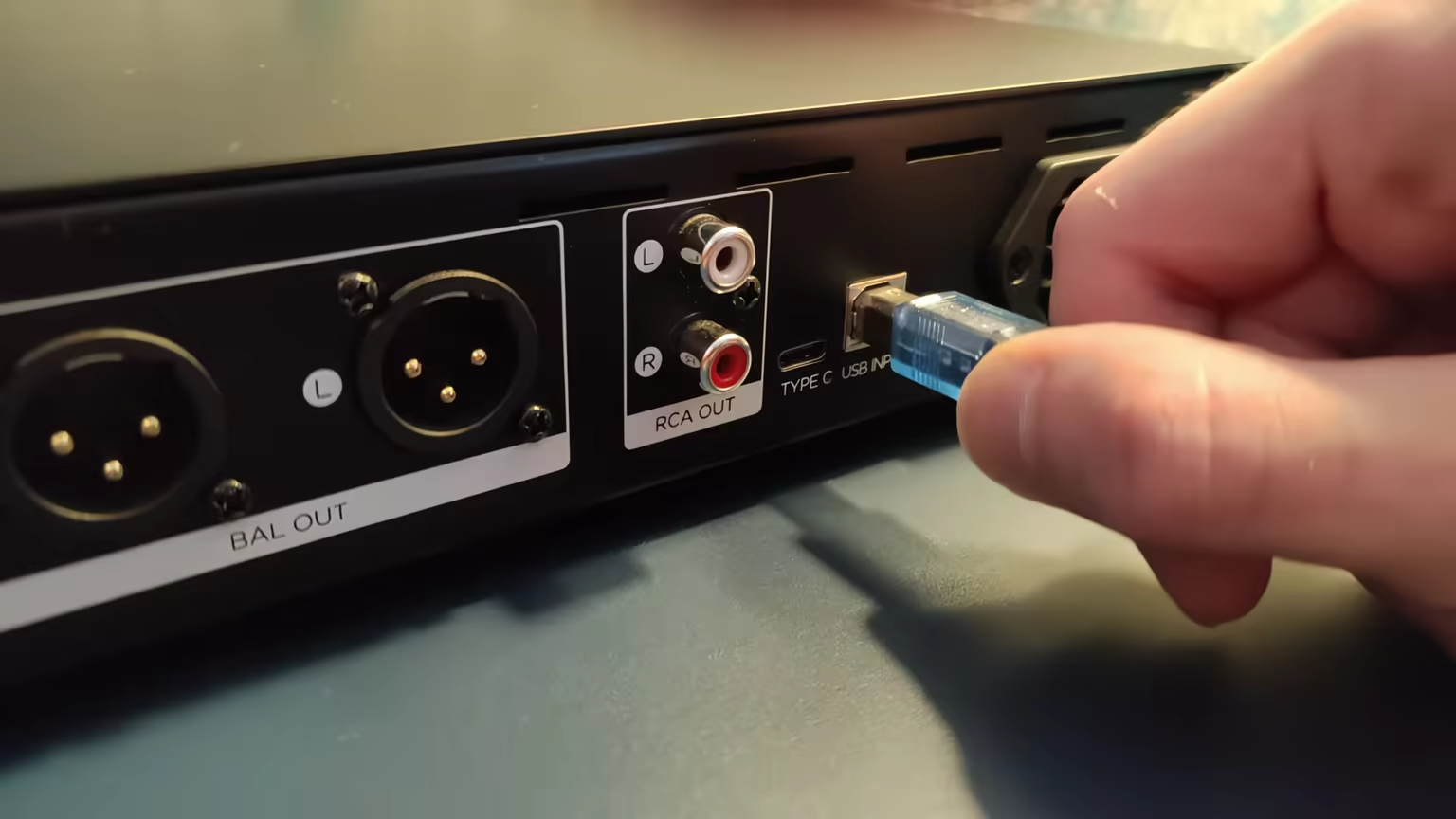 (view larger)
The front of the EF400 is by far its best-looking part. I love the symmetry of the two knobs and the headphone outs. Going from the left, there's a gain selector / oversample mode knob with four options. It's very tactile and feels great. For the headphone outs, there's a single-ended quarter-inch jack, a single-ended 3.5mm jack, and two balanced headphone outputs in the form of 4.4mm and 4-pin XLR. On the very right, there's a volume knob that, while being smooth, has some excess wobble to it. Some people seem to make it a bigger deal than it is - for me, it's not a huge deal breaker, as it doesn't make the volume control very difficult to use or anything like that. There's maybe a millimeter of wobble in the rotation.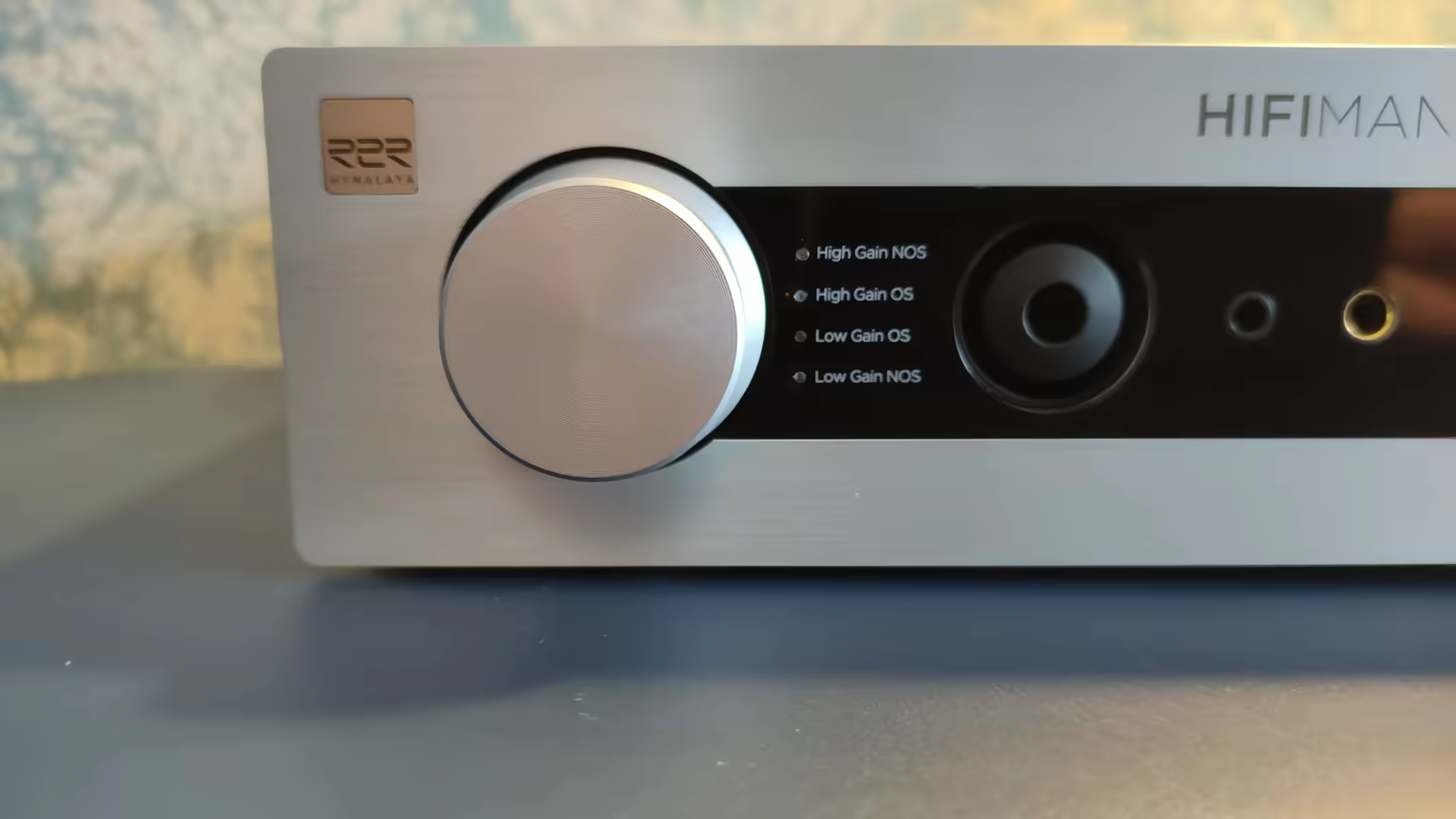 (view larger)
The DAC: HIFIMAN's Himalaya R2R with NOS
The DAC part of this unit is pretty interesting, as it's not a regular sigma-delta approach. It's a Himalaya R2R DAC, HIFIMAN's proprietary approach to resistor ladder array digital-to-analog converters on a chip. It can do PCM up to 192kHz at 32 bits.
There's a unique option of NOS - non-oversampling - which is something that only R2R DACs can do. It often leads to even worse measurements (unless you're using an external oversampling filter), but a warmer, or in some way more fun, listening experience. The difference between oversampling and non-oversampling is not huge, but it is audible. In my experience, oversampling led to a more busy, though detailed experience. On the other hand, non-oversampling sounded cleaner, yet warmer with an ever so slightly wider soundstage. It's fantastic to have the option to choose between two modes, depending on your gear, the track you're listening to, or personal preferences.
This DAC has one more special feature - it operates in a 4-channel mode, allowing for fully balanced output and separation between each channel at once. The thing is, they either made a mistake or intentionally designed it so that one channel is delayed by one sample compared to the other. Although not noticeable in terms of one channel playing the sound later than the other, this delay creates a more euphoric soundstage for some people. However, others can get dizzy due to this effect.
How Does It Sound? Soft, Sweet, and Musical
The EF400 amplifier cannot be listened to without its built-in DAC, so my sound impressions are based on the entire DAC and AMP combo.
The first thing I noticed about it is that it sounded soft, very soft - even compared to the seemingly similar EF600. What often comes with the softness is some vocal sweetness added - that's the case here as well, but it takes away from the punchy nature of some headphones, like the HE6se. I would not recommend this amplifier for the HE6se, Susvara, or Modhouse Tungsten. If you possess any of them, you should be aware of their power requirements and probably step up the ladder to pick up higher-end source gear, as the EF400 won't let them spread their wings in terms of dynamics, and probably lacks some power to get the most out of them.
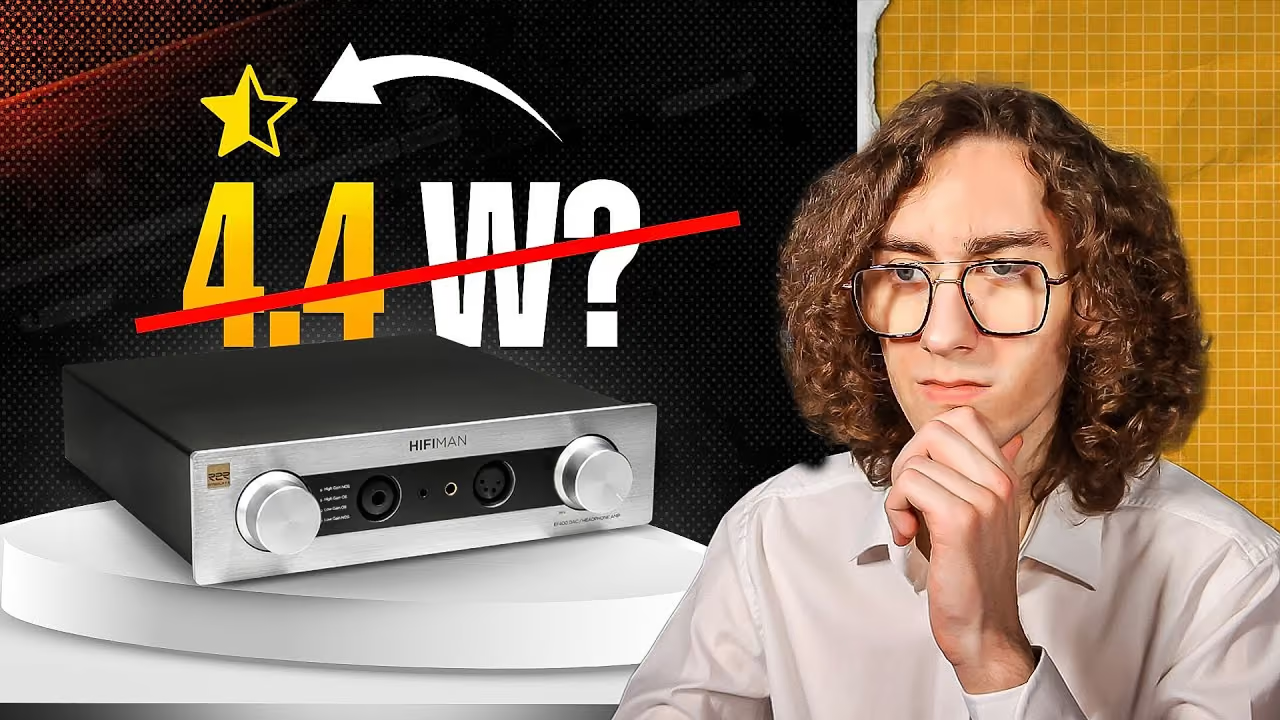
The thing with the EF400's power is odd. They advertise it to be 4.4 watts per channel, which sounds pretty impressive for this kind of device, but independent measurements were able to get roughly 3 watts into 32 ohms out of it. It is still plenty - unless you're running a very high-end or power-demanding headphone.
The signal-to-noise ratio is 118dB, and THD+N is specified to be between 0.002 and 0.004%. The channel separation is 125dB. Everything that I just mentioned may sound unimpressive - as it is. The EF400 is clearly not supposed to be a measurement-chasing unit, even due to the choice of using an R2R DAC. They're known not to measure as well as delta-sigma units, but they offer superior subjective performance. I believe that subjective performance was this unit's goal.
Regarding this, it offers a very full and rich sound, typical of Class A or in this case Class AB designs - though it can sound a little shouty with very raw vocals. You shouldn't be expecting a lot of resolution out of it, but the details that it can resolve are presented in a very pleasant, not in-your-face way. The EF400 sounds very fun and musical, and it's far from being overly analytical.
Headphone Matching: Made for HIFIMAN's Own
Almost every not-crazy-hard-to-power HIFIMAN that I've got sounded very, very pleasant. It takes a bit of the edge off of the sometimes sharp or bright-leaning tuning. Anything from the HE-R9, open-back Sundara, Deva Pro, or Edition XS sounded like it was a perfect fit. HIFIMAN knew what they were doing - making an amp that matched well with their headphones.
But there's one exception - I didn't particularly like the entry-level HE400se. That headphone doesn't do particularly well with busy passages, and the added harmonics of this amp made it even worse. Maybe it was a power thing, as the HE400se requires quite a bit of it - but I doubt it. I also doubt that anyone would pick up a $400 DAC/amp for a $100 headphone.
Most of the IEMs I've tried with it were not the greatest experience, due to quite a bit of channel imbalance in the first 10% of the volume. However, turning down the source volume allowed me to get past the problematic volume level and enjoy a wide range of IEMs with the EF400.
Generally, all headphones - except for those that are extremely difficult to drive, mid-forward, or dark-sounding - sound excellent when connected to this amplifier.
What the EF400 will drive
Rated at ~3 W measured (4.4 W rated) into 32 Ω, it clears every one of the 23 headphones we have published a power figure for - including the hungriest, the HIFIMAN HE-R9, which wants about 313 mW to reach 110 dB peaks.
Requirements are each headphone's own published figure, computed from its impedance and sensitivity by the same calculator its review runs. Where a review states a sensitivity without naming its reference, the figure used here is the worst case, so a headphone counts as driven only if the amplifier clears it either way. The rating above names more than one output; the lowest is the one used. Reproduce any of it in the headphone power calculator, or open a row's review to move the listening level and watch its figure change.
| Headphone | Needs | Drives it |
|---|---|---|
| HIFIMAN HE-R9 | 313 mW | Yes |
| Sivga Luan | 263 mW | Yes |
| OLLO Audio X1 | 248 mW | Yes |
| Sivga Robin SV021 | 99 mW | Yes |
| HIFIMAN RE2000 PRO Silver | 84 mW | Yes |
| Sivga Anser | 83 mW | Yes |
| HIFIMAN HE400se | 79 mW | Yes |
| Sivga SV021 Pro | 56 mW | Yes |
| HIFIMAN RE800 Silver | 53 mW | Yes |
| HIFIMAN Ananda Stealth | 50 mW | Yes |
| HIFIMAN HE1000 Stealth | 50 mW | Yes |
| HIFIMAN Arya Organic | 40 mW | Yes |
| HIFIMAN Arya Stealth | 40 mW | Yes |
| HIFIMAN Arya Unveiled | 40 mW | Yes |
| HIFIMAN Sundara | 40 mW | Yes |
| Kiwi Ears Orchestra Lite | 39 mW | Yes |
| HIFIMAN HE1000se | 25 mW | Yes |
| Verum Audio Verum 1 | 25 mW | Yes |
| HIFIMAN Sundara Closed-back | 16 mW | Yes |
| Meze 105 Silva | 15 mW | Yes |
| Kiwi Ears Atheia | 6 mW | Yes |
| HarmonicDyne Eris | 5 mW | Yes |
| Simgot EM6L | 5 mW | Yes |
Watch the video review
Subscribe on YouTube (opens in new tab)Prefer to read? The written review above covers everything in the video.
- 0:00 EF400 Price & Unboxing (opens in new tab)
- 0:39 Build Quality & Design (Size, Materials, OFC Toroidal Transformer) (opens in new tab)
- 1:19 Digital and Analog Inputs / Outputs (USB-C, RCA, XLR) (opens in new tab)
- 2:19 Foam Material Vibration Isolation Feet (opens in new tab)
- 2:31 Front (OS / NOS Knob, Single-Ended & Balanced Headphone Outputs) (opens in new tab)
- 2:59 Smooth, But Wobbly Metal Volume Control Potentiometer (opens in new tab)
- 3:17 HiFiMan R2R Himalaya Balanced DAC (PCM, 192KHz 32 Bit, Non Oversampling, Soundstage) (opens in new tab)
- 4:48 Headphone Amplifier (4.4WPC Power, Softness, Punch & Slam, SNR, THD+N, Channel Separation) (opens in new tab)
- 6:18 Subjective Performance (Resistor Ladder Array, Class A/B, Resolution) (opens in new tab)
- 7:04 Headphone Matching (HiFiMan HE6se & Susvara, HE400se, Modhouse Tungsten) (opens in new tab)
Common questions about the EF400
Is the HIFIMAN EF400 worth it?
Yes, for the right listener. It scored 7.5/10, Recommended, higher than 14% of everything we have tested, against a catalogue median of 8.1. On value it rates steep: better value exists across the catalogue, so you are buying performance here, not value. Price: $399.
Who should buy the HIFIMAN EF400, and who should skip it?
Buy it if you want one amplifier that will not be the limit on whatever you buy next, and you want the R-2R presentation rather than the last decimal of measured linearity. Skip it if you listen mostly on sensitive in-ears, where reserve like this is gain you have to turn down, and you choose a converter by its measurements and want the lowest distortion figure at the price.
What else have you tested around the price of the HIFIMAN EF400?
We have not run it head-to-head against anything yet. In the same category and the same rough money we have scored the HIFIMAN EF499 at 8.1/10 and the HIFIMAN EF500 at 8.2/10, which is the nearest thing to a shortlist until a matchup page exists.
Does the EF400 really make 4.4 watts?
No, and the gap is worth knowing about. HIFIMAN advertise 4.4 watts per channel, which sounds impressive for a device at this price, but independent measurements got roughly 3 watts into 32 ohms. That is still plenty for most headphones - it only becomes a problem at the top of the difficulty range. Treat the rated figure as optimistic rather than as a lie, and buy on the measured one.
Can the EF400 drive a Susvara or HE6se?
No, and I would not try. I would not recommend this amplifier for the HE6se, the Susvara or the Modhouse Tungsten. It is not only about the watts, though it probably lacks some there too - the EF400's character is soft, and softness takes the edge off headphones that live on punch. Those three will not spread their wings here in dynamic terms. If you own any of them, step up the ladder for your source gear.
What does NOS mode actually change on the EF400?
Non-oversampling is something only R2R DACs can do, and the difference is audible without being dramatic. Oversampling gave me a busier, more detailed presentation; non-oversampling sounded cleaner and warmer, with a very slightly wider stage. NOS often measures worse unless you are running an external oversampling filter, and better measurements are not what this unit is for. Having both and being able to pick per track, per headphone or per mood is the real feature.
Why does the EF400 sound wide in an unusual way?
Because of its 4-channel mode and a quirk inside it. The DAC runs four channels for a fully balanced output with separation between each channel at once - and one channel is delayed by a single sample against the other. Whether that was a mistake or a design decision I cannot say. It is not audible as one side arriving late. What it does is create a more euphoric soundstage that some people love and that makes other people dizzy.
Can you use IEMs with the EF400?
With a workaround, yes. There is quite a bit of channel imbalance in the first 10% of the volume range, which is exactly where sensitive in-ears sit, so out of the box most of them were not a great experience. Turning the source volume down pushes you past the problematic part of the pot and opens up a wide range of in-ears. It works, but it is a thing you have to know and do.
Which headphones does the EF400 suit best?
HIFIMAN's own, and that is clearly deliberate. Almost every not-crazy-hard-to-power HIFIMAN I own sounded very pleasant on it - the HE-R9, the open-back Sundara, the Deva Pro and the Edition XS all felt like perfect fits, because the amp takes a bit of the edge off their sometimes sharp, bright-leaning tuning. The exception was the entry-level HE400se: it already struggles with busy passages and the added harmonics made that worse. Anything mid-forward or dark-sounding is also the wrong match.
Should the EF400's modest measurements put you off?
Only if measurements are what you are buying. THD+N of 0.002 to 0.004%, 118dB signal-to-noise and 125dB channel separation are unremarkable numbers, and the R2R DAC is part of why - resistor ladder designs are known not to measure like delta-sigma units, and they are chosen for what they offer subjectively. This was clearly never meant to be a measurement-chasing unit. If you care deeply about the charts, look at HIFIMAN's higher-end amplifiers instead.