
HIFIMAN HE1000se Review: The $1,700 Flagship Planar
An ex-$3,500 flagship, now $1,700: nanometer diaphragm, Stealth Magnets, a holographic soundstage, and state-of-the-art detail - bright, honest, merciless with bad sources.

tied for the highest score in the catalogue, level with one other review
Value Steep. You are buying performance here, not value.
Lowest price now
$1,699 at Apos Audio, Audio46 and 3 more on
The same as the $1,700 list price. In stock at all 5 US stores we check daily. Price tracking began on Oct 6, 2026. Compare all 5 stores
- Standout
- State-of-the-art detail retrieval
- Watch out for
- Bright, peaky treble
- Cheaper alternative
- HIFIMAN Arya Organic: $600 less, a near-tie on score.
Is it for you?
Buy it if
- You want the balance to lean bright, with the detail pushed forward
- You do not want to buy an amplifier before you can hear it properly (It needs about 25 mW to reach 110 dB SPL at 35 Ω and 96 dB/mW)
Skip it if
- You're treble-sensitive
- $1,700 has to buy value as well as performance (The HE1000se scores 9.3/10 for $1,700, rated steep on value against the 29 other headphones reviewed here with a list price)
Read the HIFIMAN Arya Unveiled review instead: it leans warm. Read the HIFIMAN Arya Organic review instead: $600 less, a near-tie on score.

Named Best Overall in our Best Open-Back Headphones guide, ahead of 13 others.
I've tested a lot of headphones, and only a handful have ever sent me back to re-listen to my whole library. The HIFIMAN HE1000se is one of them. It isn't built to sound good - it's built to sound true. So the real question isn't whether it's good. It's whether you want a headphone this honest.
A light metal build and excellent comfort
The HE1000se arrives more like a luxury watch than a pair of headphones. The box is wrapped in real brown leather, and the manual tucked next to the headphone isn't really a manual at all - it's closer to a coffee-table book, full of photographs of opera houses. The "se" stands for Special Edition. It launched as a flagship at around $3,500, and now it sells for just $1,700. Inside you also get three cables: a long quarter-inch cable for desktop gear, a short right-angle 3.5-millimeter cable for portable use, and a balanced XLR. It's a genuinely generous set - and unlike the older HE1000 cables, which came in thin, medical-looking silicone tubing, these are a real step up. They're fabric-wrapped, all black, and they finally look and feel like cables that belong with a headphone at this level.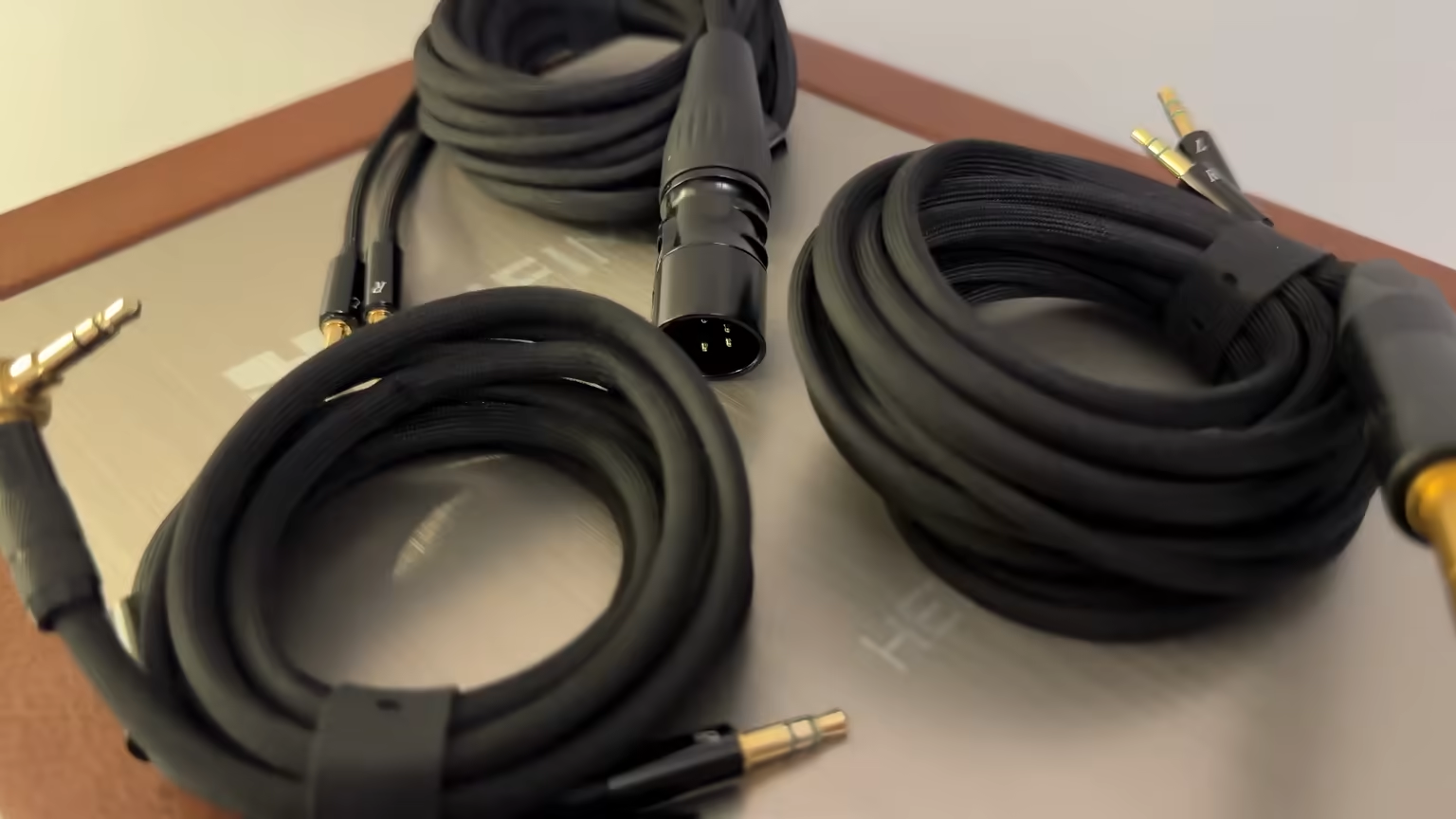 (view larger)
Pick the headphone up and the first surprise is that it's lighter than it looks - around 440 grams, which for a full-size planar magnetic is genuinely not heavy. The whole frame is metal, CNC-machined and then hand-finished by HIFIMAN's craftsmen, and you feel it the moment it's in your hands, because the cheaper models in the range lean on plastic. The cups swivel with a smooth, well-damped motion - no squeaks, no flex, no strange noises. There's one small detail I love: the cable sockets are angled by about ten degrees, so the cables fall away from your face instead of putting pressure on the connection. It's a tiny thing, but it's the kind of tiny thing that tells you someone actually thought about wearing these for hours.
And then there's the wood. The cups are finished with a band of wood veneer, and next to the silver aluminum it looks gorgeous - honestly, almost identical to HIFIMAN's flagship Susvara, which to my eye is one of the best-looking headphones they've ever built. (view larger)
Comfort is where this headphone quietly wins. It's one of the most comfortable headphones I've ever worn. The headband is wide enough to spread the weight across the top of your head, and you stop noticing it within a few minutes. The pads do the rest: they're deep, huge, and soft, angled to sit flat against your face, and built from a combination of leather on the outside, breathable cloth where they touch your skin, and perforated leather on the inside. Four hours in, your ears aren't hot or sweaty. (view larger)
There are a couple of things to watch for. When they're new the clamp is a little tight - more so if you wear glasses, like me - but give it some time and it loosens up. The one I'd actually pay attention to is size. These cups are big. If you have a smaller head, the bottom edge can end up resting on your jaw instead of sitting cleanly around your ear.
Neodymium Stealth Magnets give the film more grip
It's worth knowing what's inside, because with the HE1000se the technology is the whole point. It starts with the diaphragm - the thin film that actually makes the sound. HIFIMAN got theirs down to about a nanometer thick. How thin is that? Turn it on its edge and you can't even see it. And the thinner the film, the faster it moves, which means more detail and less distortion.
Then there are the magnets. In most planar headphones the magnets sit right in the path of the sound and create turbulence that smears the detail. HIFIMAN reshaped theirs so the sound slips straight through - Stealth Magnets, so called because acoustically they all but vanish.
Here's the interesting part. HIFIMAN's no-limits flagship is the Susvara - far pricier and far harder to drive. The HE1000se takes that same Stealth Magnet and nanometer-diaphragm thinking and adds neodymium magnets: stronger magnets in a smaller, lighter package. More grip on the film means it moves faster and hits harder without needing a monster amp to wake it up. It takes the flagship ideas and makes them far easier to live with.
And that grille on the back is the Window Shade system we know from other HIFIMANs. It protects the driver while keeping the cup wide open, so the sound escapes cleanly instead of bouncing back inside. (view larger)
Easier-to-drive specs than the HE1000 V2
If you're worried about drivability, two numbers tell you how hard a headphone is to power: impedance and sensitivity. The HE1000se comes in at 35 ohms and 96 decibels, which in plain terms makes it one of the more cooperative flagship planars out there. The older HE1000 V2 was tougher to drive - this one is about 5 decibels more sensitive, so you don't need a big, expensive amp to wake it up. A good dongle or a modest desktop amp will get it loud and happy.
But here's the catch: easy to drive isn't the same as easy to please. The HE1000se is transparent enough to pass along hiss or grain from a cheap, noisy source. It doesn't ask for much power, but it does want a clean signal to really shine. Power it's relaxed about; quality, not so much.
Frequency range is 8 hertz to 65 kilohertz, far beyond what anyone can actually hear, so you won't notice those extremes directly. And on a practical note, these are fully open-back, which means zero noise isolation for you and maximum sound bleed for everyone nearby.
State-of-the-art detail and a bright top end
As I said at the start, this thing isn't built to sound good - it's built to sound true. This is where that pays off, and occasionally where it bites.
Start with the big one, because it's the whole reason this headphone exists: detail. This is state-of-the-art detail retrieval. It pulls tiny things out of a track - the scrape of a finger on a string, the air around a voice, a background layer buried deep in the mix - and lays them out so clearly that you'll catch things in songs you've known for years. A lot of that is speed. Notes start and stop instantly, so plucked strings and percussion sound sharp and real, and even busy, crowded tracks stay clean - you can follow one instrument in an orchestra full of them without losing it.
The bass is fast, clean, and dead-linear. It goes deep, it hits hard when the track asks for it, and it's some of the tightest, most controlled bass you'll get from a planar. But it's reference bass, not basshead bass. There's no extra energy added for fun - this headphone chases realism over impact, and it can feel a touch bass-light. If you want something that slams for the sake of slamming, this isn't it.
The mids are neutral and honest. Vocals sit slightly forward, clean and beautifully separated, so with two or more singers you can pick each one out on their own. Pianos have real weight, string instruments have that little vibration that makes them feel alive, and properly recorded voices sound unreal. If I'm nitpicking, it can run a touch lean - a little more warmth and body would make it even more inviting - but nothing here sounds wrong.
The soundstage is where the HE1000se really shows off. It's big, open, and holographic - the most spacious presentation in HIFIMAN's egg-shaped lineup. It doesn't just throw sound out wide; it wraps it around you. Instead of laying the music out in front of you, it makes you feel like you're standing in the middle of it. Imaging is pinpoint - every sound has a precise, locked-in spot, and you never have to hunt for it. On big, layered music - orchestral, live, jazz - it's spectacular.
There's a catch, and it's the treble. The HE1000se is a bright headphone, and up top there's real energy, with some genuine spikes in the highest frequencies. On a great recording that comes across as air, sparkle, and stunning detail. On a bright or poorly mastered one, it can turn intense and unpleasant. If you're treble-sensitive, long sessions can fatigue you.
This is the one thing to know before you buy: the HE1000se is not forgiving. Feed it clean, well-mastered music and it's breathtaking. Feed it garbage, and it will happily show you every flaw in that garbage.
The smoother Arya Unveiled gives up detail
So who's it for? If you love detail, resolution, a huge, tall stage, and honesty above everything - and you mostly listen to well-recorded music - this is one of the best you can buy for the money.
If you want warmth and forgiveness, the Arya Unveiled is the better fit. It's a newer HIFIMAN headphone that costs less than the HE1000se, and its big change is the treble: HIFIMAN calmed down the sharp, bright top end this headphone is known for. The result is smoother and easier on the ears, with a little more bass and fuller mids - the one you can listen to all day without any fatigue. The catch is that all that smoothness costs you some detail.
For me, the HE1000se is the one I keep reaching for, largely because most of what I listen to is good-quality material. If that's you too, you'll love it. And if it isn't - now you know exactly what to get instead.
HE1000se sound signature
The review describes the HIFIMAN HE1000se as bright, with lean bass and a wide stage.
Each line is charted from the review's words quoted under it, beside the other headphones reviewed here. Parts of the sound the review doesn't describe aren't charted.
Tonal balance: Bright
Also bright, nearest in price: HIFIMAN HE1000 Stealth, HIFIMAN Arya Organic and HIFIMAN Ananda Nano.
- “Bright, peaky treble” (from the cons)
- “…and state-of-the-art detail - bright, honest, merciless with bad sources” (the summary under the title)
Bass: Lean
- “Runs slightly lean; a little more warmth would add body” (from the cons)
- “…it can run a touch lean - a little more warmth and body would make it even more inviting…” (in State-of-the-art detail and a bright top end)
Soundstage: Wide stage
Also wide stage, nearest in price: HIFIMAN Arya Unveiled, HIFIMAN HE1000 Stealth and HIFIMAN Arya Organic.
- “Huge, holographic, out-of-your-head stage with pinpoint imaging” (from the pros)
- “It's big, open, and holographic - the most spacious presentation in HIFIMAN's egg-shaped lineup” (in State-of-the-art detail and a bright top end)
Hear what "bright, lean bass, wide stage" means: a short synthesized loop, flat and then with those leanings. An illustration of the words, not a recording of the HE1000se.
Not sure which signature suits you? Find yours with a blind A/B test

HE1000se price history
List price on this review: $1,700. US stores charge the list price, Oct 8, 2026. The figures below are what retailers charged for a new unit on the days shown.
$1,699 at Apos Audio, Audio46 and 3 more is the lowest current new price we track at US stores, checked Oct 8, 2026. In stock at all 5 stores below. Tracking began on Oct 6, 2026. Before that, archived copies of these store pages show it between $1,699 and $3,499 since Feb 2023, and the current lowest is at or below every one of them.
- Price tracking
- 4 days, since Oct 6, 2026, with a reading on 3
| Retailer | Price | Stock | Checked |
|---|---|---|---|
| Apos Audio | $1,699 | In stock | Oct 8, 2026 |
| Audio46 | $1,699 | In stock | Oct 8, 2026 |
| Bloom Audio | $1,699 | In stock | Oct 8, 2026 |
| Headphones.com | $1,699 | In stock | Oct 8, 2026 |
| Upscale Audio | $1,699 | In stock | Oct 8, 2026 |
US prices are before sales tax and shipping.
Earlier prices
Archived copies of these store pages in the Internet Archive's Wayback Machine go back to Feb 2023. The lowest price they show is $1,699 at Audio46 (Jun 2024), the highest $3,499 (Feb 2023). They are one copy a month at most, so a price can have changed between them.
| Retailer | Price | Archived copy |
|---|---|---|
| Bloom Audio | $1,699 | Oct 2024 to Aug 2025 |
| Apos Audio | $1,699 | Sep 2024 to Dec 2025 |
| Upscale Audio | $1,699 | Aug 2024 to Jul 2025 |
| Headphones.com | $1,699 | Jun 2024 to May 2026 |
| Audio46 | $1,699 | Jun 2024 to Jul 2026 |
| Upscale Audio | $1,999 | May 2024 |
| Audio46 | $1,999 | Mar 2024 |
| Bloom Audio | $1,999 | Feb 2024 |
| Headphones.com | $1,999 | Oct 2023 to Mar 2024 |
| Apos Audio | $1,999 | Sep 2023 |
| Audio46 | $3,499 | Feb 2023 to Jun 2023 |
New condition only, as each retailer listed it on the day shown. Every store is checked once a day and this page is rebuilt daily, but a price can change at any time, and past prices do not predict the next one. Only the retailers in the table are tracked. No link here is an affiliate link and no retailer pays to be listed. Earlier prices are read from the Internet Archive's Wayback Machine, one copy of a store page a month at most, each checked like a daily reading and linked to the copy it came from. How prices are tracked
Watch the video review
Subscribe on YouTube (opens in new tab)Prefer to read? The written review above covers everything in the video.

- 0:00 An Insanely Detailed Planar Magnetic Headphone (opens in new tab)
- 0:32 Comfort & Build Quality - Weight, Ear Pads, Metal Parts, 3 Cables, Leather Box (opens in new tab)
- 3:24 Technologies - Neodymium Stealth Magnets, Nanometer Thickness Diaphragm (opens in new tab)
- 5:03 Technical Specs - Frequency Response, Sensitivity, Impedance, Drivability vs HE1000 V2 (opens in new tab)
- 6:22 Sound Quality - Brightness, Vocals, Midrange, Linear Bass, Clarity, Resolution (opens in new tab)
- 10:12 Arya Unveiled vs HE1000se - Comparison (opens in new tab)
Common questions about the HE1000se
Is the HE1000se worth $1,700?
At $1,700, down from a launch price of around $3,500, it earned a 9.3/10 Reference verdict. The money buys state-of-the-art detail, a huge holographic stage, blazing speed and one of the most comfortable flagship frames. On value alone it rates steep, and its bright, peaky treble punishes poor recordings, so it pays off most with a well-mastered library.
What kind of listener suits the HE1000se?
One who values detail, resolution and a big, tall stage above warmth, and who mostly plays well-recorded music. Treble-sensitive listeners, bass heads and anyone with a noisy source or a lot of poorly mastered tracks should look elsewhere, and so should people with small heads, since the large cups can rest on the jaw.
Can a dongle drive the HE1000se?
A good one can. At 35 ohms and 96 dB it's one of the more cooperative flagship planars, about 5 dB more sensitive than the older HE1000 V2, and a modest desktop amp is plenty. Quarter-inch, 3.5 mm and balanced XLR cables come in the box. Put the money into a clean source, because the HE1000se passes along any hiss or grain. About 25 mW to reach 110 dB peaks, which is a phone jack or any dongle.
Should you pick the HE1000se or the Arya Unveiled?
The Arya Unveiled is the better fit for listeners who want warmth and forgiveness. It costs less, and HIFIMAN calmed the sharp top end the HE1000se is known for, giving a smoother sound with a little more bass and fuller mids that stays easy on the ears all day, at the cost of some detail. The HE1000se leads on detail, resolution and stage size, and suits a library of well-recorded music.
Does the HE1000se's treble get harsh?
It can, on bright or badly mastered tracks. The HE1000se is a bright headphone with some real spikes in the highest frequencies, which turn into air, sparkle and detail on a great recording and into something intense and unpleasant on a hot one. Treble-sensitive listeners may tire over long sessions, and since it forgives nothing, clean, well-mastered music gets the best from it.
Does the HE1000se clamp too hard over glasses?
At first, a little. The clamp is tight when the headphone is new and tighter over glasses, but it loosens with time. Cup size is the bigger question, because on a smaller head the bottom edge can rest on the jaw. Once it fits, it's one of the most comfortable flagships around: 440 g, a wide headband and deep, breathable pads that leave ears neither hot nor sweaty after four hours.
Does the HE1000se have enough bass?
Enough for accurate listening, though it can feel a touch light. The bass is fast, clean and dead-linear, goes deep and hits hard when a track asks for it, and ranks among the tightest you'll get from a planar. It adds no extra energy for fun, so anyone who wants slam for its own sake should look elsewhere.
Sources
- IEC 60268-7: Headphones and earphones
Standard · International Electrotechnical Commission · Paid full text
The headphone standard: how impedance, sensitivity and frequency response are specified and measured.
- HyperPhysics: Diffraction of sound
Reference · Georgia State University
How sound bends around an obstacle in its path, the effect Stealth Magnets are shaped to reduce on the way out of the driver.
- Olive (2022): The perception and measurement of headphone sound quality: what do listeners prefer?
Paper · Acoustical Society of America
What listeners prefer in a headphone, from the research that measured how far a tuning can lean warm, bright or V-shaped before preference drops.
Discussed in State-of-the-art detail and a bright top end
- NYU perception lecture notes: Auditory pathways and sound localization
Lecture notes · New York University
How the ear places a sound from the timing and level differences between the two ears, the cues behind soundstage and imaging.
Discussed in State-of-the-art detail and a bright top end
If you're interested in this
All 30 headphone reviewsClosest alternatives
 HIFIMAN Ananda Stealth leans warmer, $1,300 less, scores 0.5 lower 8.8