HIFIMAN RE2000 PRO Silver Review: Does IEM Shape Matter for Sound?
An older HIFIMAN flagship IEM with the same topology driver as the RE800 but a CNC-machined aluminum shell - by far the most detailed IEM I've ever heard at $350.
higher than 79% of everything we have tested
- Standout
- Topology diaphragm with nanoparticle coating
- Watch out for
- Unusual shape takes time to fit perfectly
- Closest rival
- Flare Audio E-PROTOTYPE: $200 less, scores 0.8 lower.
Is it for you?
- You want to hear into a mix rather than be soothed by it
- You want more performance per dollar than most of its peers
- You want a forgiving listen that flatters a bad file
Named Best Overall in our Best IEMs guide, ahead of 6 others.
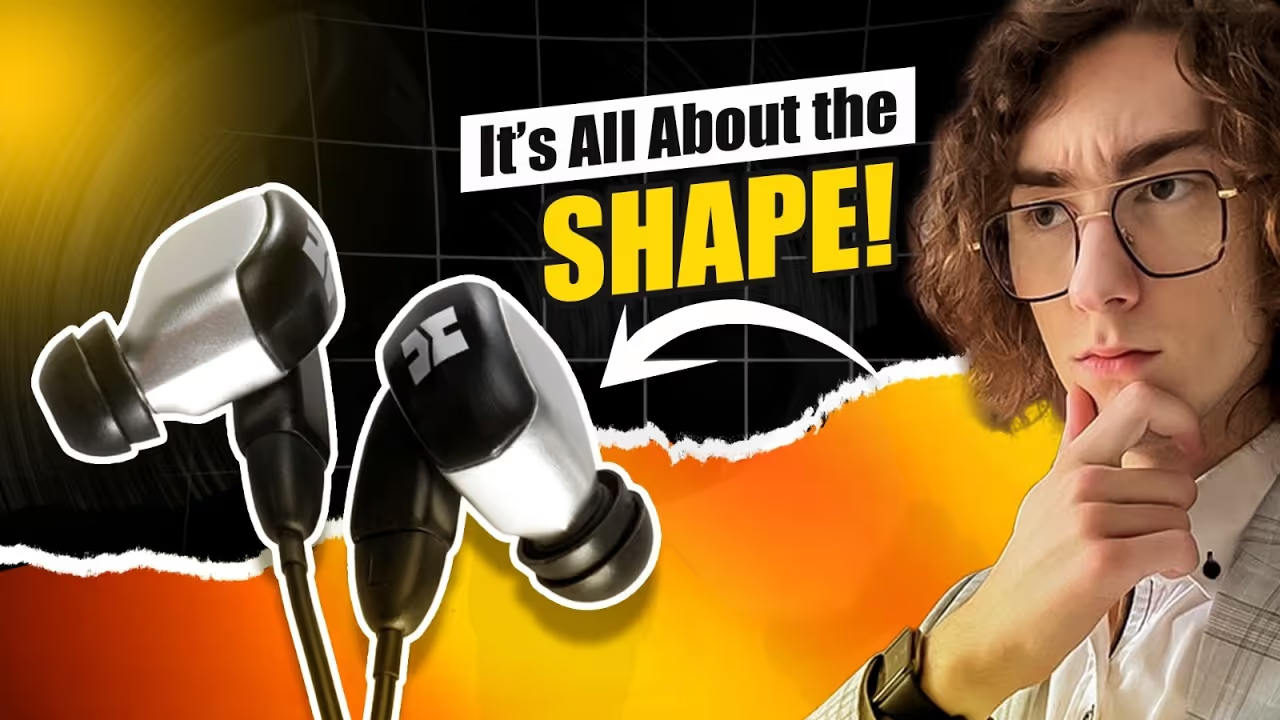
The drivers in IEMs are an important element that greatly affects the sound quality. But there are other aspects that matter for in-ear monitors - like the shell shape. The HIFIMAN RE2000 PRO Silver uses that to its advantage, keeping the same driver as a cheaper model and optimizing the enclosure.
Is It Comfortable? Odd Shape, All Aluminum
This is quite a weirdly shaped IEM. But that doesn't mean it's uncomfortable. Once you get a good fit with the correct tips, it feels very lightweight and doesn't apply any unwanted pressure inside or outside your ears.
Its shell is a highly upgraded version of the older non-pro version. It has been refined using modern CNC machining to achieve superior comfort, smoother finish, better looks, and even further optimized acoustic properties. It's nice to see that an older product is still getting new revisions that are better than the previous versions. Technology moves forward, and doing nothing about a product is going to make it irrelevant sooner or later.
The only problem with this slightly unusual shape is that it takes a long time to make it fit perfectly in my ears. I have to mess with it a little longer than I'd prefer to - so it's not a simple grab-it-and-put-it-in experience. Regardless, once I get it in, I can wear it for hours. Another advantage of this design is that it doesn't fall out easily, no matter how hard I try, so I'd say it's safe to use it for outside running, especially since it's wired. It isolates outside noises pretty well - it mostly depends on the tips you decide to use, but it can yield good results in noisy environments.
The build feels quite premium, and that doesn't come as a surprise at $350. The shells are made using aviation-grade aluminum, with no plastic parts - which means it doesn't feel plasticky or cheap. It has a detachable cable, with a 2-pin style plug, common for IEMs, so finding aftermarket cables shouldn't be a problem.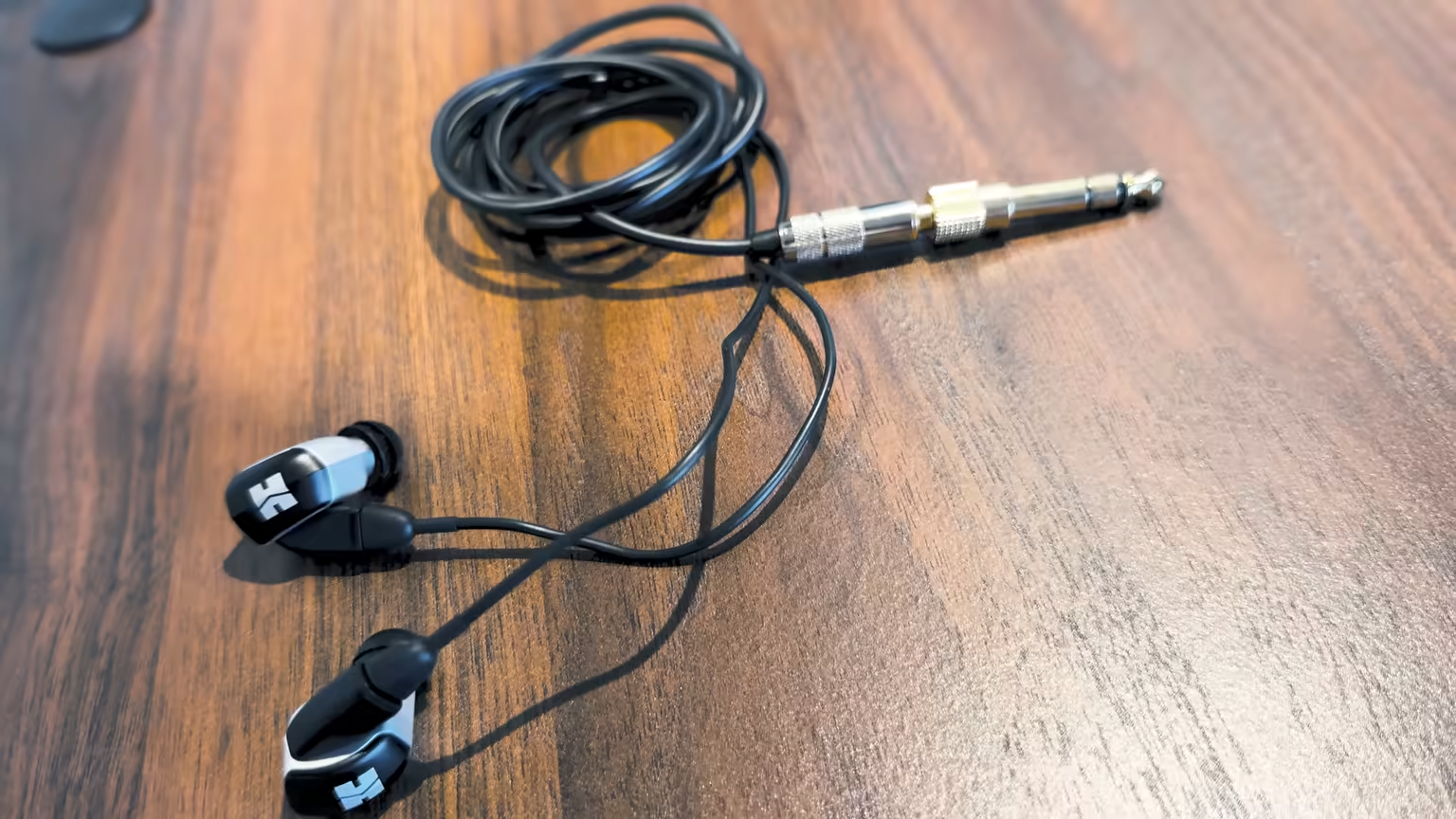 (view larger)
The stock cable itself is of much better quality than in a budget-oriented RE800. It's thicker, better behaved, and higher quality. I'm sure it would positively affect the sound a little bit better in comparison to the one permanently attached to the RE800. However, that is impossible for me to confirm, as on the RE800 it's not detachable. This cable uses premium internal conductors - made of pure crystalline copper, with a coat of silver over it for better conductivity. While it's nothing special, not braided or anything, it uses good quality connectors and I don't feel like it's a problem. I like that HIFIMAN kept in mind the stock cable itself, and made it better as you go up their product line.
In the box we also get a nice quality, metal carrying case that's padded inside, for extra protection. There's also a book explaining how HIFIMAN's technology works.
Technologies: The Topology Diaphragm
First of all, the driver used here is a dynamic driver, but it's not just a regular one. It has a topology diaphragm. It refers to a special nanoparticle coating applied to its surface. That allows HIFIMAN to achieve much more control over the driver itself, making it tailored perfectly to their needs. Dr. Fang Bian came up with this idea to essentially make a driver that performs unlike any other and eliminate other driver technologies' downsides.
Then it has a housing dedicated to this series of products. It was made to not only look good and feel comfortable in your ear, but also to sound better than any other housing shape.
Technical Specs: Easy to Drive, Deserves Better Sources
The frequency response has a wonderful extension from 5Hz all the way up to 20kHz, covering the entire human hearing spectrum and then some more in the bass. The impedance comes at 60 ohms, fairly high for an IEM. The sensitivity is 103dB, which is somewhat high but not the highest you're going to encounter in the in-ear-monitor world. This combination makes it still easy to drive regarding the amount of power needed. But because of the technical performance and the resolution of this IEM, I'd recommend not running it from a phone - instead, I'd aim for something a little bit higher quality, at least a dedicated dongle.
Sound Quality: The Most Detailed IEM I've Heard
The RE2000 PRO Silver's tonality is a shallow V - the lower bass is elevated slightly, as well as the top-end frequencies. Nevertheless, the midrange is not scooped out. It stays fairly present, musical, and well done.
The lower notes hit quickly, indicating that the driver is indeed fast, due to its small size and high diaphragm stiffness. HIFIMAN hates distortion - that's why they developed their own drivers, to avoid it as much as possible. In my opinion, they succeeded - no matter how loud I push it, there's no audible distortion or softness. It always keeps up, no matter how busy a given musical passage is. Moreover, there's a noticeable impact on some harder-hitting notes. It can punch you quite a bit when needed.
The midrange is one of my favorites amongst other IEMs. It's very musical and sweet, but when a song asks for it, it can be extremely detailed. It's super flexible, making it easy to adapt to different music genres. It's recessed a little in one frequency range, around 2 or 3kHz, which seems like a typical thing in this company's house sound. It can seem a little thin, but on a positive note, it also increases the perceived soundstage width.
Speaking of which, the positional aspects are extraordinary here. It has depth, width, and even some layering. It definitely doesn't sound like a budget IEM - and that's good, as it isn't one. It lacks some scale to the instruments, but I have yet to find an IEM that can deliver on that front. It's just a limitation of the driver size. The imaging though is razor sharp, making you able to tell where the sounds are coming from, where they begin, and where they end.
For the treble, it's pretty realistic with accurate timbre to go with. It doesn't sound metallic or plasticky, but it is a bit analytical in its nature. On the other hand, it contributes greatly to the detail retrieval - it's astonishing. It's by far the most detailed IEM I've ever heard. It can wonderfully separate voices, instruments, and other types of sounds from each other, making the presentation clear, as opposed to messy or blended in.
Sound signature
Derived from the words this review uses: each axis runs between two opposite descriptors, and the shape leans toward whichever side the writing does.
- Warm ↔ Bright Neutral, no clear signal in the review language
- Relaxed ↔ Analytical Leans analytical
- Polite ↔ Aggressive Leans aggressive
- Lean ↔ Bass-heavy Neutral, no clear signal in the review language
- Intimate ↔ Wide stage Neutral, no clear signal in the review language
Hear what "analytical, aggressive" means: a short synthesised loop, flat and then with those leanings. An illustration of the words, not a recording of the RE2000 PRO Silver.
Not sure which signature suits you? Find yours with a blind A/B test

Watch the video review
Subscribe on YouTube (opens in new tab)Prefer to read? The written review above covers everything in the video.
- 0:00 There's MORE Than Drivers! (opens in new tab)
- 0:21 Comfort & Build Quality (Unique Housing, CNC Aluminum, Tips, Fit, Sound Isolation, Cable) (opens in new tab)
- 3:02 Technologies (Dynamic Driver with Topology Diaphragm, Dedicated Shell) (opens in new tab)
- 3:44 Technical Specifications (Frequency Response, Impedance, Sensitivity, Drivability) (opens in new tab)
- 4:31 Sound Quality (V-Shaped Tuning, Bass Speed, Distortion, Midrange Musicality, Detail) (opens in new tab)
Common questions about the RE2000 PRO Silver
Is the HIFIMAN RE2000 PRO Silver worth it?
Yes - 8.8/10, Highly Recommended, higher than 79% of everything we have tested, against a catalogue median of 8.1. On value it rates strong: above average for the price in headphones. Price: $349.
Who should buy the HIFIMAN RE2000 PRO Silver, and who should skip it?
Buy it if you want to hear into a mix rather than be soothed by it, and you want more performance per dollar than most of its peers. Skip it if you want a forgiving listen that flatters a bad file.
What amplifier does the HIFIMAN RE2000 PRO Silver need?
Impedance is 60 Ω. By the rule of eighths the amplifier feeding it wants an output impedance no higher than 7.5 Ω, otherwise the interaction between the two tilts the frequency response rather than simply making it quieter. Power is the separate question. At most 84 mW to reach 110 dB peaks, which is most dongle DACs. The review records 103 dB without saying against what, and the two conventions differ by a factor of 17 at this impedance - so that is the worst case, and the real figure is at or below it.
What else have you tested that is close to the HIFIMAN RE2000 PRO Silver?
No matchup page yet, and no close price match in the catalogue either. The nearest things we have scored in the same category: the Kiwi Ears Belle, Cadenza II, Orchestra II at 8.1/10, the Flare Audio E-PROTOTYPE at 8.0/10, and the HIFIMAN RE800 Silver at 8.0/10.
Is the RE2000 PRO Silver's odd shape comfortable?
Once it is in, yes - getting it in is the annoyance. The shape takes me longer than I would like to seat properly, so it is not a grab-and-go earphone. After that I can wear it for hours with no unwanted pressure inside or outside my ear, and it is very light. There is an upside to the fit being fussy: it does not fall out no matter how hard I try, which makes it genuinely usable for running, and it isolates outside noise well in a noisy environment.
What does the RE2000 PRO Silver have over the RE800 Silver?
The shell, and that is nearly the whole difference - same topology driver, different housing. This one is CNC-machined from aviation-grade aluminium with no plastic anywhere, refined over the older non-pro version for comfort, finish, looks and acoustic properties. The cable is detachable here, on a standard 2-pin plug, and the stock cable itself is thicker and better behaved. You also get a padded metal carrying case. It is a demonstration that enclosure shape is not cosmetic.
Should you run the RE2000 PRO Silver from a phone?
I would not. Power is not the issue - 60 ohms against 103dB sensitivity makes it easy enough to drive from almost anything. The issue is that this earphone resolves well enough to show you what your source is doing, and a phone output is not where you want to find that out. Aim for at least a dedicated dongle. It is a small spend against a $349 earphone and it is the difference between hearing it and hearing your phone.
Is the RE2000 PRO Silver's midrange recessed?
Slightly, around 2 to 3kHz, and it is a recurring HIFIMAN house trait rather than a mistake here. The tonality overall is a shallow V - lower bass lifted a little, top end lifted a little - but the midrange is not scooped out. It stays present, musical and sweet, and it turns extremely detailed when a song asks it to. The dip can make things seem a touch thin; it also widens the perceived soundstage, which is part of why the positioning works as well as it does.
What are the RE2000 PRO Silver's real limits?
Scale, and a slight analytical streak. It lacks the sense of instrument size that a big driver gives you - though I have yet to hear any in-ear that delivers that, so treat it as a limitation of the format rather than of this product. The treble is realistic with accurate timbre, never metallic or plasticky, but it does lean analytical. Bass extension is good rather than boosted. None of that stops it being by far the most detailed in-ear I have heard.
Does the RE2000 PRO Silver distort when pushed?
No, and this is where the topology diaphragm earns its keep. HIFIMAN hate distortion - it is the reason they developed their own drivers - and no matter how loud I push this one, there is no audible distortion and no softening. It keeps up through busy passages that make lesser drivers smear, and the low notes hit fast thanks to the small, stiff diaphragm. There is real impact on harder-hitting notes; it can punch you when it needs to.
Is an aftermarket cable worth it on the RE2000 PRO Silver?
Not urgently. The 2-pin connector means aftermarket cables are easy to find, which is the real benefit of the detachable design. The stock cable is already a step up from the RE800's - thicker, better behaved, higher quality, with pure crystalline copper conductors under a silver coat. It is not braided and it is nothing special to look at, but the connectors are good and I do not consider it a weak point. Buy a cable if you want a balanced termination, not because this one is holding anything back.