
HIFIMAN RE800 Silver Review: An IEM That Will Save You $500
An older flagship IEM with topology driver tech, now $100 (down from $600) - audiophile-grade performance with surprisingly wide staging and an interesting non-target tuning.
higher than 34% of everything we have tested
Value Excellent. It is one of the best-value pieces we have scored.
- Standout
- Topology driver
- Watch out for
- Non-detachable cable
- Closest rival
- Flare Audio E-PROTOTYPE: $50 more, a near-tie on score.
Is it for you?
- You want weight and slam low down
- You want the most performance per dollar on the list
- You want the bass to stay out of the mids
Named Best Value in our Best Budget IEMs guide.
Tech moves fast, and in-ear monitors are no exception. The HIFIMAN RE800 Silver is an older, high-end IEM that has been stripped of its fancy packaging - but not of its incredible sound quality. So, can you really get a flagship $600 IEM and experience audiophile-grade performance without the audiophile price tag? Right now, you can pick it up for $100 - that's a huge price cut.
Is It Comfortable? Tiny Shells, Fixed Cable
It's a classic earbud style, instead of a big typical IEM that fills in your entire ear. It means a few things. First of all, most people won't have any comfort issues regarding their size. They're super tiny, which makes them go easily and quickly into your ears. It also means that they're extremely compact, making them very mobile and on-the-go friendly, and allow for storage in space-limited situations. Their low weight certainly helps with carrying them around.
In the box, we're getting lots of different tips to go with them. So it can be a comfortable IEM for everybody, no matter their ear size, shape, or personal preferences. For me, the stock double-flange ones worked the best - both for comfort and sound quality. That's the starting point I'd recommend everybody to start with.
At first sight, it can look kind of cheap. However, it's enough to touch it to realize that it's absolutely not - at least the shell itself. It is made of aluminum alloy, quite thin, but still. It gives it a more premium feeling, increases its durability greatly over plastic IEMs, and looks nicer.
The cable is permanently attached to the earpieces, which is debatable, but earbud-style products often go that route for one reason or another. For many, this wouldn't be a big problem if the stock cable was very good. In terms of the technical aspects and its materials - we have some information. The conductors are made of crystalline copper wire (probably OCC, or a similar process), with a coat of silver over them. It indicates that they paid attention to the materials themselves, but I have one concern about it - the ergonomics aren't top-notch. The cable likes to tangle up, and is slightly microphonic. It's not something that you particularly want it to do, as it introduces some sounds when moving it.
It's terminated with a very good-looking, high-quality, metal 3.5mm connector. I like that one a lot - it inspires confidence, seems durable, and makes very good contact, fitting snugly in all my devices like amplifiers, phones, and laptops.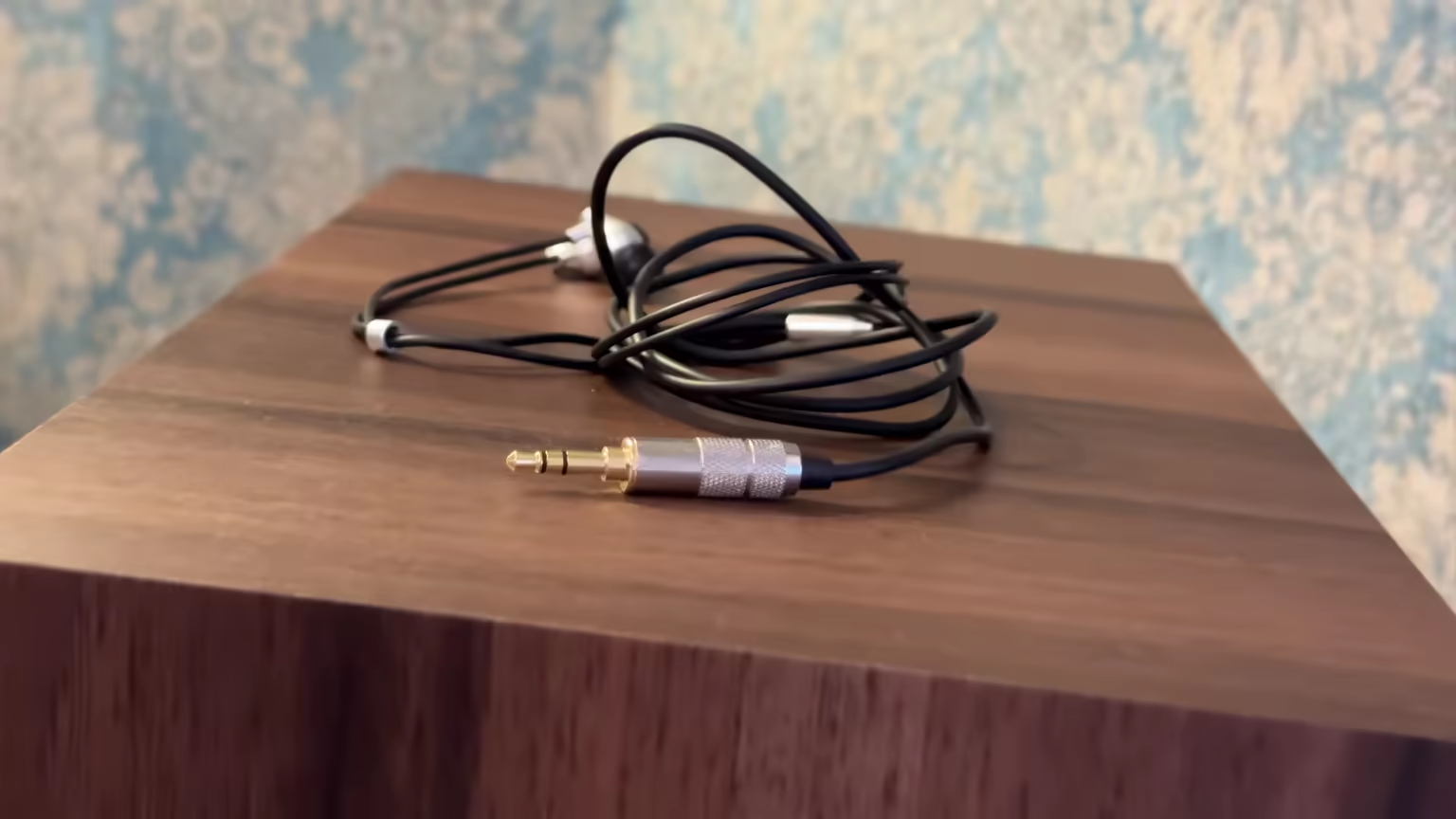 (view larger)
Technologies: One Topology Driver, No Crossover
The topology driver uses HIFIMAN's advanced technology and research to essentially make a driver unlike any other. It involves creating a topological, nanoscale layer of material that's being applied to the diaphragm. It's being distributed in distinct geometrical patterns to make tuning it easier and more accurate. Their engineers can vary the surface pattern, compound used, and even the thickness of a given pattern. That allows for the manipulation of sound wave creation like never before.
They mention that no other driver tech allows for such control and precision, resulting in clarity, detail, and nuance. HIFIMAN also says that it can best the world's most complicated multi-driver setups but with none of the coherency and crossover issues. Since it's a single dynamic driver construction, there isn't a crossover, so it can't be causing any acoustic problems, or take up more space inside than needed.
Technical Specs: High Impedance, Still Easy to Drive
The frequency response goes from an astonishing 5Hz all the way up to 20kHz. It goes much deeper than you can hear. It tells one thing - the driver is super capable, doesn't break up at low frequencies even below our hearing, and it's doing what it's supposed to do.
The impedance is 60 ohms - it's a fairly high impedance IEM. Most of them have a significantly lower impedance, making the voltage swings much smaller and easier on the amplifier. Regardless, 60 ohms is generally not very high for an audio device. Some headphones have upwards of 600 ohms of impedance, and possibly even more.
The sensitivity of this IEM is easily countering that anyway, coming at 105dB. In-ear monitors are generally very easy to drive for a few reasons. Most of them are multi-driver, increasing their sensitivity greatly. It works the same way with speakers. Even if they aren't, like the RE800, they sit very close to your eardrums, so you're not losing a lot of sound pressure by the distance itself. Lastly, the impedances are fairly low, as the thin wire coils don't have to be so long to cover the entire diaphragm, as it's much smaller. In this case, the dynamic driver's size is just 9.2mm.
Sound Quality: Rule-Breaking Tuning, Huge Stage
Its tonality may not be a perfect match for any real target. It's not what it is trying to achieve. It is not afraid to break common rules and try new things to achieve the sound signature that would otherwise be impossible to get while adhering to a conventional curve.
The bass shows clear signs of roll-off, but it's not rolling off super fast. You can still hear deep notes in the 30-40Hz region, but that sub-bass is not elevated. Regardless, it has interesting bass punch characteristics, unlike other IEMs or even full-size headphones. It's not super punchy in the common sense, but still fairly so. However, when it does punch, it does it in a very coherent way. It's not just a hit that comes from somewhere, or a random place. You're always aware of the place where it's radiating from, making it easy to localize.
The lower midrange is technically brought forward a little bit, however, the rest of it seems recessed and thin-sounding - typical of HIFIMAN products. It means that you're not getting any bloat, weight, or meat to the notes, and in return, it sounds pretty fast.
Regarding its top end, it's slightly peaky, but not in a purely random way. It seems like it's done on purpose. The hi-hats and generally high-frequency, short hits, are much harder than expected. You usually get the dynamic, punchy nature on the low end, but this IEM extends it to the very high frequencies.
Regarding detail retrieval - it's all right, nothing special on this front. Some elevation in these registers can make for a seemingly more detailed presentation than it actually is, as it tends to push details more forward at you, making them easier to discover.
The soundstage is super wide for an IEM. Usually, IEMs are very in your head, closed in, with not much spacing between notes, and even less space for the sounds to be in. That's why I was surprised to find out that it sounds wider than some of my full-size, over-ear headphones. The imaging is at a very good level. It's almost razor-sharp, precise, and doesn't feel that forced or fake.
One more odd characteristic of this IEM that I noticed is that the treble region has some audible resonance. Its decay is prolonged greatly, and I suspect that it has to do with the shell shape. The only difference between this model and the more expensive RE2000 PRO Silver is the housing itself, and its acoustic properties. So it would make sense that the shell is generating some resonance here. However, it's not an unpleasant effect. If it was in the bass it would sound boomy, but since it's in the top end, it provides interesting sparkly character and long top-end decay.
Sound signature
Derived from the words this review uses: each axis runs between two opposite descriptors, and the shape leans toward whichever side the writing does.
- Warm ↔ Bright Neutral, no clear signal in the review language
- Relaxed ↔ Analytical Leans analytical
- Polite ↔ Aggressive Leans aggressive
- Lean ↔ Bass-heavy Leans bass-heavy
- Intimate ↔ Wide stage Leans wide stage
Hear what "analytical, aggressive, bass-heavy, wide stage" means: a short synthesised loop, flat and then with those leanings. An illustration of the words, not a recording of the RE800 Silver.
Not sure which signature suits you? Find yours with a blind A/B test

Watch the video review
Subscribe on YouTube (opens in new tab)Prefer to read? The written review above covers everything in the video.

- 0:00 Audiophile In Ear Monitor That's $500 OFF! (opens in new tab)
- 0:33 Comfort & Build Quality (Earbud Style, Compact Size, Included Carrying Case, Low Weight, Ear Tips, Aluminum Alloy Shell, Cable) (opens in new tab)
- 2:57 Technologies (Topology Diaphragm, Single Dynamic Driver, Crossover) (opens in new tab)
- 4:03 Technical Specifications (Frequency Response, High Impedance, Sensitivity, Drivability, Driver Size) (opens in new tab)
- 5:23 Sound Quality (Tonality, Sub-Bass, Punch, Midrange, Detail, Imaging, Sound stage, Dynamic Range, Treble Resonance) (opens in new tab)
Common questions about the RE800 Silver
Is the HIFIMAN RE800 Silver worth it?
Yes, for the right listener. It scored 8.0/10, Recommended, higher than 34% of everything we have tested, against a catalogue median of 8.1. On value it rates excellent: top 7% for the price in headphones, so it is one of the best-value pieces we have scored. Price: $99.
Who should buy the HIFIMAN RE800 Silver, and who should skip it?
Buy it if you want weight and slam low down, and you want the most performance per dollar on the list. Skip it if you want the bass to stay out of the mids.
What amplifier does the HIFIMAN RE800 Silver need?
The HIFIMAN RE800 Silver is a 60 Ω load, so the matching rule is the rule of eighths: an amplifier's output impedance should sit at or below 7.5 Ω, an eighth of the headphone's, or its frequency response shifts audibly and usually in the bass. That is a property of the amp rather than its power rating, so a high-output-impedance tube amp can fail it while a phone jack passes. At most 53 mW to reach 110 dB peaks, which is most dongle DACs. The review records 105 dB without saying against what, and the two conventions differ by a factor of 17 at this impedance - so that is the worst case, and the real figure is at or below it.
What should I consider instead of the HIFIMAN RE800 Silver?
On the same chain, against the same recordings: the Kiwi Ears Orchestra Lite scores the same and costs $150 more. Each of those has a full head-to-head page below.
Is the non-detachable cable a dealbreaker on the RE800 Silver?
It is the thing I would want fixed, though not enough to skip the earphone at $99. Earbud-style products often go this route, and it would matter less if the cable were excellent. The materials are good - crystalline copper conductors with a silver coat - but the ergonomics are not: it likes to tangle, and it is slightly microphonic, so movement introduces noise you did not ask for. The 3.5mm plug is a genuinely nice metal connector that makes confident contact in everything I own.
Which RE800 Silver tips should you start with?
The stock double-flange pair. Plenty of tips come in the box, so almost any ear size, shape or preference is catered for, and the double-flanges worked best for me on both comfort and sound. That is where I would tell anyone to start before experimenting. Because the shells are classic earbud style rather than a big IEM body that fills your whole ear, most people will not have a size problem in the first place.
Does the RE800 Silver's 60 ohm impedance make it hard to drive?
No. Sixty ohms is fairly high for an in-ear - most sit much lower - but it is not high for an audio device in general; some headphones run 600 ohms and beyond. The 105dB sensitivity more than counters it. In-ears are easy to drive for structural reasons anyway: they sit millimetres from your eardrum, so almost no sound pressure is lost to distance, and their coils are short because the diaphragm is tiny - just 9.2mm here.
Why does the RE800 Silver stage so wide?
Partly the tuning and partly the shell, and the effect is real enough to be surprising. Most in-ears sound closed in and inside your head, with little space between notes; this one stages wider than some of my full-size over-ear headphones. The recessed, thin-sounding upper midrange contributes - there is no bloat or weight to fill the gaps - and the imaging that goes with it is almost razor-sharp without feeling forced or artificial.
Why does the RE800 Silver's treble ring?
The shell, almost certainly. There is audible resonance in the treble and its decay is greatly prolonged, and the reason I suspect the housing is that the only difference between this and the pricier RE2000 PRO Silver is the shell and its acoustic properties. It is not an unpleasant effect. Down in the bass this would read as boom; up here it comes across as a sparkly character and a long top-end decay that is part of the appeal.
Is the RE800 Silver's tuning neutral?
No, and it is not trying to be. The tonality does not match any standard target and the earphone is unembarrassed about breaking conventional rules to get a signature that a conventional curve could not produce. Practically: the bass rolls off, though not fast - you still hear 30 to 40Hz - and sub-bass is not elevated. The lower mids come forward slightly while the rest sits recessed and thin. Detail retrieval is fine rather than remarkable. Buy it for the staging and the character.
Is a $600 IEM at $99 too good to be true?
It has been stripped of its fancy packaging, not of its sound. That is the whole story of this price: an older high-end in-ear, still carrying HIFIMAN's topology driver, sold without the presentation that used to justify the flagship figure. The shell is aluminium alloy - thin, but it feels and lasts far better than plastic - and the single dynamic driver means there is no crossover to introduce coherency problems. At $99 the value is not in question.