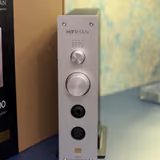
HIFIMAN Serenade Review: One Box to Replace Your DAC, Amp, and Streamer
HIFIMAN's all-in-one R2R DAC, discrete Class A amp, and hi-res network streamer in one 3kg box - lush, musical, and powerful enough to drive almost anything.
tied for the highest score in the catalogue, level with one other review
- Standout
- Proprietary Himalaya Pro R2R DAC for a natural, non-clinical sound
- Watch out for
- Voiced warm and lush on purpose
- Closest rival
- HIFIMAN EF500: $450 less, scores 1.1 lower.
Is it for you?
- You want one amplifier that will not be the limit on whatever you buy next
- You want the R-2R presentation rather than the last decimal of measured linearity
- You listen mostly on sensitive in-ears, where reserve like this is gain you have to turn down
- You choose a converter by its measurements and want the lowest distortion figure at the price
Tick anything that sounds like you.
HIFIMAN Serenade - reviewed by Jakub Charkiewicz for The Audio Stuff. Score 9.3 out of 10, Reference. Full review: https://theaudiostuff.com/reviews/hifiman-serenade/
Named Best Overall in our Best Headphone Amplifiers guide, ahead of 3 others.
Can you really replace your entire headphone stack with just one box?
Building a killer audio setup often means buying a separate DAC, amp, and sometimes a streamer. The HIFIMAN Serenade doesn't just fix that. Its hidden benefit is that because it's all handled internally, there are zero cable runs to degrade your signal. But does this all-in-one make sense?
Design and Build: A 3kg Block of CNC Aluminum
Strong point: Beautifully built ~3kg block of CNC-machined aluminum
HIFIMAN, or maybe Goldenwave, absolutely nailed it here.
Right out of the box, the first thing you notice is the sheer heft of the Serenade. Coming in at nearly three kilograms, this thing is a dense unit. The chassis is made from a solid block of CNC-machined aluminum, finished in a stealthy, matte black.
Because of that weight and the grippy rubber feet underneath, it stays perfectly planted on your desk. You can plug and unplug stiff, heavy headphone cables with one hand, and the unit isn't going to slide around or lift up at all.
Visually, they went with a really unique but a low-profile look. Instead of sharp, aggressive angles, the corners and edges are beautifully smoothed and rounded, giving it a much more elegant, refined aesthetic. But the real standout design element is the front panel. It actually extends forward from the main chassis. On top of this stepped-out section, HIFIMAN added a gorgeous glossy faceplate insert that's fitted with the controls and the screen.
The LCD screen itself is small but easy to read, giving you just the most important information without being distracting. Right next to it is the analog volume knob. The resistance on the potentiometer is fantastic - it's on the heavy side, smooth to turn, and gives you a high-end feeling. It feels much better than any of the EF-series amplifiers from HIFIMAN.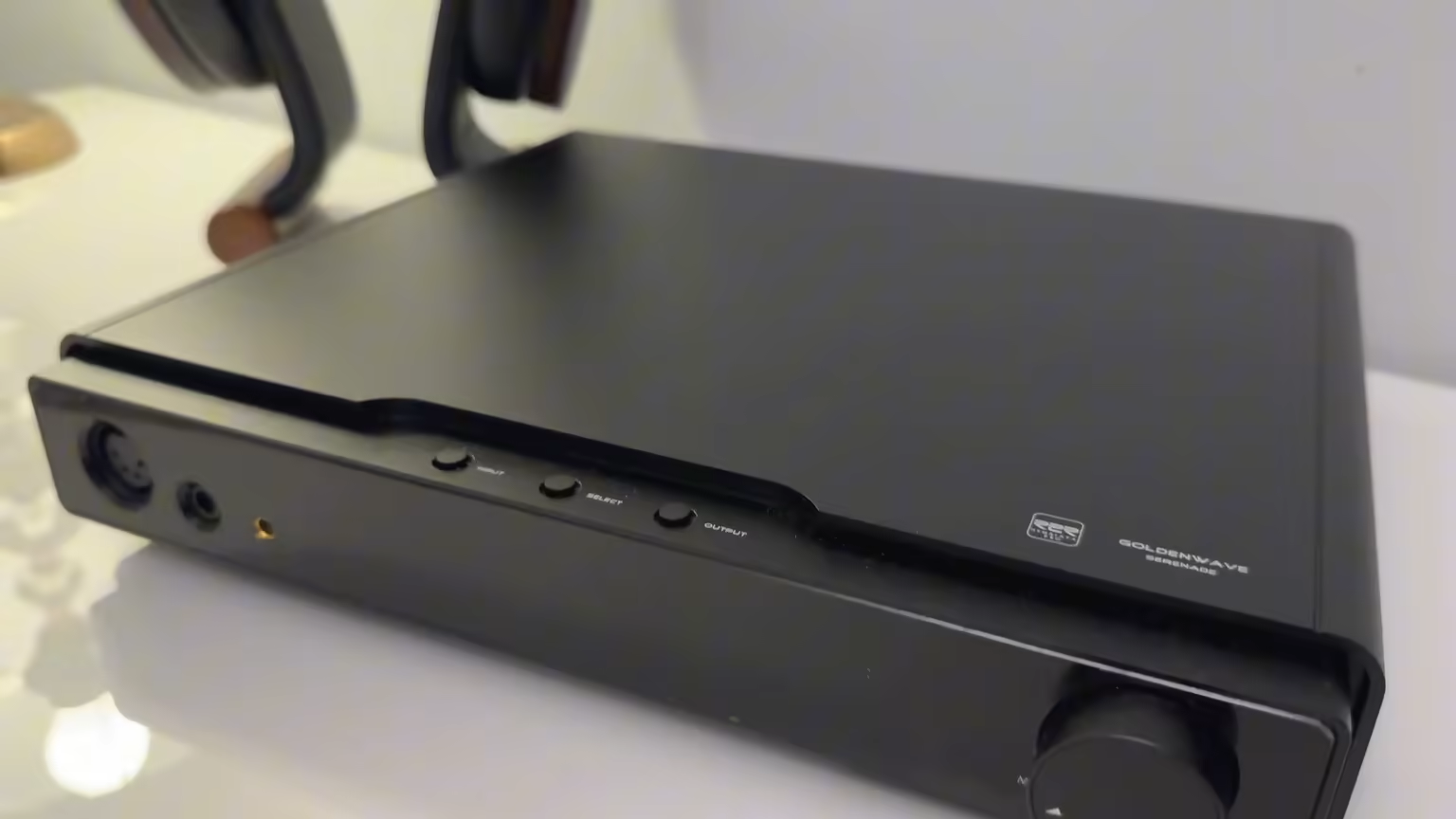 (view larger)
The top-mounted buttons for input, output, and screen brightness are tactile and they feel just fine.
Inputs and Outputs: Connectivity for Any Desktop Setup
Strong point: Every input and output you'd need: USB, optical, coax, Ethernet, Bluetooth, RCA
As for the connectivity, the Serenade is designed to cover everything you want. Starting right on the front face, you have every headphone connection you could possibly need to cover your collection. You get a standard quarter-inch single-ended jack, a 4.4-millimeter balanced port, and a 4-pin XLR balanced output. So it shouldn't matter if you're running in-ear monitors or big planar headphones, you won't need any adapters.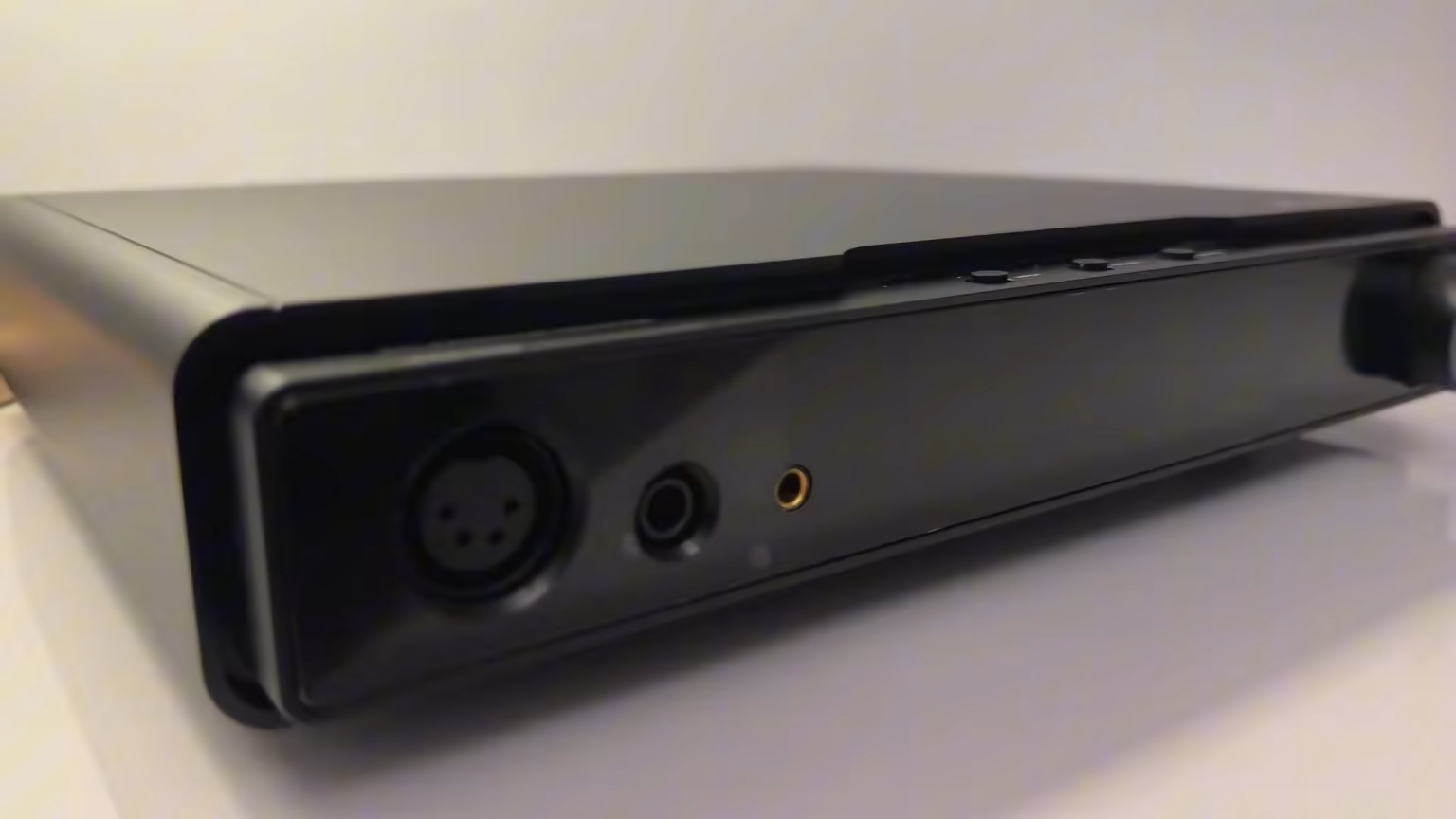 (view larger)
When you spin the unit around to the back panel, there are even more options. For getting your music into the device, it offers USB, optical, coaxial digital inputs. You also have an RJ45 Ethernet port for a network connection, a socket for the included Bluetooth antenna, and even a pair of analog RCA inputs.
For sending your music out, to use it as a preamp or a DAC, the back panel has standard RCA and fully balanced XLR line-outs. This is huge for desktop setups because it means you can run the Serenade however you like in pretty much every setup.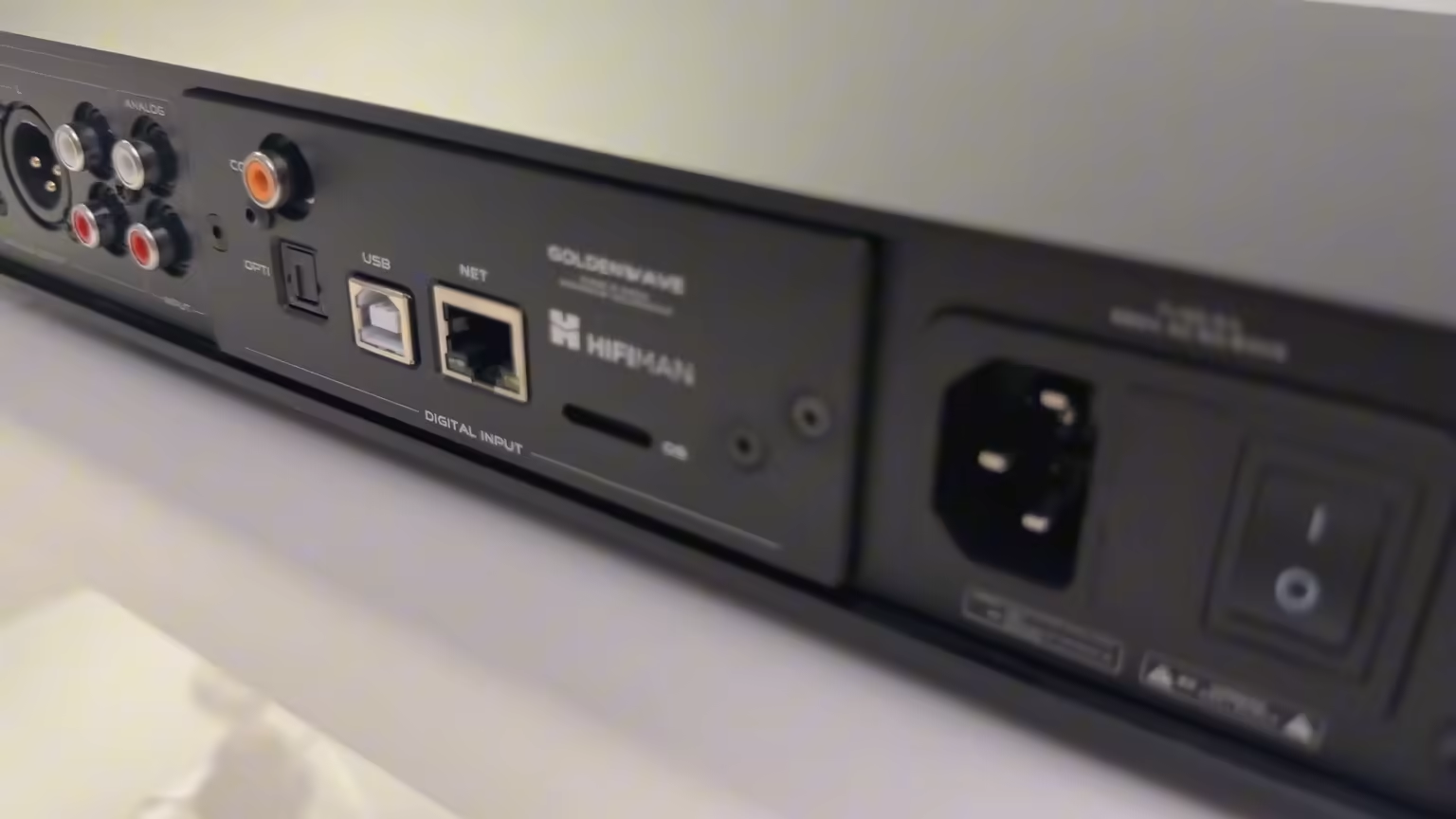 (view larger)
Inside the Serenade: Himalaya Pro R2R DAC and Class A Amp
Strong point: Massive, ultra-clean power supply (50W toroidal + 30,000µF)
This unit checks all the boxes for me, that's why I use it all the time.
Instead of slapping in an off-the-shelf Delta-Sigma chip like most manufacturers do, they built this unit around their proprietary Himalaya Pro R2R DAC. It essentially means the digital-to-analog conversion is handled by a physical ladder of microscopic resistors controlled by a custom FPGA algorithm. This architecture completely bypasses that cold, overly clinical sound you often get from standard DAC chips.
But that's not the end! There's a fully discrete, Class A headphone amplifier. Class A amps are famous for running a bit warm, but they deliver pure, continuous power that completely eliminates crossover distortion. HIFIMAN actually based this specific circuit on their legendary $3000 Prelude amplifier. To turn things up a notch, they threw in a huge 50-watt toroidal transformer and a 30,000-microfarad capacitor bank. Basically, the Serenade has a massive, ultra-clean power supply, as that's what makes music sound full and dynamic.
Technical Specs: Power, Resolution, and a Silent Noise Floor
Strong point: Dead-silent noise floor (THD 0.0015%, SNR 110dB)
If you are using the balanced headphone outputs, this unit pushes 4 Watts into 32 ohms, that's a lot. Even if you stick to the standard single-ended jack, you are still getting 2.8 Watts. The Serenade will easily drive 99 percent of the headphones on the market right now. It doesn't care if you plug in sensitive in-ear monitors or notoriously power-hungry planar magnetics, this amp will power them with authority and plenty of headroom to spare.
On the digital decoding side, it handles virtually any high-resolution file you can think of. If you plug in via USB, you get support for PCM files up to 32-bit/384kHz and DSD256. But if you use the built-in network streamer, those numbers jump to a staggering 32-bit/768kHz and DSD512. And despite pushing all of that power, the Total Harmonic Distortion sits at a microscopic 0.0015% with a Signal-to-Noise Ratio of 110dB. This means that even when you crank the volume, there's no hiss. I'm running a very sensitive pair of headphones using it, and it's dead silent up until the very end of the knob rotation.
Sound Quality: Lush, Musical, and Holographic
Watch out: Voiced warm and lush on purpose - not for fans of a bright, clinical sound
So... how does this thing actually sound? If you're hunting for a bright, clinical amplifier to expose every tiny flaw in a recording, the Serenade isn't going to be your cup of tea. HIFIMAN went in the exact opposite direction. They tuned this unit for pure musicality.
Because of that R2R architecture and the Class A power stage, the sound signature is incredibly lush, full-bodied, and natural. It has that vintage, smooth quality that allows you to stop over-analyzing your gear and actually just enjoy your favorite tracks. Starting down low, the bass delivers a really satisfying kind of physical weight. It's super dense and authoritative, giving music dynamics and that "slam". But because that Class A amp has so much headroom and a massive power supply backing it up, it never loses control. The bass stays punchy and tight without ever being sloppy. But the absolute star of the show here is the midrange. The vocal presentation is just gorgeous. All kinds of music you can think of - acoustic, jazz, or vocal-heavy tracks will sound organic and tangible. The Serenade completely strips away that harsh "digital glare" that you sometimes get from standard delta-sigma DACs. Instead, instruments have a rich, natural timbre that feels incredibly lifelike and saturated.
As for the top end, the treble is silky smooth, they truly knew how to tune this to match their own headphones. It's detailed enough that your music never feels veiled or muffled, but it intentionally smooths out the sharpest, most piercing frequencies. That means you can pair this with notoriously bright headphones and listen for six hours straight without any ear fatigue. Add in a soundstage that is remarkably wide and holographic, and you get a genuinely immersive, 3 dimensional listening experience.
How It Compares: EF400, EF600, and Prelude
Watch out: Class A circuitry runs warm by design
If you've been following HIFIMAN's lineup, you are probably wondering where exactly the Serenade fits in compared to their other popular R2R units like the EF400 and the EF600. The EF400 is more of an entry-level option. It's compact with a very warm, thick, and distinctly analog sound that's fantastic for more sensitive headphones, but it lacks raw power and features. The EF600 steps up to the Himalaya Pro DAC. It's a 5-watt monster with a massive, reference-level soundstage and a cool vertical design that doubles as a headphone stand. So what's the point of the more expensive Serenade? It basically takes the incredible detail and power of the EF600, but backs it with a much refined Class A amp to give you that lush, rich musicality of the EF400. It has a much higher quality circuitry that clearly pays off in the sound quality. Plus, unlike the other two, the Serenade has a high-res network streamer built right in.
The Verdict: Who It's For
Watch out: If you already own a similar-tier amp, the pricier Prelude is the smarter buy
I personally like this DAC-AMP a lot. That's why I use it all the time, and it's going to be difficult for anything else to replace it, but it's not like I'm closed to new options. I just prefer to do a true "upgrade" in terms of my gear, rather than waste time and on endless "side-grades". This is what I would recommend to you all. If you already have an amplifier of similar quality, skip this and go straight for the PRELUDE, if you want something from HIFIMAN. If you have a much cheaper, entry-level amp, this might be exactly what you're looking for.
What the Serenade will drive
Rated at 4 W balanced / 2.8 W single-ended into 32 Ω, it clears every one of the 23 headphones we have published a power figure for - including the hungriest, the HIFIMAN HE-R9, which wants about 313 mW to reach 110 dB peaks.
Requirements are each headphone's own published figure, computed from its impedance and sensitivity by the same calculator its review runs. Where a review states a sensitivity without naming its reference, the figure used here is the worst case, so a headphone counts as driven only if the amplifier clears it either way. The rating above names more than one output; the lowest is the one used. Reproduce any of it in the headphone power calculator, or open a row's review to move the listening level and watch its figure change.
| Headphone | Needs | Drives it |
|---|---|---|
| HIFIMAN HE-R9 | 313 mW | Yes |
| Sivga Luan | 263 mW | Yes |
| OLLO Audio X1 | 248 mW | Yes |
| Sivga Robin SV021 | 99 mW | Yes |
| HIFIMAN RE2000 PRO Silver | 84 mW | Yes |
| Sivga Anser | 83 mW | Yes |
| HIFIMAN HE400se | 79 mW | Yes |
| Sivga SV021 Pro | 56 mW | Yes |
| HIFIMAN RE800 Silver | 53 mW | Yes |
| HIFIMAN Ananda Stealth | 50 mW | Yes |
| HIFIMAN HE1000 Stealth | 50 mW | Yes |
| HIFIMAN Arya Organic | 40 mW | Yes |
| HIFIMAN Arya Stealth | 40 mW | Yes |
| HIFIMAN Arya Unveiled | 40 mW | Yes |
| HIFIMAN Sundara | 40 mW | Yes |
| Kiwi Ears Orchestra Lite | 39 mW | Yes |
| HIFIMAN HE1000se | 25 mW | Yes |
| Verum Audio Verum 1 | 25 mW | Yes |
| HIFIMAN Sundara Closed-back | 16 mW | Yes |
| Meze 105 Silva | 15 mW | Yes |
| Kiwi Ears Atheia | 6 mW | Yes |
| HarmonicDyne Eris | 5 mW | Yes |
| Simgot EM6L | 5 mW | Yes |
Watch the video review
Subscribe on YouTube (opens in new tab)Prefer to read? The written review above is a complete text version - everything covered in the video is in the article.
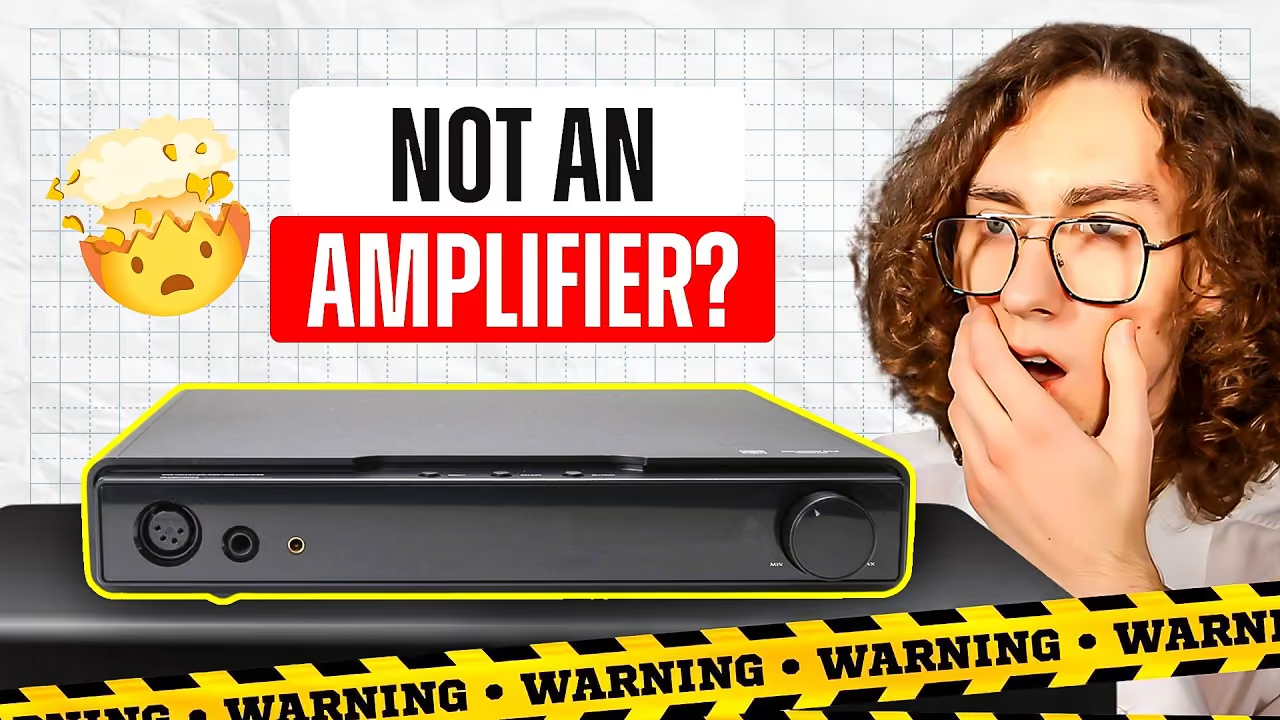
- 0:00 DAC/Amp Combo vs Separates - Which One Should You Buy? (opens in new tab)
- 0:27 Design & Build Quality - Weight, CNC Machined Chassis, Ergonomics, Display (opens in new tab)
- 2:15 Inputs & Outputs - Balanced Headphone Outputs, PRE Outs, Digital Inputs (opens in new tab)
- 3:25 Technologies - Custom FPGA-based R2R Architecture, Class A Topology (opens in new tab)
- 4:42 Technical Specs - Power, Signal-to-noise Ratio, THD+D, Dynamic Range (opens in new tab)
- 6:07 Sound Quality - Tonal Balance, Detail Retrieval, Sound Stage Width (opens in new tab)
New gear lands on @TheAudioStuff (opens in new tab) first - every written review gets a video companion on the same chain.
Common questions about the Serenade
Is the HIFIMAN Serenade worth it?
Yes, and it is the piece we measure its category against - 9.3/10, Reference, tied for the highest score in the catalogue, level with one other review, against a catalogue median of 8.1. On value it rates fair: mid-pack for the price across the catalogue. Price: $999.
Who should buy the HIFIMAN Serenade, and who should skip it?
Buy it if you want one amplifier that will not be the limit on whatever you buy next, and you want the R-2R presentation rather than the last decimal of measured linearity. Skip it if you listen mostly on sensitive in-ears, where reserve like this is gain you have to turn down, and you choose a converter by its measurements and want the lowest distortion figure at the price.
What else have you tested that is close to the HIFIMAN Serenade?
No matchup page yet, and no close price match in the catalogue either. The nearest things we have scored in the same category: the HIFIMAN EF500 at 8.2/10, the HIFIMAN EF499 at 8.1/10, and the HIFIMAN EF400 at 7.5/10.
If you're interested in this
All 4 headphone amps reviewsClosest alternatives