
HIFIMAN Sundara Closed-back Review: An Entirely Different Headphone
Sundara, but cheaper, better isolation, easier to drive? Nope, not even close. An entirely different headphone that manages to be mediocre in every way that matters to me.
higher than 1% of everything we have tested
Value Steep. You are buying performance here, not value.
- Standout
- Suspension strap headband
- Watch out for
- Extremely mid-forward tonality
- Better alternative
- HIFIMAN Sundara: $70 more, scores 2.2 higher.
Is it for you?
- You want to hear into a mix rather than be soothed by it
- You do not want to buy an amplifier before you can hear it properly
- You want a forgiving listen that flatters a bad file
- $229 has to buy value as well as performance
For the wider field, our Best Open-Back Headphones guide ranks 14 rivals in this class. This one is not among them.
Sundara, but cheaper, which isolates the sound better, and is even easier to drive? Nope, not even close. Let's talk about it.
But before that, I need to state one important thing - I'm really, really not a fan of their sound. These are, so far, my least favorite sounding headphones from HIFIMAN. I wouldn't really say that they are objectively bad, and I'll stay as transparent and objective in this review as always.
The Sundara Closed-back is a closed-back planar magnetic over-ear headphone. It features HIFIMAN's Stealth Magnets technology for reduced reflections and diffraction, which supposedly results in dramatically improved sonic output. It's also equipped with the NEO Supernano diaphragm, resulting in fast response and detailed image with lush, full-range sonics - according to HIFIMAN. We'll take a look at these qualities later.
It used to be priced at $399, but it has been consistently on sale for $229, and I think at this point that's its regular price.
Is It Comfortable? Beechwood Cups, Comfier Pads
The Sundara Closed-back has a suspension strap headband design, familiar from the Ananda or even the open-back version of the Sundara. It doesn't swivel, and its adjusting mechanism isn't the greatest, as it leaves scratches in the painting while adjusting. Either way, I still prefer it over the solid headband piece any day of the week, as I find it much more comfortable - it gets rid of any hotspots.
The earcups can freely tilt and are made of this beautiful real Beechwood, which gives them a fairly solid feeling in the hand, but also adds some more weight. It uses dual 3.5mm connectors located on the bottom of the earcups - they're slightly tilted forward to improve comfort, so the cable is not hitting your shoulder.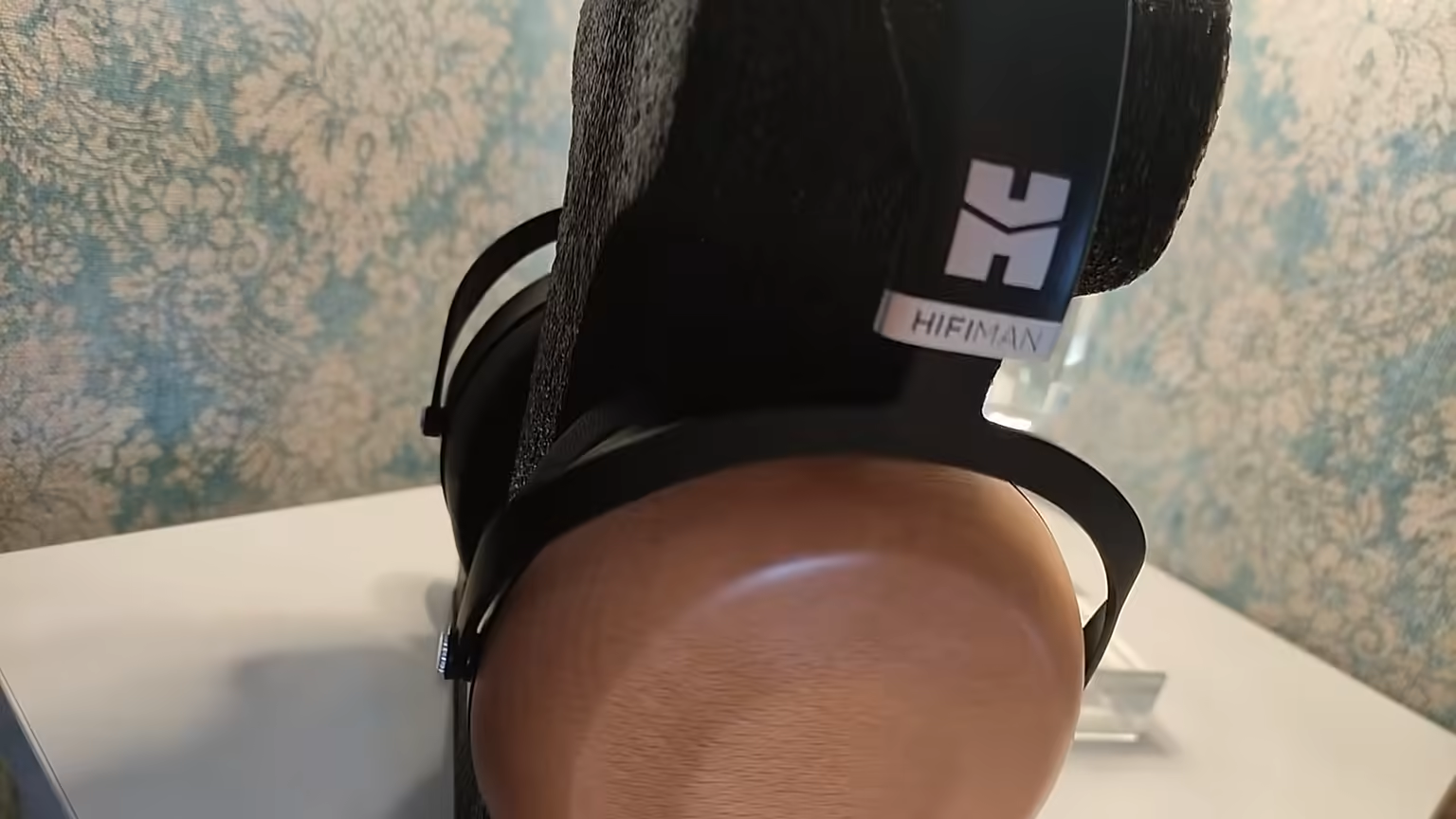 (view larger)
The pads use three different types of materials - perforated protein leather on the inside, cloth-like material (likely polyester) on the part that's in contact with your skin, and solid protein leather on the outside. We all know this approach to the pads from other HIFIMANs.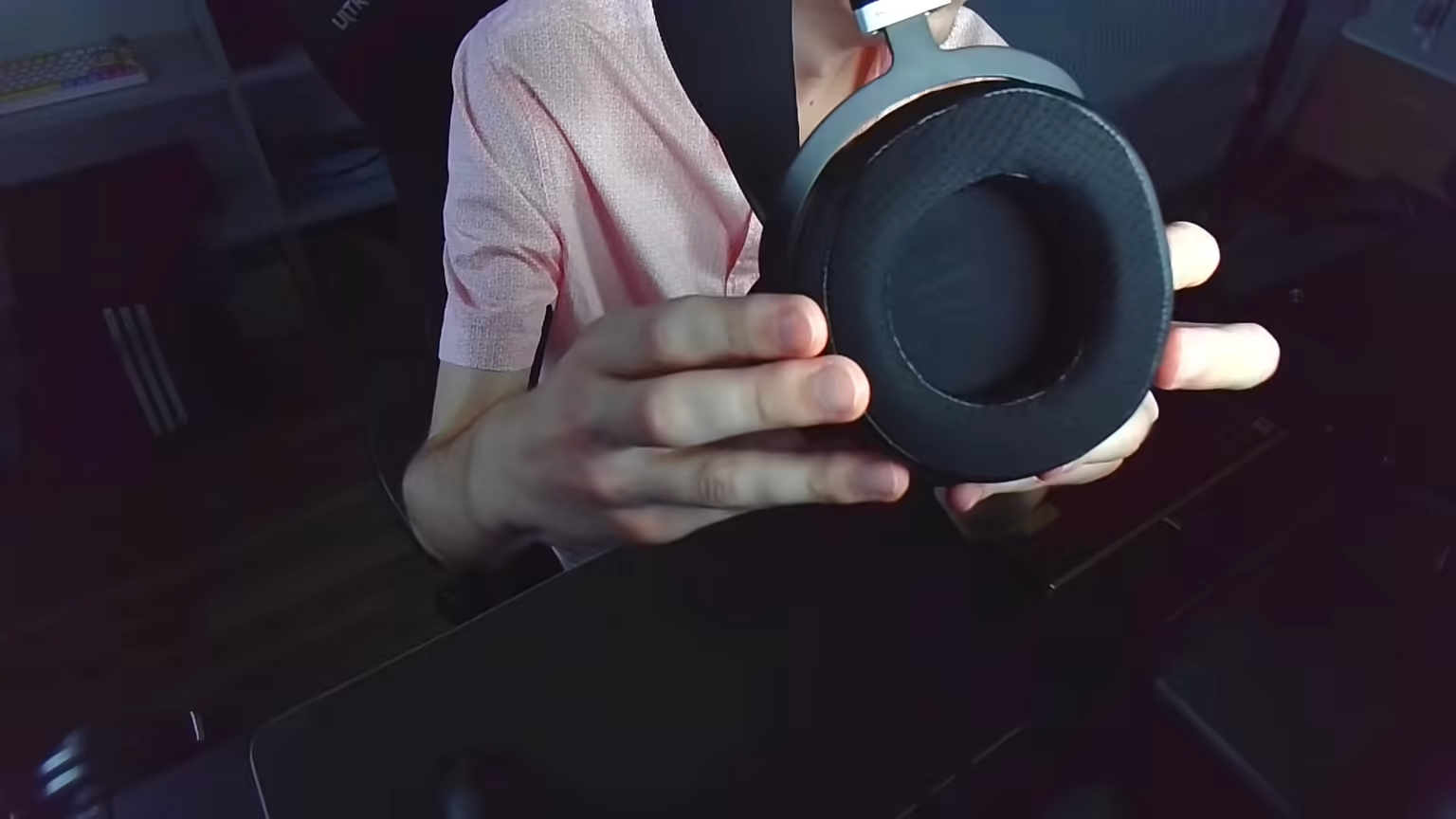 (view larger)
However, there's something different this time. They used a different mounting style, which seems like it doesn't matter too much, but the Sundara Closed-back has a different on-head feeling for some reason. It feels almost like the pads are bigger than on the open-back version. To clarify, it's a positive thing - they feel significantly more comfortable than the regular Sundara. I don't know what exactly is affecting that, likely the new mounting style, but it's definitely a step in the right direction.
Sound (Tonality): The Mid-Forward Problem
Sound, especially the tonality, is the part I particularly dislike about this headphone. Unfortunately, I couldn't find any reliable frequency response graphs, and I am not going to provide you with any that could be misleading.
Starting from the bass - it's just fine, nothing special at this price point. There's a significant amount of bass, it's definitely present, but it lacks in terms of detail and isn't particularly detailed. It doesn't quite sound bloated though, which is a good thing after all.
The midrange is where most issues come from - that's the main reason for my aversion towards this headphone. It comes across as extremely mid-forward, more than I'm used to, and I'm not the only one that has an issue with that. Folks at Custom Cans, in the UK, figured out the cause of that mid-forwardness and found a solution. It's caused by the damping foam, which is present behind the drivers. So they designed a kit "to reduce the hump in the mid-range on the Sundara closed backs." They say that "If you are finding them a little too mid-forward, this kit may be the answer." I've watched their video about this mod, including some frequency response graphs and sound tests, and I'm convinced.
The highs initially had a feel of a lack of detail. But after listening to these headphones for a while, as I always do with my evaluations, I think I know what's going on. We'll get back to that in the sound characteristics part. The high frequencies don't have a lot of airiness to them, for sure. That makes them sound a bit darker than most HIFIMANs, which emphasizes the mid-forwardness even further. The treble extension is also unimpressive - there were times when I felt like I would like it to go just a little bit higher to achieve the desired amount of pleasure and fun with the song.
Sound Characteristics: Big Stage, Closed-In Feel
HIFIMAN states that this Sundara Closed-back has a huge soundstage. I cannot disagree with that - maybe it's not huge, but still fairly large, especially for a closed-back. I was pleasantly surprised by that. However, it doesn't sound very open. You can say that's nothing unexpected for a closed-back design - however, there are headphones that sound much more open through the frequency range than the Sundara Closed-back.
Sound separation is at an acceptable level, nothing more. In some more crowded mixes, the sounds were slightly blending in with each other. That didn't happen too often, but we're not talking about a $100 pair of headphones at the end of the day - these are $229.
Detail Retrieval: There, but You Have to Dig
That's the part I was initially a little bit disappointed in, but then realized that this headphone is not aiming in the direction where it shouts at you with the micro-detail - and if it is aiming for that, then it's failing miserably. I believe that it focuses on letting you find most of the detail yourself rather than directly pointing it at you.
So the details are still there, but they're simply not as easy to perceive. You need to be looking for all the minor details in the recording to notice them.
Dynamics: A Pleasant Surprise
The dynamic range, including punch and slam, is a pleasant surprise at this price. It can't hit you as hard as let's say an Edition XS, OG HE6, or most dynamic driver headphones, but I didn't feel like it was lacking in this department. Neither was I feeling like it was sounding sluggish or lacking in the decay. I usually correlate the lack of dynamics with the headphone sounding a bit boring - here it doesn't take place.
Does It Need an Amp? Anything Will Drive It
With an impedance of only 20 ohms and a high sensitivity of 98dB, it's extremely easy to drive. It's not amp-picky at all, and basically everything can power it - even my phone. Going to a better source gear, there was a little improvement in the openness, detail retrieval, and soundstage.
Does It Block Noise? Fine Up High, Leaky Down Low
As it's a closed-back, I feel that this part may be important for some of you. Speaking about isolation of external sounds getting into your ears, it does a decent job at higher frequencies but gets worse as the frequency is getting lower. The effect of this is that everything that happens outside of the headphone sounds very bassy, lower-pitched, and muffled. Speaking of the isolation of the sound getting out of these headphones, it's quite decent, all across the frequency range - not the best, but it does an okay job at that.
Verdict: Not for Me
The Sundara Closed-back is an entirely different headphone compared to the open-back Sundara. It even has a driver that looks nothing like the one from the open-back Sundara. Moreover, the Sundara Closed-back somehow manages to be mediocre in every single aspect that I care about. It's definitely not for me, but if these characteristics aren't bothering you, then good for you.
Sound signature
Derived from the words this review uses: each axis runs between two opposite descriptors, and the shape leans toward whichever side the writing does.
- Warm ↔ Bright Neutral, no clear signal in the review language
- Relaxed ↔ Analytical Leans analytical
- Polite ↔ Aggressive Leans aggressive
- Lean ↔ Bass-heavy Neutral, no clear signal in the review language
- Intimate ↔ Wide stage Neutral, no clear signal in the review language
Hear what "analytical, aggressive" means: a short synthesised loop, flat and then with those leanings. An illustration of the words, not a recording of the Sundara Closed-back.
Not sure which signature suits you? Find yours with a blind A/B test
Watch the video review
Subscribe on YouTube (opens in new tab)Prefer to read? The written review above covers everything in the video.

- 0:00 Disclaimers (opens in new tab)
- 0:24 General Info & Technologies used (opens in new tab)
- 0:50 Pricing - Infinite Sale? (opens in new tab)
- 0:58 Build Quality & Comfort (opens in new tab)
- 2:32 Sound - Tonality (opens in new tab)
- 3:15 Midrange Issues (opens in new tab)
- 3:57 High Frequencies (opens in new tab)
- 4:35 Sound Characteristics (opens in new tab)
- 5:08 Sound Separation (opens in new tab)
- 5:26 Detail Retrieval (opens in new tab)
- 5:57 Speed & Dynamics (Punch, Slam) (opens in new tab)
- 6:23 Amplification Requirements (AMP, DAC) (opens in new tab)
- 6:50 Sound Isolation (opens in new tab)
- 7:24 Conclusion, Recommendations (opens in new tab)
Common questions about the Sundara Closed-back
Is the HIFIMAN Sundara Closed-back worth it?
Only for some buyers. It scored 6.8/10, Mixed, higher than 1% of everything we have tested, against a catalogue median of 8.1. On value it rates steep: better value exists in headphones, so you are buying performance here, not value. Price: $229.
Who should buy the HIFIMAN Sundara Closed-back, and who should skip it?
Buy it if you want to hear into a mix rather than be soothed by it, and you do not want to buy an amplifier before you can hear it properly. Skip it if you want a forgiving listen that flatters a bad file, and $229 has to buy value as well as performance.
What amplifier does the HIFIMAN Sundara Closed-back need?
The HIFIMAN Sundara Closed-back is a 20 Ω load, so the matching rule is the rule of eighths: an amplifier's output impedance should sit at or below 2.5 Ω, an eighth of the headphone's, or its frequency response shifts audibly and usually in the bass. That is a property of the amp rather than its power rating, so a high-output-impedance tube amp can fail it while a phone jack passes. About 16 mW to reach 110 dB peaks, which is a phone jack or any dongle. The review records 98 dB without saying against what, but it can only be dB/mW here: read as dB/V it would work out to 81 dB/mW, less sensitive than the Susvara and harder to drive than any headphone in production.
What else have you tested around the price of the HIFIMAN Sundara Closed-back?
We have not run it head-to-head against anything yet. In the same category and the same rough money we have scored the HarmonicDyne Eris at 6.8/10, the HIFIMAN HE-R9 at 6.9/10, and the Sivga Anser at 8.0/10, which is the nearest thing to a shortlist until a matchup page exists.
Is the Sundara Closed-back just a closed Sundara?
No, and that expectation is the reason people end up disappointed. It is an entirely different headphone - even the driver looks nothing like the one in the open-back - and it is tuned nothing like it. Going in expecting the Sundara with isolation added is the single most common mistake here. What you actually get is an extremely mid-forward headphone with a darker top end, which is a different product with a different audience.
Why does the Sundara Closed-back sound so mid-forward?
Damping foam behind the drivers, and you are not imagining it. This is the main reason for my aversion to the headphone - it is far more mid-forward than I am used to - and I am not the only person who has had the problem. Custom Cans in the UK traced the cause to that foam and built a kit specifically to reduce the midrange hump. I have watched their video with the frequency response graphs and the sound tests, and I am convinced by it.
Can the Sundara Closed-back be fixed with a mod?
Apparently yes, and it is worth knowing before you write the headphone off. Custom Cans designed a kit aimed at the damping foam behind the drivers, described as reducing the hump in the midrange - their words are that if you find them a little too mid-forward, this kit may be the answer. I have not fitted one myself, so treat this as a lead rather than a verdict, but the analysis behind it is sound and it targets the exact thing I dislike.
How well does the Sundara Closed-back block noise?
Decently up high and poorly down low, which produces a specific effect: the outside world does not disappear, it becomes bassy, lower-pitched and muffled. Leakage outward is the better half - quite decent across the frequency range, not the best but an okay job. So it will keep your music mostly to yourself in a quiet room. It will not save you from a bus engine or an air conditioner.
Does the Sundara Closed-back need an amp?
No, and this is the part it genuinely gets right. With an impedance of only 20 ohms and a high sensitivity of 98dB it is extremely easy to drive, not amp-picky at all, and basically anything will power it - my phone included. Moving to better source gear brought a little improvement in openness, detail retrieval and soundstage, so there is something to gain, but nothing here demands it.
Is the Sundara Closed-back more comfortable than the open-back?
Yes, noticeably, and it surprised me. The pads use the same three-material recipe HIFIMAN always uses, but a different mounting style - and the on-head feeling changes because of it. They feel almost bigger than the open-back Sundara's, which is exactly the complaint people have about that headphone. The suspension strap does away with hotspots, and the Beechwood cups feel solid, though they add weight. The adjustment mechanism scratches the paint as you use it.
Who is the Sundara Closed-back actually for?
Somebody who wants a closed planar with a big stage and real dynamics, and who likes forward mids rather than tolerating them. I will be straight: this is my least favourite HIFIMAN so far, and it manages to be mediocre in every aspect I care about. That is a statement about my preferences as much as about the headphone - it is not objectively bad. The stage is genuinely large for a closed back, the punch and slam are a pleasant surprise, and it is dirt cheap to drive.