
HIFIMAN Svanar Wireless Review: R2R in a $499 Wireless IEM
A $500 single dynamic driver TWS with an R2R DAC and LDAC. It's both lacking and feature-packed at the same time - and it actually delivers where it matters.
higher than 21% of everything we have tested
Value Steep. You are buying performance here, not value.
- Standout
- Built-in R2R DAC
- Watch out for
- ANC isn't amazing for the price
- Better alternative
- HIFIMAN RE2000 PRO Silver: $150 less, scores 1.0 higher.
Is it for you?
- You want a big, out-of-your-head stage
- You want vocals right in front of you
- $499 has to buy value as well as performance
Pick #6 of 7 in our Best IEMs guide.
The Svanar Wireless is a single dynamic driver TWS, which comes at a whopping price of $500.
It comes with topology diaphragm technology. What's that, you might ask? It simply refers to the special nanoparticle coating applied to the surface of the diaphragm, that's meant to result in a more natural and detailed sound.
Features: R2R DAC, LDAC, So-So ANC
In terms of features, it's both lacking and really feature-packed at the same time - let me explain.
Being a TWS, it needs to have a DAC built in - but it's not a regular DAC. It uses an R2R structure, which is basically a resistor ladder array on a chip. That's the same approach HIFIMAN has taken with their full-size desktop amps like the EF400 and the EF600, which also include R2R DACs. Their desktop amp/DAC combos have proven to sound very good. Unfortunately, I can't say how much of that is because of the DAC chip itself, but either way, the Svanar Wireless has it.
In terms of connectivity, it has Bluetooth 5.2, which is almost the latest version of Bluetooth - that's really nice to see.
But we're not offered a lot of Bluetooth codecs to choose from. Rather, just one that I would say is really good - LDAC, developed by Sony, which offers 24-bit and 192kHz bit depth and sampling rate accordingly. It's important to note that LDAC is NOT a truly lossless audio codec. However, in practical terms, this is unlikely to be a significant concern. In the context of using wireless in-ear monitors, the majority of listeners won't be exclusively listening to lossless music, and even if so, the difference is generally not huge - for some it's even hardly audible.
The connectivity itself has proven to be stable and didn't cause me any issues, like some other wireless IEMs, and I would expect it to work perfectly for that price.
Another feature that's nice to see is the inclusion of three modes of Active Noise Cancellation - there's HiFi mode (which means ANC off), Transparency mode, and ANC on. While it's nice to see ANC, it's definitely not amazing. From my testing, it doesn't do a very good job of reducing outside noises. Don't get me wrong - it helps, but not to the extent that you might expect at this price.
Is It Comfortable? Big Buds, Bulky Case
The charging case it comes with is fairly bulky and pretty heavy. It's in this kind of diamond-shaped form. It doesn't collect many fingerprints though! There's a USB-C charging port on the bottom and a button that lets you control some stuff on the rear side. I'm not going to go over the controls themselves, as you can look that up by yourself - I have no intention of wasting your time on that.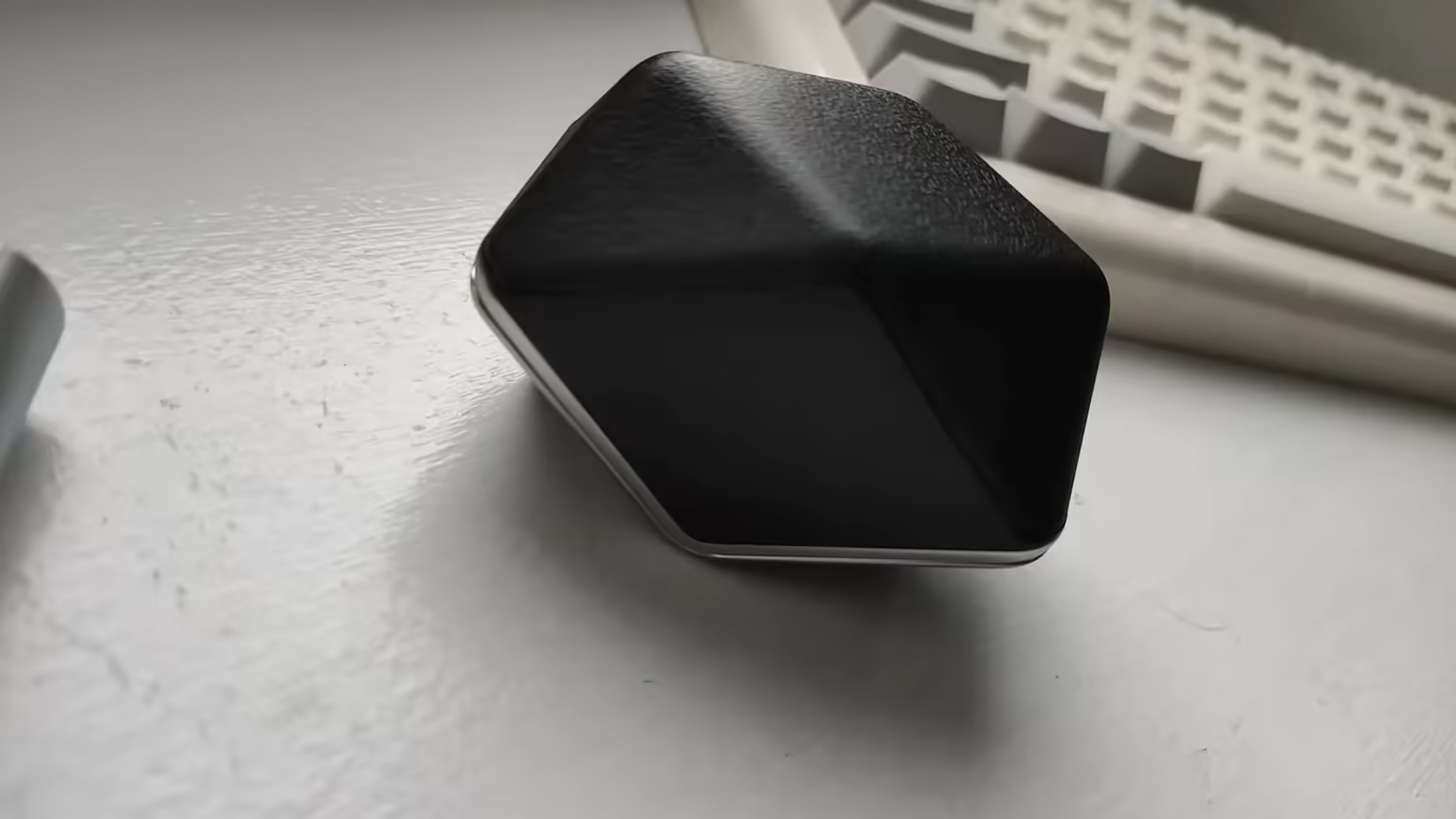 (view larger)
The earbuds themselves are also very big, but luckily lightweight. In terms of materials, they're made almost entirely out of this silver plastic, with the addition of carbon fiber-looking material on the "swan-shaped" piece - hence the name, Svanar Wireless. (view larger)
Comfort-wise, they're pretty decent and give you a lot of options, but none of them is ideal for me specifically. Their odd, big shape is something I had to get used to, and I did after some time. However, there's one problematic thing, at least for me - the carbon fiber part is a little bit rough in touch, more so than the silver plastic, and while the earbuds are in my ears, it's noticeable - it has a sort of scratchy feeling.
What did I mean by speaking of the options? You're getting a bunch of different ear tips - 8 pairs to be specific. I'm sure that most of you will figure out the perfect pair for you, as there is a lot to choose from.
Sound Quality (Tonality): The Tips Decide
Let's finally talk about their sound. It's the most important after all. Tonality first - it's entirely dictated by the ear tips you decide to use.
For example, with the regular-style big silicone ones, you're getting a bit softer highs and a huge bass boost - too huge for my liking. I assume bass heads are going to be satisfied. However, the silicone double-flange style keeps a good balance - they reduce the lows a bit to a tolerable level and bring some highs. I found them the most tonally balanced.
On the other hand, the foam ones were definitely a no-go for me - they made the sound very thin, took away the fullness and fun.
So in terms of tonality, you can choose whatever you like, as they're extremely sensitive to tip rolling, plus you're getting a lot of them included in the package.
Sound Characteristics: Where the Svanar Shines
Here we go - that's where the Svanar Wireless shines the most.
I found the soundstage to be decently wide. It didn't give me an in-head type of experience, which is often unheard of in the IEM world. I'm not saying that none of the IEMs sound wide - there indeed are some, and the Svanar Wireless is just one of them.
Sound separation was also pretty nice. Usually, the instruments and vocals are well separated. Unless it was a very warm or bassy track and I used the ear tips which emphasized that even more - then everything was just drowning in the bass.
Dynamic range, especially in the lower mids, bass, and sub-bass region, is excellent. It punches and slams very strongly, and it makes for a very fun experience. Dynamic drivers usually do a better job at dynamics than other types like planar magnetic or electrostatic.
Detail Retrieval: Texture from the Bass Up
Speaking about detail, it's pretty odd. Usually, in headphones, the details are mainly reproduced in the upper frequencies. The Svanar Wireless does it quite a bit differently. I'm unable to tell if that's because of their design, the driver, or the codec being lossy.
Either way, the bass is very, very textured and detailed here. That isn't particularly present throughout the entire midrange though, as the midrange itself is quite recessed tonally - and it isn't meant to be very detailed in music anyway, as that's where the melodies and all that are placed.
In the top end, it's also fairly resolving for a TWS. I'd say it's surprisingly resolving for something in its class. I liked that a lot, as I'm a fan of hearing minor details in songs. But still, the low end was seemingly more resolving than the top end frequencies - such a weird experience.
Who Is the Svanar Wireless For?
I don't think that everybody is going to jump in and purchase a $500 wireless IEM, as people often associate wireless technology with lower-fidelity sound. I think that HIFIMAN is trying to break that belief and come up with a decent product that shows what's possible while remaining wireless and fairly compact.
People are absolutely okay with buying crazy expensive wired IEMs for years. There are many top-of-the-line ones that cost over $2000, and there's a market for that. While you have to pay a lot for the Svanar Wireless, it also offers a lot.
I'm convinced that most of its price isn't what it costs HIFIMAN to make these, but a huge portion of that budget went into the R&D - research and development - to fit everything that it offers into a small package.
Sound signature
Derived from the words this review uses: each axis runs between two opposite descriptors, and the shape leans toward whichever side the writing does.
- Warm ↔ Bright Neutral, no clear signal in the review language
- Relaxed ↔ Analytical Leans analytical
- Polite ↔ Aggressive Leans aggressive
- Lean ↔ Bass-heavy Neutral, no clear signal in the review language
- Intimate ↔ Wide stage Leans wide stage
Hear what "analytical, aggressive, wide stage" means: a short synthesised loop, flat and then with those leanings. An illustration of the words, not a recording of the Svanar Wireless.
Not sure which signature suits you? Find yours with a blind A/B test

Watch the video review
Subscribe on YouTube (opens in new tab)Prefer to read? The written review above covers everything in the video.

- 0:00 SINGLE Dynamic Driver?! (opens in new tab)
- 0:20 Features, R2R DAC (opens in new tab)
- 1:00 Bluetooth connectivity, Sony LDAC Codec (opens in new tab)
- 1:52 Triple Mode ANC - Active Noise Cancellation (opens in new tab)
- 2:15 Build Quality & Design (opens in new tab)
- 2:56 Comfort, Ear tips included (opens in new tab)
- 3:33 Sound - Tonal Balance (opens in new tab)
- 4:25 Soundstage Width (opens in new tab)
- 4:46 Sound Separation (opens in new tab)
- 5:04 Dynamic Range - Punch, Slam (opens in new tab)
- 5:25 Detail Retrieval Capabilities (opens in new tab)
- 6:19 Price & Conclusion - Who is this for (opens in new tab)
Common questions about the Svanar Wireless
Is the HIFIMAN Svanar Wireless worth it?
Yes, for the right listener - 7.8/10, Recommended, higher than 21% of everything we have tested, against a catalogue median of 8.1. On value it rates steep: better value exists in headphones, so you are buying performance here, not value. Price: $499.
Who should buy the HIFIMAN Svanar Wireless, and who should skip it?
Buy it if you want a big, out-of-your-head stage. Skip it if you want vocals right in front of you, and $499 has to buy value as well as performance.
What else have you tested that is close to the HIFIMAN Svanar Wireless?
No matchup page yet, and no close price match in the catalogue either. The nearest things we have scored in the same category: the Flare Audio E-PROTOTYPE at 8.0/10, the HIFIMAN RE800 Silver at 8.0/10, and the Kiwi Ears Orchestra Lite at 8.0/10.
Which Svanar Wireless ear tips should you use?
The double-flange silicones, if you want balance - and the choice matters more here than on almost any other earphone, because the tonality is entirely dictated by the tips. The big regular silicones soften the highs and deliver a huge bass boost, too huge for me though bass heads will be happy. The foams were a no-go: they made the sound thin and took away the fullness and the fun. Eight pairs come in the box, so the right answer for your ears is almost certainly in there.
Is the Svanar Wireless ANC any good?
Not for the money, no. There are three modes - HiFi with ANC off, Transparency, and ANC on - and having them is nice, but the cancellation itself does not do a very good job of reducing outside noise. It helps. It does not help to the extent you would expect at $500. If active noise cancellation is the main reason you are shopping, this is not the product that will satisfy you.
Does LDAC being lossy matter on the Svanar Wireless?
In practice, no. LDAC carries 24-bit and 192kHz and it is genuinely good, and it is worth being clear that it is not a truly lossless codec. But most people using wireless in-ears are not listening exclusively to lossless material, and even when they are, the difference is generally not large - for some listeners it is hardly audible at all. It is the one codec on offer here, and it is the right one to have.
What does the R2R DAC in the Svanar Wireless actually do?
It is a resistor ladder array on a chip, and it is the same architectural choice HIFIMAN make in their desktop gear - the EF400 and EF600 both carry R2R DACs, and those combos have proven to sound very good. What I cannot tell you is how much of what I hear here comes from the DAC chip specifically, because there is no way to isolate it inside a sealed wireless earphone. What is certain is that this is an unusual thing to find in a TWS at all.
Are the Svanar Wireless earbuds comfortable?
Decent, with one specific irritation. The buds are very big but lightweight, and their odd shape took me time to get used to - I did get used to it. The problem that stayed is the carbon-fibre-look piece: it is rougher to the touch than the silver plastic around it, and with the buds in your ears that roughness is noticeable as a faintly scratchy feeling. The case is bulky and pretty heavy too, though at least it does not collect fingerprints.
Why is the Svanar Wireless detail strongest in the bass?
It is genuinely odd and I cannot fully explain it. Detail normally lives in the upper frequencies; here the bass is very textured and very detailed, more resolving than the top end, which is not how this usually works. I cannot tell whether that comes from the design, the driver or the codec being lossy. The top end is still surprisingly resolving for a TWS, and the midrange is the quiet part - recessed tonally, and not where detail lives in music anyway.
Is a $500 wireless earphone worth it?
That depends on whether you accept the premise, and most people will not. Wireless is widely associated with lower fidelity, and HIFIMAN are trying to break that. People happily spend over $2000 on wired in-ears and there is a market for it, so the objection is about wireless rather than about price. My read is that most of what you are paying for is not what it costs to build - it is the research needed to fit an R2R DAC, LDAC and three ANC modes into something this small.