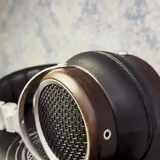
Kiwi Ears Atheia Review: A $349 Planar + Dynamic Closed-Back
A closed-back hybrid headphone pairing a 50mm dynamic driver with a 14.5mm planar - dynamic slam on the bottom, planar speed on top, in a walnut and aluminum chassis.
higher than 30% of everything we have tested
- Standout
- Walnut wood earcups with aluminum brackets
- Watch out for
- Vegan leather pads feel a bit generic
- Better alternative
- HIFIMAN Edition XS: has an easier listen, $80 less, scores 0.8 higher.
Is it for you?
- You want the balance to lean warm, with the top end eased
- You do not want to buy an amplifier before you can hear it properly
- You want every last bit of treble detail
Pick #9 of 12 in our Best Headphones Under $500 guide.
You probably think you know how headphones work - one driver per side, simple right? But what if I told you these use two drivers per side? Not for show, but to actually split the sound between them. It's called the Kiwi Ears Atheia, and it does things very differently. The question is - does this unusual design actually make them sound better or worse?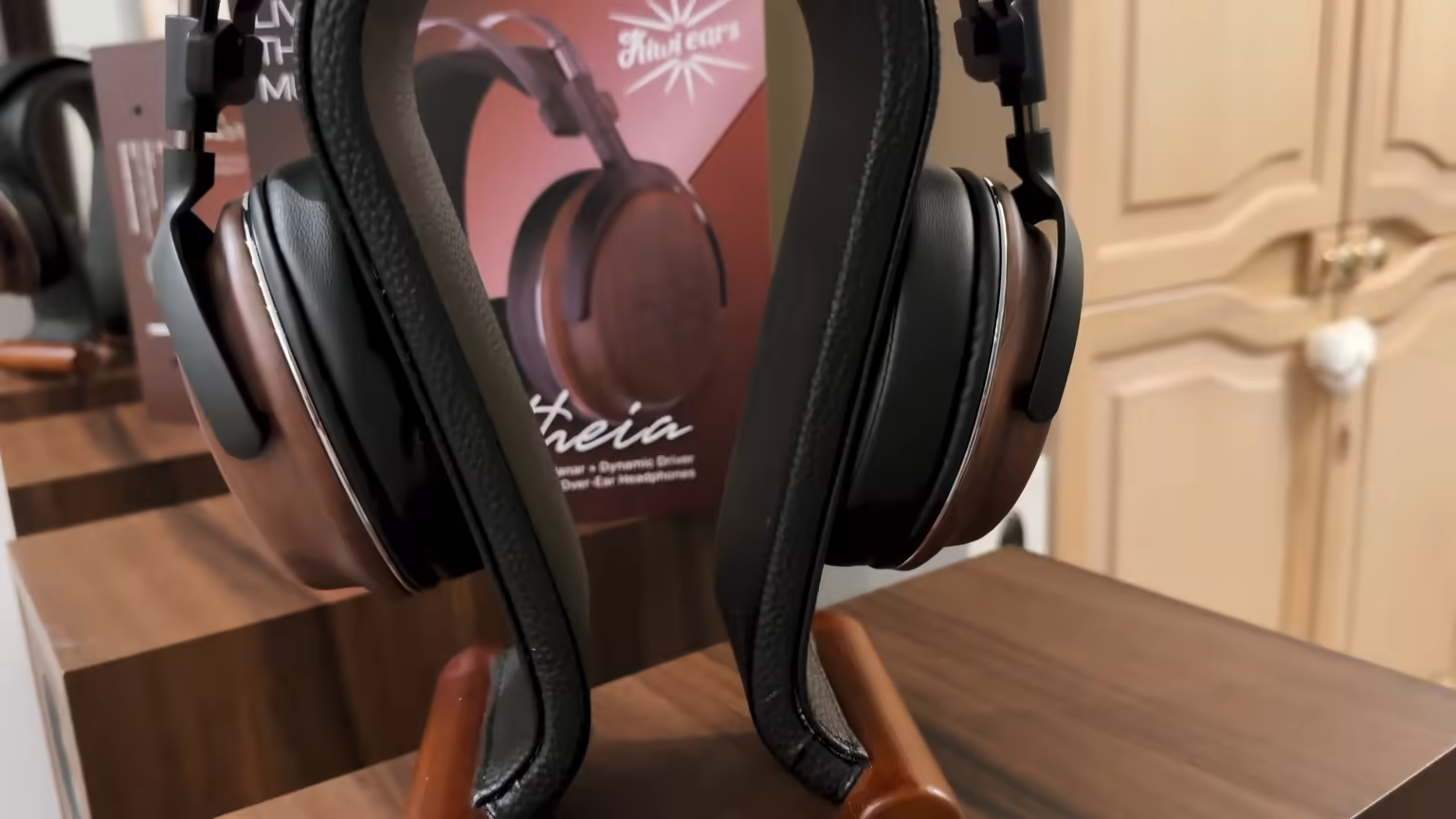 (view larger)
Comfort & Build Quality: Walnut Done with Care
The Kiwi Ears Atheia feels immediately different from most headphones you pick up. The earcups are made from walnut wood, which gives them a really warm, nice feel, and the aluminum brackets add some weight and durability without looking industrial. The headband isn't just a simple design either - the suspension strap adjusts automatically on stretchy rubber bands. And the entire headband assembly can move up and down on a slider for a more precise fit through adjustment. That makes it sit comfortably on your head without putting too much pressure on the top.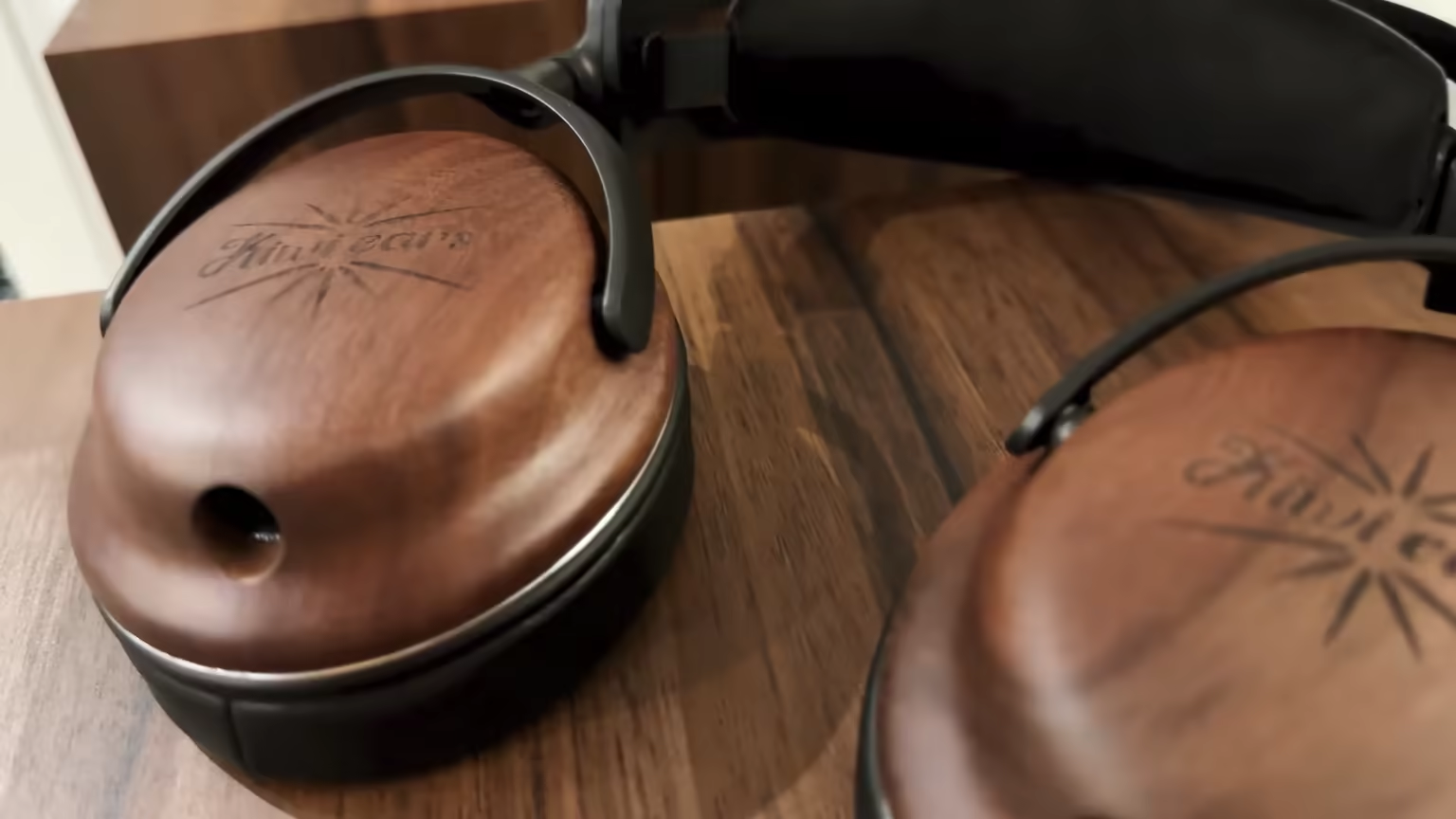 (view larger)
The ear pads are vegan leather, soft, and they form a decent seal - for some reason they have a very generic feel though. For shorter sessions, it's super comfortable, and even for a couple of hours, it's fine - but your ears might start to feel a little warm because the cups aren't huge. Also, the ear openings aren't massive, so most ears, including mine, will touch the pads a bit. It's not a dealbreaker, but something to know if you're picky about that.
The cable is another standout. It's a single-ended 3.5mm cable, but what makes it neat is the locking mechanism - it twists and clicks into the earcups so it won't come loose if you accidentally tug on it. The cable itself mixes braided nylon and a softer rubberized section near the cups, which helps keep it flexible and perhaps reduces microphonics, but unfortunately still it is a quite bit microphonic. Regardless, it's a nice step up from the generic cables you usually get in this price range.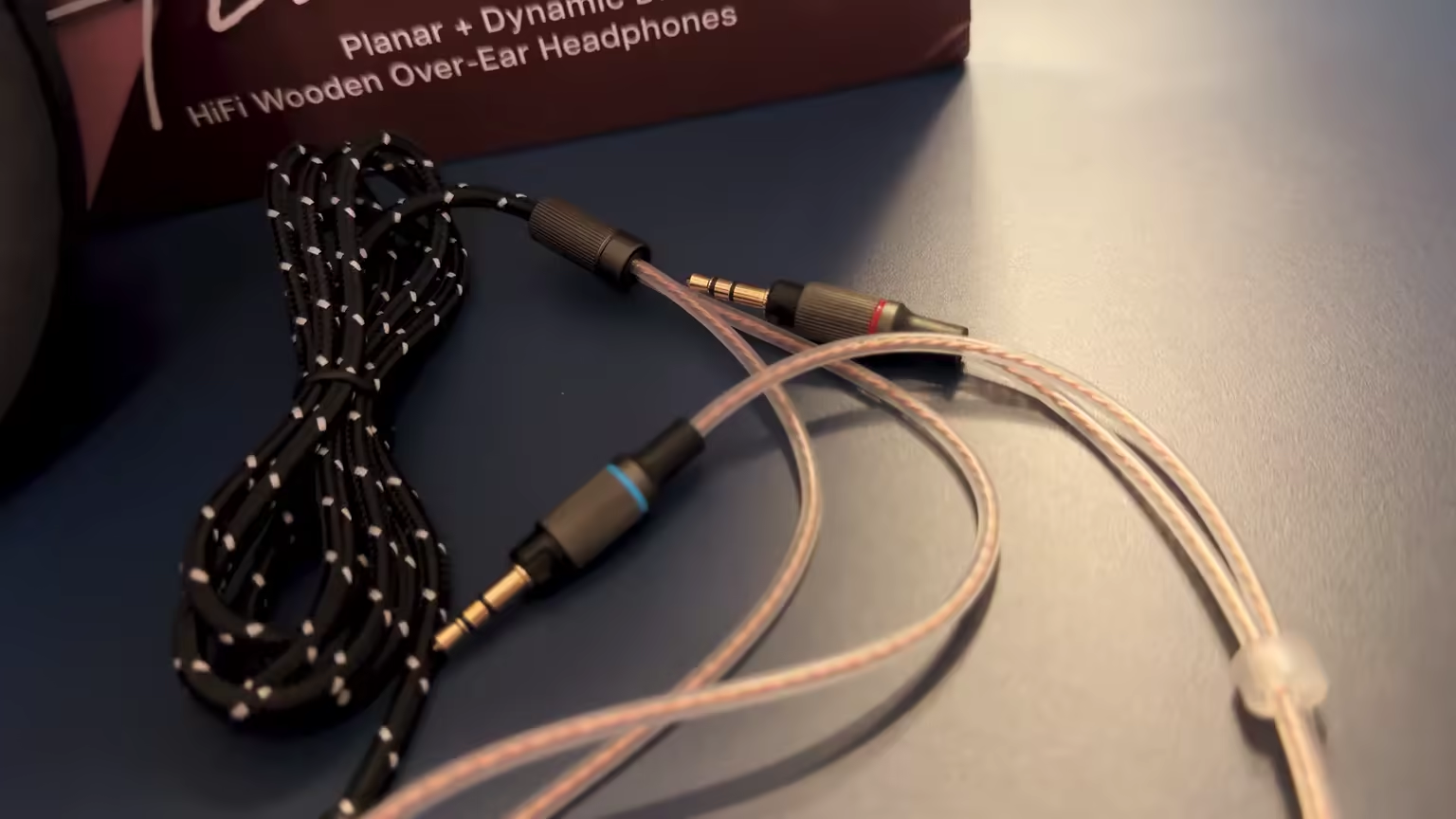 (view larger)
And then there's the carrying case. It's a small, hard-shell case with a soft lining, so you don't have to worry about scratches when you're transporting the headphones. Not massive or clunky - just practical.
Overall, the Atheia keeps a balance between premium aesthetics and everyday comfort. It's not heavy, and it doesn't feel very cheap. Many companies outside the headphone world, when making their first headphones, tend to create a product that feels generic and really OEM, but the Atheia avoids that entirely. It feels like it was designed with care and attention to detail, not just as another product to check off a list, and keep in mind that Kiwi Ears is mostly an IEM company.
Technologies: A Dynamic-Planar Driver Split
The Atheia's standout feature is its dual-driver hybrid design - a 50mm dynamic driver working in tandem with a 14.5mm planar magnetic driver. The idea is that the dynamic handles the heavier low end - all the slam and full-bodied bass - while the planar driver takes care of the upper mids and treble, especially in the textures and detail region. That lets each driver do what it's better suited for, instead of forcing one driver to do everything.
To support that, the internal acoustic architecture is tuned to balance resonances between the two driver systems. Kiwi Ears went with wooden cups that help tame coloration and resonance, paired with aluminum alloy brackets to add stability and reduce vibrational flex.
The cable system is also part of the tech design. The Atheia uses a unique left/right cable configuration, where swapping the ends breaks operation - which is essential because the dual-driver layout demands specific routing.
Does It Need an Amp? Easy to Run, Scales with Amps
First, impedance is listed as 32Ω - that's nice and low, meaning the Atheia is easy to drive from most DACs, amps, or even quality portables. With sensitivity around 102dB/mW, you won't need huge amplification to get to satisfying listening levels. But what I found is that due to the unusual design and two separate drivers, a better amp gives noticeably tighter control and cleaner separation.
The frequency range is spec'd from 20Hz up to 40kHz. Yes, the top end is way beyond what we hear, but this tells us the drivers, especially the planar component, are capable of extending treble and subtle overtones, or harmonics. The dynamic side gives weight down low, and claims usable bass output that can be felt well below 40Hz.
For distortion, according to Kiwi Ears it stays below 0.5% at 1mW. That's reasonable for this type of hybrid design - low enough that at typical listening volumes you shouldn't hear harsh artifacts.
Weight is modest - it's not ultra-light, but the combination of wood cups and open aluminum parts keeps it easily manageable. The headband mechanics and adjustment play a massive role in how wearable it feels.
When you put all those spec numbers together, what you expect is a headphone that gives strong bass extension without strain, decent treble reach, low distortion under load, and driver synergy that theoretically minimizes audible transitions between driver zones.
How Does It Sound? Huge Stage, Exaggerated Reverb
When I first started listening to the Kiwi Ears Atheia, the first thing that hit me was just how big it sounds. For a closed-back headphone, the soundstage is surprisingly wide and open - it almost feels like you're listening to a semi-open design. Everything feels spread out, with this sense of air and depth that you just don't expect from something sealed off.
The bass is honestly one of the most impressive parts here. It's punchy, energetic, and digs really deep - actually deeper than some much more expensive planars I've tested recently. There's great extension all the way down, and that sub-bass rumble gives electronic and cinematic tracks a lot of weight and excitement. It's definitely tuned to be engaging.
Now, one thing that stood out to me pretty quickly is how the Atheia exaggerates reverb in recordings. It gives tracks this sort of larger-than-life, atmospheric character - it makes certain songs sound huge and immersive, but when things get busy or complex, that extra reverb effect can make the sound a bit messy or diffuse. It's one of those traits that adds fun, but not necessarily accuracy.
Vocals are a bit of a mixed bag. They're clean and well-defined, but not very full-bodied - there's a slightly honky, midrange-forward quality that makes voices sound focused but not particularly warm. It's clear that Kiwi Ears went for cleanliness over richness here, and while it works well for modern mixes, it doesn't flatter older or more midrange-heavy recordings from the '70s and '80s quite as much.
Tonally, it's on the slightly thinner side - not in a bad or fatiguing way, but enough to make it sound quick and tight rather than lush or dense. That thinner presentation actually contributes to its technical performance, giving it a fast, detailed, almost analytical edge. In fact, it feels like a hybrid of planar-style detail retrieval and dynamic-driver punch, which makes sense given its dual-driver design. Or maybe I'm just imagining it and it would've been possible to do just well with a single driver, who knows?
One interesting thing I noticed is how it stages everything a little farther away from you - instruments and vocals feel like they're pushed a step back. It's a cool effect that adds to that sense of spaciousness, but it does make some tracks sound a bit more distant than intimate. I liked that effect quite a lot, as it showed me a different perspective on tracks I already knew very well.
Verdict: Spacious, Fast, Full of Energy
Overall, the Atheia has a very distinct personality - super spacious, clean, detailed, and fast, with bass that really slams and a top end that keeps things lively. It's not a warm or cozy-sounding headphone, but if you like something that's open, precise, and full of energy, it definitely stands out from the crowd.
Sound signature
Derived from the words this review uses: each axis runs between two opposite descriptors, and the shape leans toward whichever side the writing does.
- Warm ↔ Bright Leans warm
- Relaxed ↔ Analytical Leans analytical
- Polite ↔ Aggressive Leans aggressive
- Lean ↔ Bass-heavy Leans bass-heavy
- Intimate ↔ Wide stage Leans wide stage
Hear what "warm, analytical, aggressive, bass-heavy, wide stage" means: a short synthesised loop, flat and then with those leanings. An illustration of the words, not a recording of the Atheia.
Not sure which signature suits you? Find yours with a blind A/B test

Watch the video review
Subscribe on YouTube (opens in new tab)Prefer to read? The written review above covers everything in the video.

- 0:00 The TRUTH About Hybrid HiFi Headphones (opens in new tab)
- 0:33 Comfort & Build Quality (Wooden Cups, Suspension Strap Band, Vegan Leather Pads) (opens in new tab)
- 3:45 Technologies (Locking Cable System, Planar Magnetic and Dynamic Drivers) (opens in new tab)
- 4:54 Technical Specification (Frequency Response, Amplifier Matching, Sensitivity, Low Impedance) (opens in new tab)
- 6:44 Sound Quality (Semi-Open Sound, Bass Dynamics, Soundstage Width) (opens in new tab)
Common questions about the Atheia
Is the Kiwi Ears Atheia worth it?
Yes, for the right listener - 7.9/10, Recommended, higher than 30% of everything we have tested, against a catalogue median of 8.1. On value it rates fair: mid-pack for the price in headphones. Price: $349.
Who should buy the Kiwi Ears Atheia, and who should skip it?
Buy it if you want the balance to lean warm, with the top end eased, and you do not want to buy an amplifier before you can hear it properly. Skip it if you want every last bit of treble detail.
What amplifier does the Kiwi Ears Atheia need?
Impedance is 32 Ω. By the rule of eighths the amplifier feeding it wants an output impedance no higher than 4 Ω, otherwise the interaction between the two tilts the frequency response rather than simply making it quieter. Power is the separate question. About 6.3 mW to reach 110 dB peaks, which is a phone jack or any dongle.
What else have you tested around the price of the Kiwi Ears Atheia?
No head-to-head page for this one yet. The closest reference points we have scored in the same bracket: the Verum Audio Verum 1 at 8.0/10, the HIFIMAN Ananda Stealth at 8.8/10, and the HIFIMAN Sundara at 9.0/10.
Does the Atheia's hybrid driver design actually help?
It sounds like it does, and I want to be honest about the limits of that claim. The 50mm dynamic handles the low end while the 14.5mm planar takes the upper mids and treble, so each does what it is better suited to. What I hear is planar-style detail retrieval with dynamic-driver punch, which matches the design exactly. Whether a single well-executed driver could have got there too, I genuinely cannot say - but the result stands on its own.
Can you swap the Atheia's cable ends around?
No - swapping the ends breaks operation, and that is by design rather than a fault. The dual-driver layout demands specific left and right routing, so the cable configuration is not symmetrical the way a normal headphone's is. Worth knowing before you buy an aftermarket cable, and worth checking if one channel ever goes quiet. The stock cable locks in with a twist-and-click mechanism, so it will not pull loose.
Why does the Atheia exaggerate reverb?
It is the trait that defines the listening experience, for better and worse. Recordings take on a larger-than-life, atmospheric character that makes certain songs sound huge and immersive. When a mix gets busy or complex, that same effect turns messy and diffuse. It adds fun rather than accuracy. Combined with how far back it stages everything, it gave me a genuinely different perspective on tracks I already knew well - which I liked.
Is the Kiwi Ears Atheia warm?
No, and if that is what you want, look elsewhere. Tonally it sits on the thinner side - not fatiguing, but quick and tight rather than lush or dense - and that leanness is part of what gives it its fast, detailed, almost analytical edge. Vocals are clean and well defined but not full-bodied, with a slightly honky, midrange-forward quality. It flatters modern mixes and does less for midrange-heavy recordings from the seventies and eighties.
Is the Atheia's soundstage really that wide for a closed back?
It is the first thing that hits you. For a sealed headphone the stage is surprisingly wide and open - close to a semi-open design in feel - with air and depth you do not expect from something closed. Part of that comes from how it pushes instruments and vocals a step back from you, which adds spaciousness at the cost of intimacy on some tracks. The bass supports it too: punchy, energetic, and digging deeper than some far more expensive planars.
Does the Atheia need a good amplifier?
It runs off anything and it rewards better. At 32Ω and around 102dB/mW it is easy to drive from most DACs, amps or decent portables. What I found is that the unusual two-driver arrangement responds to amplification more than the numbers suggest - a better amp gives noticeably tighter control and cleaner separation between the driver zones, which is exactly where a hybrid can fall apart.
Will the Atheia fit large ears?
Probably not without contact. The cups are not huge and the ear openings are not massive, so most ears including mine touch the pads somewhat. It is not a dealbreaker, and it is worth knowing if you are particular about it. Warmth builds over a couple of hours for the same reason. The vegan leather pads are soft and seal decently, though they feel oddly generic against a headphone that is otherwise clearly designed with care.
If you're interested in this
All 30 headphones reviewsClosest alternatives




Different direction