Kiwi Ears Orchestra Lite Review: An 8-Driver IEM for $249
An 8-balanced-armature IEM with a 3-way crossover at $250 - mid-forward, naturally warm, with depth-focused staging that's the opposite of most IEMs in its class.
higher than 34% of everything we have tested
- Standout
- 8 balanced armature drivers with 3-way crossover
- Watch out for
- Thick nozzle due to driver count
- Better alternative
- HIFIMAN RE2000 PRO Silver: $100 more, scores 0.8 higher.
Is it for you?
- You want weight and slam low down
- You want more performance per dollar than most of its peers
- You want the bass to stay out of the mids
Pick #3 of 7 in our Best IEMs guide.
The Orchestra Lite from Kiwi Ears is an IEM that's meant to mimic the sound of a $500 flagship Orchestra model, but at a much lower price of $250. How did they make an in-ear monitor that's supposed to be almost as good as its 2x more expensive predecessor, and how does it perform?
Is It Comfortable? Big, Beautiful, Thick Nozzle
It's a fairly large IEM, looking at the shell itself. It has very smooth edges, and the outside part doesn't feel weird in any way. However, because of the crossover and the amount of drivers in there, the nozzle had to be extra thick. That's something you can definitely feel, and it makes the Orchestra Lite seem even larger than it actually is. Unless you find that to be a massive issue, it should be fairly comfortable, despite its size.
It's a gorgeous in-ear monitor. It has a semi-transparent enclosure, exposing the drivers and other internal components. As far as I'm aware, some part of the assembly is being handmade, by a human, as it's so tricky to do by a robot. There are a few faceplate colors to pick from - I've got the blue one, but you can also get it in green, purple, orange, or clear colorways.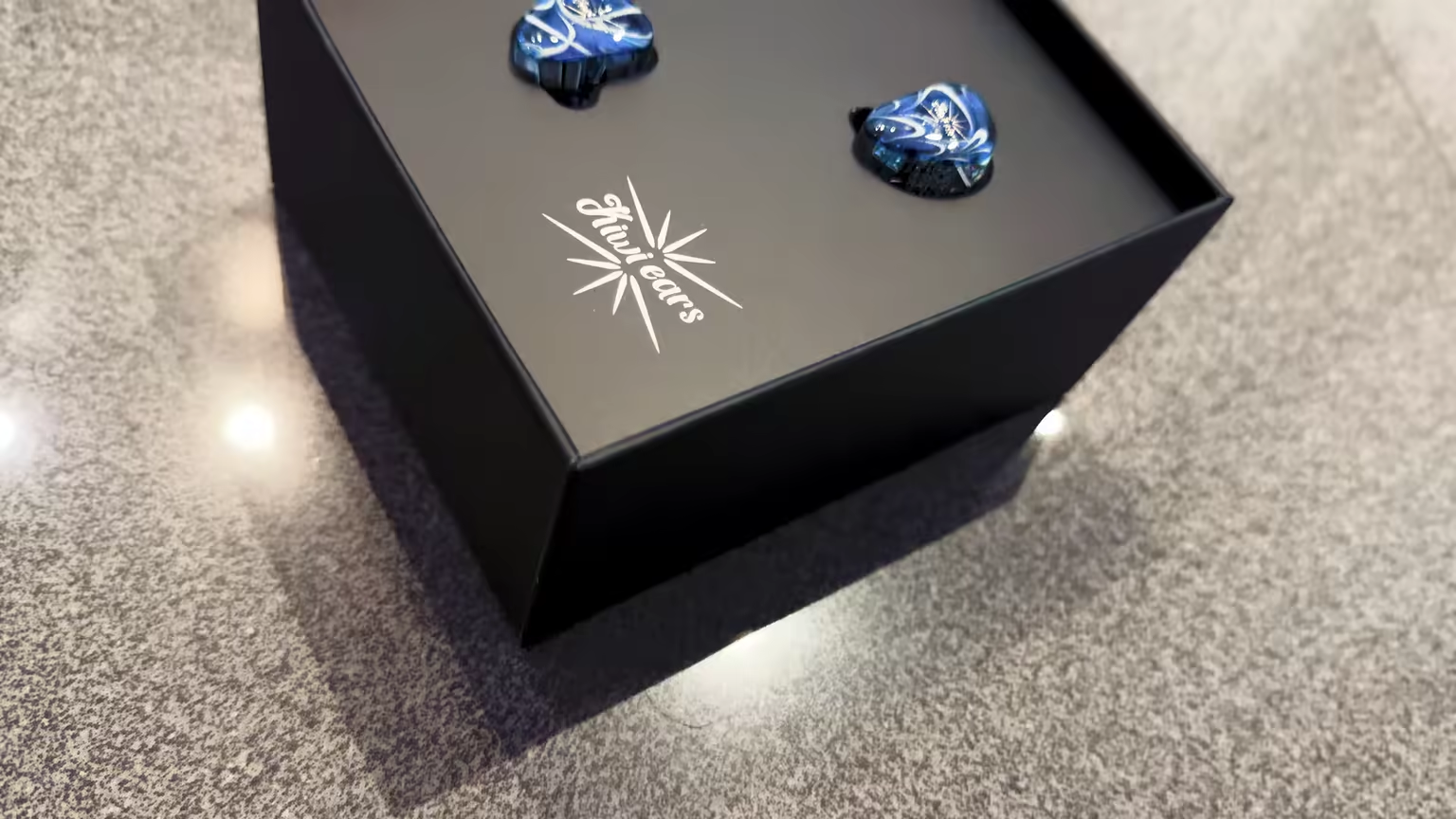 (view larger)
The stock cable is of very nice quality - I wouldn't bother replacing it. It's a 4-core 7N oxygen-free copper construction, that's nicely braided and terminated with a decent metal 3.5mm connector.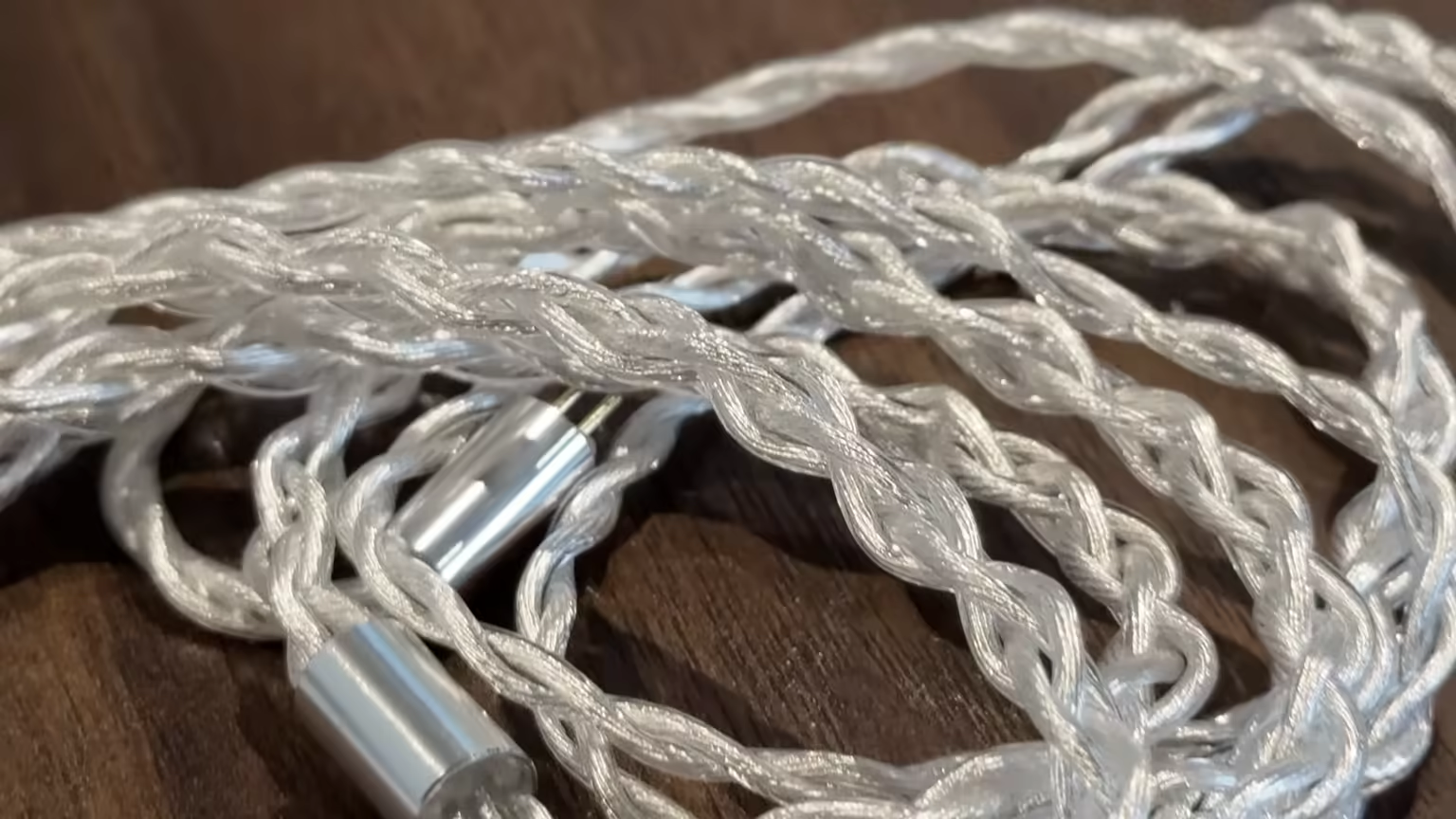 (view larger)
In the box, you're also getting a small rectangular carrying case - ideal for transporting or storage. It can fit an extra dongle if you so desire.
Technologies: Eight Balanced Armatures, 3-Way Crossover
The Orchestra Lite builds on the success of the original Orchestra model, offering the same 8 balanced armature driver configuration, with enhanced efficiency and cost-effectiveness. Those drivers are custom-made for Kiwi Ears to achieve superior performance while maintaining the same specifications as the older model.
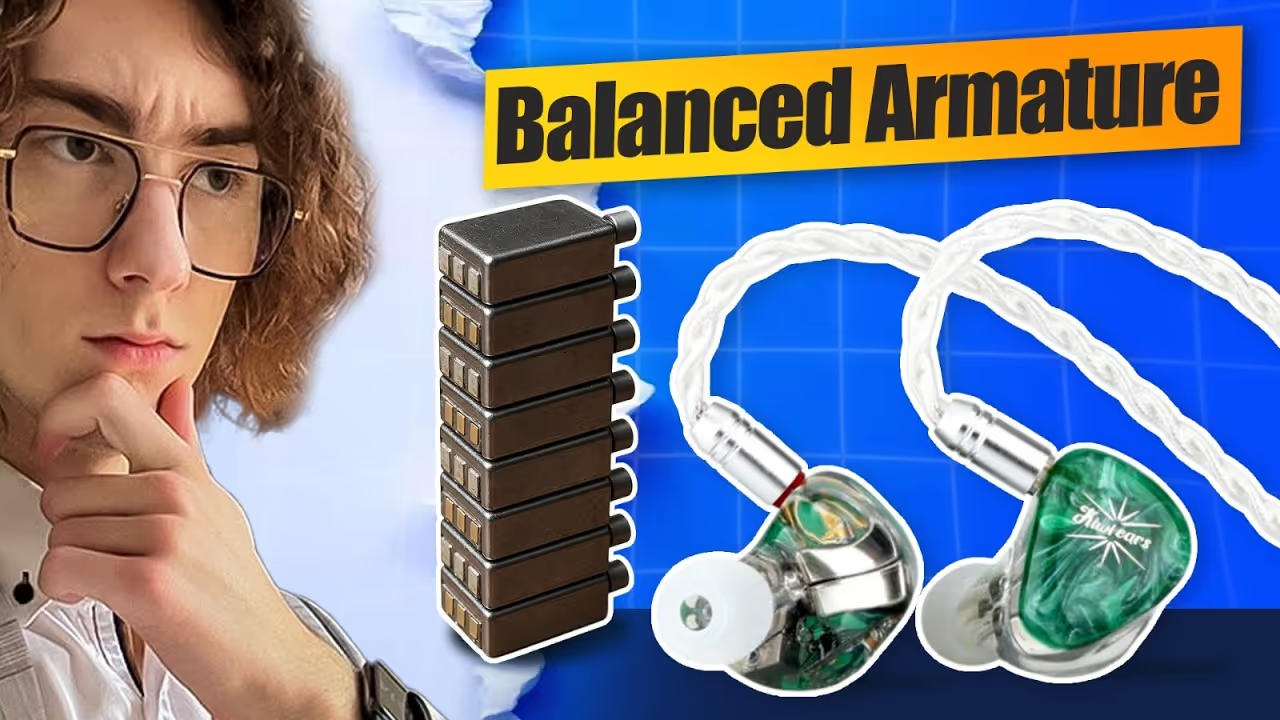
They are divided using a 3-way crossover. Two custom ultra tweeters for precise treble, four midrange balanced armature drivers for clear mids, and two subwoofer drivers for deep, resonant lows. BA drivers are generally not very capable of playing full-range signals - that's why we rarely see single-balanced-armature IEMs. A simple solution is to use either multiple BAs or combine them with some other type of driver to get a nice full-range signal. These drivers can work in harmony to produce a balanced, natural sound that faithfully reproduces the original audio source.
Does It Need an Amp? So Sensitive It Can Hiss
The impedance of this IEM is 16 ohms - it's quite low. The sensitivity, on the other hand, comes at 112dB - extremely high. This combination makes driving this in-ear monitor an ease for all sorts of devices. It's not sensitive to the source quality either, so you don't have to worry about it that much.
The only thing that can be a problem is the sensitivity being so high that some cheap, low-quality amps can pass through some hiss. This noise, despite usually not being a problem, is likely to be heard with such efficient IEMs.
Sound Quality: Mid-Forward Warmth, Depth over Width
Initially, the overall tuning seemed more or less neutral to my ears - but the more time I spent with it, the more I realized that it puts a fairly strong emphasis on the midrange. It means that the bass and treble are slightly tamed down, but not to the point of sounding flat or boring. It makes it neutral but with an audible sense of warmth.
I'd consider it a good thing, as the midrange itself is done in a very pleasant way - it sounds realistic, detailed, and is not messed up in any way.
The bass amount is good - it isn't bloated, sloppy, or boomy. But it has some roll-off as you get to the real sub-bass. Speaking of bass impact and dynamics, it's a relaxed IEM that seems like it's meant to make you chill out while listening to music, instead of hitting super hard.
The treble, on the other hand, is clarity-focused, offers lots of crunchiness to the top-end frequency sounds, and usually stays fairly clean. It accomplishes that without ever getting overly bright or sibilant.
The detail retrieval appears to vary from song to song, going from "just fine" to "very good". I think it has to do a lot with the mid-forward frequency response, and the way different albums are mixed.
The spatial effects are quite interesting here, pretty much the opposite of what every other product in this price range is trying to achieve. The soundstage width is somewhat limited - meaning the sound boundaries are not super far off. Usually, IEMs don't go super far, but this one is even more closed-in. However, the depth dimension here is definitely present, well-defined - and I'm surprised that it does it so well. You can easily tell when a sound source is brought forward or back, and it's a pleasant effect, as the sound is not just a wall in front of you.
The imaging is also outstanding for an IEM in this price range - it's sharp, focused, and precise, making instruments have a distinct place where they're placed.
So... should you buy it? I think it offers great value and good technical performance in most aspects. Personally, I like how it sounds, and even more, how it looks.
Sound signature
Derived from the words this review uses: each axis runs between two opposite descriptors, and the shape leans toward whichever side the writing does.
- Warm ↔ Bright Sits close to centre
- Relaxed ↔ Analytical Leans analytical
- Polite ↔ Aggressive Leans aggressive
- Lean ↔ Bass-heavy Leans bass-heavy
- Intimate ↔ Wide stage Sits close to centre
Hear what "analytical, aggressive, bass-heavy" means: a short synthesised loop, flat and then with those leanings. An illustration of the words, not a recording of the Orchestra Lite.
Not sure which signature suits you? Find yours with a blind A/B test
Watch the video review
Subscribe on YouTube (opens in new tab)Prefer to read? The written review above covers everything in the video.
- 0:00 Should This IEM Be MORE EXPENSIVE? (opens in new tab)
- 0:22 Comfort & Build Quality (Hand Made Construction, Colors, Stock Cable, Carrying Case, Tips) (opens in new tab)
- 1:45 Technologies (8 Balanced Armature drivers, 3-way crossover, Ultra Tweeters, Midrange Drivers, Subwoofers) (opens in new tab)
- 2:50 Technical Specification (Impedance, Sensitivity, Amp Pairing, Drivability) (opens in new tab)
- 3:27 Sound Quality (Tuning, Midrange Presence, Tonality, Bass Dynamics, Treble, Detail Retrieval, Sound Stage Width & Depth) (opens in new tab)
Common questions about the Orchestra Lite
Is the Kiwi Ears Orchestra Lite worth it?
Yes, for the right listener. It scored 8.0/10, Recommended, higher than 34% of everything we have tested, against a catalogue median of 8.1. On value it rates strong: above average for the price in headphones. Price: $249.
Who should buy the Kiwi Ears Orchestra Lite, and who should skip it?
Buy it if you want weight and slam low down, and you want more performance per dollar than most of its peers. Skip it if you want the bass to stay out of the mids.
What amplifier does the Kiwi Ears Orchestra Lite need?
The Kiwi Ears Orchestra Lite is a 16 Ω load, so the matching rule is the rule of eighths: an amplifier's output impedance should sit at or below 2 Ω, an eighth of the headphone's, or its frequency response shifts audibly and usually in the bass. That is a property of the amp rather than its power rating, so a high-output-impedance tube amp can fail it while a phone jack passes. At most 39 mW to reach 110 dB peaks, which is most dongle DACs. The review records 112 dB without saying against what, and the two conventions differ by a factor of 63 at this impedance - so that is the worst case, and the real figure is at or below it.
What should I consider instead of the Kiwi Ears Orchestra Lite?
On the same chain, against the same recordings: the HIFIMAN RE800 Silver scores the same and costs $150 less. Each of those has a full head-to-head page below.
Will the Orchestra Lite hiss on cheap gear?
It can, and it is the one drivability caveat. Sixteen ohms against 112dB sensitivity makes this extremely easy to drive from anything, and it is not fussy about source quality either - but an earphone this efficient will reveal noise that a less sensitive one would bury. Low-quality amplifiers with an audible noise floor will let hiss through. That is a property of the amp rather than a fault here, and it is the thing to listen for when you audition a dongle.
Is the Orchestra Lite's thick nozzle a problem?
It is the main comfort consideration and it is a direct consequence of the design. Eight balanced armatures and a three-way crossover have to fit somewhere, and the nozzle had to grow to carry them - you can definitely feel it, and it makes the earphone seem larger in the ear than it actually is. The shell itself has very smooth edges and does not feel odd. Unless a thick nozzle is a known problem for you, it should be comfortable enough despite the size.
Does the Orchestra Lite have deep bass?
Not really, and that is a deliberate choice rather than a failure. The bass amount is good and it is never bloated, sloppy or boomy - but there is roll-off as you reach genuine sub-bass, so this is not the earphone for anyone who wants the bottom octave. Impact and dynamics follow the same philosophy: it is a relaxed listen, made to help you settle into music rather than to hit you.
Why does the Orchestra Lite stage deep rather than wide?
It is doing almost the opposite of everything else at this price, and I found it genuinely interesting. Width is limited - the boundaries sit closer than most in-ears manage, and in-ears do not usually go far to begin with. Depth is where it works: well defined and easy to follow, so you can tell when a sound source moves forward or back. The result is not a wall in front of you, and the imaging is sharp and precise enough to give every instrument a distinct place.
Why do eight balanced armatures instead of one?
Because a balanced armature is not much good at full-range on its own, which is why single-BA earphones are rare. The usual fix is to use several, or to mix them with another driver type. Here a three-way crossover splits the work: two custom ultra tweeters for treble, four mids, two subwoofer drivers for the lows. Kiwi Ears have them custom-made to the same specification as the pricier Orchestra, and part of the assembly is done by hand because it is too fiddly to automate.
Should you replace the Orchestra Lite's cable?
I would not bother. The stock cable is 4-core 7N oxygen-free copper, nicely braided and terminated in a decent metal 3.5mm connector - genuinely good quality rather than adequate. A small rectangular carrying case comes in the box too, roomy enough to take a dongle alongside the earphones. The money is better spent elsewhere.