
OneOdio Max 1 Review: €179 Wireless Headphones With LDAC
Hi-Res certified wireless over-ears with LDAC, a 20ms ultra-low-latency wireless DJ mode, dual jacks, and 120 hours of battery life - all for €180.
higher than 7% of everything we have tested
- Standout
- Wired and wireless with LDAC + Hi-Res Audio certification
- Watch out for
- Recessed midrange
- Better alternative
- Kiwi Ears Atheia: leans warmer, $150 more, scores 0.9 higher.
Is it for you?
- You want the balance to lean bright, with the detail pushed forward
- You're treble-sensitive
For the wider field, our Best Headphones Under $500 guide ranks 12 rivals in this class. This one is not among them.
Today we're looking at a pair of headphones that throws a lot of features into the package - the OneOdio Max 1. They boast wireless connectivity, support for Hi-Res Audio, multiple wired and wireless connection options, a lot of codecs and a whole list of other tech specs. But the big question is at 180 euro, do they deliver?
Build Quality: Big, Comfortable, DJ-Flexible
First impression? These are definitely a substantial pair of over-ear headphones. You pick them up and notice the weight - around 350 grams, so they have a certain heft to them that often suggests decent build quality inside. They don't feel flimsy or toy-like, which is a good start.
Visually, they have a look that clearly nods towards their DJ heritage, co-branded with DJ Arianna. But it's not overly aggressive or flashy. There's a gloss finish on the earcups, with a kind of vinyl-record-like texture around the OneOdio logo which catches the light nicely without being distracting. And all that neatly contrasted by the red stitching. (view larger)
These are primarily made of plastic, which is pretty standard for headphones. It's worth noting that they are still feeling quite high quality overall. During my testing, there wasn't anything that would suggest any possible breakages or issues in the future, so I wouldn't worry about the longevity.
Despite being big headphones, I have to praise them for how comfortable they are - which makes sense when you consider that crazy battery life they are rated for. The earcups have thick, plush padding covered in a soft leatherette material, and the headband uses a good amount of memory foam cushioning. I have worn these for hours without ear fatigue or discomfort on the top of my head, which is fantastic news.
These things are incredibly adjustable. The earcups rotate inwards 90 degrees for flat storage or transport, then they pivot and swivel. This is great for DJs who need to listen with one ear, but it also helps in getting a really good fit on different head shapes and makes them easy to fold down, even if just into the included fabric carry bag. (view larger)
They haven't gone for a super minimalist design here. There are multiple buttons for controls, and you've got the USB-C port for charging, plus both a standard 3.5mm audio jack AND a larger 6.35mm (or quarter-inch) jack built right in. This might take a little getting used to compared to simpler headphones, figuring out which button does what. But the inclusion of both audio jack sizes is a definite plus for versatility, especially if you're plugging into audio interfaces or mixers.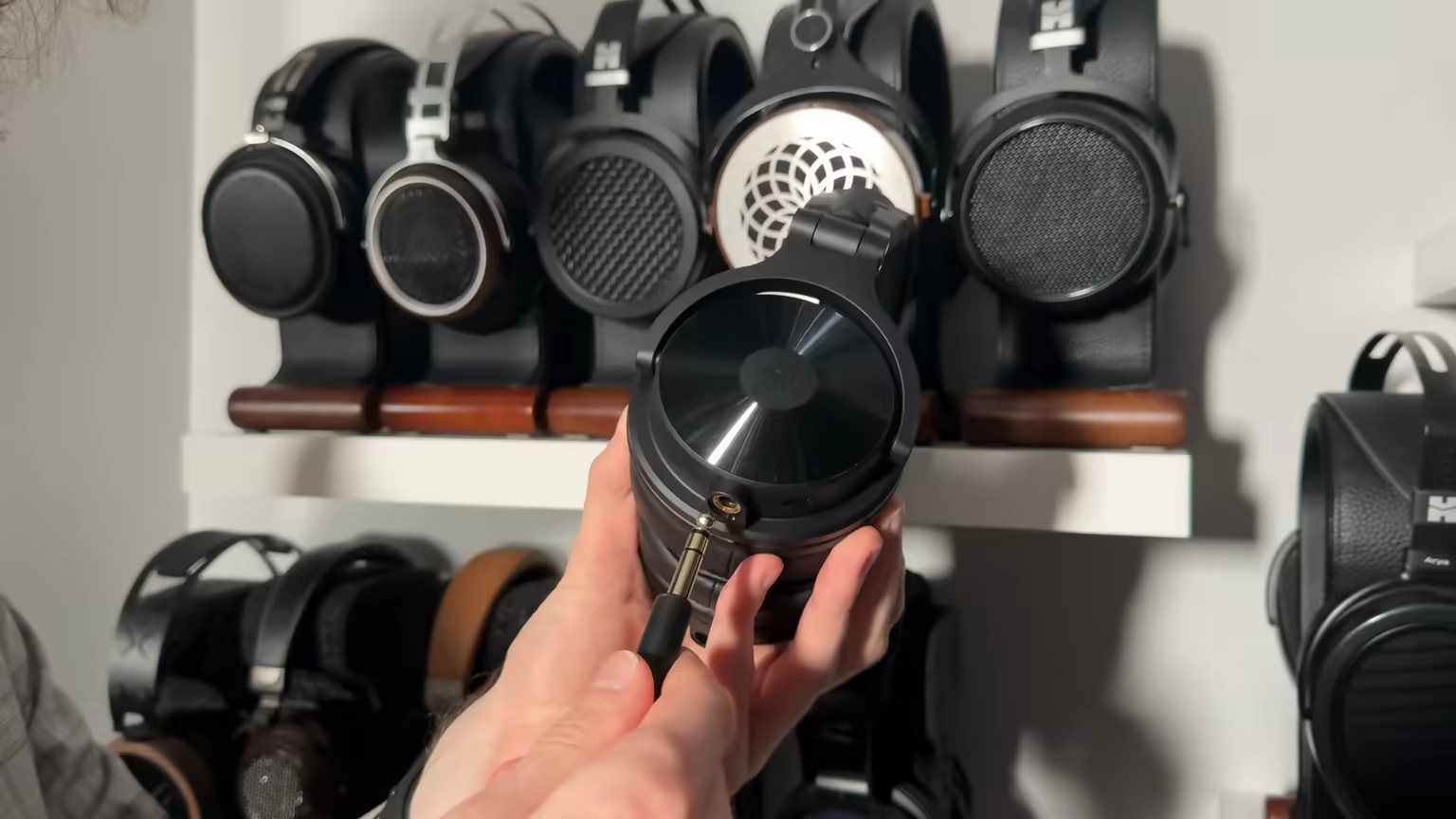 (view larger)
And speaking of versatility, the included accessories are pretty generous. You get the USB-C charging cable, a standard 3.5mm to 3.5mm audio cable, and importantly for that pro audio connection, a coiled 3.5mm to 6.35mm cable plus a separate little adapter. There's that fabric carrying pouch I mentioned, and uniquely, you also get the separate M1 wireless transmitter box in the package, which is key for that ultra-low latency connection they advertise.
Features: LDAC, a 20ms DJ Mode, 120-Hour Battery
You've got your standard Bluetooth 5.3 - a modern standard and that's very nice. What's really key here for audio quality enthusiasts is the support for the LDAC codec. If your phone or player supports LDAC, you can stream higher-resolution audio wirelessly, which ties into their Hi-Res Audio certification for wireless listening.
Then we get into the wired options. There's the standard 3.5mm jack that you find everywhere, so you can plug them in like any traditional headphones. But, they also have a built-in quarter-inch jack.
Now, the really unique part is the fourth mode: the dedicated Wireless DJ mode. This uses the separate M1 Transmitter box that comes included. You plug this transmitter into your audio source, and it connects to the headphones using "RAPID WILL+" technology with just 20 milliseconds of latency. This is incredibly fast. Such low latency is imperceptible.
The drivers are 50mm in size. Typically, bigger drivers like this can mean a more powerful sound with better bass reproduction, the potential for detailed audio is definitely there.
The battery life is just... wild. Up to 120 hours of playback time in Bluetooth mode. That is days, potentially weeks of listening depending on your habits, absolutely demolishing the battery life of most other wireless headphones on the market. There's also fast charging - just 5 minutes plugged in can give you around 2.5 hours of playtime.
How Does It Sound? Bass-Forward, Mids in the Back
The first thing that hits me is the bass - it's definitely a presence. There's a real impact and depth to it, a proper punch that makes electronic tracks and anything with a strong low-end really come alive. It's the kind of bass you can feel, which I can appreciate. However, pushing the volume does seem to introduce a bit of muddiness, and it can bleed a little into the lower frequencies where the mids should be sitting. It's not the tightest or most controlled bass I've heard, but it's got that satisfying slam that can be quite enjoyable for certain genres - I feel like ultimately this was the goal here. It's not a boring headphone with surgically clean, yet non-existent bass. The texture in the low frequency range is decent - you get a sense of the different layers, but it's not the most refined.
Moving into the mids, they definitely take a backseat in the tonal balance. Vocals and instruments in this range feel a little pushed back, lacking some of that forward presence and clarity - but this avoids mid forwardness and allows the edges of the frequency spectrum to shine through. It's like some of the finer details and the natural texture of instruments in the midrange get not quite lost, but hidden. You can still hear pretty much everything, but it's not coming at you right away. Complex arrangements still sound rather well defined here, which was a surprise with this amount of bass. For casual listening it's really good, but if I'm really trying to pick apart a track, I find myself wanting a bit more presence from this region for a more balanced presentation. But then, we wouldn't have so much of that fun DJ aspect.
The treble, on the other hand, is quite noticeable. There's a definite crispness and sparkle up top that adds a sense of airiness and detail. Things like the attack on a snare drum or the shimmer of cymbals come through nicely, and I can see how the LDAC support helps preserve some of that high-end information wirelessly. It's not consistently harsh, but its extra amount is something I'm definitely aware of. The texture in the treble is there - you can hear the bite of a guitar string or the breathiness in a vocal - but again, it's not overly aggressive which I appreciate so much.
Soundstage and Imaging: Oddly, Impressively Wide
Technically speaking, the detail retrieval is okay for the price, and considering it's wireless - it's great. With LDAC, I can definitely pick out some of the finer elements in tracks, but they're not going to compete with higher-end, much more expensive headphones in terms of sheer resolution across the board, especially given that recessed midrange.
The soundstage feels oddly wide to me - the music doesn't feel completely trapped inside my head, which is a plus. I'm not sure if they're doing some DSP magic to make it this wide, but it's truly amazing - it instantly stands out. I didn't expect that.
Imaging is also reasonably accurate - I can generally place different instruments in the stereo field. However, that V-shaped sound signature sometimes makes it harder to clearly separate multiple string instruments that occupy that quieter midrange. But then again, it was not made for it.
Wired or Wireless? The Cable Wins on Refinement
What's interesting is the difference between wired and wireless. Going wired, especially through the 3.5mm or even the quarter-inch jack, seems to clean things up a bit. The sound feels a touch more balanced, and I think there's a slight improvement in detail retrieval, with maybe a little less emphasis on the bass. LDAC definitely helps close the gap wirelessly, but there's still a sense that the wired connection offers a bit more refinement.
Verdict: Fun-First, Bass-Forward
So, overall, my impression of the sound quality is that it's fun and engaging, with that strong bass and lively treble being the dominant characteristics. It's definitely geared towards a more energetic listening experience. The massive punch and slam in the low end are enjoyable for certain genres. However, that recessed midrange is a noticeable characteristic that you might like or not, and the treble can rarely lean towards sharpness, but the detail more than compensates for that. If you're after a powerful, bass-forward sound for casual listening, these could definitely be in the running.
Sound signature
Derived from the words this review uses: each axis runs between two opposite descriptors, and the shape leans toward whichever side the writing does.
- Warm ↔ Bright Leans bright
- Relaxed ↔ Analytical Leans relaxed
- Polite ↔ Aggressive Leans aggressive
- Lean ↔ Bass-heavy Leans lean
- Intimate ↔ Wide stage Leans wide stage
Hear what "bright, relaxed, aggressive, lean, wide stage" means: a short synthesised loop, flat and then with those leanings. An illustration of the words, not a recording of the Max 1.
Not sure which signature suits you? Find yours with a blind A/B test

Watch the video review
Subscribe on YouTube (opens in new tab)Prefer to read? The written review above covers everything in the video.

- 0:00 Design & Build Quality (Swivel, Over-Ear Construction, Plush Ear Pads, Memory Foam) (opens in new tab)
- 3:30 Features (Bluetooth 5.3, Hi-Res Audio, LDAC Codec, Wireless M1 Transmitter Box) (opens in new tab)
- 5:13 Sound Quality (Tonal Balance, Bass Amount, Dynamic Range, Detail Retrieval, Soundstage) (opens in new tab)
Common questions about the Max 1
Is the OneOdio Max 1 worth it?
Only for some buyers - 7.0/10, Mixed, higher than 7% of everything we have tested, against a catalogue median of 8.1. On value it rates fair: mid-pack for the price in headphones. Price: €179 (≈ $195 approx.).
Who should buy the OneOdio Max 1, and who should skip it?
Buy it if you want the balance to lean bright, with the detail pushed forward. Skip it if you're treble-sensitive.
What else have you tested around the price of the OneOdio Max 1?
No head-to-head page for this one yet. The closest reference points we have scored in the same bracket: the Sivga SV021 Pro at 7.6/10, the HIFIMAN HE-R9 at 6.9/10, and the Sivga Robin SV021 at 7.8/10.
What is the OneOdio Max 1's DJ mode?
A fourth connection mode with its own hardware. The included M1 transmitter box plugs into your audio source and links to the headphones over RAPID WILL+ at just 20 milliseconds of latency, which is fast enough to be imperceptible. That is the feature that separates these from ordinary wireless over-ears, and it is why the cups also rotate 90 degrees for one-ear monitoring. The DJ heritage is not just styling, though the co-branding with DJ Arianna is.
Is 120 hours of battery life real?
That is the rating, and it is wild even allowing for optimism - days or potentially weeks of listening depending on your habits, which demolishes most wireless headphones on the market. There is fast charging behind it too: five minutes plugged in gives around 2.5 hours of playtime. It also explains the comfort priorities, since a headphone you can wear for that long has to be wearable for that long.
Should you use the Max 1 wired or wireless?
Wired, if refinement matters. Going through the 3.5mm or the quarter-inch jack cleans things up: the balance is a touch better, detail retrieval improves slightly, and there is a little less emphasis on the bass. LDAC closes much of the gap wirelessly and the Hi-Res Audio certification is real, but the cable still offers more. Having both jacks built into the headphone rather than needing an adapter is genuinely useful with interfaces and mixers.
Why do vocals sound distant on the OneOdio Max 1?
The mids take a deliberate backseat, and it is the main trade this tuning makes. Voices and midrange instruments feel pushed back, losing some presence and clarity, so the finer textures are not lost exactly but hidden - you hear everything, it just does not come at you. Complex arrangements still hold together better than I expected given the bass level. For casual listening it is fine; for picking a track apart you will want more presence there.
Is the Max 1's bass well controlled?
Not the tightest, and it has a specific failure point. There is real impact and depth, the kind of bass you can feel, and it makes electronic music come alive. Push the volume and some muddiness appears, bleeding into the lower frequencies where the mids should be. Texture down low is decent - you get a sense of the layers - without being refined. The goal here was clearly slam rather than surgical cleanliness, and on that basis it succeeds.
Why does a closed-back wireless headphone stage this wide?
I genuinely do not know, and it is the thing that stood out immediately. The music does not feel trapped inside my head, which is rare for a closed wireless design - I suspect some DSP is involved, but whatever it is, it works. Imaging is reasonably accurate too, though the V-shaped balance makes it harder to separate multiple string instruments sitting in that quieter midrange.