
Sivga Luan Review: The Most Comfortable $299 Semi-Open?
A semi-open dynamic with real wood cups and a natural, chocolatey midrange - $360 at launch, now $299.
higher than 49% of everything we have tested
- Standout
- Looks and feels like a $500+ headphone for $299
- Watch out for
- Bass rolls off below ~45Hz
- Better alternative
- Meze 105 Silva: leans weightier low down, $200 more, scores 0.6 higher.
Is it for you?
- You want the balance to lean warm, with the top end eased
- You want more performance per dollar than most of its peers
- You want every last bit of treble detail
- A desktop amplifier is not on the cards
Pick #6 of 12 in our Best Headphones Under $500 guide.
The Sivga Luan is not only beautiful, well-made, and extremely comfortable - that would already be enough to get some of you sold on it - it also sounds great. So, is it a good all-rounder? Let's see.
Comfort & Build Quality: Looks $500, Costs $360
The headphones launched at $360 and now list at $299, but just looking at them, they certainly appear to be worth more than $500. This impression becomes even stronger once you pick them up and use them for a minute. You can get these headphones in two colors - dark and light. You're currently looking at the dark one, as I thought it looked a bit better.
In both cases, the earcups are made of real wood with a very smooth finish. The grills are fully metal, making a nice blacked-out mesh pattern with a silver aluminum ring around it. There's a layer of felt behind it, which technically makes this headphone semi-open-back instead of being truly open-back. (view larger)
A suspension-style design has been chosen for the headband, being a clear upgrade from the lower series of Sivga products with standard, one-piece headbands. This one is much more comfortable, as it adjusts to your head shape better. It's virtually impossible to get any hotspots because of that. On the inside of this leather strap, there are soft elements, that remind me a lot of Dekoni Nuggets. Those are supposed to provide more padding, which is usually lost with strap-based designs.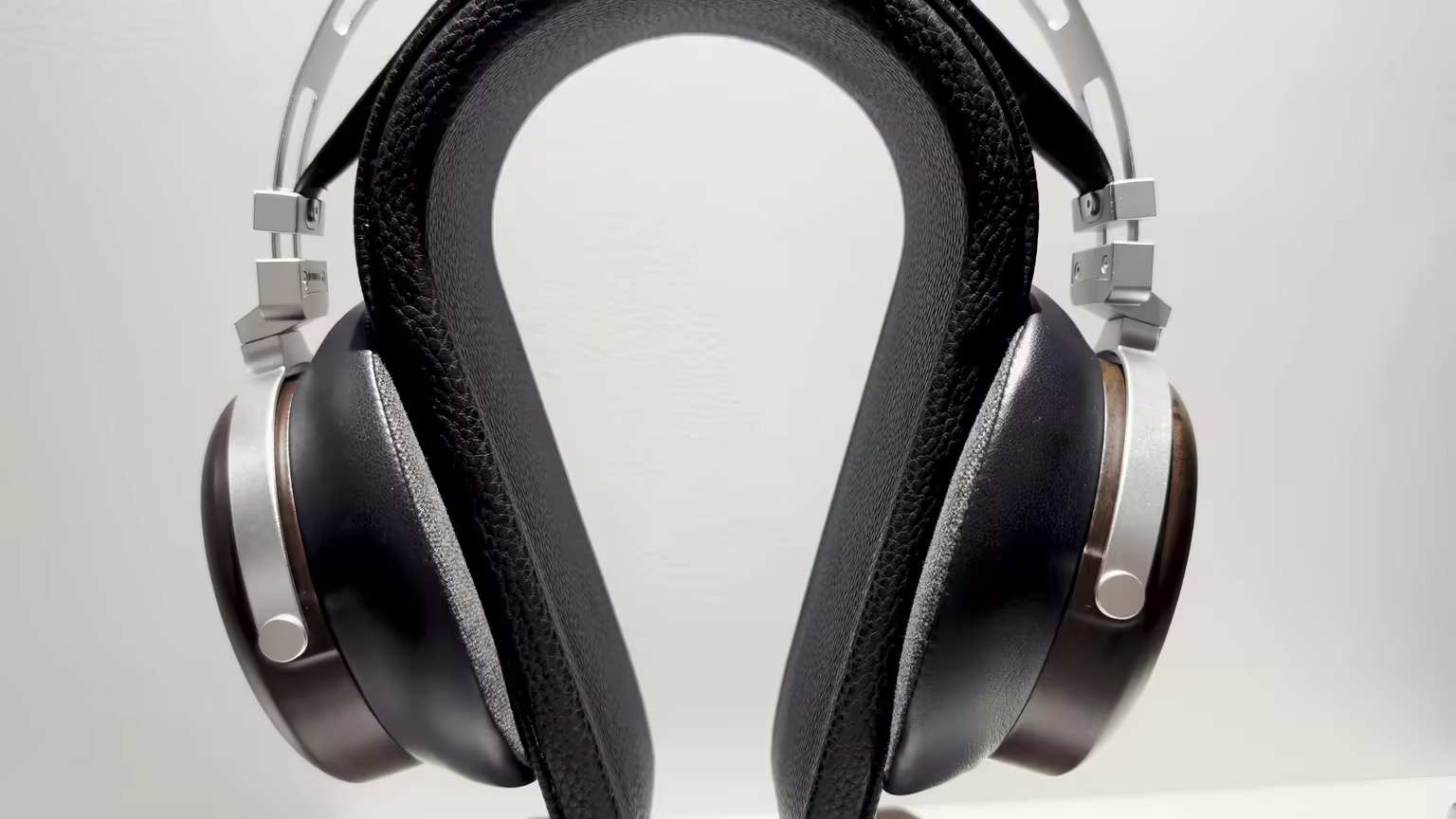 (view larger)
There are a few ways to adjust for supreme comfort. To make up for a smaller, or a larger head size, there are super smooth sliders that can help accommodate many sizes of heads. The cups have limited, but still a good amount of tilt and what's even more important - swivel. The mechanism has some linear resistance, with no scratchiness or making any sound - it's exceptionally smooth and truly silent.
These headphones may appear to have small ear cups, which could make it seem like your ears are constantly touching the inside of the pads. However, it's important to note that the pads have a significantly larger inner and outer diameter than the cups themselves, allowing for more space for your ears. They are very soft, maintain their shape well, and feature a synthetic leather finish with perforations on the inside.
I can wear, and listen to these headphones for hours with little to no breaks, absolutely no hotspots or anything like that. For me, putting just one more song or even one more album on play doesn't ever become an issue.
Connectors and Accessories: 3.5mm Jacks, Leather Case
The connectors used here are standard 3.5mm jacks, thankfully avoiding the inferior 2.5mm standard. I don't understand the need for the smaller connectors in some headphones - they are much more fragile, offer less contact area, and while they are somewhat smaller, they also look unattractive. Here, we have 3.5mm jacks with no forward angle or recess, which means any regular headphone cable will work. However, some stiffer cables may hit your shoulders.
In the box, you get two things. The first is a cable, terminated with high-quality, metal 3.5mm connectors. It's single-ended, instead of balanced, and has a simple rubberized finish - so there are reasons why you may want to upgrade it to something nicer-looking at some point.
The second thing you get in the box is a hard, leather carrying case, in a suggestive shape. Regardless, it offers good protection for the headphones while traveling or when you want to bring them to work or school. It's a wonderful addition that feels premium, especially with this metal zipper.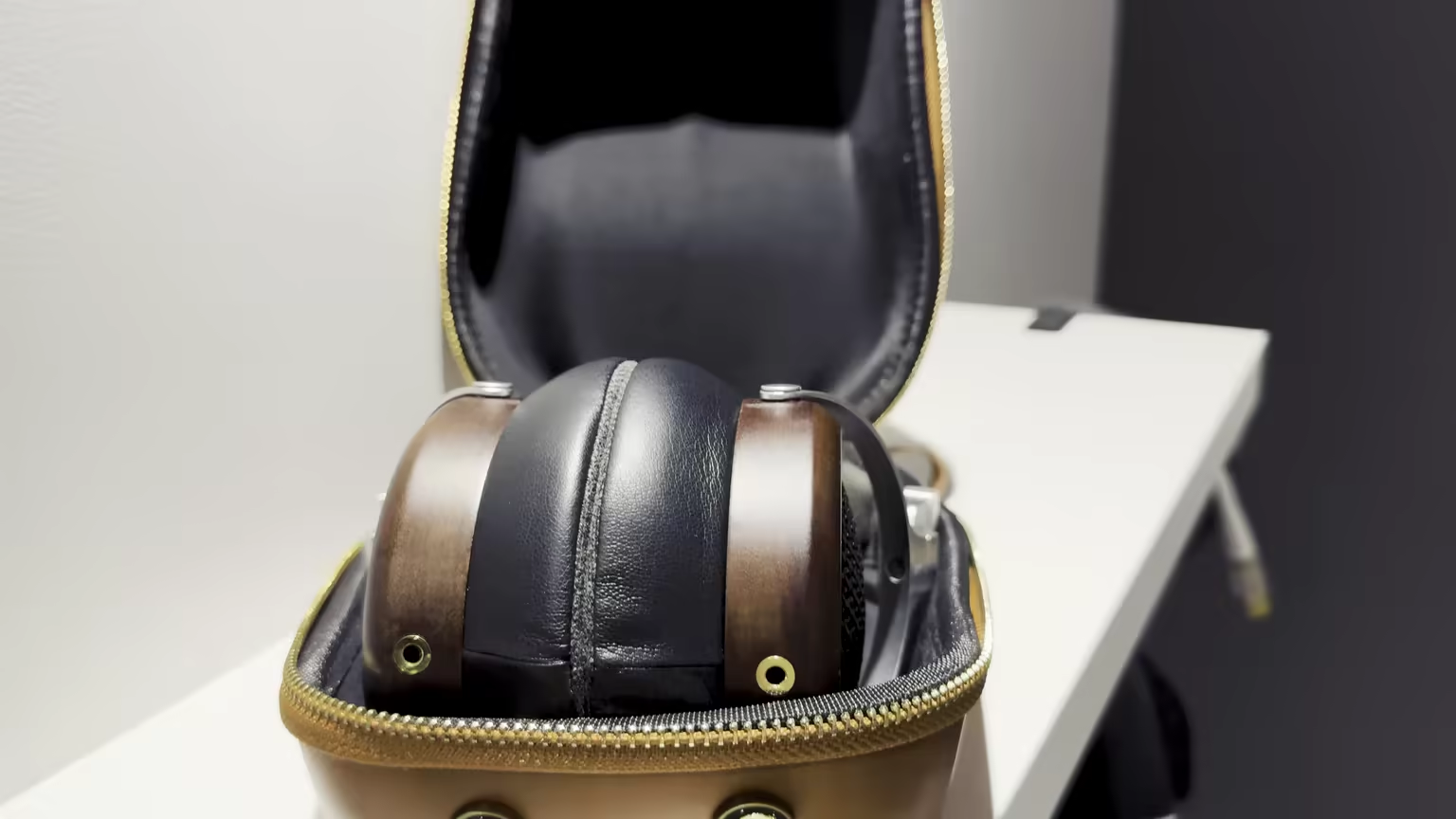 (view larger)
Technologies: A Nickel-Coated Dynamic Driver
The Luan features a dynamic driver with a diaphragm that is nickel-coated around the edges, ensuring low weight, good rigidity, and elasticity. According to the manufacturer's information, it should provide deeper bass extension and a fuller midrange. I can already say that I mostly agree with those statements, so it's probably not pure marketing talk.
The dome is made of organic carbon fiber composite, for effective absorption and suppression of excessive vibration to reproduce delicate, non-sharp, but clear treble. That's another thing I have to agree with, but you'll learn more about it in the sound section.
The choice of the coil's material is something I don't fully understand. They went for copper-clad aluminum for some reason. I'd assume that using more conductive materials in this application would be beneficial. They either wanted to cut down on the cost, or there was another good reason. CCA supposedly makes sound more delicate and natural.
On the other hand, the magnets and the decisions made regarding them are reasonable, especially for somebody like me - mostly a large planar magnetic headphone enjoyer. They are oversized, 24.5mm in size to be specific, with high magnetic energy to achieve high sensitivity, resolution, and finite detail retrieval.
Does It Need an Amp? Easy to Drive, Pairs Widely
This headphone's impedance is on the medium-low end, coming at 38Ω - so pushing voltage through it is not going to make your amplifier sweat. On the other hand, the sensitivity is super high - 100dB, so you won't need much power, or even gain on your source, to power it. It's not very sensitive to amplification scaling, so you can probably get away with something budget-oriented.
It still scales a bit though - when I tried it with better amps, the soundstage became a bit wider and the dynamics improved a little, so keep that in mind. Overall, it can be paired with warm, neutral, and somewhat bright-sounding gear based on your preferences, as it won't lean too heavily in any particular direction.
How Does It Sound? Neutral, with Chocolatey Mids
Considering the price, it sounds impressive. Taking the price out of the equation, it still sounds good. I could imagine daily driving that one without many complaints, and if you know something about me, you know that I'm picky.
The tonality fits more or less within my preferences, being mostly neutral and Harman target adherent. In the bass, it is fairly accurate, but rolls off in the lowest registers, below around 45Hz. The bass you're getting with these is clean, distortion-free, and tight, however, the amount can be arguable for bass heads. There isn't much musical content in the lowest frequencies, so you aren't missing out on much by not having a flat extension down to 20Hz. In the mid-bass, we get some extra warmth, making for perhaps a more organic presentation. It is impactful in the dynamic sections of songs, where transitions from quiet to loud happen quickly.
The midrange is where the Luan shows its strengths the most. First and foremost it sounds natural. The vocals truly shine here with a warm, yet clean presentation, that has a "chocolatey" character for lack of a better word. It is rather detailed in the mids, which not all headphones can do. It is ever so slightly recessed at around 1kHz, enhancing the separation between mids and highs. In actual songs, this creates an added space from the vocals to the high-frequency details.
Going to the treble is fairly magical. It extends quite well for a dynamic driver as they usually aren't known for extending super well at the bottom or in the top end. Anyway, this magic factor comes from the way it measures versus the way it sounds. On a frequency response graph, it may seem a bit brought up in the ear gain region. What's interesting though is when you listen to it, it usually has none of that characteristic. 95% of the time it sounds rather smooth with no fatiguing elements. I'm using an R2R DAC, which likely helps to reduce some excess treble energy. Yet even without it, the sound rarely becomes offensive or overly forward in the higher registers. Some may say that it lacks attack around let's say 5 to 6kHz, but it's a matter of taste. Generally, though it is fairly resolving despite its delicacy, it easily displays most of the details in the recordings.
If you're a fan of the typical showroom and V-shaped sound, feel free to pair it with brighter, solid-state amplifiers and chip-based digital-to-analog converters. However, the way I like listening to it is by matching its strengths with the source gear to extract even more of the good thing. So I use an R2R DAC with a warmer amplifier or even occasionally a full-on tube amplifier, but that can be too much.
Soundstage and Imaging: Precise, Projected Forward
For the subjective performance, which is unrelated to the frequency response and tonality, why don't we start with the soundstage size? While not hugely expansive, it is undoubtedly going out of your head quite a bit. Because of the open-back nature, it can expand much wider laterally than other Sivga headphones with a closed-back design.
Moreover, the imaging is very precise. Sounds like the instruments are locked in place, with dead-centered vocals. This combination makes for quite a 3D experience while listening to music and lots of immersion in movie watching.
An interesting "quirk" regarding the spatial cues is the way it presents sounds mostly in front of you - this can be desirable for some, as it makes you feel more connected with the music. On the other hand, it can take away a bit from the natural, cohesive nature of these headphones.
I am personally a huge fan of headphones that can realistically reproduce the attack, sustain, and decay. In this case, it is fairly natural. While not the fullest sounding, and without the longest decay in the world, it still sounded like a much more expensive headphone in this regard.
Is the Luan Worth It?
Imagine that you have a good all-rounder for its price point. It does pretty much all sound quality aspects reasonably well and then you combine it with a midrange from a much more expensive headphone like a Sennheiser or some ZMF options. Then you add to it the fantastic build quality, premium materials, plus crazy good comfort for long listening sessions. Simply speaking - yes, I think it is worth it, and it's a very good deal.
Sound signature
Derived from the words this review uses: each axis runs between two opposite descriptors, and the shape leans toward whichever side the writing does.
- Warm ↔ Bright Leans warm
- Relaxed ↔ Analytical Leans relaxed
- Polite ↔ Aggressive Leans aggressive
- Lean ↔ Bass-heavy Leans lean
- Intimate ↔ Wide stage Neutral, no clear signal in the review language
Hear what "warm, relaxed, aggressive, lean" means: a short synthesised loop, flat and then with those leanings. An illustration of the words, not a recording of the Luan.
Not sure which signature suits you? Find yours with a blind A/B test

Watch the video review
Subscribe on YouTube (opens in new tab)Prefer to read? The written review above covers everything in the video.

- 0:00 This MUST Be A GREAT Deal In HiFi! (opens in new tab)
- 0:17 Build Quality (Unusually Premium Feel, Suspension Strip With Dekoni Nugget-like Design, 3D Adjustment) (opens in new tab)
- 3:12 Technologies (Lightweight, Nickel Dynamic Driver, Carbon Fiber Cone, CCA Voicecoil) (opens in new tab)
- 4:20 Technical Specs (Impedance, Sensitivity, Amplifier Pairing, Source Gear Scaling) (opens in new tab)
- 5:01 Sound Quality (Harman Target, Roll-off, Distortion, Bass Amount, Musicality) (opens in new tab)
Common questions about the Luan
Is the Sivga Luan worth it?
Yes, for the right listener - 8.1/10, Recommended, higher than 49% of everything we have tested, against a catalogue median of 8.1. On value it rates strong: above average for the price in headphones. Price: $299.
Who should buy the Sivga Luan, and who should skip it?
Buy it if you want the balance to lean warm, with the top end eased, and you want more performance per dollar than most of its peers. Skip it if you want every last bit of treble detail, and a desktop amplifier is not on the cards.
What amplifier does the Sivga Luan need?
Impedance is 38 Ω. By the rule of eighths the amplifier feeding it wants an output impedance no higher than 4.8 Ω, otherwise the interaction between the two tilts the frequency response rather than simply making it quieter. Power is the separate question. At most 263 mW to reach 110 dB peaks, which is a desktop headphone amplifier. The review records 100 dB without saying against what, and the two conventions differ by a factor of 26 at this impedance - so that is the worst case, and the real figure is at or below it.
What should I consider instead of the Sivga Luan?
The pieces we have actually run against it: the Sivga Anser scores 0.1 lower and costs $100 less and the Verum Audio Verum 1 scores 0.1 lower and costs $50 more. Every one of those matchups has its own page in the head-to-head section.
Is the Sivga Luan actually open-back?
Semi-open, strictly speaking. The grilles are full metal in a blacked-out mesh pattern with a silver aluminium ring, and there is a layer of felt behind them - which technically makes this semi-open rather than truly open-back. In practice it still stages much wider laterally than Sivga's closed-back models, and it still leaks. Treat it as an open headphone with slightly better manners rather than as something you can wear in an office.
Will your ears touch the Luan's pads?
Almost certainly not, despite how it looks. The cups appear small enough that you would expect constant contact, and the important detail is that the pads have a significantly larger inner and outer diameter than the cups themselves - so there is more room in there than the outside suggests. They are very soft, hold their shape, and have a perforated synthetic leather inner face. I wear these for hours with no breaks and no hotspots.
Does the Sivga Luan need a good amplifier?
No. At 38Ω the impedance is medium-low so no amplifier will sweat pushing voltage into it, and the 100dB sensitivity means you need very little power or gain. Something budget-oriented will do. It does scale a little - better amps widened the soundstage slightly and improved the dynamics - but the effect is subtle rather than transformative. It will pair happily with warm, neutral or somewhat bright gear, because it does not lean hard in any direction itself.
How deep does the Sivga Luan's bass go?
It rolls off below roughly 45Hz, and I think that matters less than it sounds. What you do get is clean, distortion-free and tight, with extra warmth in the mid-bass for a more organic presentation, and real impact when a track swings from quiet to loud. There is not much musical content in the lowest registers, so a flat extension to 20Hz would win you less than the number suggests - but bass heads will find the overall quantity arguable.
Is the Sivga Luan bright?
Measured, maybe. Heard, no - and that gap is the interesting part. On a frequency response graph it can look lifted through the ear gain region, and yet 95% of the time it sounds smooth with nothing fatiguing about it. I run an R2R DAC which probably takes some excess treble energy off, and even without it the top end rarely turns offensive or forward. Some listeners will say it lacks attack around 5 to 6kHz. That is taste, not a defect.
What should you pair the Sivga Luan with?
Either direction works, and it depends what you want from it. If you like a showroom, V-shaped presentation, put it on a brighter solid-state amplifier and a chip-based DAC and it will oblige. My own preference is the opposite - match its strengths rather than counter them, so an R2R DAC with a warmer amplifier, and occasionally a full tube amp, though that can be too much. The headphone is neutral enough to take direction from whatever you feed it.
Why does the Luan sound like it is in front of you?
It is a genuine quirk of how it places things, and worth knowing before you buy. Imaging is very precise - instruments locked in place, vocals dead centre - and the whole presentation sits mostly in front of you rather than wrapping around your head. Some people find that more connected and more involving. Others will feel it takes something away from the natural, cohesive character of the headphone. It is a preference question rather than a flaw.
If you're interested in this
All 30 headphones reviewsClosest alternatives


Different direction