
Sivga Robin SV021 Review: A $149 Closed-Back, Messy Mids
A $150 closed-back dynamic with real wood earcups, masterpiece-level build, and a fun, exciting V-shaped sound that breaks the 'budget closed-back' mold.
higher than 21% of everything we have tested
- Standout
- Built like a masterpiece for the price
- Watch out for
- Very uneven tonality
- Better alternative
- Sivga Luan: leans tighter in the bass, $150 more, scores 0.3 higher.
Is it for you?
- You want the balance to lean warm, with the top end eased
- You want more performance per dollar than most of its peers
- You want every last bit of treble detail
Pick #2 of 4 in our Best Budget Headphones guide.
This can't compete in the objective sound quality aspects compared to other options on the market. But things it is good at, and our subjective preferences, can easily outweigh the measurement downsides. Meet the Sivga Robin SV021 - a $150 dynamic driver, closed-back, over-ear headphone.
Is It Comfortable? Wood Cups, Feather Clamp
It's built like a masterpiece for this price point. There are 2 color variants available - black and brown. I picked the light brown one, as it looks more natural and fun. Both versions feature real wood earcups, that are polished for an extra shiny look. There's a Sivga logo engraved in them, but it's not super catchy - they rather went for a stealth type of branding, which is great.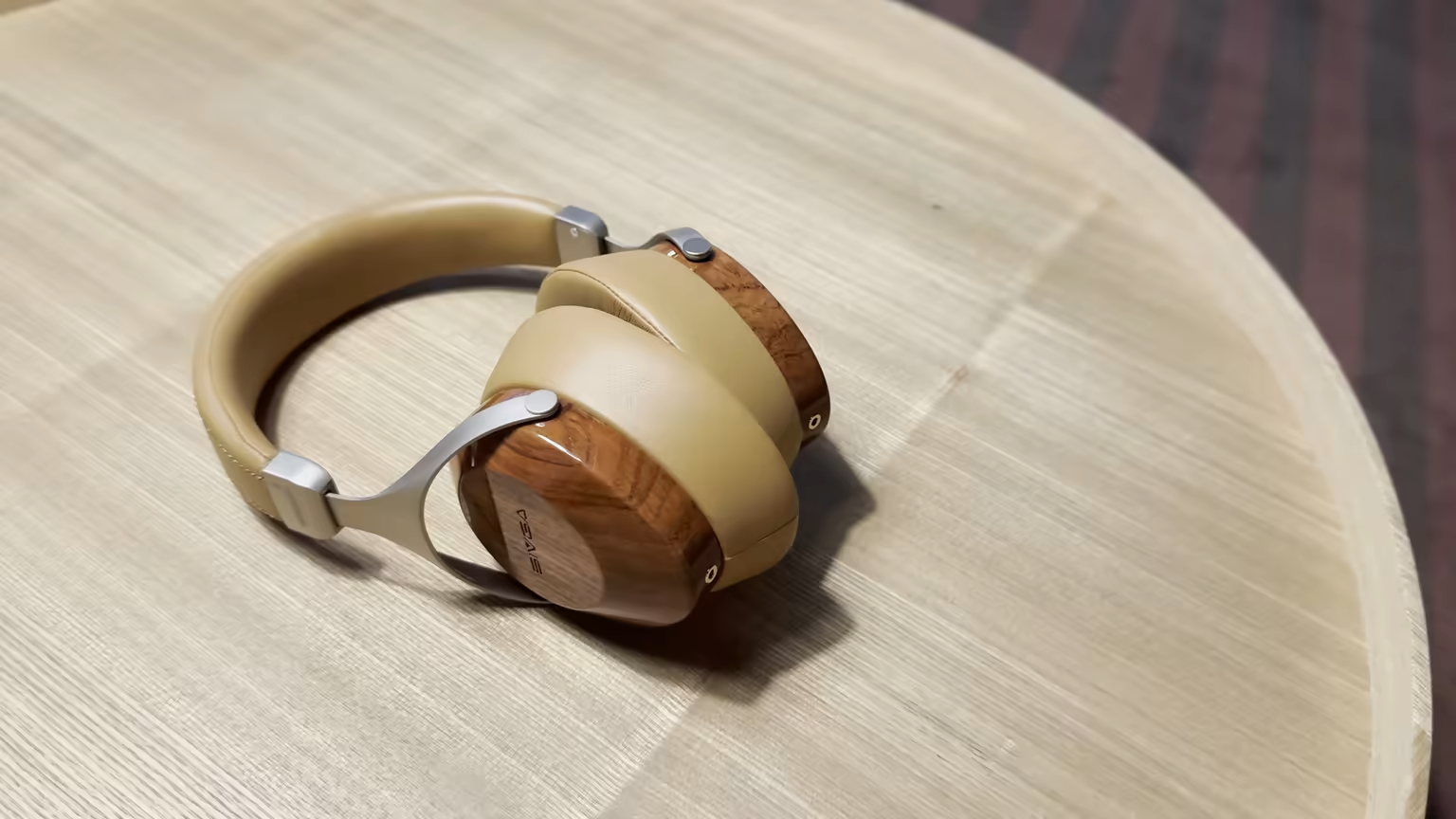 (view larger)
The yokes are made out of metal, feel sturdy, and offer size adjustment that feels also very high quality. In addition to that, there's cup tilt, but no swivel. I can confidently say that it's not going to be an issue, as the ear pads make up for it perfectly. They're extremely soft and adapt to any ear shape perfectly. They're medium-small sized, which means that your ear is probably going to touch them in one place or another, but that's not an issue at all.
The synthetic leather is also superb in terms of comfort. It can get a little warm inside on a hot day when you spend multiple hours with these, nothing crazy though. The headband is also covered in the same leather material, with some foam on the bottom side that touches your head. This makes the profile lower, and still provides sufficient padding, as the headphone itself is super lightweight, coming at 275 grams. Moreover, the clamping force is very light - it doesn't add any unnecessary pressure.
Then we have the connectors. They're dual 2.5mm, which allows for a balanced connection with an aftermarket cable but is not as common or durable as 3.5mm. I didn't find that to be a problem, and they probably couldn't fit 3.5mm jacks in there, so we're left with something more compact. It's likely not going to be an issue for you as well, as they're including a matching cable.
Summing up this part, it's built in a way that provides very good comfort, looks, and material choices. Nothing rattles here, nothing feels like it's about to break down.
Accessories: A Stock Cable Worth Keeping
I usually don't dedicate an entire part to talk about the extras we're getting in a box, but I'll make an exception this time, as they're really up there.
First of all, we're getting a super nice linen pouch that can fit the headphone, a cable, and some DAC/amp dongle with no issues. I used it extensively during my vacation trip, and it stood the test perfectly. Then we're getting a 3.5mm to 1/4-inch jack adapter that can fit the included cable.
The cable we're getting in the box is fantastic. That's why I previously mentioned that it probably will be enough for you, with no need to further upgrade - unless you want a balanced connection, or for some reason something even more fancy. It comes color-matched to your headphones, with a high-quality material braiding over it. It's single-ended terminated with 3.5mm on the amplifier end, and dual 2.5mm on the headphone end.
The connectors used here are amazing - fully metal, with a nice texture that helps greatly with the grip, and spring-style strain relief. The plugs fit extremely tightly and snugly. You might initially think that something is wrong, but they simply require more force to push in than you're expecting, which decreases the contact resistance and makes sure that they stay in place. The entire cable is pretty much non-microphonic, which is another reason not to replace it.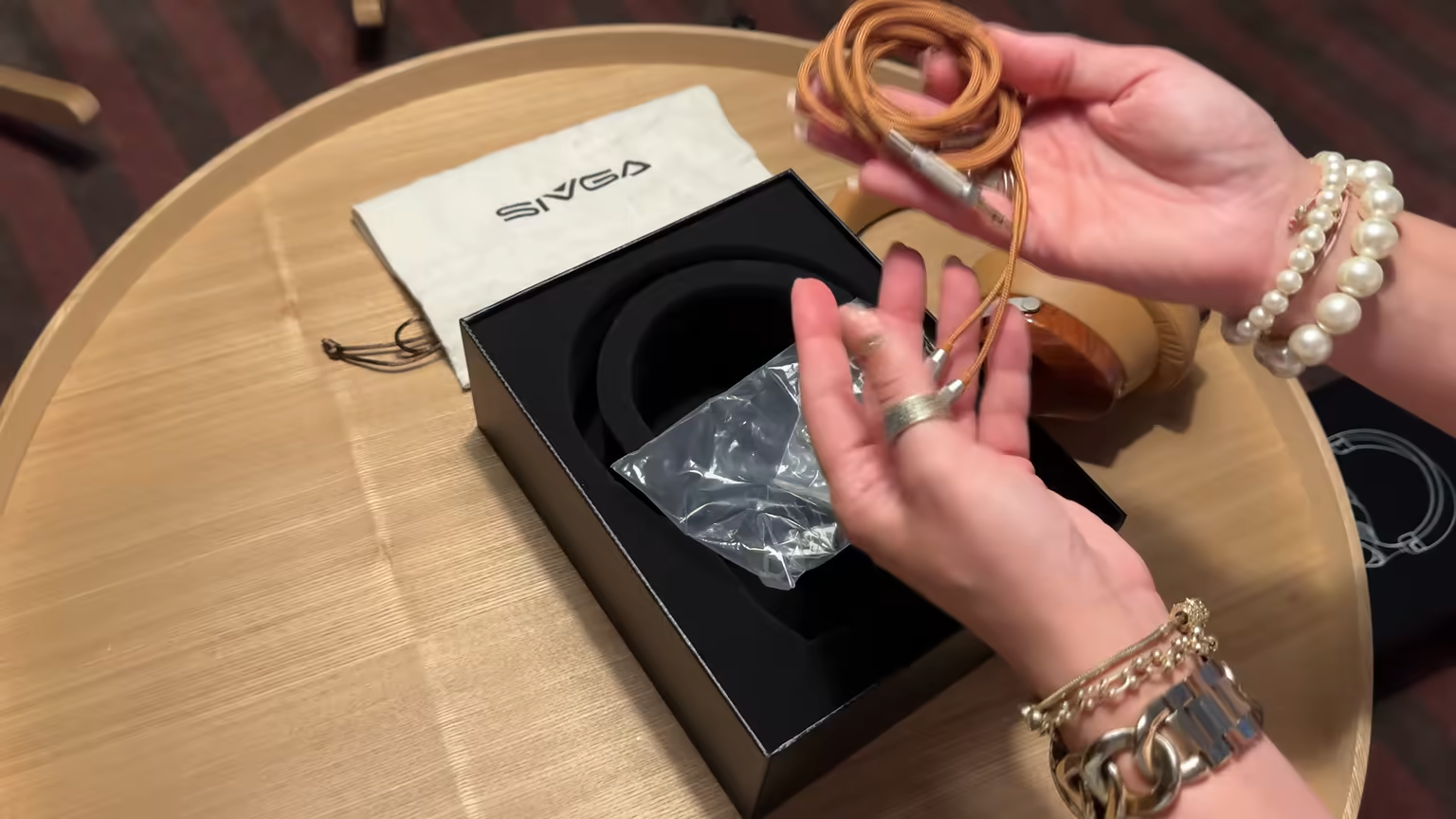 (view larger)
Technologies: Sivga's In-House 50mm Driver
It uses a 50mm dynamic driver, developed in-house by Sivga, for smooth sound and enduring listening. The diaphragm is ultra-thin and flexible, made of polycarbonate and fiber. This material combination is supposed to result in a lush and natural sound when the music is playing. The magnet used for driving it is 3 millimeters thick, to provide strong power to the driver. They even disclose the coil material - it's made of special copper-clad aluminum wire, for high sensitivity and softness in the sound.
Does It Need an Amp? Impossible to Underpower
The frequency response is specified to range from 20Hz to 20kHz, which covers the entire human hearing range. Its sensitivity is very, very high at 105dB. The impedance is rather low for a dynamic driver, coming at 32 ohms - the impedance is surprisingly flat. This combination makes driving it not a problem, no matter what gear you'd like to use. I tried it with high-power desktop amplifiers, low-power dongles, delta-sigma and R2R DACs, and even my MacBook. What I found is that it sounds good with pretty much everything - it's virtually impossible to underpower it. However, I prefer it with a bit of bright-leaning sources to bring up the top end just a bit and get a better balance.
How Does It Sound? Fun, Uneven, Bass-Heavy
Initially, its tonality may come off as very uneven, and to some extent it is. There's a big boost in the mid-bass region that doesn't extend to the sub-bass. Then we have a large dip in the midrange at 500Hz, and a slight boost in the treble. This makes for a very exciting and fun presentation at first, but has some downsides as well.
In budget headphones, especially closed-back ones, the bass is done in one of two ways. It can be either very light and not impactful, or bloated. Here it leans definitely on the more bloated end, which means that there's a lot of it. This headphone's bass isn't full, but it's full of bass. It's also not incredibly resolving in terms of the finest detail - it's not pushing them forcefully at you, and in terms of source gear, it's not going to reveal lots of issues with your chain.
All that contributes to the vocal performance. They often sound generally empty and hollow, probably due to the dip in the lower midrange. It also tends to make them a bit echoey, making their presentation quite unique. At higher volumes, you can expect some shoutiness, which can be distracting - but since it's a closed-back with decent sound isolation, there are very few situations where you have to turn up the volume a lot.
The vocal performance can be described as very intimate. They play inside your head, in the very center. The soundstage isn't particularly wide. I found that it likes to put things behind my ears. That's especially noticeable when the sound source is panned hard left or right. On the other hand, the instruments sound much wider than the vocals. Not wide in general, but wider. It's a pleasant effect, often desirable with headphones, as it is literally a combination of being intimate and wider at the same time, and for the right sounds.
The instrumental performance is good. Their timbre isn't bad, despite the crazy uneven measured frequency response. I'm not sure how they achieved that, but I'm suspecting that it comes from their treble response. String instruments and drums tend to pop more from the mix for some reason, just as if they were being played louder than the rest.
For the technical performance, it's generally not impressive and doesn't stand out much from the crowd, but I liked one thing in particular about it - the decay. It's very long and satisfying, making percussion, violins, cellos, and large-scale music oddly satisfying.
Comparisons: Robin vs. HE-R9 and HE400se
Let's take its 2 closest competitors in this price range.
The first one is the closed-back HE-R9 from HIFIMAN. Compared to the Sivga Robin, it's slightly less sensitive, but still very easy to drive. When I was going back and forth, I just had to bring up the volume slightly on the HE-R9. Then, its sound isolation is not nearly as good as the Sivga. On the other hand, its midrange was much fuller, less empty, and echoey. There was not nearly as much mid-bass, but a bit better low-end extension. The soundstage is definitely more intimate on the Sivga, which can be nice for a super close, in-your-face vocal performance. The HE-R9's top-end extension is not as good though - it lacks some energy there, which makes it come off as a bit dull at times.
Now, a bit of a different competitor - HIFIMAN's HE400se is a cheaper headphone, but it's an open-back planar. It requires much, much more amplification. Without it, you're even likely not to get it loud enough. The quality of the power also needs to be good - otherwise you'll be left with mediocre bass, a claustrophobic soundstage, and poor imaging. But once you get it, you can live with an open back, meaning you're fine with using your headphones mostly inside, you can expect some interesting sound characteristics. For example, its tonality is significantly more balanced from the bass to the treble. It offers a not-as-claustrophobic soundstage, but still small, yet even better vocals and some layering. On the other hand, it's pretty bass-light.
So, as you can see, you have lots of different options for headphones at this price point. We're barely scratching the surface. The Sivga Robin provides a unique presentation, and if it's not your only headphone, you might have lots of fun with it - in part because of its unbalanced frequency response.
Sound signature
Derived from the words this review uses: each axis runs between two opposite descriptors, and the shape leans toward whichever side the writing does.
- Warm ↔ Bright Leans warm
- Relaxed ↔ Analytical Sits close to centre
- Polite ↔ Aggressive Leans aggressive
- Lean ↔ Bass-heavy Leans bass-heavy
- Intimate ↔ Wide stage Sits close to centre
Hear what "warm, aggressive, bass-heavy" means: a short synthesised loop, flat and then with those leanings. An illustration of the words, not a recording of the Robin SV021.
Not sure which signature suits you? Find yours with a blind A/B test

Watch the video review
Subscribe on YouTube (opens in new tab)Prefer to read? The written review above covers everything in the video.

- 0:00 WHY It's BAD, But Also GOOD? (opens in new tab)
- 0:22 Build Quality & Comfort (Color Variants, Wooden Earcups, Sivga Logo, 2.5 mm Connectors, Metal Yokes, Soft Pads, Weight, Clamp Force) (opens in new tab)
- 2:35 Included Accessories (High-Quality Linen Carrying Pouch, 3.5 mm To 1/4 Inch Jack Adapter, Fantastic Braided Cable, Plugs) (opens in new tab)
- 4:03 Features In Sivga's Product Line (50 mm Custom Dynamic Driver, PC + Fibre Diaphragm, 3 mm Thick Magnets, CCA Wire Coil) (opens in new tab)
- 4:41 Technical Specification (Frequency Response, Sensitivity, Resistance/Impedance, AMP/DAC Pairing, Drivability) (opens in new tab)
- 5:31 Sound Quality (Uneven Tonality, Bass Bloat, Resolution/Detail Retrieval, Empty Vocals, Echo, Shoutiness, Sound Stage Width, Imaging, Instrumental Performance, Decay) (opens in new tab)
Common questions about the Robin SV021
Is the Sivga Robin SV021 worth it?
Yes, for the right listener - 7.8/10, Recommended, higher than 21% of everything we have tested, against a catalogue median of 8.1. On value it rates strong: above average for the price in headphones. Price: $149.
Who should buy the Sivga Robin SV021, and who should skip it?
Buy it if you want the balance to lean warm, with the top end eased, and you want more performance per dollar than most of its peers. Skip it if you want every last bit of treble detail.
What amplifier does the Sivga Robin SV021 need?
Impedance is 32 Ω. By the rule of eighths the amplifier feeding it wants an output impedance no higher than 4 Ω, otherwise the interaction between the two tilts the frequency response rather than simply making it quieter. Power is the separate question. At most 99 mW to reach 110 dB peaks, which is most dongle DACs. The review records 105 dB without saying against what, and the two conventions differ by a factor of 31 at this impedance - so that is the worst case, and the real figure is at or below it.
What else have you tested around the price of the Sivga Robin SV021?
No head-to-head page for this one yet. The closest reference points we have scored in the same bracket: the OneOdio Max 1 at 7.0/10, the Sivga SV021 Pro at 7.6/10, and the HIFIMAN HE400se at 7.6/10.
Why do vocals sound hollow on the Sivga Robin?
A large dip in the midrange around 500Hz, and it is the headphone's defining flaw. Voices often come across as empty and hollow, with a slightly echoey quality that makes their presentation genuinely unusual - not broken, but not right either. At higher volumes you can also get some shoutiness. Since this is a closed back with decent isolation, there are few situations where you actually need to turn it up, which takes some of the sting out.
Is the Sivga Robin's bass bloated?
Yes, and I would rather have it this way than the alternative. Budget closed-backs usually go one of two ways - thin and unimpactful, or bloated - and this lands firmly on the bloated end. There is a big mid-bass boost that does not extend down into the sub-bass, so this headphone's bass is not full so much as full of bass. It is not especially resolving down there either, and it will not expose problems in your source chain.
Do you need to upgrade the Sivga Robin's cable?
No, and I say that rarely. The included cable is fantastic: colour-matched to the headphone, braided in a high-quality material, and pretty much non-microphonic. The connectors are fully metal with a grippy texture and spring-style strain relief, and the plugs fit so tightly you may think something is wrong - they simply need more force than you expect, which lowers contact resistance and keeps them seated. The only reasons to replace it are wanting a balanced connection or wanting something fancier to look at.
Are the dual 2.5mm connectors a problem?
Less than they could have been. They are less common and less durable than 3.5mm, with a smaller contact area, and I would always rather have the bigger standard - but they probably could not fit 3.5mm jacks into cups this size. In practice it did not cause me any trouble, largely because the included cable is good enough that you are unlikely to go hunting for a replacement. They do allow a balanced connection with an aftermarket cable.
Does the Sivga Robin need an amplifier?
It is virtually impossible to underpower. Sensitivity is very high at 105dB, the impedance is a low and surprisingly flat 32 ohms, and I tried it with high-power desktop amplifiers, low-power dongles, delta-sigma and R2R DACs and my MacBook - it sounds good off all of them. If you want to optimise rather than merely drive it, I prefer a slightly bright-leaning source, which lifts the top end a little and gets you a better overall balance.
Sivga Robin or HIFIMAN HE-R9?
Different compromises at similar money. The HE-R9 is slightly less sensitive - I had to nudge the volume up switching to it - and its isolation is nowhere near as good as the Sivga's. Its midrange is much fuller, less empty and less echoey, with less mid-bass but better low-end extension. The Robin is the more intimate of the two, which is lovely for close, in-your-face vocals. The HE-R9's top end lacks energy by comparison and can come off dull.
Who should buy the Sivga Robin?
Somebody who wants a second headphone with real character rather than a balanced first one. It cannot compete on objective sound quality with the best options at the price, and the tonality is genuinely uneven. What it offers instead is a unique presentation - very long, satisfying decay that makes percussion, violins, cellos and large-scale music oddly compelling, instruments staged wider than the dead-centre vocals, and a build that looks like a masterpiece for $149.
If you're interested in this
All 30 headphones reviewsClosest alternatives




Different direction