SMSL DL100 Review: Best Budget DAC/Amp Under $200?
A $180 balanced DAC/amp combo with MQA, DSD256, 4 Cirrus Logic chips, and a clarity-focused house sound that punches well above its budget category.
higher than 56% of everything we have tested
Value Excellent. It is one of the best-value pieces we have scored.
- Standout
- Balanced DAC + balanced headphone amp at $180
- Watch out for
- Sub-bass is less extended than measurements suggest
- Closest rival
- SMSL DO100 PRO: $40 more, scores 0.2 lower.
Is it for you?
- You want the balance to lean bright, with the detail pushed forward
- You want the most performance per dollar on the list
- You're treble-sensitive
Pick #3 of 8 in our Best DACs guide.
The SMSL DL100 is a game-changer in the budget DAC market - it costs $180. That's not a high price for a device that can be a perfect starting point for a beginner audiophile with little money to spend. It also comes with a secret that's going to leave you wondering how they did that.
Build Quality: A Sturdier Black Box
It's just another black box. They can get boring, especially when a company like SMSL offers dozens of similar products. That's why they dressed it up to make it more interesting.
The chassis is fully metal, made out of bent aluminum sheet. It's not super thick, but it's also not as thin as on the DO100 PRO - one of their products I recently had a chance to review. The sides are angled a little - that's a purely aesthetical move to differentiate this model from other similar ones they offer.
On the bottom, it has 4 rubber feet that do a good enough job of preventing unwanted movement on the desk. This unit is not heavy enough to allow you to plug in cables without holding the device itself - realistically though, how often do you plug and unplug headphones or amps from a DAC?
The front of this unit greets us with a small, tactile volume knob. Next to it is a very bright screen used to display volume, sampling rate, and current settings. It's an improvement over older SMSL products, as it is not only brighter but also more functional and refined.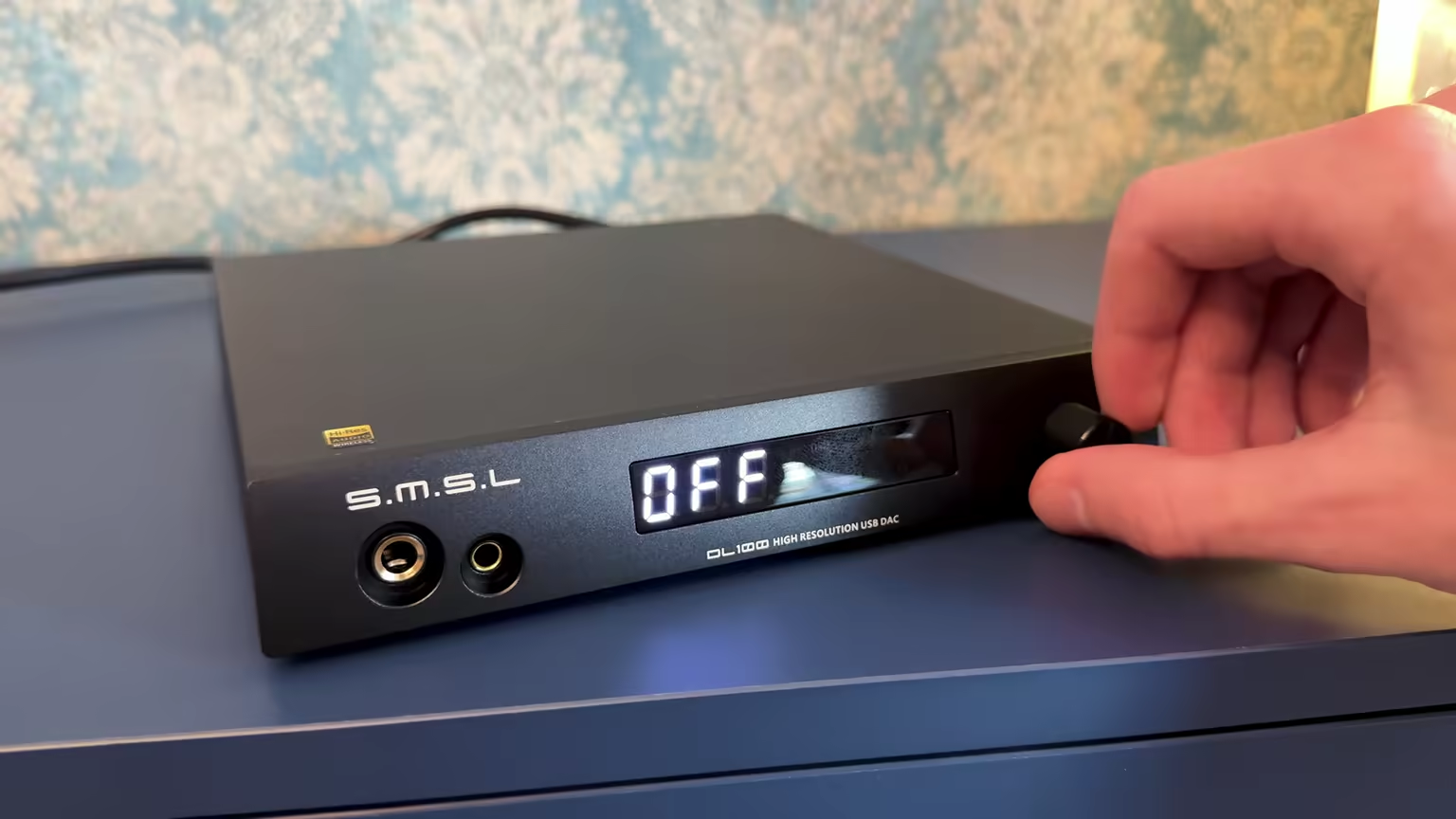 (view larger)
It's also a step up in the way it feels. I wouldn't call it premium, but the case feels much more sturdy. The tolerances are better, which decreases wobble in the connectors, or even the potentiometer. The finish itself seems thicker, thus much harder to scratch off. All that gives me confidence that this unit is not going to fail or break out of nowhere.
Inputs/Outputs: HDMI ARC and Balanced XLR at $180
Most of the I/O is on the back. We can find a standard power connector here, used for supplying AC power to the internal low-noise switch-mode power supply. Next are digital inputs in the form of USB Type-C, which has two modes to choose from: USB 1.1 for older devices and USB 2.0. They go through the brand-new third-generation XMOS chip.
The DL100 can take wireless audio with the use of Bluetooth input, using the external antenna. For TV users, HDMI ARC is going to come in handy. Then there is an optical Toslink connection, as well as a standard Coax.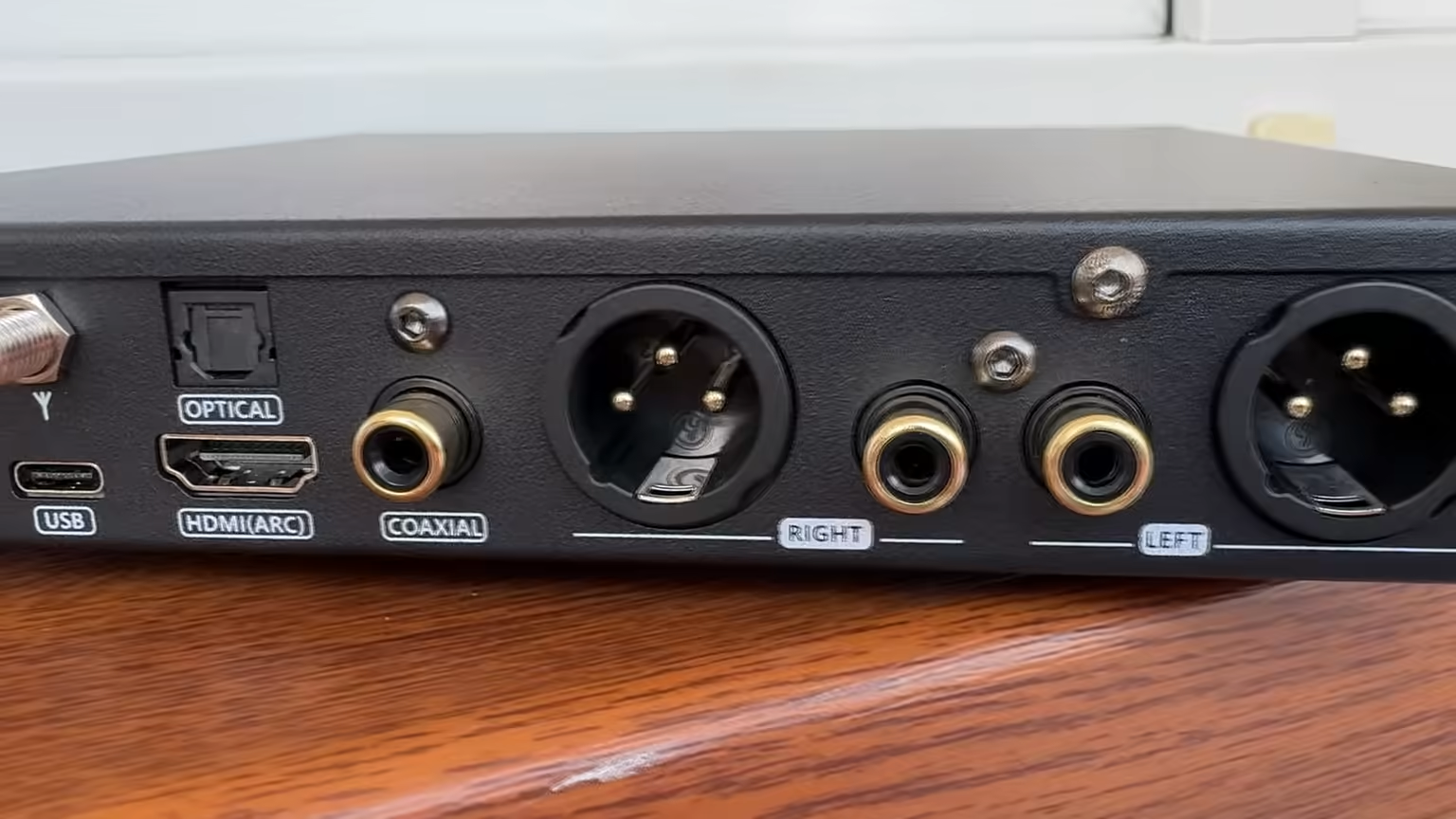 (view larger)
Since it's a DAC, it outputs an analog signal. And because it's a balanced DAC - which is crazy at this price - it has XLR balanced analog outputs, plus a pair of single-ended RCAs for compatibility. I'm considering the RCAs to be a compatibility-only thing, because the balanced outputs sound noticeably better - they're cleaner, more detailed, and more dynamic. That's how I used it during the evaluation.
On the front, we have some more analog outputs - namely headphone outs, as this unit is also a headphone amp. It's mind-blowing how many things SMSL managed to fit in such a small box and tight budget. They come in two flavors - a 1/4-inch single-ended jack and a 4.4mm balanced.
Functions: MQA, DSD256, and Five Filters
It's a fairly feature-packed unit. It supports MQA decoding and MQA-CD for those Tidal users. I'm not using it personally, I prefer regular PCM files. It can decode DSD256, with the addition of DSD over PCM.
Their proprietary audio clock processing circuit was implemented to help greatly reduce clock jitter. It uses numerous audio-specific audiophile-grade resistors and capacitors, instead of regular cheap, Chinese parts. It is equipped with a full-featured remote control, and it can work as a digital pre-amp. SMSL even put some effort into getting a Hi-Res certification, thus a sticker confirming that.
Finally, we can pick from 5 different types of filters. The differences between them can be subtle, but I can hear them. The most interesting thing about them is the non-oversampling filter. It is not running your DAC in a real NOS mode, as it's not an R2R DAC. However, what it does is quite simple - it doesn't purposefully cut down any top-end frequencies, which is perfect for the signal phase. This filter is perfect for extremely well-recorded music and well-done recordings. For everything else, it's probably the worst, as it unmasks unpleasant issues in a very obvious way. My recommendation would be to use a slow and phase-compensated filter. That's the next best thing that doesn't mess up the songs as much, in cases where they aren't perfect.
Technical Specs: Flagship Numbers, Budget Price
It can take up to 32-bit, 768kHz PCM signals. For digital-to-analog conversion, it uses 4 pieces of Cirrus Logic's audio decoding chip. Its performance reaches a level of 0.00009% non-weighted THD+N. That's a very good number for a chip-based DAC.
The output level is a bit higher than standard. It provides 2.5V for RCA and 5.2V for XLR. That's, at least partly, why it performs so well on paper. But I wouldn't consider this cheating the spec sheets. Even with a little over 5 volts on the XLRs, you're rather unlikely to overdrive any amplifiers and make them distort.
The built-in headphone amplifier doesn't seem like an afterthought with no real amplification stage. SMSL developed an independent circuit dedicated to it. Its power output is not bad - 3 watts into 16 ohms, or 1.5W into 32 ohms, which is a more realistic measurement. That should be enough to power most headphones.
How Does It Sound? Clean and Airy, Light Sub-Bass
At first sight, it shares the typical SMSL house sound. Tonally, it leans more toward clarity and airiness. It seems to avoid muddiness at all costs. In this case, that cost is some lower midrange energy, warmth, and fullness. This can make for a dull presentation if the rest of your chain - like the amplification, speakers, or headphones - are already on the brighter, thinner side of things.
But it can also pair perfectly with lots of warmer gear, making it more balanced, natural, and, for lack of a better comparison, more true to the recording.
The only real sonic characteristic I didn't particularly find appealing is the sub-bass. It doesn't seem that extended, despite what frequency response measurements try to indicate. That leaves us with less dynamic impact and punch than expected. It isn't anything major though - that's only noticeable compared to more expensive DACs and becomes clear once you get to the higher end of speakers or headphones. Before you get to this level, you're likely going to upgrade your source gear anyway to SMSL or another company's high-priced products.
The positive effect of the tonal characteristics affected the soundstage. It's not collapsed, but also not super wide. However, what I find very nice about it is the accuracy and precision. The analytical nature of this product helps it a lot. The instruments and vocals are very close to being locked in a single place where they're supposed to be. There's some movement and blurriness, nevertheless it's quite impressive.
The vocals are a little forward. I assume that it's on purpose, as they implemented an HDMI ARC connection - so they assume that people will use it with their TVs. The most common things that people watch on TV are movies, news, and stuff where human voices, as well as their intelligibility, really matter.
Sound signature
Derived from the words this review uses: each axis runs between two opposite descriptors, and the shape leans toward whichever side the writing does.
- Warm ↔ Bright Leans bright
- Relaxed ↔ Analytical Leans analytical
- Polite ↔ Aggressive Leans aggressive
- Lean ↔ Bass-heavy Leans bass-heavy
- Intimate ↔ Wide stage Sits close to centre
Hear what "bright, analytical, aggressive, bass-heavy" means: a short synthesised loop, flat and then with those leanings. An illustration of the words, not a recording of the DL100.
Not sure which signature suits you? Find yours with a blind A/B test
What the DL100 will drive
Rated at 1.5 W into 32 Ω, it clears every one of the 23 headphones we have published a power figure for - including the hungriest, the HIFIMAN HE-R9, which wants about 313 mW to reach 110 dB peaks.
Requirements are each headphone's own published figure, computed from its impedance and sensitivity by the same calculator its review runs. Where a review states a sensitivity without naming its reference, the figure used here is the worst case, so a headphone counts as driven only if the amplifier clears it either way. Reproduce any of it in the headphone power calculator, or open a row's review to move the listening level and watch its figure change.
| Headphone | Needs | Drives it |
|---|---|---|
| HIFIMAN HE-R9 | 313 mW | Yes |
| Sivga Luan | 263 mW | Yes |
| OLLO Audio X1 | 248 mW | Yes |
| Sivga Robin SV021 | 99 mW | Yes |
| HIFIMAN RE2000 PRO Silver | 84 mW | Yes |
| Sivga Anser | 83 mW | Yes |
| HIFIMAN HE400se | 79 mW | Yes |
| Sivga SV021 Pro | 56 mW | Yes |
| HIFIMAN RE800 Silver | 53 mW | Yes |
| HIFIMAN Ananda Stealth | 50 mW | Yes |
| HIFIMAN HE1000 Stealth | 50 mW | Yes |
| HIFIMAN Arya Organic | 40 mW | Yes |
| HIFIMAN Arya Stealth | 40 mW | Yes |
| HIFIMAN Arya Unveiled | 40 mW | Yes |
| HIFIMAN Sundara | 40 mW | Yes |
| Kiwi Ears Orchestra Lite | 39 mW | Yes |
| HIFIMAN HE1000se | 25 mW | Yes |
| Verum Audio Verum 1 | 25 mW | Yes |
| HIFIMAN Sundara Closed-back | 16 mW | Yes |
| Meze 105 Silva | 15 mW | Yes |
| Kiwi Ears Atheia | 6 mW | Yes |
| HarmonicDyne Eris | 5 mW | Yes |
| Simgot EM6L | 5 mW | Yes |
Watch the video review
Subscribe on YouTube (opens in new tab)Prefer to read? The written review above covers everything in the video.
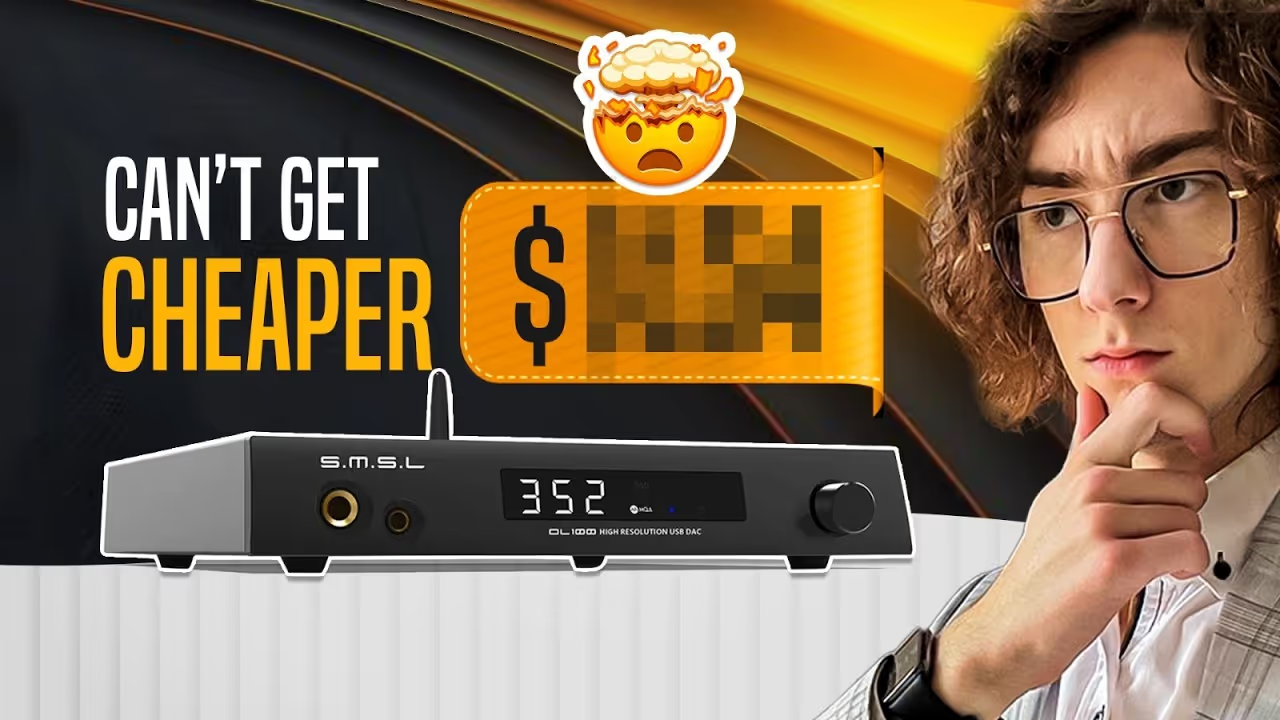
- 0:00 Can THIS Be The BEST Budget DAC/AMP? (opens in new tab)
- 0:24 Build Quality & Aesthetics (Aluminum Chassis, Feet, Weight, Display, Volume Knob) (opens in new tab)
- 1:55 Inputs / Outputs (Low-Noise Power Supply, USB-C, XMOS Chip, Bluetooth 5.1, HDMI ARC, Toslink, Coax, Balanced XLR, RCA, 4.4 mm, 1/4 inch jack) (opens in new tab)
- 3:22 Functionality (MQA-CD, DSD256, DoP, Audio Clock, Audiophile Capacitors & Resistors, Remote, Pre-AMP, HiRes Certification, Upsampling Filters, NOS) (opens in new tab)
- 5:01 Technical Specification (PCM Sample Rate, Bit Depth, THD+N, Output Voltage, Powerful Headphone AMP) (opens in new tab)
- 6:11 Sound Quality (Tonality, Clarity & Airiness, Warmth, Fullness, Dynamics, Sub-bass, Brightness, Sound Stage, Accurate Imaging) (opens in new tab)
Common questions about the DL100
Is the SMSL DL100 worth it?
Yes, for the right listener - 8.2/10, Recommended, higher than 56% of everything we have tested, against a catalogue median of 8.1. On value it rates excellent: top 14% for the price in DACs, so it is one of the best-value pieces we have scored. Price: $179.
Who should buy the SMSL DL100, and who should skip it?
Buy it if you want the balance to lean bright, with the detail pushed forward, and you want the most performance per dollar on the list. Skip it if you're treble-sensitive.
What should I consider instead of the SMSL DL100?
The pieces we have actually run against it: the SMSL DO100 PRO scores 0.2 lower and the SMSL RAW-MDA1 scores 0.2 lower and costs $60 more. Every one of those matchups has its own page in the head-to-head section.
Which SMSL DL100 filter should you use?
The slow, phase-compensated one for everyday listening. There are five, and the differences are subtle but audible. The interesting one is the non-oversampling filter - it is not true NOS, since this is not an R2R DAC, but it deliberately declines to cut top-end frequencies, which is ideal for phase. On genuinely well-recorded material it is the best of them. On anything else it is probably the worst, because it unmasks flaws very obviously.
Should you use the DL100's RCA or XLR outputs?
Balanced XLR, and it is not close. The balanced outputs sound cleaner, more detailed and more dynamic, and that is how I evaluated the unit. I regard the RCAs as a compatibility feature rather than a real alternative - they are there so the DAC fits into a system that has no balanced inputs. A balanced DAC at this price is unusual enough that it would be a shame to buy one and then not use the part that makes it unusual.
Does the DL100 pair well with bright gear?
No, and this is the pairing to avoid. The SMSL house sound leans toward clarity and airiness and avoids muddiness at all costs - the cost being lower-midrange energy, warmth and fullness. Put that in front of speakers or headphones that are already bright and thin and the result is dull rather than detailed. With warmer gear it is excellent: more balanced, more natural, and closer to what the recording actually holds.
Is the DL100's headphone amp an afterthought?
No - SMSL developed an independent circuit for it rather than tapping the line stage. It delivers 3 watts into 16 ohms, or 1.5W into 32 ohms which is the more realistic figure, and that is enough to power most headphones. You get both a quarter-inch single-ended jack and a 4.4mm balanced output on the front. For a $179 box that is also a balanced DAC with HDMI ARC and Bluetooth, fitting a real amplifier stage in as well is the surprising part.
How is the DL100's sub-bass?
Less extended than the measurements suggest, and it is the one sonic thing I did not like. The consequence is slightly less dynamic impact and punch than you would expect from the numbers. It is not a major flaw - it only becomes noticeable against more expensive DACs, and it becomes clear once your speakers or headphones are good enough to show it. By the time you reach that level you were probably going to upgrade the source anyway.
Why are vocals slightly forward on the DL100?
I suspect it is deliberate, and HDMI ARC is the clue. SMSL put a TV input on this DAC, which means they expect people to run films and news through it - and in that material human voices and their intelligibility are what matter most. A small lift there is a sensible choice for the use case. On music it is mild rather than distracting, and it comes with a genuine benefit: imaging is precise, with instruments and voices locked close to where they belong.
Is the DL100 built better than the DO100 PRO?
Yes, noticeably. The chassis is bent aluminium sheet - not super thick, but thicker than the DO100 PRO's - and the tolerances are better, which shows up as less wobble in the connectors and in the volume pot. The finish is thicker and harder to scratch through. The angled sides are pure styling to set it apart from SMSL's other black boxes. None of it is premium, but it gives me confidence the unit will not fail out of nowhere.