SMSL RAW-MDA1 Review: The ESS DAC That Sounds Different
A $240 balanced DAC/headphone amp with dual ES9039Q2M chips that doesn't sound like every other ESS box - warmer tonality, forward mids, and a flexible soundstage.
higher than 34% of everything we have tested
- Standout
- More premium feel than other SMSL DACs in the price range
- Watch out for
- Doubled coax/optical inputs instead of BNC or AES
- Cheaper alternative
- SMSL DL100: $60 less, scores 0.2 higher.
Is it for you?
- You want the performance close in
- You want the room to open up around you
Pick #4 of 8 in our Best DACs guide.
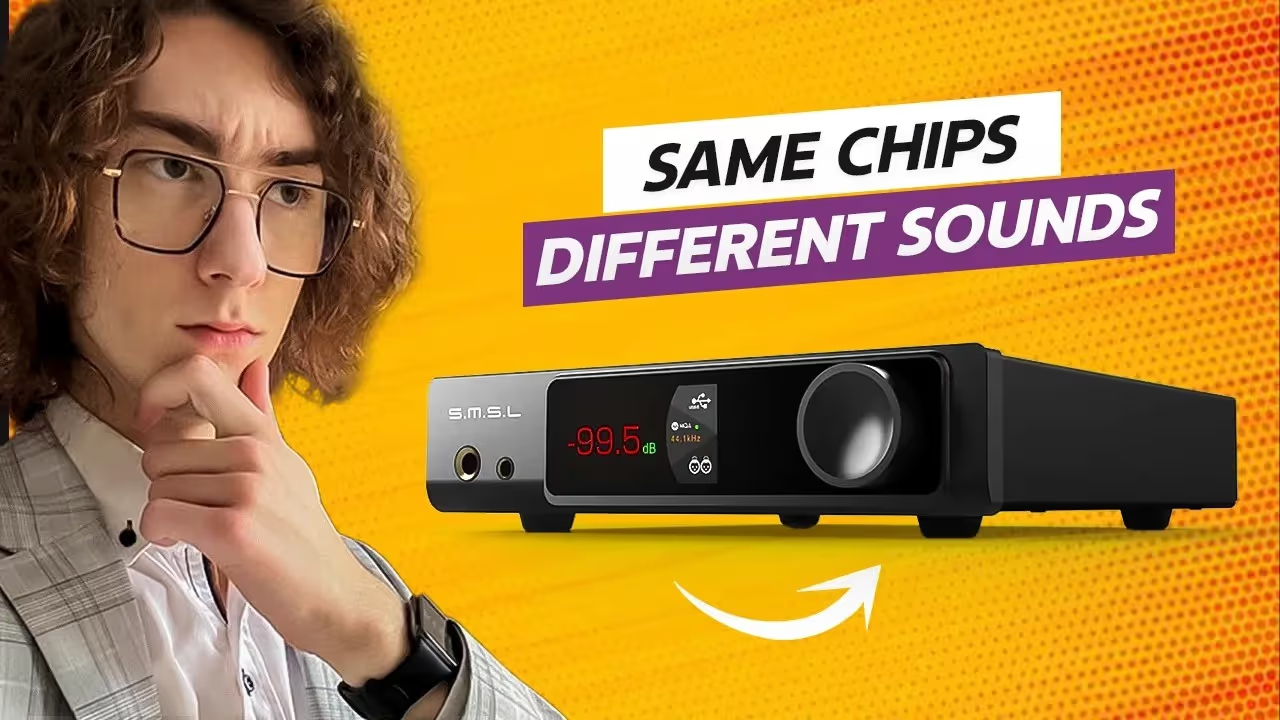
Many popular DAC/amps appear to use identical ESS chips, the same XMOS USB interfaces, and similar switch-mode power supplies, resulting in almost indistinguishable sound. The SMSL RAW-MDA1 may seem similar on paper, but it is completely different in practice.
Design & Build Quality: Denser, Sharper, More Premium
This unit stands out when compared to similarly priced options from SMSL, as it offers a distinctly more premium feel. While the enclosure is made from a rather thin metal sheet - common in this price range - what I found particularly interesting is the considerable weight increase for some reason. This heft makes for the density that contributes to an overall impression of quality and sturdiness. It's important to note that it might not be the most luxurious construction on the market, but it undeniably represents an improvement over other DACs offered by SMSL. This gives you a sense of reliability and durability that many users are looking for in audio equipment.
Examining the RAW-MDA1 closely, you'll notice that its front plate is not only thicker than its sides but also extends beyond the body in all directions. This design choice imparts a modern aesthetic that avoids the conventional squared-off box look that many audio devices have. Instead, the unit's profile presents an appearance that fits well within a variety of setups.
It holds a high-resolution, colorful LCD display protected by tempered glass, which enhances scratch resistance and durability - in other words, it shouldn't get scratched easily by your finger or any plastic objects, as you can only scratch a surface with a harder material than a given surface.
Next to the screen, you'll find a rotary, stepped digital knob that allows for intuitive control over the DAC including volume adjustment and changing the internal settings. While it looks almost identical to one on, for example, the DO100 PRO - it's designed with a bit more finesse. It has a firmer feel, minimizing any wobbling, and it responds with satisfying, more tactile feedback. Unfortunately, it seems to be less accurate as rapid volume adjustments can be unpredictable at times.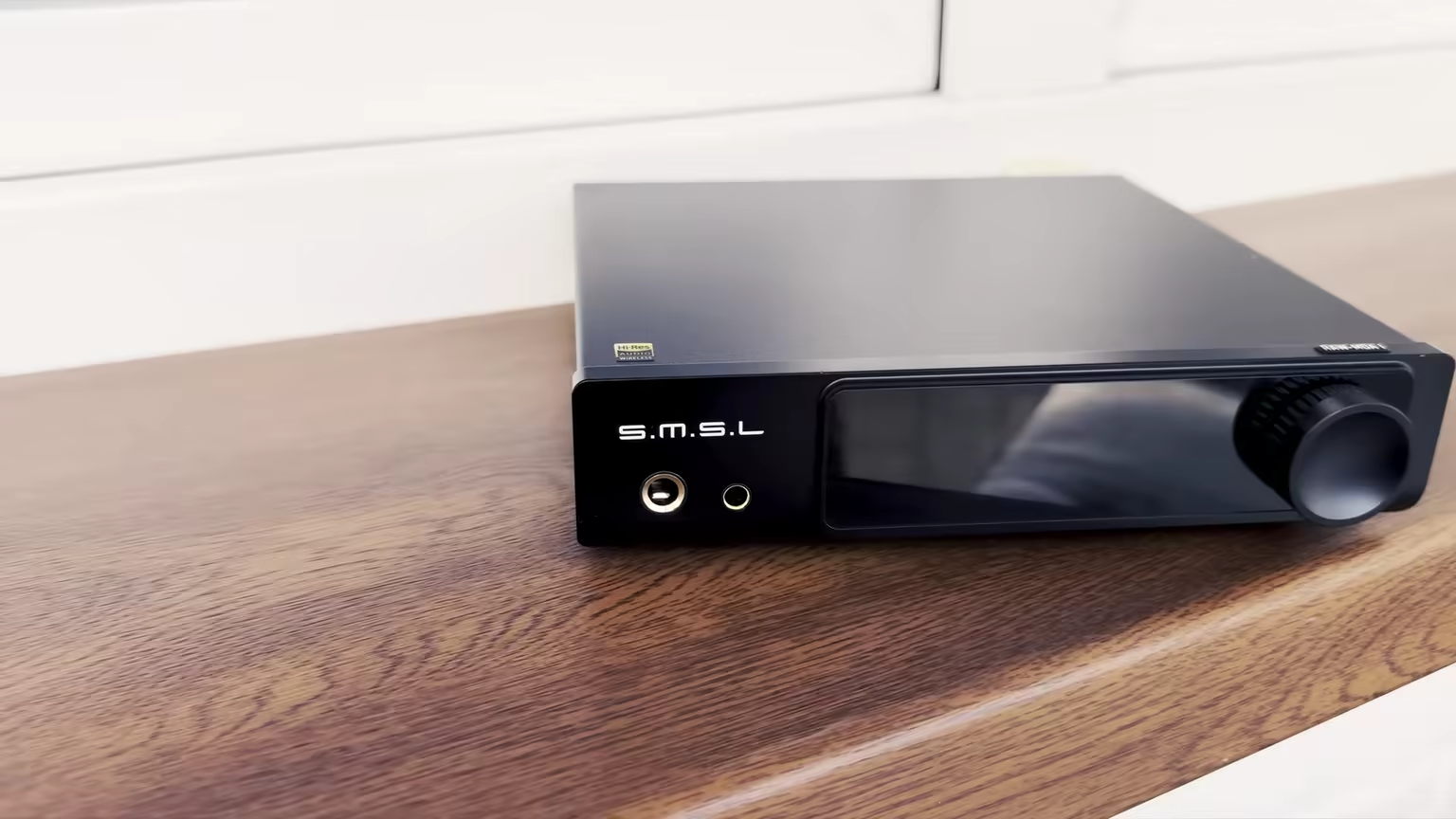 (view larger)
The graphical interface presented on the LCD is clean and modern, contributing to an overall user-friendly experience. However, for those who appreciate a nostalgic touch, the option to switch to a more retro display style is a useful feature. It is still going to look digital, so don't expect any simulated VU meters. Instead, the old-school mode reminds me of SMSL DACs from a few years ago.
At the bottom of the unit, four rubber feet provide elevation, which can help with ventilation to prevent heat buildup. These feet also keep the device from sliding on a desk. However, when plugging in or removing cables, it's still necessary to hold the DAC, so it stays in place. Well, you can't expect everything to be top-notch out of a budget-oriented all-in-one device coming at below $240. Nevertheless, I very much appreciate the simplistic design, as it simply works - looking good with almost all other gear stacked on top or next to it.
Inputs & Outputs: Doubled-Up Digital Inputs
The choices made regarding the I/O are rather uncommon and pretty unique. We can feed it digital data using one of two coaxial RCA inputs, one of two optical toslink connectors, wirelessly through Bluetooth, or by connecting a USB-C cable. I have no idea why they went for this doubling of standards instead of replacing one COAX with for example BNC and the second optical with perhaps AES. Maybe they realized those are the most popular ones and it'd be somehow beneficial for people to have multiple of the same standards.
It is powered by a regular C16 power cable with a power switch on the back, which is also included in the box.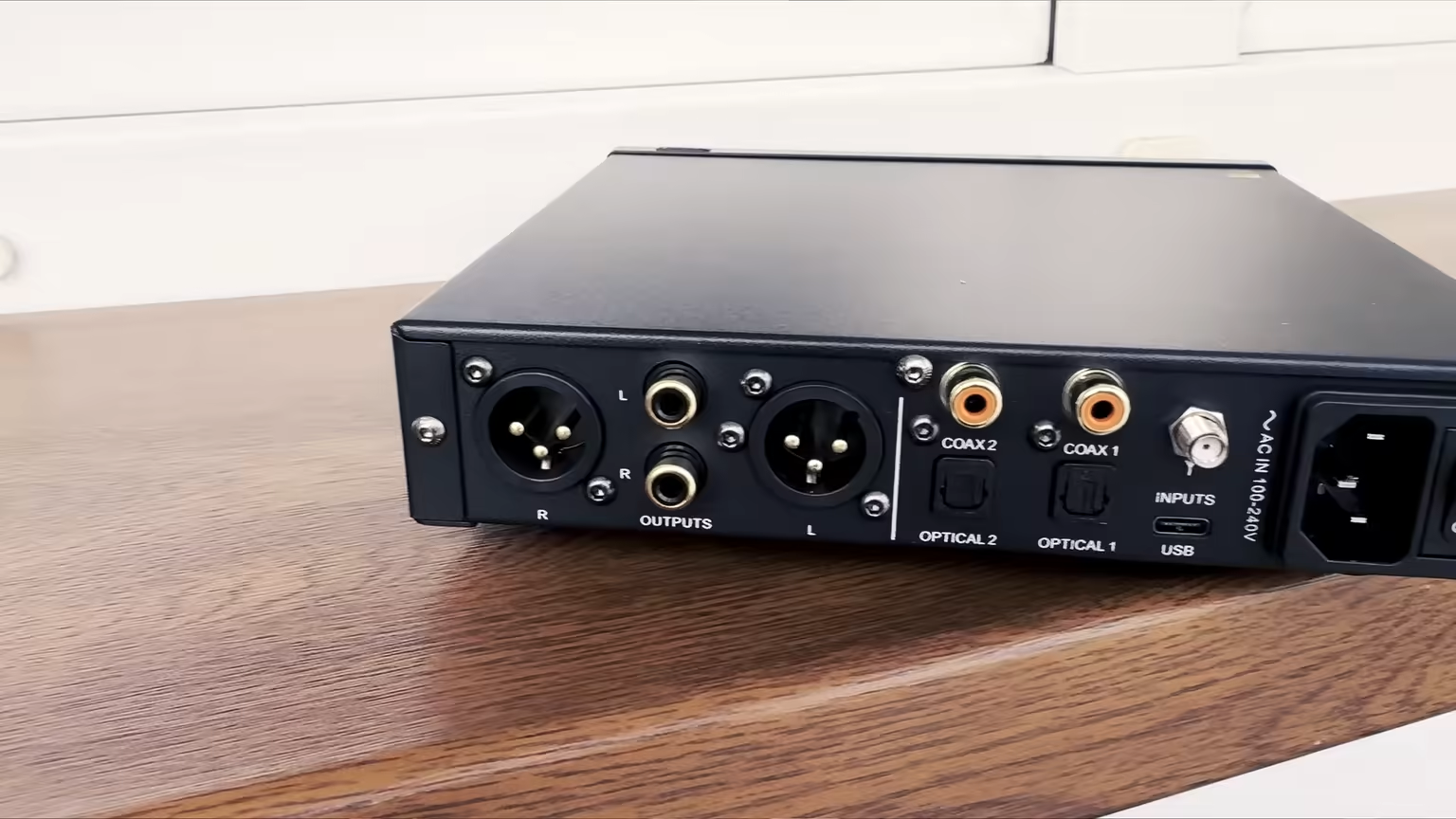 (view larger)
For the outputs, it makes more sense. On the back, we have direct DAC outs - a pair of balanced XLRs and single-ended RCAs in the middle. It's an interesting layout, but I'd assume it helps to save some more space or separate two channels more. This is a balanced DAC and I found that it performed better in the XLR mode. The RCA was not massively worse, but it lost some dynamics, detail, and stage width.
On the front, we have headphone outputs, that go through both the DAC and headphone amplifier section. They come in two flavors - desktop-sized 1/4 inch jack, as well as 4.4 millimeters. I'm not sure if the amp section is also balanced, but both outputs sounded pretty similar.
Technologies: Dual-Mono ESS, Six Op-Amps
As always with SMSL products - it's packed with fun functions, features, and some extra gimmicks. It supports MQA decoding and MQA-CD file formats for those Tidal users. I'd say this one is not very useful, I don't listen to MQA files at all. I have my true lossless music library that is not - like MQA - close to the original recording - it IS the original recording with uncompressed-like quality.
This DAC has 2 of the latest ESS chips - the ES9039Q2M in a configuration that I'd assume to be dual mono, so one separate chip per channel. This increases the channel separation as the signal from one chip doesn't bleed to the other. Additionally, this lowers the distortion and improves the SINAD slightly.
For wireless audio, Qualcomm's latest Bluetooth chip supports LDAC, APTX/HD, SBC, and AAC codecs - none of which are lossless yet.
There are 6 high-end dual OPA1612A op-amps for signal amplification. These operational amplifiers are quite popular, but most companies seem to limit the number they use to 3, 4, or maybe 5. Using 6 is not trivial. The well-known XMOS XU-316 is being used as a digital interface - not a surprise. It can work with PCM, DSD, and DoP files - so basically no matter what you throw at it, it'll handle that.
There's a built-in, developed by SMSL low-noise switching power supply. While we all know the benefits of linear PSUs with large toroidal transformers, good switch-mode designs can also sound good, while not getting extremely inefficient and cooking itself.
Technical Specifications: 132dB DNR, Hot Outputs
This is a seriously good measuring unit.
The dynamic range and THD+N are the same. The XLR outputs have an impressive 132dB, with RCA outputs at 127dB and headphone output at 122dB. A lower distortion indicates that the device produces a sound that is closer to the original audio source without unwanted artifacts or distortions. This means you'll experience a cleaner, more accurate sound reproduction with less coloration, but it is never the full story. There are different types of distortion, harmonics, and overtones and it all adds up to the final sound.
The line output levels are above the industry standard, with 5.2Vrms for XLR, 2.5Vrms for RCA, and 8.2Vrms for headphone outputs. These amplitude levels suggest high gain for the DAC section. Driving external amplifiers is on one hand going to be easier, as gain shouldn't be a problem, but on the other hand, you have to be careful of clipping the signal with some amps. Higher output voltages, such as those from the XLR outputs, will provide greater dynamic range and headroom, enabling more intricate audio detail to come through. Some may call it cheating to get better measurements though.
The headphone output delivers 2.5W per channel for 16Ω and 1.7W per channel for standard 32Ω loads. This power rating means that a wide range of headphones can be driven, providing sufficient power for both low and high-impedance cans. I wouldn't trust it as much to drive a Susvara, HE6, or Tungsten with it, but regular headphones should work optimally without distortion, ensuring a satisfying listening experience.
For PCM it supports a maximum of 768kHz at 32bit, with a maximum of DSD512 for direct stream digital files.
How Does It Sound? Warm for an ESS, Mids Forward
If you think it sounds the same as every other ESS DAC, you're mistaken. It is even unlike other SMSL chip-based DACs. Even the tonality is not a dead neutral flat line you might be expecting here. Instead, it provides a warmer, but not tube-like experience. It still sounds like a digital device, and it isn't something bad in particular. But it has that warmth, even with no sound color settings.
The bass is typical for any solid-state electronics - meaning well extended, clean, and pretty, but not the most dynamic. I sometimes wanted to get a bit more slam together with concentrated punch, but hey - it still beats most tube-based designs.
In the midrange, what's interesting, I perceive significantly more energy. There's more midrange, than any other frequency spectrum - making it sound a little forward in these registers. It didn't overdo that part though, so you don't have to worry about excessive mids or unwanted forwardness in this range. I think it's a great match to slightly V-shaped transducers that are lacking in the midrange, as it can fill it in.
The treble performance is reasonable for the price. It offers good extension, and some sparkle on top, but not sharpness. It has a bit of that stereotypical digital glare above 13kHz or so, however, it's not that easily noticeable - you have to listen for it. The resolution is more or less in line with my expectations - it doesn't go above and beyond to throw the micro-details at you. Despite that, I never felt like it was veiled in any way, shape, or form.
The soundstage is very flexible, and elastic in its presentation. It can be super close, narrow, and intimate when needed, with for example Billie Eilish vocals. Whereas in large-scale, epic, orchestral symphonies it can immediately expand its boundaries. Of course, it won't get the typical tube-gear width or a good R2R DAC size. No amount of added artificial harmonics can change that. Those technologies are simply better if you want to achieve the ultimate width. But with that dual mono-chip configuration, it gets pretty close. It doesn't sacrifice any imaging precision to do it. The individual sounds are well separated, without a feeling of being stretched laterally to achieve that wider staging.
What's more - this device is silent in terms of noise, it doesn't produce any high-frequency hiss or transformer DC hum. Well, a part of that could be that it doesn't use a transformer. But at least the other part is a competent design with no ground loops.
Verdict: Good, if the Extra Mids Fit Your Gear
Is it a good product? Sure, but keep in mind its tonality and the extra midrange. On some gear, it might not be desirable, while on others it can be exactly what you're looking for.
Sound signature
Derived from the words this review uses: each axis runs between two opposite descriptors, and the shape leans toward whichever side the writing does.
- Warm ↔ Bright Sits close to centre
- Relaxed ↔ Analytical Leans analytical
- Polite ↔ Aggressive Leans aggressive
- Lean ↔ Bass-heavy Neutral, no clear signal in the review language
- Intimate ↔ Wide stage Leans intimate
Hear what "analytical, aggressive, intimate" means: a short synthesised loop, flat and then with those leanings. An illustration of the words, not a recording of the RAW-MDA1.
Not sure which signature suits you? Find yours with a blind A/B test
What the RAW-MDA1 will drive
Rated at 1.7 W into 32 Ω, it clears every one of the 23 headphones we have published a power figure for - including the hungriest, the HIFIMAN HE-R9, which wants about 313 mW to reach 110 dB peaks.
Requirements are each headphone's own published figure, computed from its impedance and sensitivity by the same calculator its review runs. Where a review states a sensitivity without naming its reference, the figure used here is the worst case, so a headphone counts as driven only if the amplifier clears it either way. Reproduce any of it in the headphone power calculator, or open a row's review to move the listening level and watch its figure change.
| Headphone | Needs | Drives it |
|---|---|---|
| HIFIMAN HE-R9 | 313 mW | Yes |
| Sivga Luan | 263 mW | Yes |
| OLLO Audio X1 | 248 mW | Yes |
| Sivga Robin SV021 | 99 mW | Yes |
| HIFIMAN RE2000 PRO Silver | 84 mW | Yes |
| Sivga Anser | 83 mW | Yes |
| HIFIMAN HE400se | 79 mW | Yes |
| Sivga SV021 Pro | 56 mW | Yes |
| HIFIMAN RE800 Silver | 53 mW | Yes |
| HIFIMAN Ananda Stealth | 50 mW | Yes |
| HIFIMAN HE1000 Stealth | 50 mW | Yes |
| HIFIMAN Arya Organic | 40 mW | Yes |
| HIFIMAN Arya Stealth | 40 mW | Yes |
| HIFIMAN Arya Unveiled | 40 mW | Yes |
| HIFIMAN Sundara | 40 mW | Yes |
| Kiwi Ears Orchestra Lite | 39 mW | Yes |
| HIFIMAN HE1000se | 25 mW | Yes |
| Verum Audio Verum 1 | 25 mW | Yes |
| HIFIMAN Sundara Closed-back | 16 mW | Yes |
| Meze 105 Silva | 15 mW | Yes |
| Kiwi Ears Atheia | 6 mW | Yes |
| HarmonicDyne Eris | 5 mW | Yes |
| Simgot EM6L | 5 mW | Yes |
Watch the video review
Subscribe on YouTube (opens in new tab)Prefer to read? The written review above covers everything in the video.
- 0:00 Why Do ALL DACs Sound The SAME? (opens in new tab)
- 0:20 Design & Build Quality (Metal Enclosure, Colorful LCD Display, Rotary Knob) (opens in new tab)
- 2:21 Inputs / Outputs (Wireless Bluetooth, USB Functionality, Double Digital Connectors?!) (opens in new tab)
- 3:39 Technologies (MQA Decoder, Dual Mono ES9039Q2M, Digital XMOS Interface, DSD, DoP, PCM) (opens in new tab)
- 4:42 Technical Specifications (Measurement Monster! - SNR, THD+N, Increased Voltage Outs, Power) (opens in new tab)
- 6:18 Sound Quality (Tonality, Midrange Energy, Elastic Sound Stage, Imaging, Tube-like / R2R Sound) (opens in new tab)
Common questions about the RAW-MDA1
Is the SMSL RAW-MDA1 worth it?
Yes, for the right listener. It scored 8.0/10, Recommended, higher than 34% of everything we have tested, against a catalogue median of 8.1. On value it rates fair: mid-pack for the price in DACs. Price: $239.
Who should buy the SMSL RAW-MDA1, and who should skip it?
Buy it if you want the performance close in. Skip it if you want the room to open up around you.
What should I consider instead of the SMSL RAW-MDA1?
On the same chain, against the same recordings: the Henry Audio DA 256 scores 0.2 higher and costs $1,491 more, the SMSL DL100 scores 0.2 higher and costs $60 less, and the SMSL DO100 PRO scores the same. Each of those has a full head-to-head page below.
Does the RAW-MDA1 sound like every other ESS DAC?
No, and that is the reason it is worth attention. Plenty of DAC and amp combos use identical ESS chips, the same XMOS interface and similar switch-mode supplies, and end up nearly indistinguishable. This one is not even like other SMSL chip-based DACs. The tonality is not the dead flat line you would expect - there is genuine warmth here, without any sound-colour setting engaged. It still sounds like a digital device; it just does not sound like the default one.
What does the RAW-MDA1's forward midrange suit?
Slightly V-shaped headphones and speakers that are short in the middle. There is noticeably more energy in the midrange than anywhere else, which makes the presentation a little forward there - not excessively, and never shouty, but it is the defining characteristic. If your transducers dip through the mids, this fills them in and the match is excellent. If they are already mid-forward, this is the wrong DAC and no amount of everything else will fix that.
Can the RAW-MDA1 drive hard-to-power headphones?
Normal ones yes, the notorious ones no. It delivers 2.5W into 16Ω and 1.7W into 32Ω, which covers a wide range of low and high impedance headphones without distortion. I would not trust it with a Susvara, an HE6 or a Tungsten - those need dedicated amplification and this is a $239 all-in-one. For anything short of that tier it works properly rather than merely adequately.
Can the RAW-MDA1's output voltage clip my amplifier?
It can, and you should check. The line outputs run above the industry standard at 5.2Vrms on XLR and 2.5Vrms on RCA, with 8.2Vrms from the headphone output. High gain means driving an external amplifier is easy, and it also means some amps can be clipped if you are not careful with levels. The upside is real - more headroom and dynamic range - though some people would call hot outputs a way of flattering the measurements.
Why does the RAW-MDA1 have two coax and two optical inputs?
I genuinely do not know, and it is the one design choice I would question. Doubling up on the same two standards seems a strange use of the back panel when one coax could have been BNC and one optical could have been AES. The charitable reading is that SMSL decided these are the connectors people actually own and that having two of each is more useful than having one of four. Outputs make far more sense: balanced XLR and RCA on the back, quarter-inch and 4.4mm on the front.
Is there any hiss from the RAW-MDA1?
None. It is silent - no high-frequency hiss, no transformer hum. Part of that is simply that there is no transformer, since SMSL use their own low-noise switching supply here. The rest is a competent design with no ground loops, and it matters more than it sounds: a noise floor you can hear is the thing that makes sensitive headphones unusable on otherwise good gear.
What are the RAW-MDA1's sonic limits?
Bass slam and ultimate stage width. The bass is well extended, clean and pretty in the way solid-state usually is, but I sometimes wanted more slam and more concentrated punch. The soundstage is genuinely flexible - intimate on a close vocal, expanding immediately on orchestral material - and the dual-mono chip layout gets it close to bigger-sounding gear without stretching the imaging to fake it. It will not reach tube or good R2R width. There is also slight digital glare above 13kHz if you listen for it.