Loudspeaker reviews covering bookshelf monitors, floorstanders, active and passive designs, and studio nearfields. Every speaker measured against published references in its price tier, evaluated for imaging, soundstage, low-end extension, dispersion, and room behaviour in real listening rooms.
6 reviews published so far, scored against the same reference list.
Filter by driver / topology, price, impedance and connectivity. Pick within a row to widen; combine rows to narrow. Only options the catalogue actually covers are shown.
Driver / topology
Price
Impedance
Connectivity
SpeakersTAV-607F
7.9
Recommended
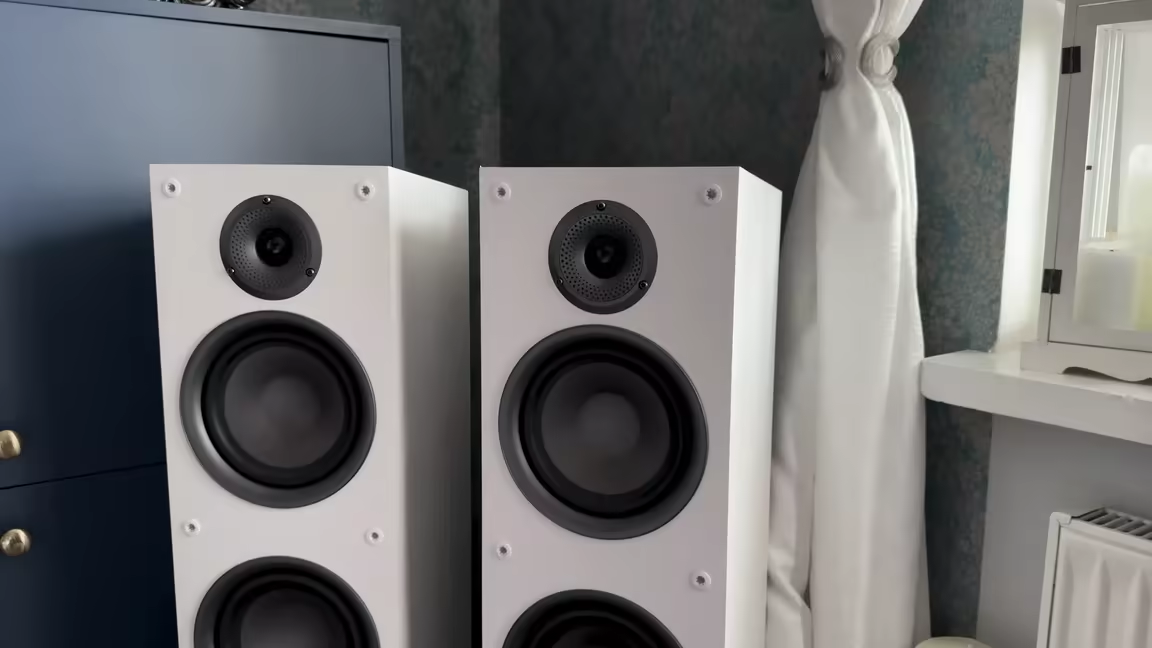
Taga TAV-607F Review: Floorstanders at Bookshelf Money
A surprisingly capable three-way floor-stander with twin 6.5" woofers, an angled-top low-interference cabinet, and an articulate, energetic sound that punches above its budget.
Taga TAV-500B v.2 Review: €249 Active Bookshelf Speakers
Active 6.5-inch bookshelf speakers with built-in Class D amplification, Bluetooth, USB, optical, and a 30Hz bass extension that punches way above their €249 price.
Triangle Australe EZ Review: Floorstanders That Cheat a Stage
French three-way floor-standers with a rear-firing DPS tweeter that 'cheats' a massive soundstage - lively, detailed, and demanding the right partnering gear.
Diora Acoustics Chors 5 Review: Speakers That Break the Rules
A 2-way closed-box floor-stander with ceramic-coated drivers, fast dynamic bass with no port, and uniquely smooth treble - one of the most distinct speakers in its class.
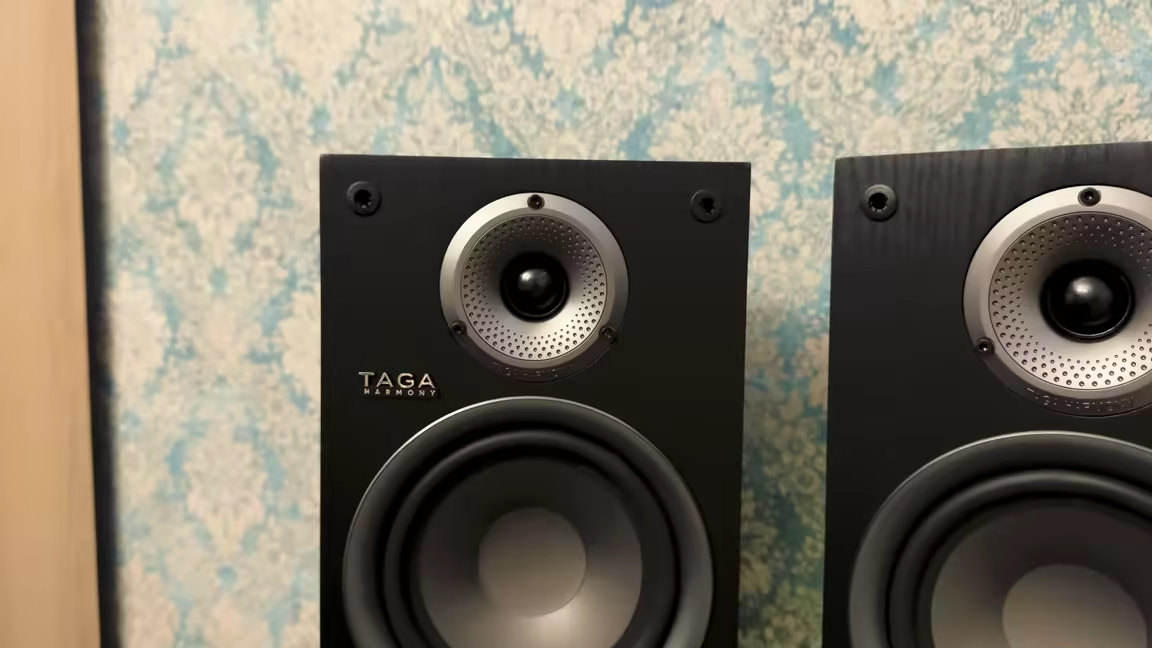
Taga Harmony DIAMOND B-60 Review: Is Neutrality in a Speaker Boring?
Bookshelf speakers with no parallel surfaces, neutral and organic tonality, and a midrange focus that's so inoffensive you'll listen for hours without noticing time pass.
Triangle Borea BR09 Review: The Best Budget Tower Speakers
Three-way French floor-standers with three bass drivers, neutral tonality, and a bigger-than-expected soundstage - balanced, distortion-free, and free of overdone bass.
Curated shortlists and free calculators to take you from browsing the list above to a decision you can act on.
Buying guideBest SpeakersEvery speaker we've had on the reference chain, ranked by score. Bookshelf and floor-standing loudspeakers, active and passive, from €249 to $4,999 a pair.Read the guide
CalculatorSpeaker Wattage CalculatorHow many watts your speakers need at the chair, by sensitivity, distance, room gain, and crest-factor headroom. Inverse-square law done for you.Open the tool
VisualizerRoom Mode CalculatorMap every standing wave resonance up to 300Hz in rectangular, L-shaped, round, and arched-ceiling rooms. Canvas visualizer shows nodes and antinodes. Tells you where to sit and where to place bass traps.Open the tool
FinderHelp Me Choose: Audio Gear Finder QuizAnswer four quick questions - category, budget, sound preference, use case - for a ranked shortlist pulled straight from our scored reviews. Then see every product mapped by price against score, your picks highlighted, every dot linking to its review.Open the tool
Head-to-head comparisons for speakers
The speakers we get asked about most, compared on one page - scores, sound signature, and which one to actually buy.
Every loudspeaker review on this page reflects weeks of listening in a measured, treated room, the same room every speaker passes through, with the same source chain (Denafrips Enyo 15th DAC, Hermes 12th transport), the same amplifier matched to the speaker's drive requirements, and the same listening positions. The Triangle Australe EZ is the in-house floor-standing reference, and the room itself has been measured with the room-mode calculator behaviour baked in so bass behaviour is calibrated rather than guessed.
On-axis frequency response evenness, the listening-window family of measurements, and whether the speaker tells the truth about the recording or imposes its own colour.
Imaging and soundstage
Lateral precision, depth layering, off-axis behaviour. A speaker that disappears as a sound source and replaces itself with a continuous stereo image earns the top marks here.
Low-end extension and control
Useful bass to ±3 dB, room loading behaviour, port chuffing, group delay. Speakers that hit deep but slosh are scored separately from speakers that hit deep and stop on time.
Room behaviour and dispersion
Directivity index, how the speaker integrates with a real room rather than an anechoic chamber, off-axis tonal balance at the listening seat.
Build and value
Cabinet construction, driver quality, finish, and how the speaker stacks against the reference list at its bracket. A $1,000 monitor that competes with $3,000 monitors earns the verdict that says so.
How to read the scores: A 9.0 speaker is a genuine category benchmark, reference-class in its price tier, often punching above it. An 8.0 is the top of its bracket without being category-defining. Speakers below 7.0 rarely ship as reviews unless they fail in interesting ways that other buyers should know about, and the reference list itself updates whenever a new piece earns its place.
Terms you will hit in the reviews
Sensitivity (dB/W/m)
SPL output at one metre when driven with one watt. Drops 3 dB for every halving of sensitivity, doubles the amplifier wattage required for the same SPL.
Spinorama / CTA-2034-A
Standardised loudspeaker measurement set: on-axis response, listening window, early reflections, sound power, and directivity index. The framework underpinning every modern speaker review.
Room mode
A standing-wave resonance fixed by the room dimensions. Creates audible bass peaks and nulls at specific frequencies below ~300 Hz; the room-mode calculator predicts every one of them.
Toe-in
The angle at which the speakers point toward the listener. Adjusts treble level and soundstage focus; even five degrees changes the experience meaningfully.
Bookshelf vs floorstanding
Two cabinet form factors. Bookshelves usually go on stands and pair well with subwoofers; floorstanders include their own low-frequency drivers and need more floor area and amplifier power.
We do not score speakers by cabinet finish, by what the demo-room cables cost, or by what the dealer wants moved this quarter. The room and the reference chain are the truth-tellers; brand prestige is not part of the rubric.
Speakers reviews: common questions.
Buying advice, terminology, and how the speakers category is reviewed on The Audio Stuff.
How do I choose the best speakers for my listening room?
Match speaker size to room volume and listening distance. Small bookshelves (5-6 inch woofer) for rooms under 25 sqm and chair distances under 3 m. Larger bookshelves or floorstanders for bigger rooms or longer distances. Use the room mode calculator to predict bass behaviour, and the SPL distance tool to confirm the speakers will play loud enough at your chair.
Should I get bookshelf or floorstanding speakers?
Bookshelves with a sub usually outperform similarly-priced floorstanders, especially in small rooms. The sub is positioned for smoothest bass while the bookshelves go where imaging is best. Floorstanders win for sub-free simplicity and maximum SPL in larger spaces. Both can sound spectacular; bookshelves give more flexibility per dollar.
Active vs passive speakers: which is better for hi-fi?
Active speakers (built-in amps) give you a complete, optimally-matched system in one box: the amp is engineered for the drivers, no cable losses, often DSP correction included. Passive speakers let you upgrade amp and source independently, with more cosmetic and connectivity flexibility. Active is the smarter all-in-one; passive is the audiophile playground.
How important is speaker placement?
More important than the speaker choice itself, in many rooms. Distance from rear and side walls changes bass extension by 6-12 dB. Toe-in changes treble character and soundstage focus. A mediocre speaker placed correctly often beats a great speaker placed poorly. Spend an afternoon with a tape measure before you spend a thousand dollars upgrading drivers.
Do I need studio monitors for accurate sound?
No. Studio monitors are tuned for short-distance critical listening with flat-on-axis response. Hi-fi speakers are tuned to sound right at typical home distances and angles. Use studio monitors if you mix; use hi-fi speakers for music enjoyment. Some pieces (like Genelec Ones, Neumann KH series) blur the line.

 Speakers TAV-607F