
Synergistic Research Network Router UEF Review: Does a $3,000 Router Improve Sound?
A wired-only audiophile router with a linear power supply, EM cell, ULF generator and carbon fiber voicing. In my system it lowered the noise floor on everything I stream.
higher than 21% of everything we have tested
Value Steep. You are buying performance here, not value.
- Standout
- Aircraft-grade aluminum chassis with a carbon fiber lid
- Watch out for
- Three thousand dollars, for a network router
Is it for you?
- You can hear hum or hash between tracks and want the fault fixed at the source
- You have a rack or a deep desk to give it
- Your system is already silent at the listening seat, where this is insurance rather than an upgrade
- It has to share a small desk, or move
Pick #9 of 13 in our Best Hi-Fi Accessories guide.
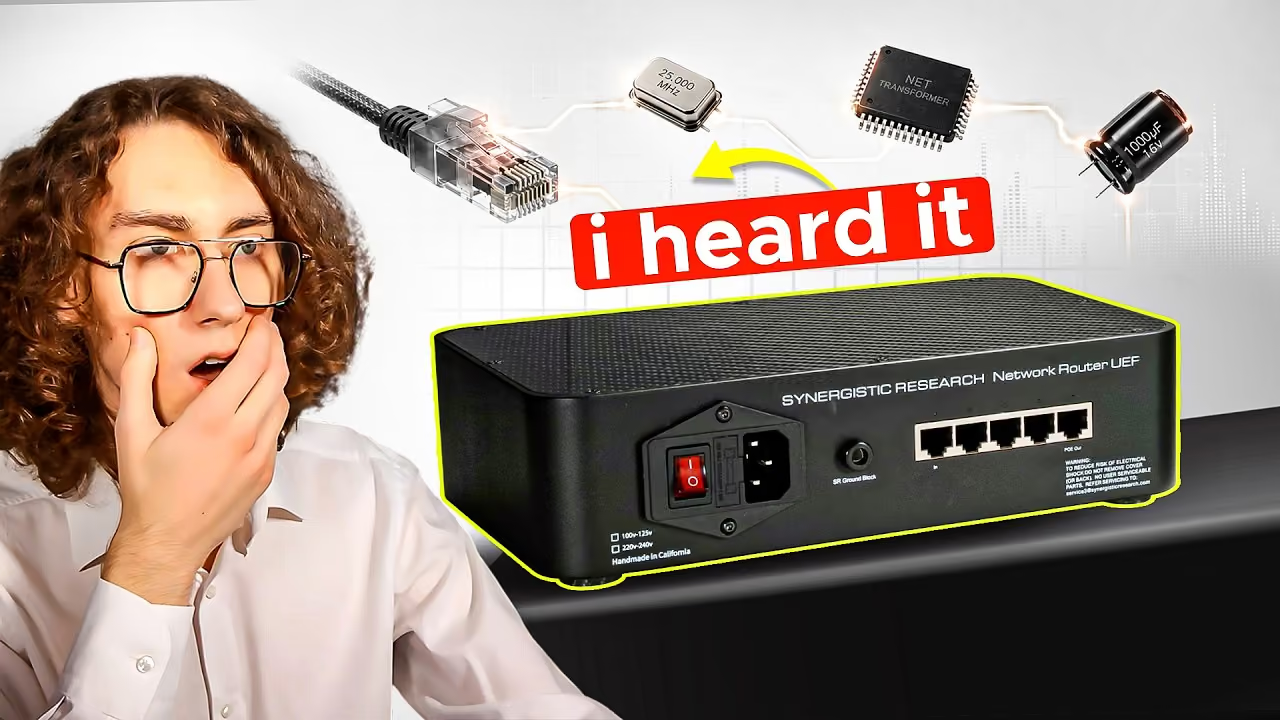
Three thousand dollars. For a router. And it claims to make your music sound better. Half the audio world calls the Synergistic Research Network Router UEF snake oil. The company guarantees it, or your money back. Somebody is wrong, so I tested it.
Design & Build Quality: 2.8 kg of Aluminum and Carbon Fiber
When I pulled the unit out of the box, my honest first thought was that no router has any business weighing this much. Two point eight kilos, in a footprint smaller than a shoebox. The router in your house right now is what, three hundred grams of plastic? This is a solid chunk of aircraft grade aluminum with a carbon fiber lid, carbon feet under it, and it is put together better than some amplifiers I have tested. Which is a genuinely weird sentence to write about a network router. That lid is also mirror-reflective, so it photographs far worse than it looks sitting in front of you.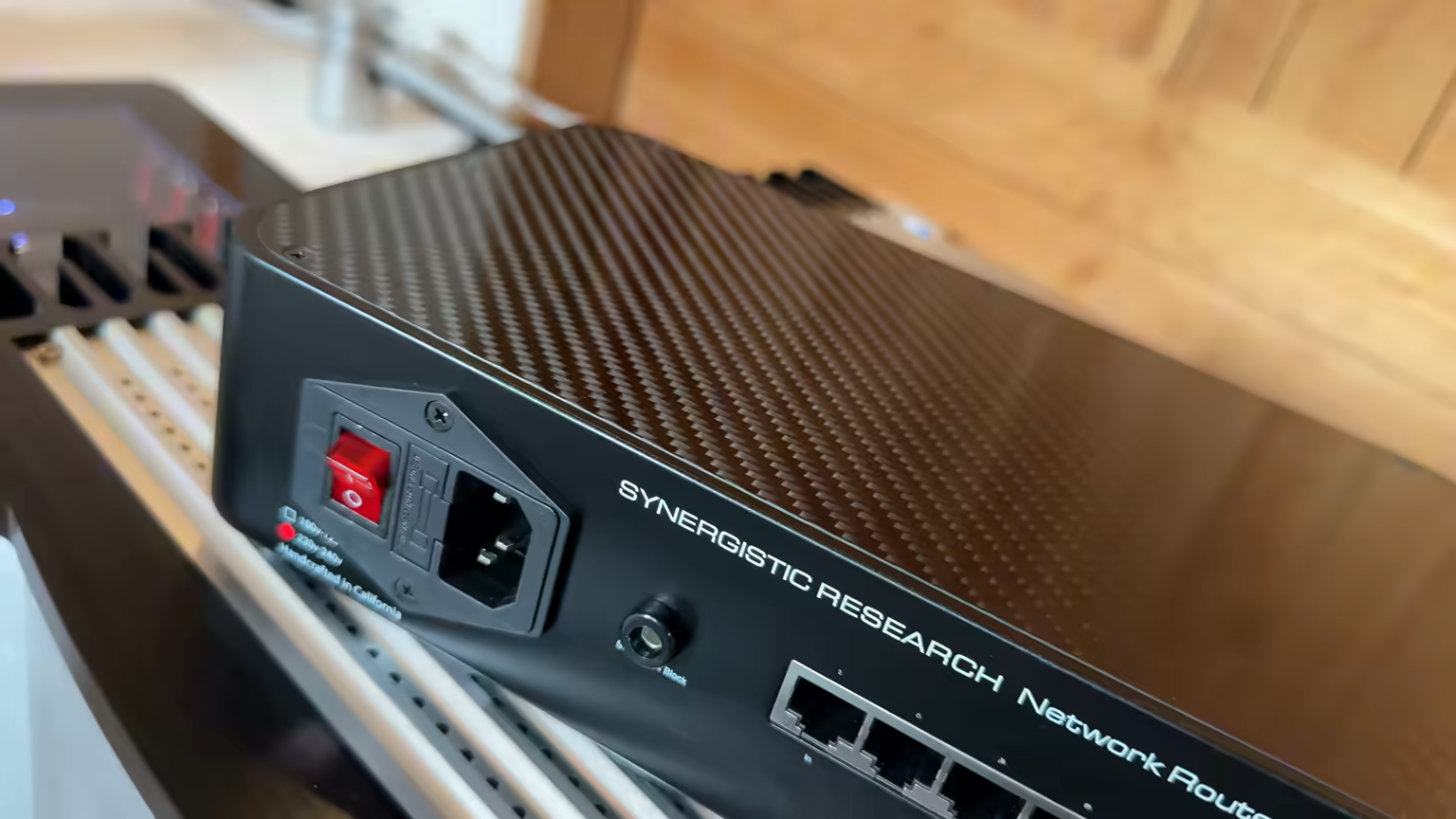 (view larger)
And it keeps going. Around the back there is a full power inlet, the same kind you would find on an amp, and in the box you get one of Synergistic Research's own Foundation power cables, a proper 12 gauge cord. There is an audiophile fuse inside too, and if that somehow is not enough, you can pay extra to upgrade the fuse. In your router. I am not joking.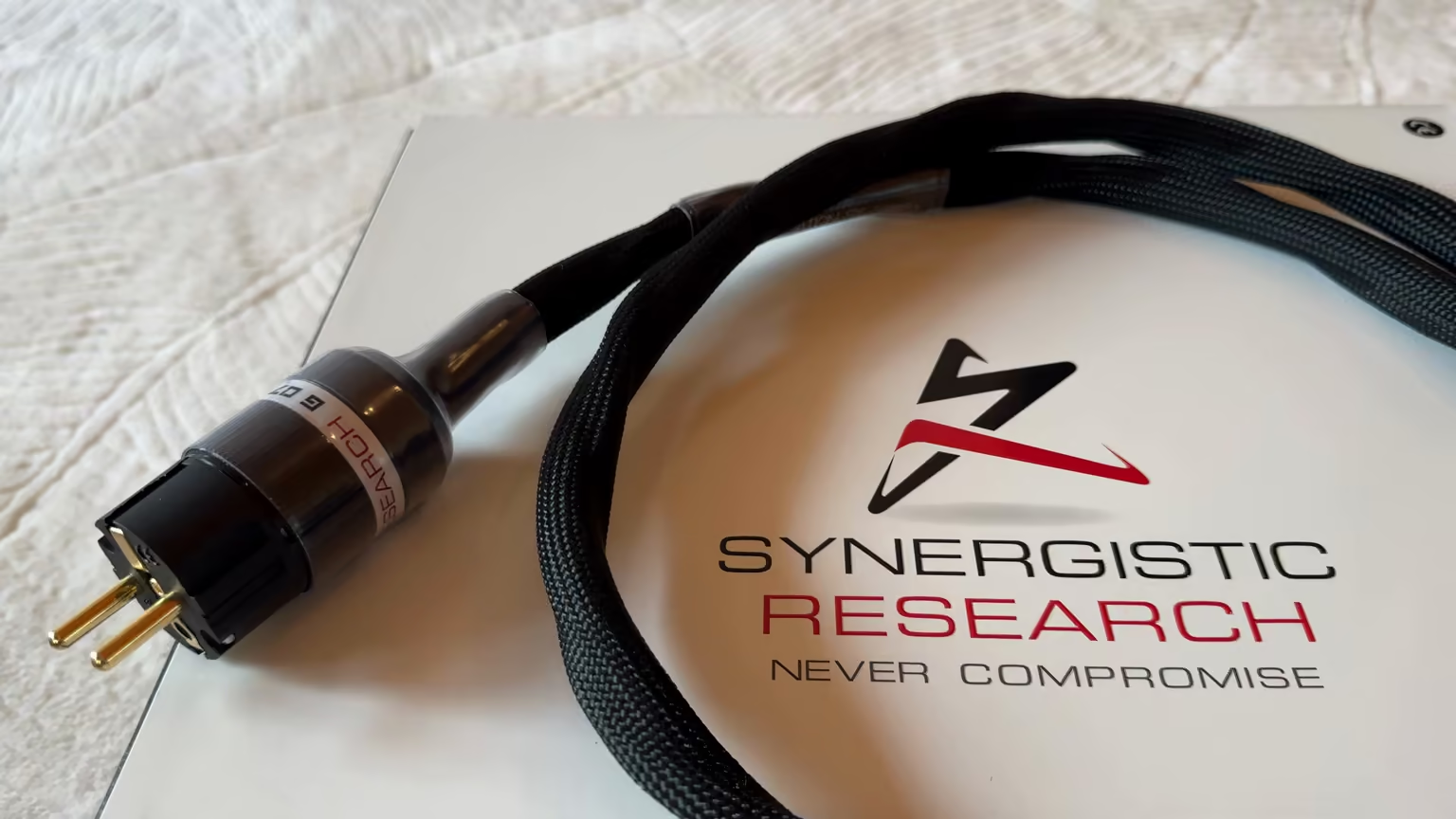 (view larger)
They do not stop at the carbon feet either. The box also holds a set of the company's own heavy metal footers, seriously dense little pucks, so you can stand the router on those instead and isolate it from your shelf even further. That is the kind of thing that only comes bundled with the highest-end audio products, not with anything that has an RJ45 socket on it.
Round the back you get five ethernet ports, so this can sit at the center of a whole audio system, plus a dedicated ground connection if you run their Ground Block. And there is a satisfyingly chunky power switch with a red indicator. Mine is the 220-240 V version, and the panel quietly tells you it was handcrafted in California.
So as a physical object, I really cannot knock it. It is wildly overbuilt, and it feels exactly like the high-end component the price says it is. The arguments only start when you ask what is actually going on inside.
Technologies: No WiFi, a Linear Supply, and a Schumann Generator
This is a wired-only unit. So why leave WiFi out? Because to Synergistic Research, WiFi is the enemy. A wireless router is basically a little radio transmitter sitting inside your hi-fi, throwing interference in every direction, and their whole argument is that this kind of wireless interference is exactly what degrades high-fidelity audio, so they isolated the network signal from it completely. They ripped it out on purpose. Once you understand that, the entire box starts to make sense, because every single thing inside it is built to fight one enemy. Noise.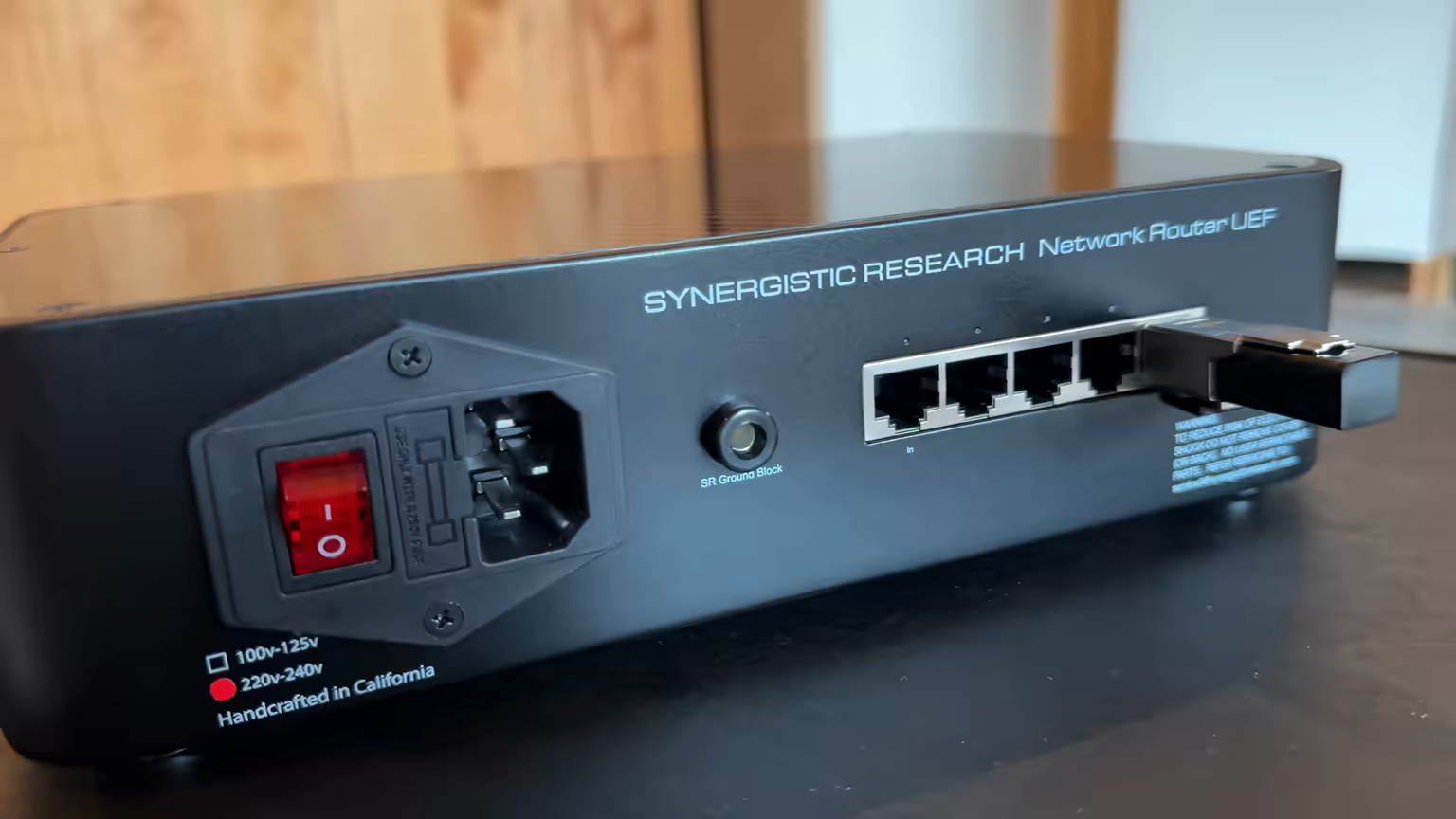 (view larger)
And the list of weapons they packed in here is honestly kind of absurd, starting with the power. A normal router runs off a switched-mode PSU, the cheapest and noisiest way you can feed a circuit. This one runs off a proper linear power supply instead, and not some generic one either. It is adapted from the design they first built for the Galileo PowerCell, their flagship power conditioner. So before any signal can pass through it, it is already being fed like a piece of quality audio gear.
Then it gets more exotic. Inside there is what SR calls an EM Cell, an electromagnetic cell, and this serves two purposes. It conditions the AC power coming into the unit, and it conditions the digital signal on its way out. Same family of technology as their Tranquility Pod, shrunk down and fitted into a router. On top of that you have got their UEF treatment, the uniform energy field tech that gives every SR product its name. Here it is applied to keep pushing electrical noise down on both the signal and the ground.
Now, the one that makes some people start a heated debate. There is an active generator inside this router tuned to the Schumann resonance. If that is new to you, the Schumann resonances are natural electromagnetic frequencies that exist between the Earth's surface and the ionosphere, people call them the planet's heartbeat, and they sit way down around eight cycles a second. SR built a dual frequency ultra-low-frequency generator using tech they first tested in the FEQ Carbon. It broadcasts harmonics of that frequency to actively shield and condition the whole unit. The idea, as they describe it, is that this low-frequency field overpowers the ambient radio interference around your gear. So yes. There is a box in this router resonating along with the Earth. That is a real feature, on a real spec sheet.
They are still not done. There is a passive ground conditioner built in, the same thinking as their Ground Block products, plus that dedicated jack on the back if you want to tie it into their bigger external grounding system. And then my favorite part: they voice this router. There is a custom carbon fiber tuning disc fixed to the circuit, with more carbon discs placed at specific spots inside the chassis. On top of that, every unit goes through high-voltage conditioning treatments before it ships, something like burn-in but at a much higher voltage. In their words, that tuning is there for added harmonic texture and liquidity. (view larger)
Does an Audiophile Router Change Anything?
Does a three-thousand-dollar router actually change the sound? I put it in my system to find out. Here is exactly what I did. Same DAC, same amp, same tracks, volume matched and never touched, for weeks. The only thing changing was the box feeding the network.
And I will be honest. The first time, I sat there thinking, I hear... something, maybe. I was tired after an entire day of setting things up in my listening room and other work, so I could not really judge it properly. If the test had ended there, the skeptics would have won.
But the real moment came about two weeks in, and it came the way it always seems to with this kind of gear. When I took it out. I went back to my normal router to reset my ears, played the same playlist, and something was significantly off. Flatter, in a way. The space between instruments collapsed, and the background was not as quiet as I had gotten used to. My honest first reaction was annoyance. I did not want this box to be a thing.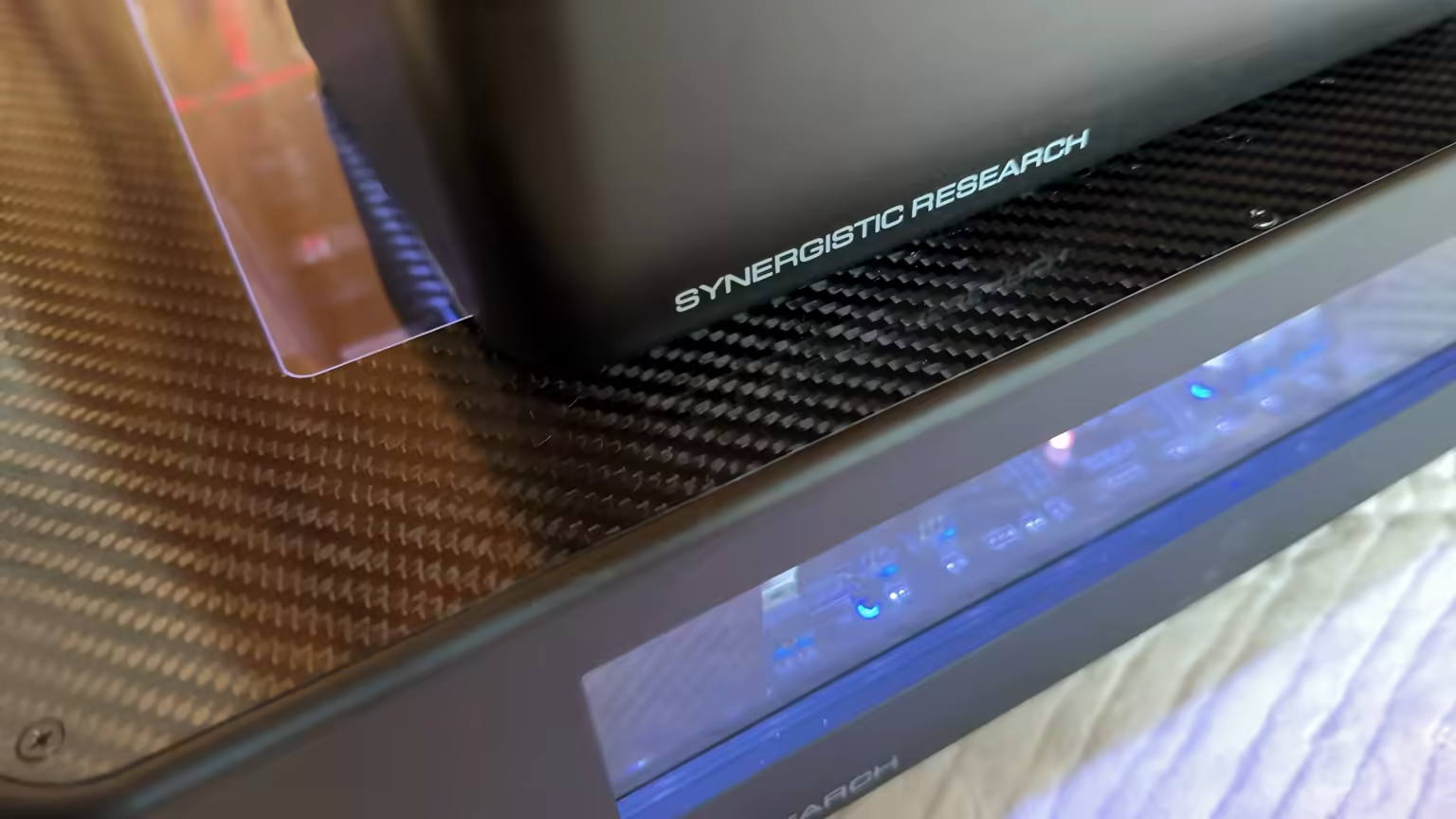 (view larger)
Now, it did not sound like trash either. My system still sounded great, just not as pristine anymore. So what actually changes? Not quite the tone. Nothing you would catch on a frequency response chart. It is the stuff around the music. The background gets darker, and against that darker background the layering opens up. Voices sit a little freer, not as blended with the instruments. Reverb tails hang a touch longer before they fade, though surprisingly, that never costs you any detail. The soundstage stretched wider and even slightly deeper for me, and everything flowed in a way that was just easier to listen to. Less of that low-level digital glare, which brought my system one step closer to a fully analog one. And the biggest one for me was streaming. The gap between Tidal and my local files shrank. Streamed music stopped sounding like the budget version of my library.
Now the part I cannot skip. Placebo. Expectation bias. I know. I would point at the same thing. A three-grand router is exactly the kind of product where your brain wants to hear a difference. All I can tell you is what I did about it. Matched the volume perfectly, repeated across weeks, swapped back and forth more times than was fun. I kept landing on the same answer. I will not call that scientific proof. It is not a measurement, and I cannot hand you my ears. But it is the most honest listening I know how to do, and the difference survived it. I am certain it is there.
Is it a big difference? Yes and no. And this is where products like this get misunderstood, so let me be really clear. A speaker upgrade will be more significant, and the same is true for acoustics. But you are often at a point where those are not practical, or you are just happy with them. That is where products like this router come into play. It is about as significant as your DAC or streamer, both still crucial elements of your system that you should not cheap out on.
One more obvious but important thing. This only matters in proportion to how much of your listening actually arrives over the network. If you stream everything, this box sits in the path of every single note you hear. If you mostly spin vinyl or play discs, it is simply not for you, and that is true no matter what the company promises.
So, this brings us all the way back. Somebody has to be wrong. The engineering side says a router cannot matter. Synergistic Research says it will transform your system, and they back that with a money-back guarantee and in-home auditions through their dealers. And after weeks, or actually months at this point with it, my answer is the one I least expected to give. In my system, something real happened. But you do not actually have to trust my ears, and that is the point. With that guarantee, your own room and system can settle this at basically zero risk. That is more than most controversial products will ever offer you.

Watch the video review
Subscribe on YouTube (opens in new tab)Prefer to read? The written review above covers everything in the video.
- 0:00 Is This HiFi Router A SCAM? (opens in new tab)
- 0:28 Design & Build Quality - Grounding Connection, MiG 4.0 Footers, Carbon Fiber, Weight (opens in new tab)
- 2:54 Technologies - UEF Treatment, Ground Conditioning, EM Cells, Linear PSU, No WiFi (opens in new tab)
- 7:05 Sound Quality - A/B Testing, Background Noise, Layering, Sound Stage Width (opens in new tab)
Common questions about the Network Router UEF
Is the Synergistic Research Network Router UEF worth it?
Yes, for the right listener - 7.8/10, Recommended, higher than 21% of everything we have tested, against a catalogue median of 8.1. On value it rates steep: better value exists in accessories, so you are buying performance here, not value. Price: From $2,995.
Who should buy the Synergistic Research Network Router UEF, and who should skip it?
Buy it if you can hear hum or hash between tracks and want the fault fixed at the source, and you have a rack or a deep desk to give it. Skip it if your system is already silent at the listening seat, where this is insurance rather than an upgrade, and it has to share a small desk, or move.
Can a router really change how your system sounds?
In mine, something real happened, and I did not want it to. The first listen was inconclusive and I was tired. The moment came about two weeks in, when I took it out: going back to my normal router, the same playlist was flatter, the space between instruments collapsed, and the background was not as quiet as I had got used to. My honest first reaction was annoyance. It did not sound bad afterwards - just not as pristine.
How do you rule out placebo on a $3,000 router?
You cannot entirely, and I will not pretend otherwise. This is exactly the kind of product where your brain wants to hear a difference. What I did about it: matched the volume perfectly and never touched it, repeated across weeks, and swapped back and forth more times than was fun. I kept landing on the same answer. That is not scientific proof and I cannot hand you my ears - it is the most honest listening I know how to do.
Why does an audiophile router have no WiFi?
Because to Synergistic Research, WiFi is the enemy. A wireless router is a small radio transmitter sitting inside your hi-fi throwing interference in every direction, and their argument is that this is precisely what degrades high-fidelity audio. So they removed it deliberately and isolated the network signal from it. Once you understand that, the rest of the box makes sense - every component inside is fighting noise. You will still need a separate access point.
Who should not buy the Network Router UEF?
Anyone who mostly plays vinyl or discs, and that is not a hedge. This only matters in proportion to how much of your listening arrives over the network: if you stream everything, the box sits in the path of every note you hear; if you spin records, it does nothing for you regardless of what the company promises. A speaker or acoustics upgrade will also always move you further, and this is for people for whom those are not practical.
What is the Schumann resonance generator actually for?
Active shielding, and it is the feature that starts arguments. The Schumann resonances are natural electromagnetic frequencies between the Earth's surface and the ionosphere, sitting around eight cycles a second. Synergistic built a dual-frequency ultra-low-frequency generator, first tested in the FEQ Carbon, that broadcasts harmonics of it to shield and condition the unit - the idea being that this low-frequency field overpowers ambient radio interference around your gear.
What does the Network Router UEF actually change?
Not the tone, and nothing you would catch on a frequency response chart. It is the stuff around the music: the background darkens, and against that the layering opens up. Voices sit a little freer rather than blending with the instruments, reverb tails hang slightly longer without costing any detail, and the stage stretched wider and a touch deeper. Less low-level digital glare. The biggest one for me was that the gap between Tidal and my local files shrank.
How risky is buying the Network Router UEF?
Less than you would think, and that is genuinely the point. Synergistic back it with a money-back guarantee and offer in-home auditions through their dealers, so your own room and system can settle this at essentially zero risk. That is more than most controversial products will ever offer. You do not have to trust my ears - which is exactly what I would say to anyone who reads a claim like this and reaches for the word snake oil.