Taga Harmony DIAMOND B-60 Review: Is Neutrality in a Speaker Boring?
Bookshelf speakers with no parallel surfaces, neutral and organic tonality, and a midrange focus that's so inoffensive you'll listen for hours without noticing time pass.
higher than 56% of everything we have tested
- Standout
- No parallel surfaces
- Watch out for
- Initial impressions can feel boring
- Better alternative
- Diora Acoustics Chors 5: $1,400 more, scores 0.3 higher.
Is it for you?
- You want to hear into a mix rather than be soothed by it
- You want more performance per dollar than most of its peers
- You want a forgiving listen that flatters a bad file
Pick #2 of 6 in our Best Speakers guide.
Many HiFi speakers have bright highs, bloated bass, or the typical, overemphasized showroom sound. The Taga Harmony DIAMOND B-60 v.3 bookshelf speakers are completely different. But is it good or bad news?
Build Quality and Design: Curved, Quietly Elegant
These are not your typical rectangular box-type speakers. There are no parallel surfaces. They look regular from the front, with a rounded-off top, but when viewed from the top, you can see that the sides curve inward towards the rear. It makes for a fairly elegant, but not boring aesthetic.
It looks fine and doesn't stand out a lot in terms of any flashy elements. By putting it in your living room, when your friends come in, they aren't going to think that you're crazy.
The drivers are surface mounted, but the rings around them have exposed screws - personally, it didn't bother me much. On the bottom, you get nice, thin rubber feet, so the speaker doesn't get scratched when you place it on any surface, it's not going to scratch that surface itself, and it should stay in place without sliding around.
The rear also has an interesting shape, with the top and bottom elements sticking out. There's a rear-mounted bass reflex port. However, it's important to note that the tweeter is not in a separate, internal, sealed enclosure - so it is also vented. You get two pairs of high-quality binding posts, allowing the speaker to be used in a bi-wire or bi-amp configuration.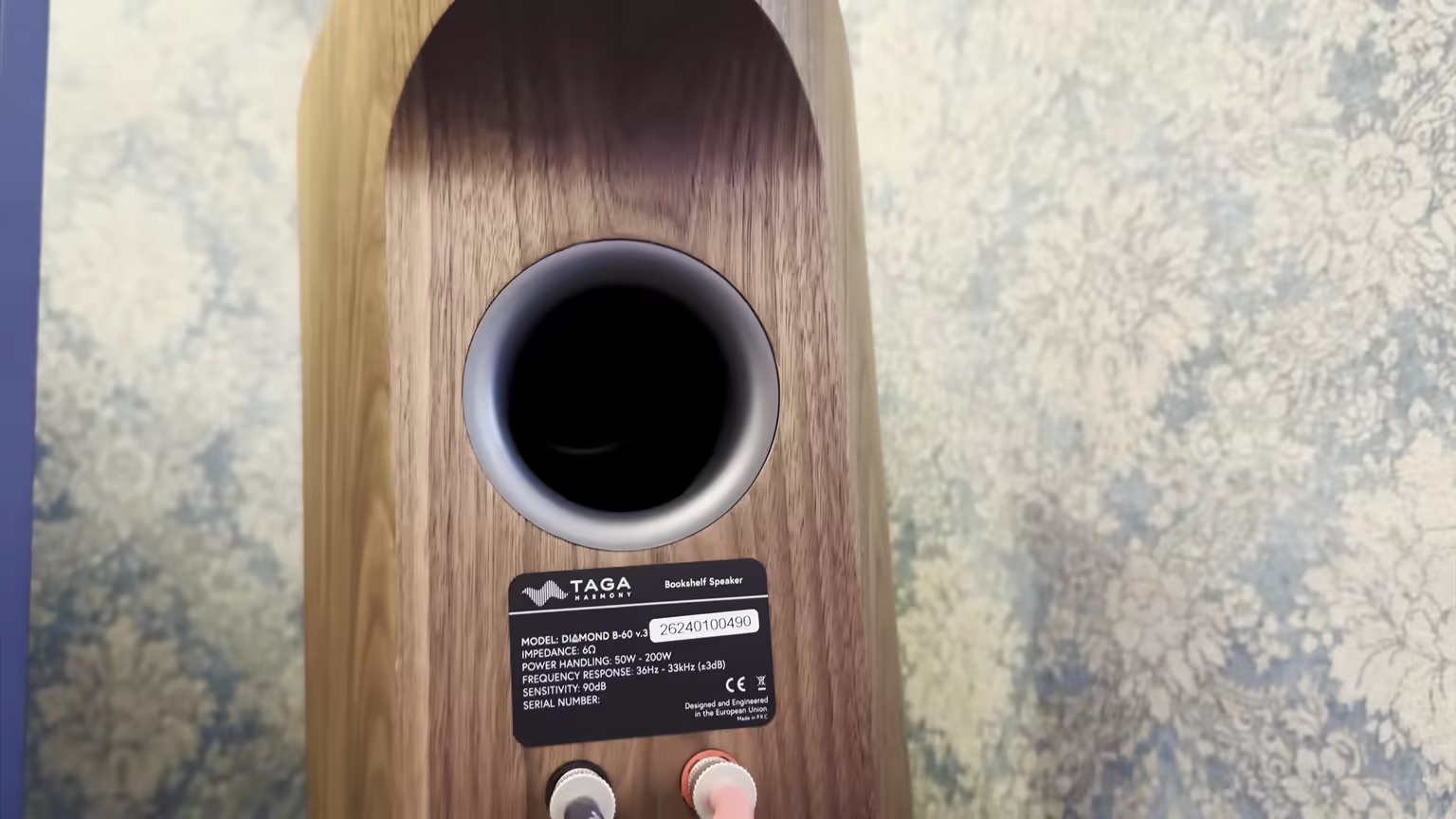 (view larger)
They come in multiple finishes - matte and gloss - so you can pick whichever one you like. The veneer itself is of superb quality, has a real texture, and is applied just perfectly, with no visible problems whatsoever.
It's a well-made, sturdy speaker, with a dense cabinet, and not a lot of internal resonances. Lastly, you get magnetic grills, to protect the drivers from kids or pets, and make the speaker look even more stealthy.
Features: A Titanium Dome and Paper Cone Pairing
The internal enclosure damping is being done using a high-end material to break up the standing waves, lower resonances, and limit distortions, which improves the smoothness and characteristics of sound in all ranges.
For the internal wiring, 14 AWG, multi-stranded oxygen-free copper has been used to connect all drivers with the crossover and to ensure that the incoming signal will not lose the most important details on the path from the amplifier to the drivers.
The crossover has been made using a minimal number of high-quality components in the tweeter and the woofer sections to ensure neutrality, handle massive amounts of power, and provide the greatest precision.
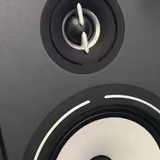
The 2nd generation titanium dome tweeter is 36mm in size and provides high power handling while maintaining accuracy, smoothness, and detail. It is cooled by ferrofluid to further emphasize this effect, especially at high volumes. Its voice coil has silver wiring and is paired with two magnets for exceptional precision combined with an ultra-extended high-frequency response. The metal mesh surrounding it is here to help with equal and flat sound dispersion on and off-axis.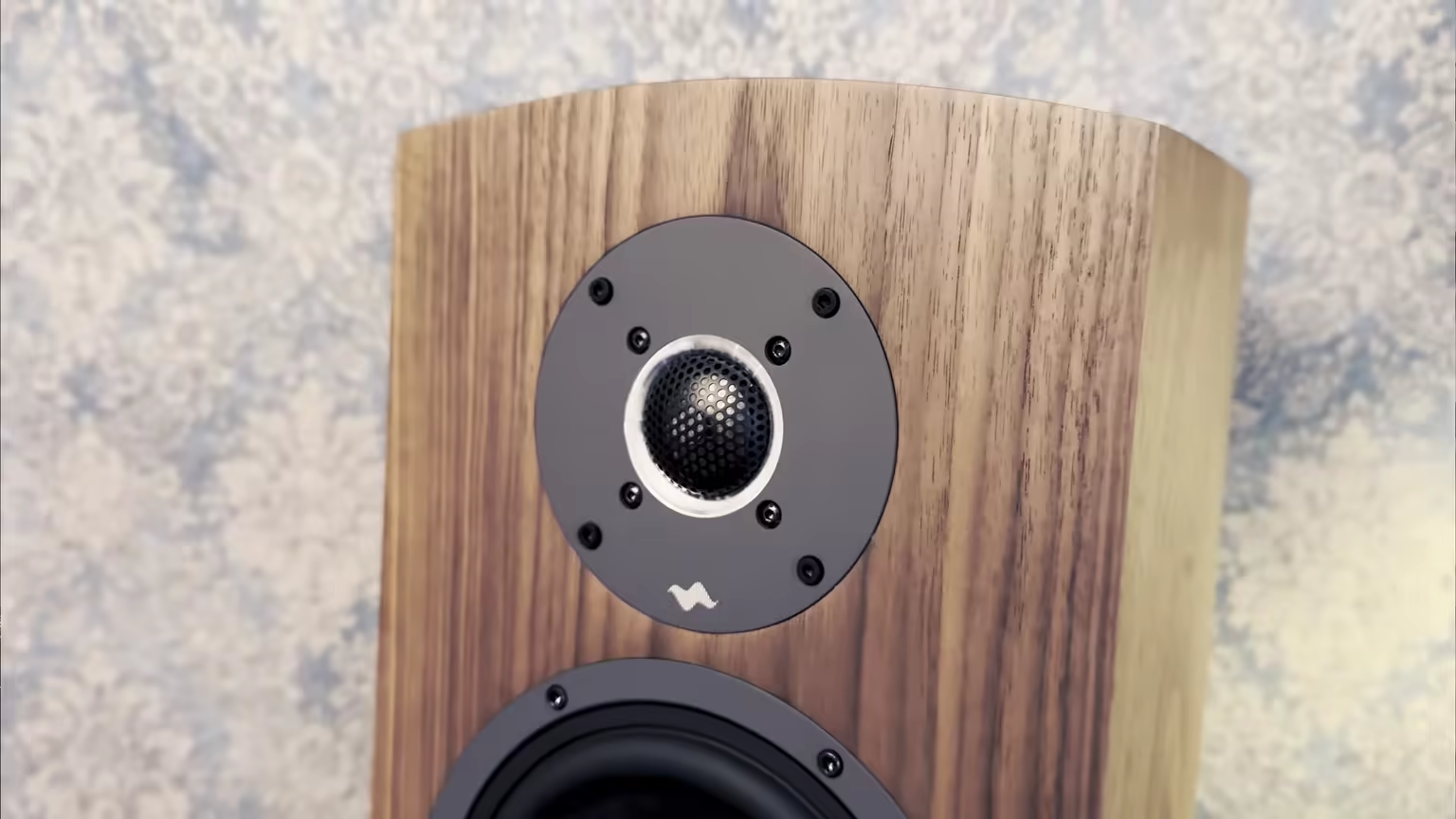 (view larger)
The 6.5-inch non-pressed paper cone driver handles the bass and midrange - as this speaker is a 2-way bookshelf. It is equipped with two oversized magnets and an aluminum chassis to make it extremely rigid and vibration-free. Its voice coil is made with 2 layers of copper-clad aluminum, to offer deep, precise, and detailed performance, according to the manufacturer.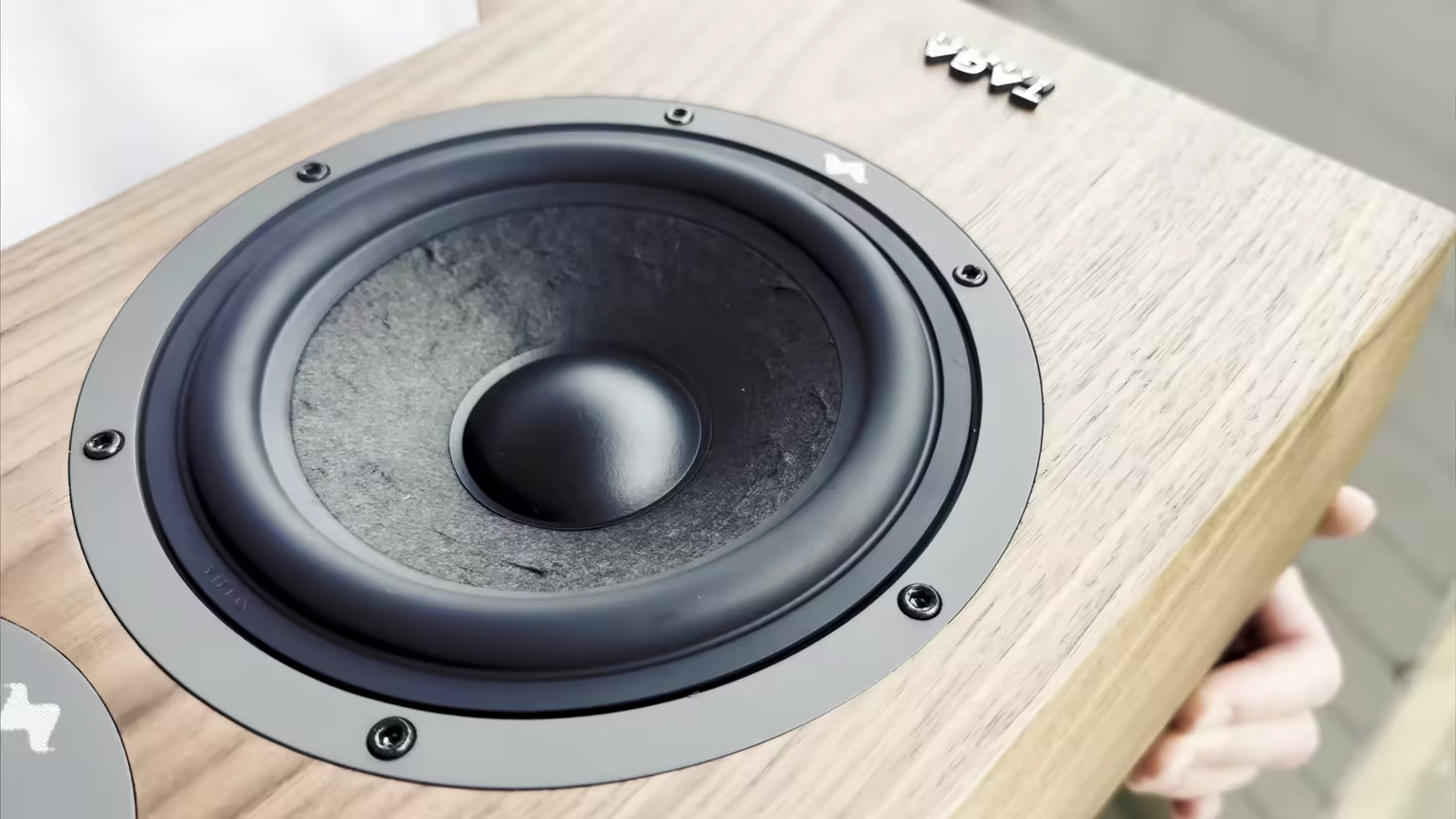 (view larger)
Technical Specs: Deep for a Bookshelf, Wants Power
Its frequency response ranges from 36Hz up to 33kHz. This range is quite surprising for a seemingly small, in a relative sense, speaker. It has just one woofer, and it's not even dedicated to the bass, yet it can still dig fairly deep. The treble extends much above the human hearing range - it's a very good characteristic, as it means no break-ups in the audible spectrum.
Additionally, it can handle up to 150W RMS, which is a figure mostly seen in much larger floor-standing speakers. The sensitivity is 90dB, paired with a nominal impedance of 6 ohms. It presents quite an easy load on most amplifiers regarding current. The amount of power needed to achieve high volumes is not very high, but I'd recommend getting an amplifier that has a bit more power than you might think you need. This speaker can scale well with the source gear, and it needs a certain level of equipment to open up. 50-200W is recommended by the manufacturer, however, in my experience, I'd say go for at least 100W.
How Does It Sound? Inoffensive in the Best Way
At first sight, my initial impressions of this speaker indicated that it's very boring, nothing stands out, and it just plays the music. But the more I listened to it, the more I realized "Wait... it's been a long time, I'm still listening to it, and I didn't get bored." That was the moment when I found out it's not just dull or lacking life. It's so inoffensive that I couldn't find a single thing that stood out and could take my attention away from it.
This brings us to its tonality.
On the bottom end, the bass has warmth, is full, and goes kind of deep for a bookshelf. You still might want to pair it with a subwoofer, for higher output, or even more bass extension. But if you so desire, you can get away without it easily. You're never going to feel like a lot is missing in the bass department. Despite the driver being 6.5 inches, it's not super analytical or fast. It mostly focuses on organic reproduction, thus being realistic.
The midrange is what this speaker specializes in. It seems like those registers are brought forward, yet not overdone. The midrange has great timbre and accuracy, with some extra warmth too. The vocals, or wooden instruments, sound impeccable here.
Going to the treble - it's fairly relaxed, very smooth and lifelike. Sibilance? What sibilance. You'd have to try really hard to make it overly sharp or bright. The source gear you put behind this speaker is a decision you have to make on your own. But I can tell you - if you're looking for more excitement up top, you can get some without crossing the line, by using sharper, for example Topping DACs. It can help you open up the presentation and get more details - but you have to keep in mind that it's never going to be an overly detailed, analytical speaker that's unpleasant to listen to.
The soundstage has some width, but more importantly, depth, paired with layering.
Summing up, the DIAMOND B-60 v.3 is a speaker that focuses on sounding organic, without messing up any frequency spectrum or introducing any stand-out features. It's going to sound good with almost any source gear, plus it is fairly flexible with positioning. If you're into a warmer, relaxed presentation, but you still want to get some of the typical audiophile features, it is a great choice.
Sound signature
Derived from the words this review uses: each axis runs between two opposite descriptors, and the shape leans toward whichever side the writing does.
- Warm ↔ Bright Sits close to centre
- Relaxed ↔ Analytical Leans analytical
- Polite ↔ Aggressive Leans aggressive
- Lean ↔ Bass-heavy Neutral, no clear signal in the review language
- Intimate ↔ Wide stage Neutral, no clear signal in the review language
Hear what "analytical, aggressive" means: a short synthesised loop, flat and then with those leanings. An illustration of the words, not a recording of the DIAMOND B-60 v.3.
Not sure which signature suits you? Find yours with a blind A/B test
Watch the video review
Subscribe on YouTube (opens in new tab)Prefer to read? The written review above covers everything in the video.
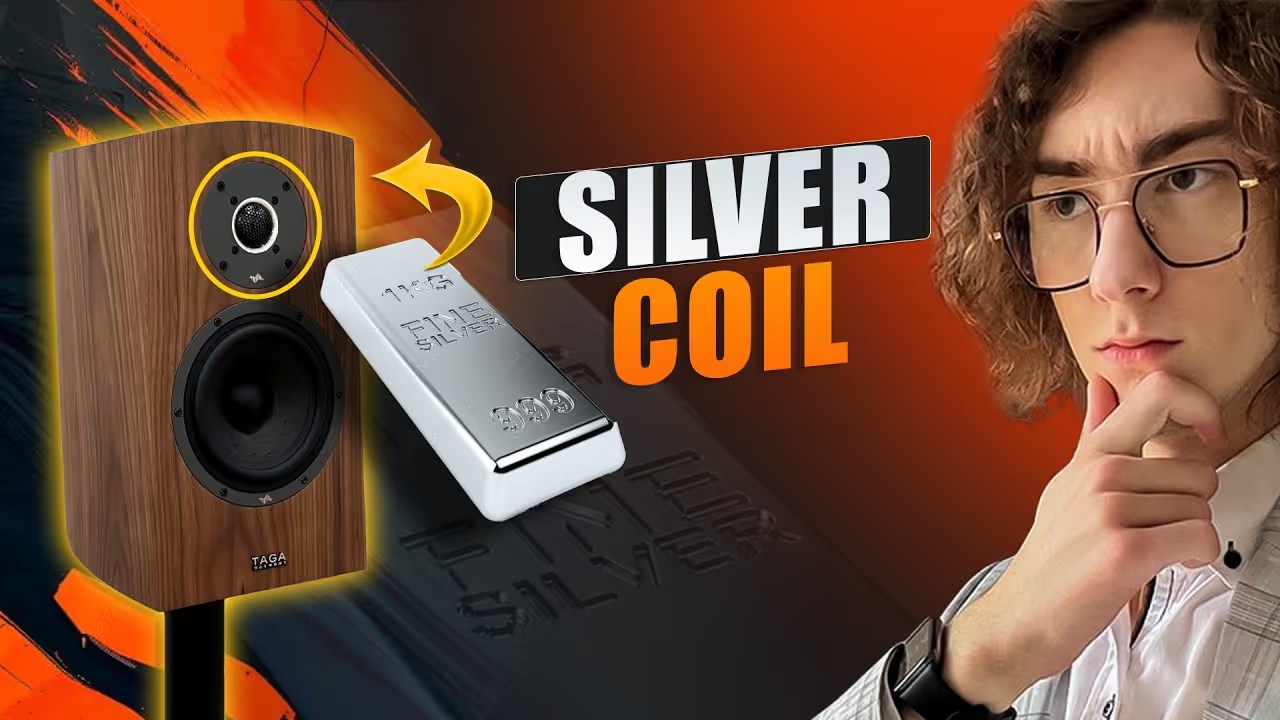
- 0:00 Top 3 issues of audiophile speakers (opens in new tab)
- 0:18 Build Quality & Design (Curved edges, Materials, Finish, Surface mounted drivers, Bi-amp, Bi-wire) (opens in new tab)
- 2:15 Features (High-quality enclosure damping, Internal wiring, Crossover components, Titanium tweeter) (opens in new tab)
- 3:55 Technical Specs (Impedance, Frequency response, Power handling, Sensitivity, AMP matching) (opens in new tab)
- 5:07 Sound Quality (Refinement, Tonal balance, Bass Extension, Midrange, Vocal Performance, Realism, Detail retrieval) (opens in new tab)
Common questions about the DIAMOND B-60 v.3
Is the Taga Harmony DIAMOND B-60 v.3 worth it?
Yes, for the right listener - 8.2/10, Recommended, higher than 56% of everything we have tested, against a catalogue median of 8.1. On value it rates strong: above average for the price in speakers. Price: $1,099/pair.
Who should buy the Taga Harmony DIAMOND B-60 v.3, and who should skip it?
Buy it if you want to hear into a mix rather than be soothed by it, and you want more performance per dollar than most of its peers. Skip it if you want a forgiving listen that flatters a bad file.
What else have you tested around the price of the Taga Harmony DIAMOND B-60 v.3?
No head-to-head page for this one yet. The closest reference points we have scored in the same bracket: the Triangle Borea BR09 at 8.0/10.
Is the DIAMOND B-60 boring?
That was my first impression and it was wrong. Nothing stands out, and I initially read that as dull. Then I noticed I had been listening for a long time without getting bored - which was the moment it clicked. It is not lacking life; it is so inoffensive that nothing ever pulls your attention away from the music. If you want a V-shaped showroom thrill, this is the wrong speaker. If you want to listen for hours, it is unusually good at it.
How much power does the DIAMOND B-60 need?
Taga say 50 to 200W; I would go for at least 100W. The 90dB sensitivity and 6-ohm nominal impedance make it an easy load in current terms, and getting to high volume does not take much - but this speaker scales with what is behind it and needs a certain level of equipment before it opens up. Buying more amplifier than you think you need is the right call here, which is not true of every speaker.
Do you need a subwoofer with the DIAMOND B-60?
Not for music. The response reaches 36Hz, which is surprising for a bookshelf with a single 6.5-inch driver that is also doing the midrange, and the bass is warm, full and goes reasonably deep - you will never feel a lot is missing. A subwoofer is worth adding for higher output, more extension, or home theatre. Bear in mind the driver is not especially analytical or fast down there; it is aimed at organic, realistic reproduction.
How do you add excitement to the DIAMOND B-60?
Through the source, and carefully. The treble here is relaxed, very smooth and lifelike - you would have to try hard to make it sharp or bright, and sibilance is essentially absent. If you want more sparkle you can get it without crossing a line by using a sharper DAC, something like Topping's, which opens up the presentation and brings out more detail. Just know the ceiling: it is never going to become an analytical speaker, and that is the point of it.
What does the DIAMOND B-60's curved cabinet do?
It removes parallel surfaces, which is where standing waves inside a box come from. From the front it looks conventional with a rounded top; viewed from above, the sides curve inward toward the rear. Inside, a high-end damping material breaks up standing waves further, lowers resonance and limits distortion. The result is a dense, sturdy cabinet without much internal resonance, and an aesthetic that will not make your friends think you have lost it.
Is the vented tweeter a problem on the DIAMOND B-60?
It is worth knowing rather than worrying about. The tweeter does not sit in its own sealed internal enclosure, so it shares the cabinet volume with the woofer and is therefore vented by the rear bass reflex port. Plenty of good speakers do this. The tweeter itself is well specified for the money: a second-generation 36mm titanium dome with ferrofluid cooling, a silver-wired voice coil and two magnets, behind a metal mesh that helps keep dispersion even on and off axis.
If you're interested in this
All 6 speakers reviewsClosest alternatives