
Verum Audio Verum 1 Review: The Planar That's Scared of Treble
A $350 open-back planar that goes the opposite direction from most of the market - smooth, refined highs, full warm mids, and ruler-flat bass to 20Hz.
higher than 34% of everything we have tested
- Standout
- Stunning wooden earcup design with metal cut-out grills
- Watch out for
- 8Ω impedance demands real current from the amplifier
- Better alternative
- HIFIMAN Sundara: $50 less, scores 1.0 higher.
Is it for you?
- You want to hear into a mix rather than be soothed by it
- You do not want to buy an amplifier before you can hear it properly
- You want a forgiving listen that flatters a bad file
Pick #8 of 12 in our Best Headphones Under $500 guide.
Lots of headphones - like ones from HIFIMAN, Beyerdynamic, or Audeze are trying to squeeze as much detail as possible. Verum 1, instead of being overly analytical, bright, and sharp takes a different approach. Let's check it out.
Comfort & Build Quality: Comma-Shaped Wood, Magnetic Leather Pads
This is a stunning-looking headphone. Does it stand out from the crowd? Yeah, maybe a little bit, considering that a lot of headphones nowadays are simply blacked out with no flashy elements. But does it look cheap? Nooo. (view larger)
The earcups are made of shockproof ABS, so they aren't real wood, but for durability and maintenance reasons, that's preferable. They are quite large, however their shape is not a circle - that's for a reason. Instead, they are "comma-shaped", or in the shape of a text bubble. Regardless, the reason behind that is closely related to the way the 3.5mm connectors are mounted. They are at an almost 90-degree angle, making them pretty difficult to use with most regular cables. Luckily in the box, you also get a cable that takes full advantage of this design, with matching 90-degree headphone connectors. This smart design makes the cable go out of the way a lot. Since it's brought forward, compared to regular jack connector placement, it is not hitting, or resting directly on your shoulders. That's pretty brilliant until you want to swap the cable with something aftermarket.
Getting back to the headphones, they have fully metal grills, with a nice cut-out design, and a small V in the middle, which is a logo of Verum Audio. The earpads are thick - for both comfort and tuning reasons. They are made of real leather, for a more premium feel. Their shape is angled externally, to better match the human head. Internally the shape is oval, to fit our ears better, than if they were completely round. What's interesting - you can replace the pads in a matter of seconds, as they are magnetically attached. In my opinion, that is a very smart choice. (view larger)
For the headband - a unique type of suspension stripe construction has been chosen. It has a real leather strap, that's quite soft and adjusts to my head shape perfectly. Moreover, there's a good amount of swivel around the screw point in the middle. That's an interesting way to make cups rotatable, but hey - it works! Additionally, we get cup tilt, that's pretty much unlimited, for even better seal and comfort.
This headphone comes in 3 color variants - 2 of them have a wooden finish, with different wood types and grill colors, and one of them imitates a carbon fiber look. I'm personally a fan of the wooden ones - they look so good.
Cable and Accessories: A Clever 90° Cable, and Little Else
Besides the headphones, all we get in the box is the included cable. It is single-ended, however, you can also get its balanced version. It uses two conductors per connection point. It could get away with a single one, and make a good enough job at transferring the signal, but Verum Audio decided to go a step further. Doubling the conductive area surely had some impact on the signal quality getting to the headphones. Skipping its effect on the sound, as I'm sure it's going to make some people mad, it also helps greatly with durability, nicer feeling, and looking more substantial.
The connectors used here seem to be of higher quality than your standard plastic ones because of their fully metal enclosure on both ends. It also uses an aluminum splitter that matches the color-way of this cable perfectly.
Technologies: An 82mm Planar Driven by 28 Magnets
Verum 1 uses planar magnetic technology - which is definitely less common than dynamic drivers. Instead of having a coil with a suspension and a membrane, it uses magnets. They're moving a super thin diaphragm by varying the electromagnetic fields, which affect the magnetic coating, made of aluminum, on the diaphragm.
This approach allows for more control over the headphone's sound, lower distortion, and potentially larger radiating area. The diaphragm itself is being controlled, and put into motion by 28 rare-earth magnets.
Technical Specifications: 8Ω, Current-Hungry, Scales with Power
This headphone's membrane is 82mm in size - trust me, that's a serious number. Most dynamic driver headphones max out at roughly 50mm. Its sensitivity comes at 96dB/mW of power - that's pretty high. On the other hand, the impedance is extremely low - 8 ohms. That's a number, that indicates a high current demand from your amplifier.
Although you might think that lower impedance means easier to drive, which more often than not is true, in this case, it isn't the full story. 8 ohms is unusually low, and while you're surely able to drive it with less powerful sources, because of the high sensitivity, it scales. The more power you provide and the higher its quality, the better the sound quality becomes. The bass becomes more prominent, tight, and accurate. The soundstage gets noticeably wider, and less closed in.
I'd recommend starting with 2 watts per channel, as a good starting point. Nowadays, it's not as difficult for amplifiers to achieve, so you don't have to spend big money on the amplifier itself. Of course, if you do, it helps - you get more refinement and detail - but let's not go crazy, this headphone is priced at $350.
Sound Quality: Smooth Treble, Warm Mids, Flat Bass to 20Hz
The first thing, that you can immediately hear, and I even asked one of my non-audiophile friends to try it out, just to confirm that I'm not imagining things, is that it sounds very smooth and extremely delicate in the top end. It never ever goes sharp at all. Sometimes the treble seems a little backed off if anything. It is almost impossible to make it sibilant, even with rather bright-sounding source gear, like for example topping offerings. For some, it's going to sound perhaps veiled or lacking clarity, but that's going to be their first impression only. After you spend some time with it, you start appreciating this fact more and it turns into refinement.
The midrange is one of the most important aspects of any audio device in my opinion. Here, it is very full, warm, and inviting, especially with modern vocals. There's a little bit of forwardness, compared to other, perhaps slightly v-shaped competitors on the market. If you're a fan of this lively midrange, here, you get even more of it. When listening to songs that on other gear place the vocalist and the instrumental track equally in the mix, on Verum 1 the instruments seem to be dominating.
The bass extension is pretty much ruler flat down to 20Hz, possibly even lower. Yes, you can hear 20Hz with no problem whatsoever. Not every headphone, and definitely not a lot of dynamic driver headphones can do that. It is one of the aspects where planar magnetic technology truly shows its potential. Regarding bass speed, it is up there. That's quite a fast, snappy-sounding driver, it never approaches any sluggishness. What's surprising, is the long decay, that's not lost despite the rapid driver movements. Usually when a headphone sounds quick in the bass hits, it lacks some decay information, making it somewhat dry, or unrealistic. This phenomenon doesn't occur with Verum 1 for a reason that's probably their secret!
Soundstage and Imaging: Sounds Behind You, but Closed-In
Additionally, it's good at placing sounds behind me, not all headphones can do that, usually with head-based listening devices, you get left-to-right and some frontal staging. Here, in some cases, it goes to the back, which reminds me a lot of the Edition XS.
Overall the soundstage is not super wide, it seems pretty closed-in. Not nearly to the HD650 extent, as the Verum 1 can at least get out of your head slightly. I have a feeling it's related to the frequency response, and the upper midrange dip, as I've heard other headphones do that to achieve a sense of spaciousness.
Is the Verum 1 Worth $350? A Disruptive Planar
This headphone is a serious contender in its price category. I know that it caused some disruption in the market already, and I know that it will continue to do so unless its price is going to be increased. I'm also aware that Verum Audio is working on a new, even better version called - Verum 2. I'm very excited to see how it goes from there, as their first headphone is packing some serious punch.
Sound signature
Derived from the words this review uses: each axis runs between two opposite descriptors, and the shape leans toward whichever side the writing does.
- Warm ↔ Bright Sits close to centre
- Relaxed ↔ Analytical Leans analytical
- Polite ↔ Aggressive Leans aggressive
- Lean ↔ Bass-heavy Neutral, no clear signal in the review language
- Intimate ↔ Wide stage Neutral, no clear signal in the review language
Hear what "analytical, aggressive" means: a short synthesised loop, flat and then with those leanings. An illustration of the words, not a recording of the Verum 1.
Not sure which signature suits you? Find yours with a blind A/B test

Watch the video review
Subscribe on YouTube (opens in new tab)Prefer to read? The written review above covers everything in the video.
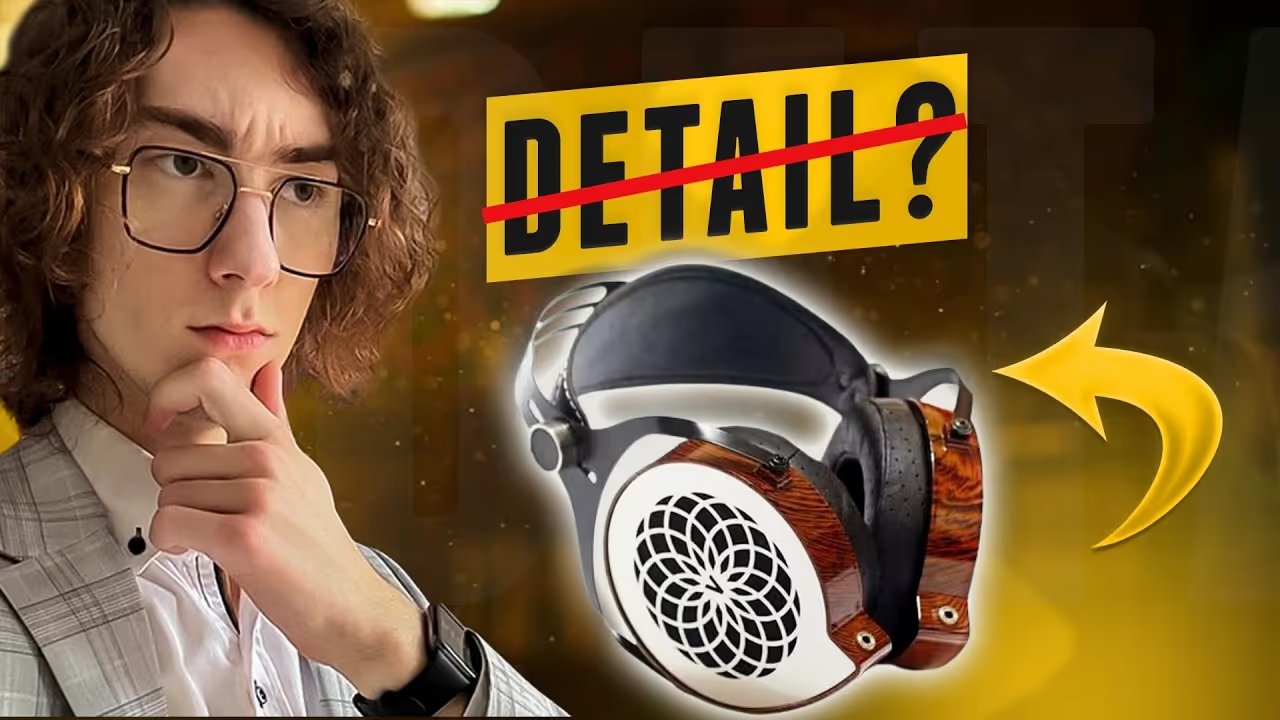
- 0:00 Why So Many Headphones Are TOO BRIGHT? (opens in new tab)
- 0:17 Comfort & Build Quality (Shockproof ABS, 90-degree Connectors, Audiophile-Grade Cable) (opens in new tab)
- 3:40 Technologies (Planar Magnetic Driver, Rare-earth Magnets, Thin Diapgragm, Aluminum Coating) (opens in new tab)
- 4:18 Technical Specs (Large Membrane, Unusually Low Impedance, High Sensitivity, AMP Scaling) (opens in new tab)
- 5:56 Sound Quality (Tonal Balance, Lack Of Sibilance, Refinement, Midrange Warmth, Soundstage) (opens in new tab)
Common questions about the Verum 1
Is the Verum Audio Verum 1 worth it?
Yes, for the right listener - 8.0/10, Recommended, higher than 34% of everything we have tested, against a catalogue median of 8.1. On value it rates fair: mid-pack for the price in headphones. Price: $349.
Who should buy the Verum Audio Verum 1, and who should skip it?
Buy it if you want to hear into a mix rather than be soothed by it, and you do not want to buy an amplifier before you can hear it properly. Skip it if you want a forgiving listen that flatters a bad file.
What amplifier does the Verum Audio Verum 1 need?
Impedance is 8 Ω. By the rule of eighths the amplifier feeding it wants an output impedance no higher than 1 Ω, otherwise the interaction between the two tilts the frequency response rather than simply making it quieter. Power is the separate question. About 25 mW to reach 110 dB peaks, which is a phone jack or any dongle.
What should I consider instead of the Verum Audio Verum 1?
The pieces we have actually run against it: the Sivga Luan scores 0.1 higher and costs $50 less and the Sivga Anser scores the same and costs $150 less. Every one of those matchups has its own page in the head-to-head section.
What amplifier does the Verum 1 need?
Start at 2 watts per channel, and understand why. The 8-ohm impedance is unusually low, which means high current demand rather than easy drive - the high 96dB/mW sensitivity will get it loud off modest sources, but that is not the same as getting it right. This headphone scales hard: more power and better power both improve it. The bass becomes more prominent, tight and accurate, and the soundstage widens noticeably. Two watts is not expensive to find these days.
Is the Verum 1's treble veiled?
It will sound that way at first, and then it stops. The top end is extremely smooth and delicate, it never goes sharp, and it is almost impossible to make sibilant even with bright sources. Sometimes it seems a touch backed off. I had a non-audiophile friend listen just to check I was not imagining it. Some people will read that as veiled or short on clarity on first impression - spend time with it and the same quality reads as refinement.
Why are the Verum 1's connectors at 90 degrees?
To keep the cable off your shoulders, and it works brilliantly until you want a different cable. The cups are comma-shaped specifically so the 3.5mm jacks can sit at almost 90 degrees, which brings the cable forward instead of letting it hang down and rest on you. The included cable is built for it, with matching right-angle connectors. Most regular aftermarket cables are awkward to use as a result, and the balanced version is sold separately.
Are the Verum 1's earcups real wood?
No - they are shockproof ABS, and two of the three colourways carry a wood finish rather than wood itself. I regard that as the right call for durability and maintenance, since real wood in a cup this size is a long-term liability. The pads are real leather, thick for both comfort and tuning, angled externally to match a head and oval internally to match an ear. They attach magnetically, so swapping them takes seconds.
How wide is the Verum 1's soundstage?
Not very, and it is the clearest limitation. The presentation is fairly closed in - it gets out of your head slightly, nowhere near as confined as an HD650, but it is not spacious. My suspicion is that it relates to the frequency response and the upper midrange dip, since other headphones use the same trick to create a sense of space. The compensation is unusual: it will place sounds behind you, which most headphones cannot do at all.
How deep does the Verum 1's bass go?
Ruler flat to 20Hz, possibly lower, and you can hear 20Hz with no trouble at all. Not many headphones manage that, and very few dynamic drivers do - this is where planar technology genuinely shows its advantage. The driver is fast and snappy with no hint of sluggishness, and the surprise is that it keeps a long decay anyway. Quick bass usually loses decay information and ends up dry or unrealistic; this does not, and I do not know how.