Predict the absorption coefficient of any porous acoustic panel from 20 Hz to 8 kHz. Set the thickness, flow resistivity, and air-gap depth - the tool plots the full curve, computes NRC and SAA, and tells you exactly where the panel will and will not work in a room.
My designs
Save panel designs as you iterate. Useful for planning a treatment plan across multiple panels and comparing variants.
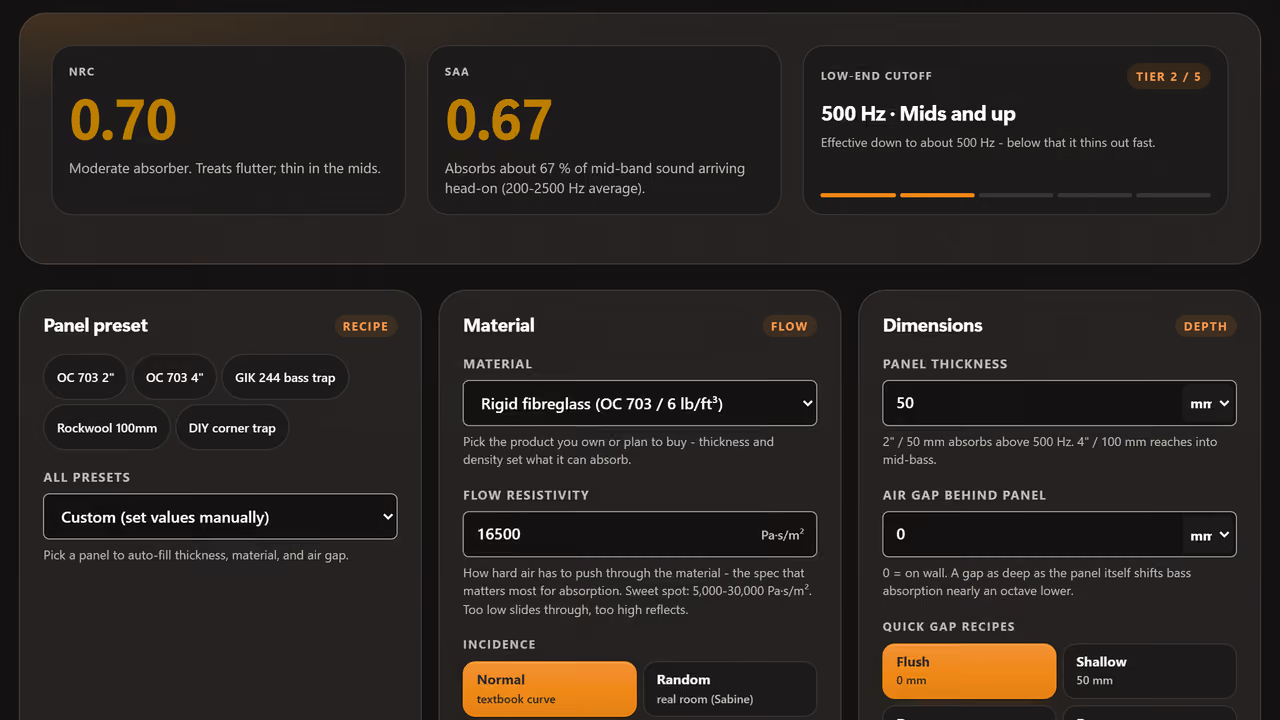
SAA-Sound absorption average (200-2500 Hz, more accurate than NRC).
Low-end cutoff-
-Lowest frequency where the panel reaches α ≥ 0.5.
Side-by-side
Current designCurrent
vs
Saved design-
Panel preset
recipe
Pick a panel to auto-fill thickness, material, and air gap.
Material
flow
Pa·s/m²
The biggest absorber spec. Sweet spot: 5,000-30,000 Pa·s/m². Too low slides through, too high reflects.
Dimensions
depth
2" / 50 mm absorbs above 500 Hz. 4" / 100 mm reaches into mid-bass.
0 = on wall. A gap as deep as the panel itself shifts bass absorption nearly an octave lower.
Absorption coefficient across the audible band
hover to read
The curve is the absorption coefficient α at each 1/3-octave centre frequency from 20 Hz to 8 kHz. Above 1.0 means the panel absorbs more than its surface area (lab edge-diffraction artefact; capped at 1.0 here for the NRC). Hover or tap the curve to read values - it snaps to the nearest measured 1/3-octave point.
Why these numbers
How a porous panel actually absorbs sound
The Delany-Bazley model in plain English
Porous absorbers (fibreglass, mineral wool, open-cell foam) convert sound energy into heat via viscous friction as air molecules push through the fibres. The efficiency depends on one number: flow resistivity, measured in Pa·s/m². Too low and the air slides through without losses. Too high and the panel reflects like a wall. Sweet spot: 5,000-30,000 Pa·s/m².
The calculator runs the Delany-Bazley empirical model - the industry standard for porous-absorber prediction. It computes the complex propagation constant and characteristic impedance at every frequency, transfers them through the panel and air gap to get the surface impedance, then the absorption coefficient.
Thickness moves the low end, air gap moves it further
A porous panel only starts absorbing where its thickness equals roughly a quarter wavelength of the sound. At 500 Hz a quarter wavelength is 17 cm - so a 5 cm panel is well past its low-end limit. At 100 Hz it's 86 cm; three feet of fibreglass for a single octave.
The air-gap trick: mounting the same panel a few inches off the wall puts an empty chamber behind it. The panel sits where particle velocity is highest (the absorber needs velocity, not pressure), shifting the effective absorption an octave or more lower. A 5 cm panel with a 10 cm gap absorbs nearly as well at 200 Hz as a 15 cm slab on the wall would - and the gap is free.
Common absorbers, by NRC and where they bite
NRC is a single-number summary at 250/500/1k/2k Hz - useful for paperwork, useless for bass. "Where it bites" is the band where the panel actually does work; below that the curve has rolled off.
Panel
Thickness
NRC
Where it bites
Auralex Studiofoam 2" wedge
50 mm
0.55
800 Hz - 5 kHz. Useless below 500 Hz.
Auralex 4" wedge
100 mm
0.95
500 Hz - 5 kHz. Still misses bass.
OC 703 2" direct mount
50 mm
0.95
500 Hz - 8 kHz. Studio standard above 500 Hz.
OC 703 4" direct mount
100 mm
1.05
250 Hz - 8 kHz. Mid-bass capable.
Rockwool RW3 50 mm on wall
50 mm
0.90
500 Hz - 8 kHz. UK/EU OC 703 equivalent.
Rockwool RW3 100 mm on wall
100 mm
1.00
250 Hz - 8 kHz.
GIK 242 (4" + cloth, no gap)
100 mm
1.00
200 Hz - 8 kHz. Broadband mid panel.
GIK 244 Bass Trap (4" + 4" gap)
200 mm
1.05
80 Hz - 8 kHz. Default bass-trap shape.
DIY corner trap (100 mm RW3 + 50 mm gap)
150 mm
1.00
60 Hz - 8 kHz. Floor-to-ceiling = bass killer.
Polyester batting 50 mm on wall
50 mm
0.65
800 Hz - 8 kHz. Cheap, fire-safe, mediocre.
2 cm carpet on concrete
20 mm
0.30
2 kHz - 8 kHz only. Negligible for music.
Painted concrete wall (reference)
-
0.02
Nothing. 98 % reflects.
FAQ
Acoustic panel design FAQ.
What thickness actually absorbs bass, why air gaps work, when foam is enough, and how to read the NRC number on a panel data sheet.
What is an acoustic panel absorption coefficient?
The absorption coefficient (α) is the fraction of sound energy that a surface absorbs rather than reflects, on a scale from 0 (perfect reflector) to 1 (perfect absorber). It is frequency-dependent: most porous panels absorb strongly above 500 Hz and weakly below 200 Hz. The calculator plots α from 63 Hz to 8 kHz at 1/3-octave centres.
How thick does an acoustic panel need to be to absorb bass?
A porous absorber begins to work where its thickness equals about one quarter of the wavelength. A quarter wavelength at 100 Hz is 86 cm of solid absorber, which is impractical. The shortcut is the air gap: a 10 cm panel mounted 10 cm off the wall reaches an octave lower than the same panel on the wall, because the panel sits where the air-particle velocity is highest.
What is flow resistivity and why does it matter for acoustic panels?
Flow resistivity is how strongly a porous material resists air being pushed through it, measured in Pa·s/m². The Delany-Bazley model used here takes flow resistivity as its single material input. Optimal broadband absorption sits between 5,000 and 30,000 Pa·s/m². Lower and sound slides through; higher and the panel reflects like a wall.
What is the difference between NRC and SAA?
NRC (Noise Reduction Coefficient) averages absorption at 250, 500, 1k, and 2k Hz, rounded to 0.05, the legacy US specification. SAA (Sound Absorption Average) averages 1/3-octave centres from 200 to 1250 Hz, rounded to 0.01, the modern replacement standardised in ASTM C423. Both are visible in the tool, and both ignore the bass-trap behaviour below 200 Hz that often matters most in rooms.
Is Owens Corning 703 better than Rockwool RW3?
They are near-equivalents. OC 703 is the US studio standard rigid fibreglass at roughly 6 lb/ft³ (96 kg/m³) with flow resistivity around 16,500 Pa·s/m². RW3 is the closest UK/EU equivalent in mineral wool at 60 kg/m³ and roughly 14,000 Pa·s/m². At 50 mm direct-mount, both produce nearly identical absorption curves; pick whichever ships locally.
Does acoustic foam actually work for bass?
No. Open-cell foam in the 2 to 4-inch (50-100 mm) thicknesses sold for studio panels rolls off below 400-500 Hz. It is effective on early reflections and sibilance but does nothing at room-mode frequencies. For bass, the tool will show you the difference between 100 mm foam on the wall (almost no bass absorption) and 100 mm mineral wool with a 100 mm air gap (real low-end absorption).
How big do I need to build my DIY acoustic panels?
Cover at least 15-25% of room surface area for music listening, more for control rooms. Distribute panels across first reflection points (side walls, ceiling above the desk) and corners (bass traps). The calculator will tell you the absorption depth you need for the frequencies you want to treat; the wall-coverage percentage is set by how much absorption the room needs overall. Use the room mode tool to find what frequencies to target first.
Why does the absorption curve go above 1.0 in published panel specs?
Lab-measured α can exceed 1.0 because edge diffraction at the panel boundaries effectively captures sound from beyond the panel's geometric area, so the panel absorbs more energy than is incident on its face. The calculator caps at 1.0 for the NRC calculation. In a real installation with many panels side-by-side this edge effect disappears and the absorption sits closer to 1.0 maximum.
Does the Delany-Bazley model account for cloth covering or perforated facings?
Not directly. The model treats the absorber as a homogeneous porous layer in front of either a rigid wall or an air cavity. A breathable speaker-grille cloth has negligible effect. A perforated panel with low open area starts to act as a Helmholtz resonator and shifts the curve. That is a different model. For typical cloth-wrapped panels the calculator is accurate to within 5-10% of measured data.