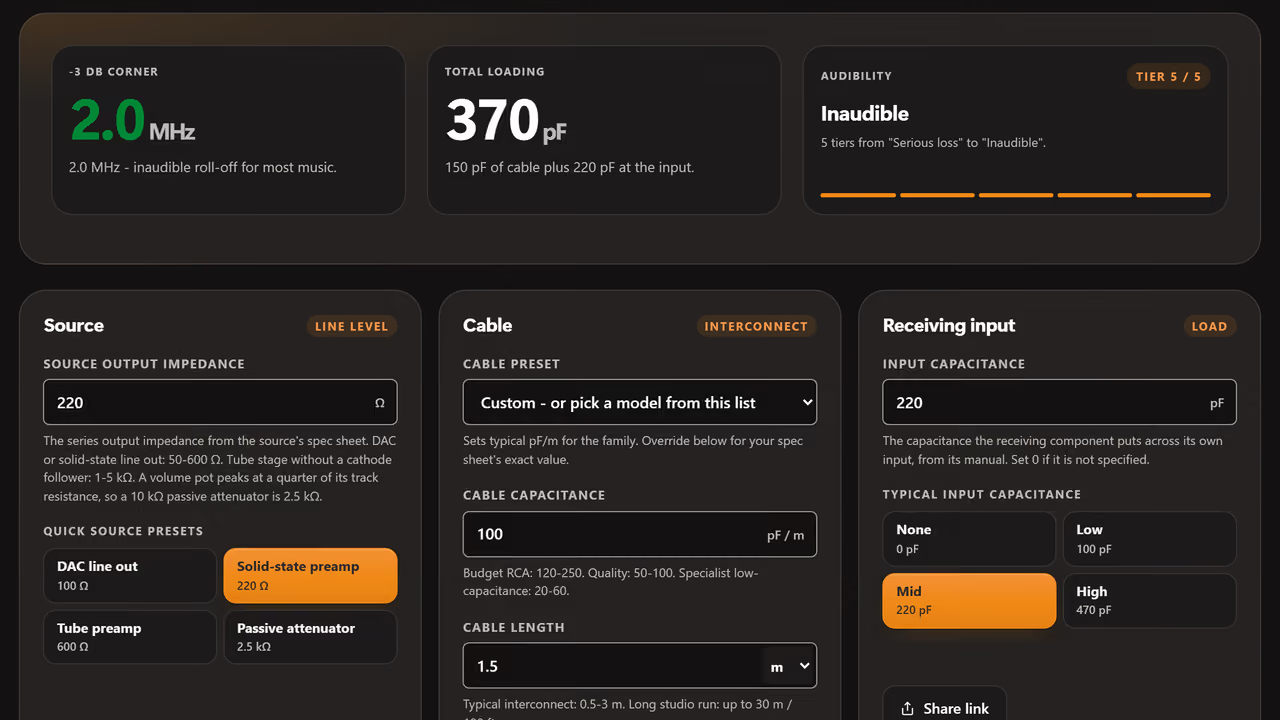
Will a long interconnect audibly dull the treble? That is the question this tool answers, with a mode for each kind of cable. At line level (a DAC, CD player, or preamp feeding an amp) the cable's capacitance works against the source's output impedance, the small internal resistance the source drives the cable through. Together they form a low-pass filter, which is a gentle treble cut. That mode finds the -3 dB corner, the frequency where treble is down 3 dB, and plots the curve. On a moving-magnet turntable (the common cartridge type) capacitance is a loading budget instead. Phono mode adds your cable and phono stage together, then checks the total against the figure your cartridge's maker publishes.
New to this? Short interconnects between a DAC and amp are almost never a problem - this tool shows you when long runs or turntable cables are.
My setups
Save a whole configuration: mode, source or cartridge, cable, and receiving input. Useful when you're picking between cable choices, checking a long run, or matching a cartridge to a phono stage.
-3 dB corner-The frequency where treble is down 3 dB. Only a problem near or below 20 kHz.
Total loading-Cable capacitance plus the receiving input's.
Audibility-
-5 tiers from "Serious loss" to "Inaudible".
Current setupCurrent
vs
Saved setup-
Source
line level
Ω
The series output impedance from the source's spec sheet. DAC or solid-state line out: 50-600 Ω. Tube stage without a cathode follower: 1-5 kΩ. A volume pot peaks at a quarter of its track resistance, so a 10 kΩ passive attenuator is 2.5 kΩ.
Cartridge
loading target
Picking a cartridge fills in the total loading capacitance its maker recommends. Not listed? Leave Custom and type the figure from its manual.
pF
The total the cartridge should see: cable plus phono-stage input, added together. It is on the cartridge's spec sheet. Low-output moving-coil cartridges publish no figure, and the presets record that as 0.
Cable
interconnect
Sets typical pF/m for the family. Override below for your spec sheet's exact value.
Typical interconnect: 0.5-3 m. Long studio run: up to 30 m / 100 ft.
Receiving inputPhono stage
load
pF
The capacitance the receiving component puts across its own input, from its manual. Set 0 if it is not specified. On a phono stage this is the input loading figure: typically 100-300 pF.
High-frequency responseWhy phono mode shows no curve
livenot computed
Log axis 1 kHz - 100 kHz. The -3 dB point is where treble is half-power; below it the response is flat, above it rolls off at 6 dB/octave. The audio band (≤ 20 kHz) is lightly shaded. Aim to keep the corner above 20 kHz - past the top of the audible band.
There is no curve here on purpose. A moving-magnet cartridge is an inductive source, so its top octave is set by a resonance between the cartridge's own coil inductance and the capacitance you load it with. That is a second-order L/C response, not the first-order RC roll-off drawn in line-level mode, and the two do not give the same answer. This tool holds no cartridge inductance figures, so any curve it drew for a cartridge would be a guess. What it can do honestly is add your capacitance up and compare the total with the figure the cartridge's maker publishes, which is exactly how that maker expects you to set the load.
Show the math
Two problems that look like one
Line level: an RC low-pass filter
A source drives the cable through its own output impedance. That series resistance and the shunt capacitance of the cable plus the receiving input form a low-pass filter with corner frequency f = 1 ÷ (2π x R x C), where R is the source's output impedance in ohms and C the total capacitance in farads.
Total capacitance = cable pF/m x length + the receiving input's pF. Shorter, lower-capacitance cable moves the corner up; so does a source with a lower output impedance. Most line outputs sit between 50 and 600 Ω, which puts the corner somewhere between a few hundred kilohertz and several megahertz on a normal interconnect: nowhere near the audio band. What bites is a high source impedance into a long, high-capacitance run - a passive attenuator, a tube stage without a cathode follower, or a 20 m studio cable.
Phono: a loading budget, not a corner
A moving-magnet cartridge is an inductive generator, so the capacitance hanging off it does not set an RC corner at all. It tunes a resonance with the cartridge's own coil inductance. Add capacitance and that resonance moves down: past a point it drops into the top octave, first as a lift and then as a steep fall above it.
That is why cartridge makers publish a total loading capacitance instead of a frequency. Meeting it is arithmetic: cable pF/m x length, plus the phono stage's input capacitance, compared with the maker's figure. Phono mode does exactly that sum and nothing more. The 47 kΩ a phono stage presents is a load resistance, not a series source resistance, so it never belongs in the RC formula above. Low-output moving-coil cartridges publish no capacitance figure and do not need one; their generator inductance is far lower, so this resonance sits well clear of the music.
Typical capacitance, by cable type
pF/m is the number to look for on the datasheet. Multiply by length and add the receiving input's pF: at line level that total is what the source has to drive, and on a turntable it is what you compare with your cartridge's recommended loading.
Cable type
Capacitance
Where it shows up
Generic shielded RCA (PVC dielectric)
120-250 pF/m
Bargain-bin AV cable. Worst case on long runs.
Standard hi-fi interconnect
80-130 pF/m
Mid-tier RCA. Fine at line level and normal lengths.
Quality interconnect (PE / PTFE)
50-90 pF/m
Reference audio cable. Headroom on longer runs.
Tonearm cable (specialist)
20-60 pF/m
The lowest-capacitance family sold. Built to leave cartridge-loading headroom.
Studio mic cable (Star-Quad XLR)
35-60 pF/m
Pro audio long runs. Low pF/m is part of the spec.
Coaxial digital (75 Ω S/PDIF)
~67 pF/m
Fixed by the 75 Ω geometry. Not relevant here.
USB cable
N/A (digital)
Irrelevant - bit-stream regenerated by receiver.
When cable capacitance stops being theoretical
Every cable stores a little charge between its conductors, and that capacitance forms a low-pass filter with whatever resistance is driving it. The higher the source impedance and the longer the cable, the lower the frequency at which the top end starts to roll away.
At line level from a modern low-impedance output this is almost always inaudible: the roll-off sits far above the audible band. The interesting case is a phono cartridge, where the source impedance is high and inductive, and where the cartridge maker specifies a total capacitance the cable is part of.
That is why this tool has two modes. At line level it shows you how much headroom you have; in phono mode it checks whether your tonearm cable, interconnect and phono stage together land inside the cartridge's recommended loading - the one case in domestic audio where cable capacitance genuinely changes frequency response.
Worked example
A 1.5 m interconnect at 100 pF per metre, from a 220 ohm solid-state preamp output into a 220 pF input.
Total loading 370 pF and a -3 dB corner at 2.0 MHz.
The corner frequency is the whole answer, and 2.0 MHz sits a hundred times above anything audible. Capacitance only starts to matter when a high source impedance meets a long, high-capacitance cable, which is why the tool asks what the source is before it asks about the cable.
The ideas behind the controls
Capacitance per metre
The specification that matters. Multiply by length to get the total the source actually sees.
Source impedance
The output resistance driving the cable. It is the other half of the filter, which is why the same cable is harmless at line level and decisive on phono.
Cartridge loading
The resistance and capacitance a moving-magnet cartridge is designed to see. Miss it and the treble develops a peak or a slump.
-3 dB point
The frequency at which the roll-off has cost 3 dB. Useful as a landmark, not as the point where the effect begins.
Cable capacitance and treble roll-off FAQ.
Why cable capacitance rolls off high frequencies at line level, why phono is a loading budget instead, what specification to look for, and when it stops mattering.
Why does cable capacitance matter for phono cartridges?
Moving-magnet (MM) phono cartridges are spec'd for a specific load capacitance (typically 100-300 pF including the phono cable). The cartridge coil and that capacitance form a resonance; high-capacitance RCA runs drag the resonant peak down into the top of the audible band, and above the peak the response falls away. The calculator's phono mode adds your cable and phono-stage capacitance together and compares the total with the figure your cartridge's maker publishes.
What is a safe cable capacitance for line-level RCA runs?
At line level, capacitance almost never bites. A typical solid-state output of 100-600 ohms driving a few hundred picofarads puts the -3 dB corner up in the megahertz, roughly a hundred times above the top of the audio band. The corner only falls anywhere near music when the source impedance is high: a passive attenuator, a tube stage without a cathode follower, or a very long run off a weak output. Put your own source impedance and cable length into line-level mode and the tool shows where the corner actually lands.
How do I find my cable capacitance specification?
It is usually printed on the cable jacket or in the manufacturer datasheet, listed as picofarads per foot or per meter. Generic RCA cables are 30-50 pF/ft; high-capacitance cables can be 80+ pF/ft; specialty low-capacitance cables for phono use are 15-25 pF/ft.
Can cable capacitance affect digital signals like USB or HDMI?
Practically no for properly impedance-matched digital interfaces. The issue is reflection and ringing, not roll-off, and modern receivers re-clock the bitstream. The calculator targets analog applications: line-level cable, where capacitance and source impedance form a low-pass filter, and phono cable, where capacitance is part of the load the cartridge sees.
What is the right cable capacitance for an Ortofon 2M Blue?
Ortofon recommends 150-300 pF total loading for the 2M series. Subtract your phono stage's input capacitance (often 100-220 pF) and the remaining 50-200 pF is your cable budget. A 1 m run at 50 pF/m is comfortable; a 1.5 m run at 100 pF/m gets close to the upper limit. The calculator's phono mode does that subtraction for you and shows how much budget is left.
My phono stage hums and the treble is rolled off, is it the cable?
Hum is grounding, not capacitance. Check the ground wire to the phono stage chassis and the tonearm grounding scheme. If the calculator's phono mode puts your total loading well past the figure your cartridge maker publishes, capacitance is a real suspect: swap to a lower-pF/m cable or use a phono stage with selectable input capacitance (Pro-Ject Phono Box S2 and similar). Both fixes are usually free or under $200.