Free Calculator

Headphone Amplifier Power Calculator

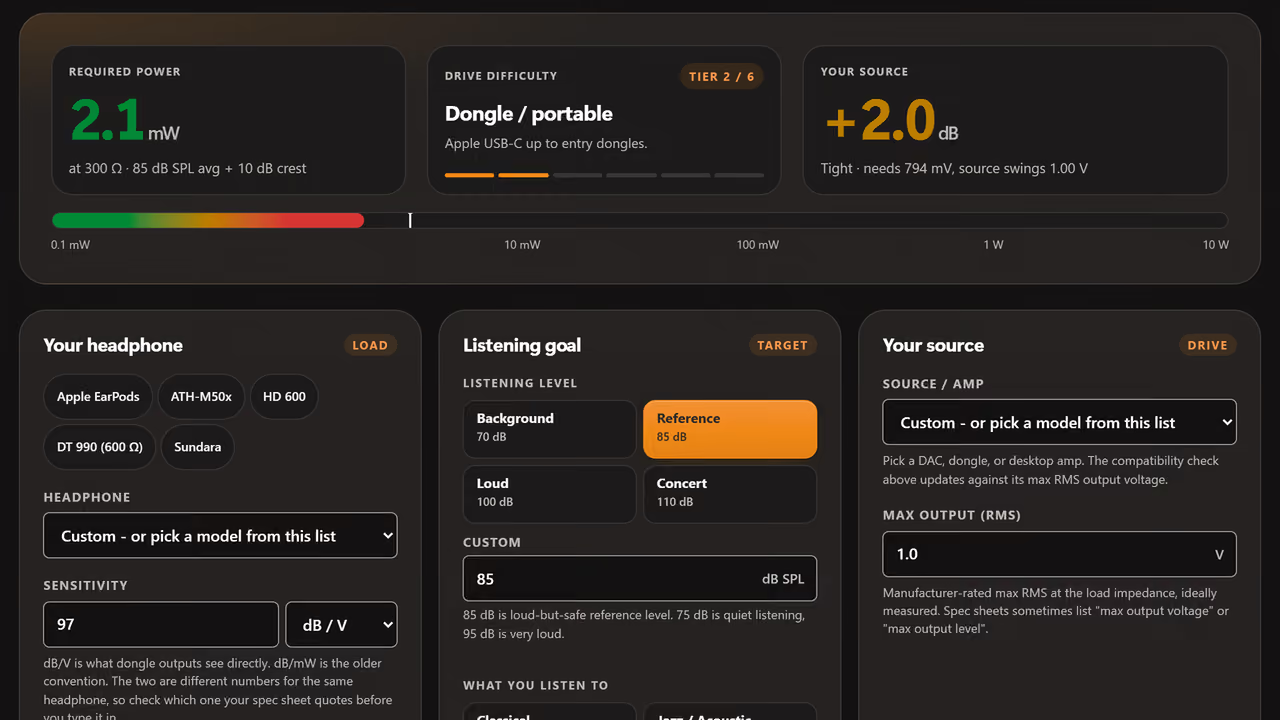
How much amplifier power your headphones actually need to hit your target listening level with proper crest-factor headroom. Works for both common sensitivity specifications (dBSPL/mW and dBSPL/V) and any impedance from 8 ohms to high-impedance dynamics like the AKG K1000.

Quick example: A Sennheiser HD800S (102 dB SPL/V, 300 ohm) targeting 110 dB peaks with 6 dB headroom needs about 250 mW into 300 ohms - well within reach of a desktop amp. A HIFIMAN Susvara at 86 dB/mW with the same target lands at over 6 W: a hard-to-drive load that demands a real power amp.

Common range: 85-115 dBSPL/mW. Susvara is around 60. dBSPL/V is what dongle outputs see directly.

e.g. 32 Ω (easy IEMs), 64 Ω (Susvara), 300 Ω (HD800S), 600 Ω (DT880).

85 dB = reference. 100 dB = loud. 110 dB = peak music transients with headroom.

6 dB doubles the power requirement. 10-12 dB for highly dynamic recordings.

The headphone power math, demystified

From sensitivity to required power

For dBSPL/mW sensitivity, required power is P = 10^((target − sensitivity + headroom) ÷ 10) mW. The corresponding RMS voltage drops out of Ohm's law: V = √(P × Z) with P in watts and Z in ohms.

For dBSPL/V sensitivity, required voltage is V = 10^((target − sensitivity + headroom) ÷ 20), and power follows from P = V² ÷ Z.

Converting the two: dBSPL/V = dBSPL/mW + 10 × log10(Z ÷ 1000). At 300 Ω, dBSPL/V = dBSPL/mW − 5.2 dB.

Why high-impedance cans need more voltage

At the same SPL/mW figure, a 300 Ω headphone needs roughly 2× the voltage of a 75 Ω headphone, because power scales with voltage squared. Phone outputs and dongle DACs run out of voltage before they run out of current. That is why a 600 Ω DT880 stays quiet on a phone and roars on a desktop amp.

For sanity-checking an amp shop list, look at its rated output at the impedance of your headphone, not at 32 Ω. Most amps publish multiple curves; the conservative buy is one that exceeds your calculated requirement at your impedance with at least 2-3× headroom.

Reference headphones, by what they need

Plug any of these into the calculator above and see exactly which amplifier tier the result lands in. Sensitivity figures are manufacturer specs at the listed reference; impedance is the rated nominal value.

HeadphoneSensitivityImpedanceWhat drives it
Apple EarPods (3.5 mm)109 dB/V23 ΩPhone or laptop jack - that's the design target.
Sennheiser HD 60097 dB/V300 ΩMid-tier desktop amp; phones run out of voltage.
Sennheiser HD 800 S102 dB/V300 ΩMid-tier desktop amp with clean voltage swing.
Beyerdynamic DT 880 (600 Ω)96 dB/V600 ΩVoltage-rich amp - V swing is everything.
HIFIMAN Arya Organic94 dB/mW16 ΩCapable dongle through entry desktop amp.
Audeze LCD-X103 dB/mW20 ΩEasy on paper, but rewards higher current.
HIFIMAN HE6se V283.5 dB/mW50 ΩSpeaker amp via TRS or proper headphone power amp.
HIFIMAN Susvara83 dB/mW60 ΩSpeaker-tap power amp; 1-2 W minimum at 60 Ω.
AKG K1000 (early)74 dB/mW120 ΩDriven from speaker outputs - 4-10 W typical.

FAQ

Headphone power FAQ.

Required mW for hard-to-drive cans, what target SPL means in practice, and why dBSPL/mW is the better cross-impedance metric.

  1. How do I calculate the amplifier power my headphones need?

    Enter the headphone sensitivity (dB SPL/mW or dB SPL/V), impedance (ohms), and target SPL at your ears (typically 100-110 dB peak for music with 20 dB headroom). The calculator returns required power in milliwatts and the corresponding output voltage. Match an amp that exceeds the requirement at the headphone impedance.

  2. What is a safe target SPL for headphones?

    For long listening sessions, 70-80 dB SPL average is safe. Music has dynamic range, so the calculator factors in 15-20 dB of peak headroom on top of the average. WHO guidelines recommend keeping average levels below 80 dB to protect hearing - the safe-listening tool covers daily exposure time.

  3. Why do high-impedance headphones need more amplifier power?

    Power scales with voltage squared divided by impedance. Doubling impedance halves current at the same voltage, so a 600-ohm headphone needs roughly four times the voltage of a 150-ohm pair for the same SPL, assuming similar sensitivity per volt. Sensitivity per milliwatt is the better comparison metric across impedances.

  4. How much amp headroom do I need over the calculated requirement?

    A factor of 2-3x in power (3-5 dB) is the working minimum. Some amps soft-clip well; others go straight into hard distortion. If your headphone is a hard-to-drive planar like the HIFIMAN Susvara, target 4-6 W at 60 ohm and prefer a desktop amp over a dongle.

  5. What headphone sensitivity spec should I trust on a spec sheet?

    Sensitivity in dB SPL/mW is most useful for comparing across impedances. dB SPL/V is what dongle dacs and phone outputs see. Manufacturer numbers can be optimistic; if you have measurement data from third parties (Crinacle, Headphones.com), use those for the calculation instead.